

E-1 Visa Requirements for Italians: The 2026 Strategic Guide

Many Italian entrepreneurs believe that a single multi-million dollar shipment is the golden ticket to a US trade visa, but the reality is quite the opposite. Success in the 2026 landscape depends on proving trade frequency and continuity rather than just raw dollar value. You've likely spent hours parsing the vague definitions of substantial trade while worrying if your business model will survive the scrutiny of the US Embassy in Rome. It's a daunting task to prove that your commercial bridge across the Atlantic meets the rigid 51% trade nexus. Understanding the specific E-1 visa requirements for Italians is the first step in transforming this ambiguity into a structured, successful application.
This guide provides a definitive blueprint to mastering these technical protocols, ensuring your "Rome Package" is technically flawless. We'll examine the nuances of trade continuity, the 50% ownership rule, and the precise electronic filing protocols required through the E Visa Navigator. You'll gain the confidence to prove that your business model satisfies the 51% rule while preparing for the successful relocation of your key personnel. From navigating the $315 application fee to mastering the specific 2026 reciprocity standards, we provide the clarity needed to secure your Treaty Trader status through the US-Italy commercial corridor.
Table of Contents
The US-Italy Treaty Trader Framework in 2026
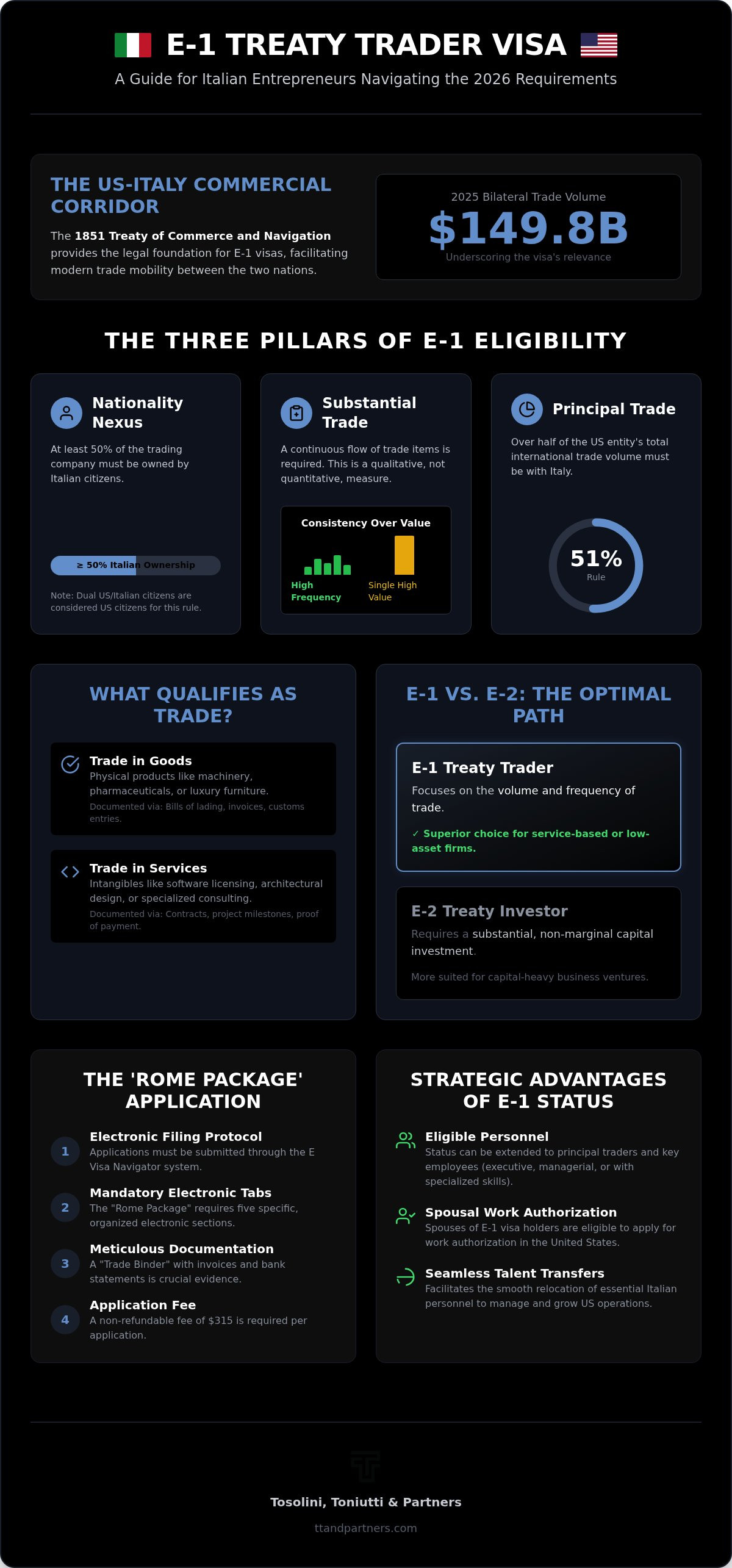
The 1851 Treaty of Commerce and Navigation between the United States and Italy provides the legal foundation for modern commercial mobility. This historical agreement allows Italian nationals and firms to engage in substantial trade under the E-1 Treaty Trader Visa classification. In 2025, bilateral trade between these nations reached $149.8 billion, a figure that underscores why this visa is more relevant than ever. Success in securing this status depends on meeting the specific E-1 visa requirements for Italians, which begin with proving a definitive nationality link between the applicant and the treaty country.
The Nationality Nexus: Proving Italian Ownership
The core of the E-1 application is the nationality requirement. At least 50% of the trading enterprise must be owned by persons who possess Italian citizenship. This rule applies whether the business is a sole proprietorship or a complex corporate entity. For dual citizens holding both US and Italian passports, it's crucial to recognize that they cannot be used to establish treaty nationality; for E-1 purposes, they're considered US citizens. In complex parent-subsidiary structures, firms must document the entire chain of ownership to prove that the ultimate beneficial owners maintain Italian nationality. This transparency is vital for the US Embassy in Rome to verify the firm's eligibility under the treaty's protections.
E-1 Eligibility for Individual Traders vs. Corporate Employees
Eligibility extends beyond the business owners to include key personnel essential to the trade operations. Individual principal traders must demonstrate they're coming to the US solely to engage in substantial trade. For corporate entities, employees may qualify if they serve in an executive or managerial capacity, or if they possess specialized skills essential to the firm's efficient operation. The nationality link must remain unbroken. If the ownership of the firm shifts and Italian nationals no longer hold at least 50% of the company, the E-1 status for all employees becomes void. Firms often coordinate with legal counsel at Tosolini, Toniutti & Partners to ensure these ownership structures remain compliant during periods of corporate growth or restructuring.
Decoding 'Substantial Trade' and the 51% Requirement
Substantial trade isn't defined by a rigid dollar threshold. Instead, it refers to the continuous flow of items between the United States and Italy. According to the official USCIS E-1 requirements, this trade must be already in existence at the time of your application. For Italian firms, this means demonstrating a history of commercial exchange that justifies the presence of treaty personnel. The "substantial" nature is qualitative; it's about the volume of transactions and the frequency of the exchange rather than a single high-value contract.
The "principal trade" requirement is equally strict. At least 51% of the total volume of international trade conducted by the US business must be between the US and Italy. If your Italian firm operates globally, you must isolate the US entity's international transactions. For diversified businesses, this calculation requires precision. You're measuring the trade of the US branch or subsidiary, ensuring the US-Italy corridor remains the dominant channel. A meticulous "Trade Binder" containing bills of lading, invoices, and bank statements serves as the empirical backbone of your case at the US Embassy in Rome.
What Qualifies as Trade? Goods vs. Services
Traditional trade in goods, such as machinery, pharmaceuticals, or luxury furniture, remains a staple of the US-Italy commercial relationship. However, the rise of service-based trade has created new opportunities for Italian tech and design firms. This includes software licensing, architectural design, and specialized consulting. Meeting the E-1 visa requirements for Italians in the service sector involves proving that a "trade item" has been exchanged for a fee. Trade in services is documented through contracts, project milestones, and proof of payment for intangible deliverables rather than physical customs entries.
Frequency vs. Value: Why Consistency Wins
Consular officers prioritize the number of transactions over the raw value of a single invoice. A firm with fifty shipments of $10,000 each often presents a stronger case than a company with one $500,000 contract. Numerous small transactions prove a "continuous flow" and suggest a stable, ongoing business relationship. This consistency demonstrates that the trade is not a one-off event but a sustained economic bridge. If you're unsure how to categorize your global transactions to meet these thresholds, speaking with a cross-border legal strategist can provide the necessary clarity before you begin the filing process.
E-1 vs. E-2: Evaluating the Optimal Path for Italian Firms
Choosing between the E-1 and E-2 classifications requires a strategic assessment of your business's underlying structure. While both pathways originate from the same 1851 treaty, they serve distinct commercial objectives. The E-1 visa is a tool for mobility fueled by trade flow, whereas the E-2 visa is a vehicle for capital investment. For many Italian firms, especially those in the "Made in Italy" sector, the E-1 visa requirements for Italians offer a more accessible entry point. It doesn't demand that you commit significant liquidity to a US enterprise before operations begin. Instead, it validates the commercial momentum you've already established across the Atlantic.
The E-1 is the strategic choice for low-asset, high-activity firms. This includes consulting agencies, design studios, and software exporters who move intellectual property rather than heavy machinery. These businesses often lack the massive physical footprint required for a traditional E-2 investment but maintain high-frequency trade that easily satisfies E-1 criteria. As a business evolves, transitioning between these categories is possible. A firm might enter the US market as an E-1 trader and later shift to E-2 status once they decide to build a permanent manufacturing facility or warehouse on US soil.
The Investment Threshold Factor
The primary differentiator lies in how "substantiality" is measured. Under E-2 rules, you must place capital "at risk" in a US business, meaning the funds could be lost if the venture fails. In contrast, E-1 substantiality is measured by the volume and frequency of existing trade. In the 2026 economic climate, many Italian entrepreneurs prefer the E-1 path because it relies on proven revenue rather than speculative investment. It allows you to leverage your existing Italian client base and supply chains to secure legal status without the immediate need for a six-figure capital injection.
Operational Continuity for Italian Brands
E-1 status provides superior support for the traditional export model. It allows you to transfer executive, managerial, and essential-skill personnel from Italy to oversee the US distribution of your products or services. This ensures that the brand's core values and technical standards remain intact during international expansion. While the E-1 focuses on the movement of goods and services, those planning a more capital-intensive presence may find more value in our E-2 Visa Guide 2026: The Strategic Framework for Treaty Investors. Managing US-based personnel under treaty trader status requires a deep understanding of how to maintain the Italian nationality link while scaling your workforce to meet US market demands.
Mastering the 'Rome Package': The E-1 Application Protocol
All E-visa processing for Italian nationals is centralized at the US Embassy in Rome. This creates a uniform but demanding standard for every applicant. The "Rome Package" is not just a collection of forms; it's a meticulously structured digital dossier. Success hinges on a firm's ability to present complex trade data within a rigid electronic framework. Failing to follow the specific formatting guidelines can lead to immediate administrative delays. Meeting the E-1 visa requirements for Italians involves more than just proving trade; it requires mastering the embassy's digital architecture. It's a technical challenge that mirrors the precision of the trade operations it describes.
The Five-Tab Documentation Framework
The embassy requires five distinct PDF attachments, labeled Tab A through Tab E. Tab A contains the table of contents and a strategic cover letter. Tab B houses the mandatory administrative forms. Tab C details applicant information, including CVs and job descriptions. Tab D proves the nationality of the enterprise, while Tab E provides the empirical evidence of substantial trade. Every document must be translated into English and remain strictly germane to the E-1 visa requirements for Italians. Extraneous paperwork often triggers a Request for Evidence (RFE); this usually stalls an application for several months. Precision in this phase is non-negotiable.
Navigating the E-Visa Navigator and DS-160
The submission process begins with the DS-160 form and the payment of the $315 MRV fee. Applicants must then use the official E Visa Navigator to submit their digital package to the dedicated embassy email address. File sizes are strictly limited; exceeding these limits often leads to the immediate rejection of the electronic submission. For those relocating with family, spouses and children must be included in the initial digital filing to ensure concurrent processing. Once the embassy completes its pre-screening, the applicant schedules an interview through the Yatri system. The interview in Rome is the final hurdle. In 2026, consular officers focus heavily on the continuity of trade and the validity of the 51% rule. They expect the applicant to speak fluently about their commercial flow. If you want to ensure your digital dossier is beyond reproach, contact our specialists to review your Rome Package before submission.
Strategic Advantages of E-1 Classification for Italian Personnel
The E-1 classification serves as a cornerstone for sophisticated corporate architecture, extending far beyond the mechanics of trade. It facilitates the seamless transfer of human capital from Italy to the United States, ensuring that the intellectual and creative essence of a brand remains intact during its international expansion. For the individual, these benefits encompass the entire family unit. Spouses of E-1 holders are entitled to work authorization, and children can access the US education system, making the professional transition culturally and economically sustainable. While the E-1 is a non-immigrant classification, it establishes a professional footprint that can later serve as a foundation for other strategic paths, provided the intent to depart at the end of the status remains documented.
Leveraging this status allows Italian firms to build a resilient US business architecture. By maintaining a core team of Italian nationals, companies can ensure that their operational philosophy and aesthetic standards are preserved. This continuity is essential for brands that rely on the "Made in Italy" reputation to command premium positioning in the American market. The E-1 visa is not merely a permit; it's a strategic tool for long-term growth and market penetration.
Essential Personnel and Skill Transfers
The ability to transfer "essential" personnel is a vital component of the E-1 visa requirements for Italians. This category is not limited to senior executives; it includes specialists who possess proprietary knowledge or unique technical skills that are unavailable in the local US labor market. For an Italian firm, these technicians and specialists are the guardians of quality, ensuring that brand standards are replicated precisely in US operations. This human bridge is most effective when integrated into a robust corporate structure, often beginning with professional LLC Incorporation to provide a stable legal home for these skill transfers.
Professional Legal Counsel for Treaty Traders
Securing a treaty trader status requires more than just meeting the basic E-1 visa requirements for Italians; it demands a dual-jurisdiction strategy. The intersection of US immigration law and Italian corporate regulations is complex, requiring a holistic understanding of how ownership shifts in Italy might impact visa eligibility in Rome. A well-designed US-Italy commercial corridor respects the legal traditions of both nations while prioritizing the efficiency of the trade flow. Managing these overlapping legal spheres ensures that the business remains compliant while scaling its international presence. Strategic thinkers often seek a Contact with Tosolini, Toniutti & Partners to align their corporate governance with the long-term goals of their US-based personnel. This collaborative approach transforms a technical application into a sustainable engine for global growth.
Securing Your Commercial Legacy in the United States
Success in the transatlantic corridor is defined by more than just trade volume; it's a testament to the enduring relationship established by the 1851 treaty. By prioritizing trade continuity and mastering the technical nuances of the 51% rule, your firm can transform from a local exporter into a permanent fixture of the American market. Understanding the specific E-1 visa requirements for Italians is the first step toward building a resilient business architecture that supports your family and your most essential personnel.
With decades of experience at the US Embassy in Rome and a specialized focus on Italian treaty traders, our firm provides the comprehensive cross-border legal support needed to navigate this complex process. We believe that professional precision and aesthetic excellence go hand in hand when presenting your business vision to consular officers. It's time to solidify your legacy. Schedule a consultation with our US-Italy immigration experts today to ensure your application meets the highest standards of the 2026 environment. Your vision deserves a structure as robust as the trade it facilitates.
Frequently Asked Questions
What is the minimum dollar amount for E-1 substantial trade?
There's no specific monetary threshold or minimum dollar amount required to define substantial trade. The standard is qualitative, emphasizing a continuous flow of trade items between the US and Italy. Consular officers prioritize a high frequency of smaller transactions over a single large contract. This numerous and ongoing exchange proves the existence of a stable commercial bridge that satisfies the E-1 visa requirements for Italians.
Can I apply for an E-1 visa if I only trade services, not physical goods?
Yes, the exchange of services is fully recognized as trade under the E-1 classification. This includes fields such as architectural design, software development, and specialized consulting. To qualify, you must document that a specific trade item was exchanged for a fee. Evidence typically consists of detailed service contracts, project milestones, and bank records showing payments for these intangible deliverables rather than traditional customs entries.
How do I prove that 51% of my trade is between Italy and the US?
You must isolate the international trade volume of the US entity and demonstrate that the majority occurs with Italy. This is proven through a comprehensive Trade Binder containing empirical evidence such as invoices, bills of lading, and financial statements. The calculation focuses on the volume of trade conducted by the US branch or subsidiary. Precision is vital here to ensure the US-Italy corridor remains the dominant channel for your global operations.
How long is the E-1 visa valid for Italian citizens in 2026?
Italian nationals can receive an E-1 visa with a maximum validity period of five years. However, the final duration remains at the discretion of the consular officer in Rome. While the visa itself allows for entry, your actual period of stay is determined by US Customs and Border Protection at the port of entry. You can renew the visa indefinitely as long as the underlying trade remains substantial and continuous.
Can my spouse work in the US if I have an E-1 visa?
Yes, spouses of E-1 treaty traders are entitled to work authorization in the United States. Once the principal trader's visa is granted, the spouse can apply for an Employment Authorization Document (EAD). This allows them to work for any US employer or even start their own business. This benefit makes the E-1 classification a sustainable choice for Italian families seeking to relocate for long-term commercial projects.
Do I need to have a physical office in the US before applying for an E-1?
You must demonstrate that the US enterprise is active and capable of conducting trade at the time of application. While the regulations don't always mandate a specific square footage, having a physical office or warehouse strengthens your case. It provides tangible proof that the business is a real, operating entity. The embassy in Rome expects to see evidence that the infrastructure is ready to support the proposed commercial activity.
What happens if my trade volume drops below 51% after I get the visa?
Maintaining the 51% trade nexus is a continuous requirement for staying in legal status. If your international trade shifts so that Italy is no longer the primary partner for the US entity, your E-1 status becomes void. This applies to both the principal trader and all treaty employees. Regular internal audits of your trade logs are essential to ensure you remain compliant with the E-1 visa requirements for Italians throughout your stay.
Is the E-1 visa a direct path to a Green Card?
The E-1 is a non-immigrant visa and doesn't lead directly to permanent residency. Applicants must maintain the intent to depart the United States once their treaty status terminates. While it provides a stable foundation for long-term business operations, it's not a dual-intent visa like the H-1B or L-1. If your ultimate goal is a Green Card, you'll eventually need to transition to a different immigrant classification.


Comments