

E-2 Visa Business Plan for Italians: 2026 Strategic Guide

What if the very business model that made you successful in Italy is the primary reason your U.S. visa application might fail? For many Italian entrepreneurs, the challenge isn't the quality of their vision but the complex task of translating that vision into a US-compliant framework. You've likely realized that a standard financial forecast isn't enough to satisfy the U.S. Embassy in Rome. An effective E-2 visa business plan for Italians must serve as a precise legal instrument, proving that your investment is substantial and, crucially, not marginal. It's a delicate balance of Italian ingenuity and American regulatory rigor.
This strategic guide for 2026 provides the exact roadmap you need to secure a 5-year E-2 visa. You'll learn how to navigate the 5MB electronic submission limit, prove significant job creation, and present market analysis even without local U.S. data. We'll examine the specific requirements for Italian treaty investors, from the $198 reciprocity fee to the mandatory electronic protocols. By the end of this article, you'll understand how to bridge the gap between your current success and your future U.S. enterprise with absolute confidence.
Table of Contents
The Strategic Role of the E-2 Visa Business Plan for Italian Investors
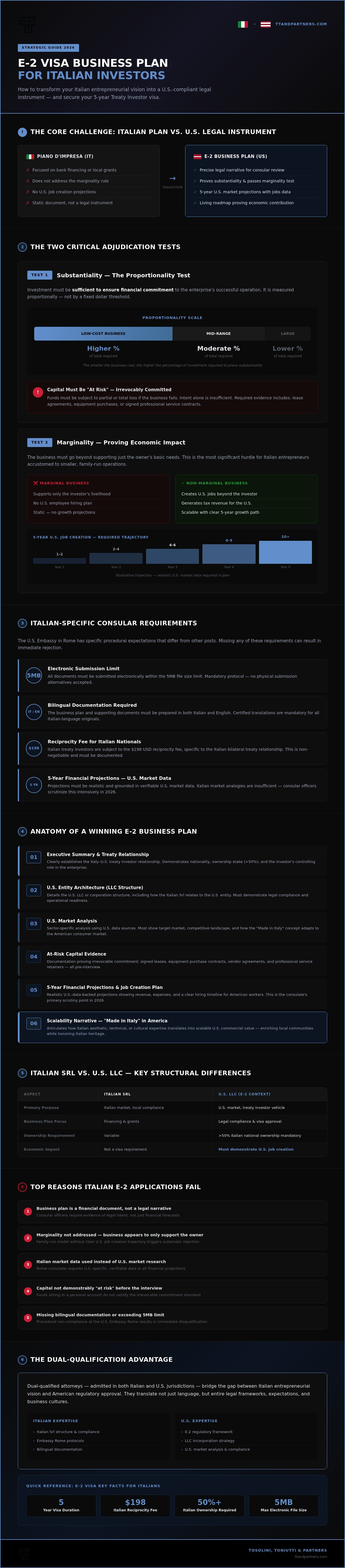
The E-2 visa business plan for Italians serves as the narrative heart of an investor's application. It's much more than a collection of financial spreadsheets or a traditional Italian Piano d’Impresa. While a domestic Italian plan often focuses on securing bank financing or local grants, the U.S. version must satisfy specific regulatory criteria defined by the E-2 Investor Visa framework. In the current 2026 adjudication climate, consular officers at the U.S. Embassy in Rome are looking for a clear, visionary roadmap that demonstrates how an Italian enterprise will thrive within the American economy. Standard Italian models often fail because they don't adequately address the "marginality" rule, which requires the business to grow beyond supporting the owner's basic needs. A successful plan must present a compelling 5-year projection that establishes your status as a legitimate Treaty Investor.
Why the US Consulate Scrutinizes the Business Plan
The business plan provides the primary evidence for the consular officer's assessment of your "intent." It isn't enough to simply state you want to open a business. You must prove the existence of a legitimate treaty relationship between Italy and the U.S. through the structure of your investment. This document acts as a legal roadmap for your U.S. economic contribution. In 2026, the scrutiny is particularly high regarding the 5-year financial projection. These projections must be realistic, grounded in U.S. market data, and clearly show the path toward hiring American workers. The consulate uses this data to verify that your investment is at-risk and irrevocably committed to the enterprise before you even step into the interview. The plan ultimately justifies why you deserve a 5-year stay to manage your investment.
Translating Italian Success into American Growth
Many Italian entrepreneurs struggle with adapting "Made in Italy" concepts for a U.S. audience. A business model that flourishes in Milan or Florence might require significant structural adjustments to succeed in a U.S. regulatory environment. Proving the scalability of these models is essential for a successful E-2 visa business plan for Italians. You must demonstrate that your aesthetic or technical expertise can be effectively commercialized within the American market. This requires a deep understanding of both the Italian Srl and the U.S. LLC incorporation strategy. For a broader look at the current requirements, consult our E-2 Visa Guide 2026. The goal is to present your venture not as a static entity, but as a living project that enriches the local community while honoring its Italian heritage. Successful applicants show how their unique cultural value translates into tangible U.S. job creation and tax revenue.
Core Adjudication Standards: Substantiality and Marginality in 2026
Adjudication standards for the E-2 visa rely on two primary legal concepts: substantiality and marginality. These aren't arbitrary hurdles. They are qualitative measures of your commitment to the U.S. economy. According to USCIS E-2 Visa Regulations, a substantial investment is one that is sufficient to ensure the treaty investor's financial commitment to the successful operation of the enterprise. This is determined through the proportionality test. This test compares the amount of qualifying funds invested against the total cost of either purchasing an established business or creating a new one from the ground up.
Your E-2 visa business plan for Italians must also demonstrate that the capital is "at risk." This means the funds must be subject to partial or total loss if the business fails. Mere intent to invest or holding money in a personal bank account won't suffice. You must show that the capital is irrevocably committed to the enterprise. This often involves providing evidence of lease agreements, equipment purchases, or professional service contracts already in place. It's about showing that you've already crossed the point of no return with your capital.
The Marginality Test: Proving Economic Impact
The marginality rule is often the most significant hurdle for Italian entrepreneurs who are used to smaller, family-run operations. A business is considered marginal if it doesn't have the present or future capacity to generate more than enough income to provide a minimal living for you and your family. To overcome this, your plan must project the hiring of U.S. workers over a five-year period. It's not enough to be an "active" manager; you must demonstrate that the business will create a broader economic ripple. For Italian family businesses, this means clearly delineating roles and showing how the enterprise will expand beyond the immediate family circle to employ local staff. If you need clarity on how your specific structure fits these rules, you can reach out to our bilingual legal team for a detailed analysis.
Substantiality Across Different Industries
Investment requirements for an enterprise to be considered substantial vary significantly depending on the nature of the industry. A service-based consultancy will naturally have lower startup costs than a capital-intensive manufacturing facility. Adjudicators look for an investment that is large enough to ensure the business's success in its specific sector. Substantiality is a relative measure of commitment, not a static threshold. Your business plan must justify the investment amount by providing detailed industry benchmarks and a clear breakdown of how every dollar supports the operational viability of the U.S. entity. Proving that the investment is sufficient to ensure the business's success is the ultimate goal of this section.
Navigating the Consular Review: Italian-Specific Expectations
Adjudicators at the U.S. Embassy in Rome maintain a high standard for clarity and transparency. Unlike other consular posts that might follow a more generalized approach, the Italian post is deeply familiar with the specificities of Italian corporate structures and family-owned enterprises. This local expertise means they'll look closely at how your Italian business success translates into a viable U.S. entity. Your E-2 visa business plan for Italians must be the bridge between these two worlds. Every piece of supporting evidence, from bank statements to contracts, requires certified English translations. Bilingual documentation isn't just a courtesy; it's a procedural necessity that ensures the officer can verify your claims without ambiguity.
Source of Funds and Italian Financial Regulations
Documenting the legal path of your capital is perhaps the most scrutinized part of the application. Whether your investment funds originate from dividends of an Italian company, the sale of real estate, or a personal inheritance, you must show a clear trail from the source to your U.S. business bank account. The Rome post is accustomed to reviewing Italian tax records, but these must be presented as part of a coherent financial narrative. Given the strict 5MB limit for electronic submissions to the Rome consular email address, you must be strategic. Include only the most impactful tax documents and bank statements that prove the lawful source and the "at-risk" nature of the funds. If your financial history involves complex cross-border transactions, you can contact Tosolini, Toniutti & Partners to help refine your documentation strategy.
Consular Interview Preparation for Italians
The interview is your opportunity to bring the business plan to life. Consular officers in Rome often focus on your specific goals and your ability to manage the U.S. enterprise. They'll likely ask questions that test the depth of your market research and your understanding of U.S. labor laws. Your verbal answers must mirror the technical data and hiring timelines outlined in your written plan. Think of the business plan as a strategic cheat sheet. If the plan projects a specific revenue target or a certain number of U.S. hires by Year 3, your answers should be immediate and consistent. This alignment demonstrates that you're an active investor with a firm grasp of your operational roadmap. Preparing for these cultural and technical nuances is what separates a standard application from a successful 5-year visa approval.
Anatomy of a Winning E-2 Business Plan: Essential Components
A successful E-2 visa business plan for Italians begins with a robust Executive Summary that frames the entire application as a legal argument. It must immediately establish the investor's nationality and the substantial nature of the capital involved. Rather than a generic business overview, this section acts as the thesis statement for the U.S. Consulate in Rome. It summarizes how the venture meets every regulatory requirement while highlighting the unique value of the Italian contribution. This initial narrative sets the tone for the officer's review, focusing on the investor's intent and the enterprise's viability.
The structural section of the plan must detail the LLC incorporation strategy. This is where the bridge between the Italian Srl and the American LLC is built. You must demonstrate that the U.S. entity is at least 50% owned by Italian citizens, satisfying the treaty requirements. It's not just about paperwork; it's about proving a clear, legal line of control and ownership that remains consistent with the Treaty of Commerce and Navigation. This clarity prevents delays during the electronic submission process, where the 5MB file limit requires every document to be essential and transparent.
Market Analysis and Competitive Strategy
Your market analysis must prove that the Italian concept has a distinct Italian advantage in the American market. Whether through superior craftsmanship, design innovation, or culinary heritage, you need to identify a specific U.S. demographic that values these traits. Use U.S. based industry data to validate your revenue assumptions. Adjudicators want to see that you aren't just bringing an Italian idea to America, but that you've analyzed how that idea will compete against established U.S. businesses. Proving this viability is crucial for an E-2 visa business plan for Italians seeking a full 5-year validity period.
The 5-Year Personnel and Hiring Roadmap
The personnel plan is your primary tool for defeating the marginality test. It should feature a 5-year roadmap that includes detailed job descriptions for future U.S. employees. An organizational chart is essential to show the treaty investor at the top of the hierarchy, exercising direct and develop authority. The timeline for hiring must be specific, showing how the business will grow from a startup phase to a mature enterprise that supports multiple American workers. This demonstrates that the investment is a vehicle for broader U.S. economic growth. If you're ready to translate your Italian entrepreneurial vision into a compliant U.S. roadmap, consult with our dual-qualified attorneys to begin your journey.
The TT&P Advantage: A Bridge for Italian Entrepreneurs
Success in the U.S. market requires more than just a well-drafted document; it demands a deep understanding of the legal systems on both sides of the Atlantic. Tosolini, Toniutti & Partners acts as a dedicated bridge for Italian investors, offering the precision of dual-qualified attorneys who navigate the complexities of both U.S. and Italian law. This unique perspective is critical when developing an E-2 visa business plan for Italians, as it allows for a seamless translation of an Italian Srl structure into a compliant U.S. LLC. By understanding the cultural and financial nuances of your home country, we minimize the risk of a Request for Evidence (RFE) that often plagues applications handled by firms without this specific cross-border expertise.
Our firm's influence extends beyond the initial visa approval. We provide holistic support for the entire lifecycle of your investment, from real estate closings to complex International Litigation. Having a physical presence in both New York and Italy ensures that we're always positioned to protect your interests, regardless of where a dispute or opportunity arises. This integrated approach allows you to focus on growth while we handle the intricate legal architecture of your expansion. We don't just process papers; we build the structural foundation for your American dream.
Comprehensive Cross-Border Legal Support
Navigating the U.S. regulatory environment involves several high-stakes technical steps that require absolute accuracy. We coordinate every aspect of your entry, including company formation, acquisition of U.S. tax IDs, and the final visa filing with the U.S. Embassy in Rome. Our team ensures that your corporate governance remains compliant with both U.S. and Italian frameworks, preventing the administrative friction that can stall a new venture. This level of coordination is only possible through a collaborative mindset that treats the investor, the legal team, and the environment as a single, harmonious system. We manage the technical details so your Italian business model can scale without legal interruption.
Securing Your Future in the United States
While the E-2 visa is a powerful tool for entry, many investors eventually look toward a more permanent solution for their families. We help you plan for long-term residency, providing a clear strategy for those who may wish to transition to a Green Card in the future. As you prepare to enter the U.S. market in 2026, it's vital to have a partner who sees the big picture. Don't leave your vision to chance. Schedule a strategic consultation with our US-Italy immigration experts to build a foundation that lasts.
Strategizing Your Entry into the American Market
Navigating the proportionality test and overcoming the marginality hurdle are the essential foundations of a successful application. A well-crafted E-2 visa business plan for Italians acts as a precise legal bridge. It ensures that your entrepreneurial vision aligns perfectly with the strict electronic submission protocols of the U.S. Embassy in Rome. It's not just about meeting a basic requirement. It's about presenting a narrative of growth and economic contribution that passes the most rigorous consular scrutiny with confidence.
Since 2005, Tosolini, Toniutti & Partners has specialized in Italian Treaty Investor Visas, providing a unique bilingual perspective that few can match. With dual-qualified attorneys and a strategic physical presence in New York, Miami, Milan, and Naples, we offer a comprehensive roadmap for your cross-border expansion. We understand the complexities of both legal systems. We're ready to support your journey from initial incorporation to long-term residency. Your vision deserves a professional structure as refined as the heritage it represents. Secure your US-Italy business expansion with expert legal counsel and take the first step toward your American legacy today.
Frequently Asked Questions
Can I write my own E-2 business plan for the US Consulate in Rome?
While you're legally permitted to draft your own document, it isn't recommended due to the technical legal requirements involved. An E-2 visa business plan for Italians isn't just a commercial proposal; it's a legal argument that must satisfy specific U.S. Department of State criteria. Professional plans ensure that concepts like the proportionality test and at-risk capital are correctly addressed to withstand the scrutiny of adjudicators at the U.S. Embassy in Rome.
How long should an E-2 visa business plan be for an Italian applicant?
A standard plan typically spans between 25 and 40 pages. It's important to prioritize concise, high-impact data over sheer volume. Since the U.S. Embassy in Rome enforces a strict 5MB file size limit for electronic submissions, your plan must be strategically formatted. Every page should serve a purpose, from the executive summary to the five-year personnel roadmap, ensuring the officer receives a clear narrative without unnecessary filler.
What is the most common reason for E-2 business plan rejection for Italians?
Marginality is the most frequent cause for rejection among Italian applicants. This occurs when the plan fails to prove that the business will generate more than enough income to support the investor and their family. To avoid this, your E-2 visa business plan for Italians must clearly project the hiring of U.S. workers. You need to demonstrate that the enterprise will have a significant economic impact on the local community within its first five years.
Do I need to hire US employees before I apply for the E-2 visa?
You don't need to have U.S. employees on the payroll at the exact moment you apply. However, your business plan must include a credible and detailed five-year hiring schedule. Adjudicators look for specific job descriptions and a timeline that aligns with your financial projections. While actual hires strengthen an application, a well-documented intent to create jobs for American workers is often sufficient to satisfy the non-marginal requirement.
Can I use an existing Italian company's financials for my US business plan?
You can't substitute the financials of an Italian parent company for the U.S. entity's projections. However, the success of your Italian business serves as vital evidence of your managerial experience and the viability of the business model. Use your Italian financial history to build credibility in the background section of the plan. The core financial projections must remain focused exclusively on the anticipated performance and costs of the new U.S. enterprise.
How detailed should the market analysis be for a new US startup?
The market analysis must be extremely detailed and grounded in localized U.S. data. You need to identify specific competitors within your target area and explain your competitive advantage. Vague references to national trends aren't enough. For a new startup, you must prove there's a clear demand for your Italian concept among American consumers. This section justifies your revenue projections and proves that your business isn't just a passive investment.
Is a franchise business plan different from an independent startup plan for the E-2?
Franchise business plans differ because they rely on a proven corporate model and established brand recognition. This can simplify the market analysis section since the franchisor often provides extensive data. However, you must still customize the plan to show your personal management role and the specific economic impact on your chosen U.S. location. Adjudicators will still apply the same proportionality and marginality tests used for any independent startup or purchase.
How often should I update my E-2 business plan after the visa is granted?
You should formally update your business plan every five years to coincide with your visa renewal process. A renewal is essentially a complete re-adjudication of the business. You'll need to compare your original projections with your actual performance, proving that the business has grown beyond a marginal enterprise. Keeping your plan current throughout the visa term allows you to document job creation and investment growth as they happen.


Comments