

US Market Entry for Italian Companies: The 2026 Legal Strategic Roadmap

For an Italian entrepreneur, the Atlantic is no longer just a geographical divide; it's a legal frontier where traditional European civil law meets the complex, high-stakes reality of the American common law system. With Italian exports to the US growing by 7.2% in 2025, the momentum for US market entry for Italian companies has never been stronger. You've likely built a prestigious brand at home, yet the prospect of navigating federal visa tiers, litigation risks, and 2026 tax compliance feels like a daunting departure from familiar territory.
We understand that expansion isn't just about growth; it's about protecting the heritage of your parent company while planting new roots. This roadmap offers the professional precision you need to master legal and immigration requirements for a successful launch. We'll examine the strategic selection of E-1, E-2, and O-1 visas, the architecture of a secure corporate structure, and the latest 2026 regulatory shifts, including the permanent 21% corporate tax rate. By aligning your vision with a robust legal framework, you can transform the challenge of expansion into a legacy of international success.
Table of Contents
The Strategic Landscape of US Market Entry for Italian Enterprises
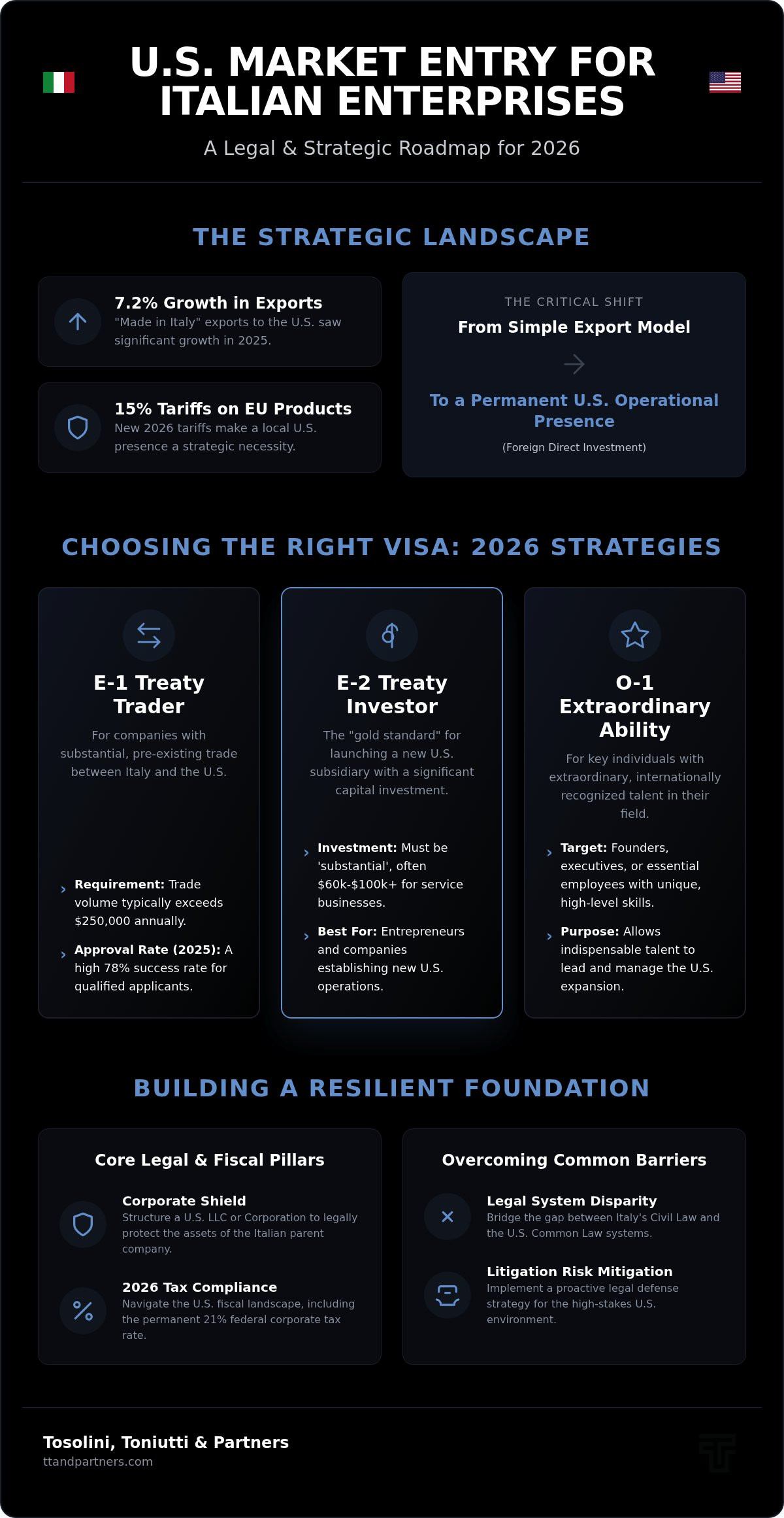
The transition from an export-only model to a permanent operational presence marks the boundary between being a distant supplier and a local market leader. For visionary firms, Foreign Direct Investment (FDI) represents the most sophisticated stage of US market entry for Italian companies. It's a shift from simply shipping containers to establishing a dedicated corporate ecosystem. The 2026 economic landscape justifies this ambition. Following a 7.2% growth in "Made in Italy" exports in 2025, the demand for authentic Italian craftsmanship remains high. However, the May 2026 introduction of 15% tariffs on specific European products has fundamentally changed the calculation. Local assembly or distribution through a domestic entity isn't just a growth strategy; it's a necessary shield against trade volatility.
Relying on a virtual office or a remote agent is often insufficient for firms targeting high-velocity growth. A physical footprint signals commitment to American partners and facilitates smoother banking and commercial relationships. It requires a cross-border legal partner who serves as a bridge between the Italian civil law tradition and the US common law system. This prevents the friction that often arises when two distinct corporate cultures collide. Strategic thinkers look beyond the immediate operational launch. They focus on building a structure that can scale while remaining compliant with both Italian and American regulations, ensuring the parent company's assets remain secure.
The Italian Advantage: Leveraging Treaty Status
Italy's bilateral agreements with the United States provide a distinct competitive edge. Unlike entrepreneurs from many non-treaty nations, Italian citizens benefit from specific visa categories like the E-1 and E-2. These treaties recognize the historical and economic ties between the two nations, simplifying the entry process significantly. The "Made in Italy" brand acts as a strategic asset, but it's the treaty status that provides the legal machinery to capitalize on that reputation. This status allows for a more fluid movement of personnel and capital, which is essential for maintaining the aesthetic and technical standards of the parent company across the Atlantic.
Entry Barriers and How to Overcome Them
The US regulatory environment is multifaceted and decentralized. One common misconception is that a contract drafted under Italian principles will carry the same weight in an American court. It won't. Success requires navigating three primary paths: establishing a trade-based presence, making a substantial capital investment, or leveraging extraordinary individual talent. The Italian government is currently supporting these efforts through initiatives like the SIMEST U.S. Measure, which offers financial grants through 2026. Overcoming barriers starts with a proactive legal architecture that anticipates litigation and ensures compliance before the first employee is hired. For those ready to begin this journey, a direct dialogue regarding your specific goals is the first step toward a secure operational launch.
Choosing the Right Visa: E-1, E-2, and O-1 Strategies for 2026
Selecting the correct immigration vehicle is a strategic decision that dictates the speed and flexibility of your American expansion. For many, US market entry for Italian companies begins with the E-1 or E-2 treaty visas. These options aren't just permits; they're structural tools that allow owners and essential staff to manage US operations directly. Choosing between them depends on whether your business model relies on existing trade flows or new capital deployment. It's a choice that requires looking beyond the immediate launch toward a five-year operational horizon.
E-1 vs. E-2: Which Treaty Visa Fits Your Model?
The E-1 Treaty Trader visa is designed for firms with established commercial ties. In 2025, the approval rate for E-1 visas reached 78%, typically requiring trade volumes exceeding $250,000 annually. Conversely, the E-2 Treaty Investor visa serves as the gold standard for entrepreneurs launching new subsidiaries. While there's no fixed minimum, the investment must be substantial. For service-based ventures, $60,000 to $100,000 often suffices. You can review the specific E-2 Treaty Investor Visa Requirements to ensure your financial planning aligns with federal expectations. For a deeper look at capital criteria, our E-2 Visa Guide 2026 provides a comprehensive framework for treaty investors.
O-1 Visas for Italian Innovators and Scientists
For Italian founders with a record of "extraordinary ability," the O-1 visa offers a powerful alternative that bypasses treaty requirements. This is particularly relevant for tech innovators or scientists whose value lies in intellectual property rather than initial trade volume. The O-1 requires evidence of sustained national or international acclaim, making it a prestigious choice for leaders in specialized industries. If you're leading a high-growth startup, our O-1 Visa for Entrepreneurs guide details how to document these achievements effectively. Over time, these non-immigrant paths often evolve into Green Card petitions, providing the permanent residency needed for decades of business stability. If you're unsure which path aligns with your corporate structure, we invite you to discuss your strategy with our cross-border team.
Establishing a Legal Foundation: LLC Incorporation and Corporate Structure
The choice of legal entity is the most consequential decision in the architecture of US market entry for Italian companies. It's not merely a filing; it's a strategic shield. For many Italian enterprises, the debate centers on the Limited Liability Company (LLC) versus the C-Corporation. A C-Corp offers a traditional structure where the entity pays its own taxes at the permanent 21% federal rate established in 2025. This often suits larger firms planning for future public offerings. Conversely, an LLC provides flexibility that often aligns with the agile nature of Italian SMEs. Regardless of the choice, the primary objective remains the same: creating a legal barrier that prevents US operational liabilities from reaching the Italian parent company's balance sheet.
Managing a US subsidiary from a headquarters in Italy requires disciplined governance. You'll need to maintain distinct corporate records and adhere to state-level regulations, such as Delaware's annual franchise tax, which increased to $400 in August 2026. For a comprehensive overview of the current regulatory environment, investors should consult the official U.S. Investment Climate and Resources portal. This ensures that your operational logistics remain synchronized with federal expectations while you focus on market growth.
LLC Incorporation for Foreign Nationals
The LLC is frequently the preferred vehicle because of its pass-through tax nature, which can prevent double taxation in a cross-border context. However, tax transparency for foreign owners involves complex treaty interpretations. It's essential to structure the entity so that it remains compliant with both the Internal Revenue Service (IRS) and Italian fiscal authorities. For a deeper analysis of these structural nuances, our LLC Incorporation guide explores the specific architectural requirements for 2026.
Synchronizing Corporate Setup with Visa Requirements
Your corporate structure must do more than just facilitate business; it must satisfy immigration officers. For E-1 and E-2 visas, Italian nationals must maintain at least 50% ownership of the US entity. If the corporate bylaws don't explicitly reflect this, or if the active investment criteria aren't met through the entity's capitalization, the visa petition risks rejection. A robust business plan is the final piece of this puzzle. It serves as both a roadmap for your operation and a legal document proving your intent to create American jobs. If you're ready to design a structure that bridges these two worlds, our team is available to discuss your corporate setup.
Operational Logistics: Real Estate, Banking, and Compliance
Establishing a corporate structure is the strategic blueprint; securing the physical and financial foundations is the actual construction. For US market entry for Italian companies, the operational phase requires a transition from abstract planning to tangible assets. In 2026, this involves more than just signing a lease. It requires a synchronized approach where commercial real estate and banking compliance support your broader immigration and tax goals. Success in this phase depends on your ability to translate Italian business excellence into a compliant American operational model.
Real Estate Closings for Business Expansion
The US commercial real estate market operates on principles that differ sharply from Italian norms. Whether you're acquiring property or negotiating a lease, the legal process of a real estate closing requires meticulous due diligence to ensure the title is clear and the zoning aligns with your industrial or commercial needs. For Italian firms, physical office space isn't just a logistical necessity; it's a critical evidentiary component of a visa application. Consular officers look for a physical place of business to satisfy the "active investment" criteria of the E-2 visa. A common pitfall for international tenants is failing to negotiate "good guy" guarantees or overlooking complex "common area maintenance" (CAM) charges that can unexpectedly inflate overhead. Securely navigating these contracts ensures your physical presence is as robust as your brand reputation.
Banking and Financial Compliance
Opening a US business bank account as a foreign-owned entity has become increasingly rigorous due to federal regulations. Anti-money laundering (AML) and Know Your Customer (KYC) protocols often require extensive documentation from the Italian parent company, including proof of beneficial ownership and historical financial statements. You'll first need to obtain an Employer Identification Number (EIN) from the IRS. This number acts as the tax identity for your US subsidiary and is essential for banking, hiring, and state-level registrations. Integrating US operations with Italian financial reporting requires a clear understanding of these financial prerequisites early in the expansion process.
Hiring your first US employees or transferring Italian expats introduces a new layer of compliance. You must navigate federal employment laws while managing specific tax withholding requirements. For those investing in property, understanding the Foreign Investment in Real Property Tax Act (FIRPTA) is essential to avoid unexpected withholdings on future dispositions. If you're navigating the complexities of a US property acquisition or corporate banking setup, our team can provide the specialized legal support for real estate closings and operational compliance you need to ensure a seamless transition.
Mitigating Risk: International Litigation and Cross-Border Compliance
The American legal system operates on an adversarial basis that often surprises European executives accustomed to the predictable timelines of civil law. In the United States, litigation isn't just a possibility; it's a standard commercial risk that must be managed through proactive legal architecture. For any firm pursuing US market entry for Italian companies, the best defense is a contract that anticipates conflict before it arises. This involves drafting cross-border agreements that clearly define jurisdiction, choice of law, and specific dispute resolution mechanisms. It also requires a rigorous approach to intellectual property, ensuring that Italian trademarks and patents are registered and defended within the US legal framework from day one.
Enforcing an Italian judgment in a US court, or vice versa, is a complex procedural undertaking. There's no automatic reciprocity; enforcement typically relies on state-specific statutes or international principles of comity. Without a synchronized strategy, a legal victory in Italy might prove impossible to collect upon across the Atlantic. Managing these risks requires a partner who understands the friction points between the two systems and can design a corporate presence that minimizes exposure to aggressive US discovery processes and high-stakes litigation.
Protecting the Parent Company
The primary goal of establishing a US subsidiary is to serve as a liability firewall. However, this protection isn't absolute. Italian owners must remain vigilant against the "piercing the corporate veil" doctrine, where US courts might disregard the subsidiary's separate legal status if corporate formalities aren't strictly observed. If the US entity lacks sufficient capital or if finances are commingled with the Italian parent, that firewall can collapse. Ring-fencing your assets requires disciplined governance and a clear separation of operations. You can review our guide on International Litigation for a deeper exploration of how to handle these cross-border legal disputes effectively.
Ongoing Compliance and Maintenance
Long-term success depends on a commitment to ongoing maintenance. 2026 regulations demand strict annual reporting for foreign-owned US entities, including detailed disclosures of beneficial ownership. Visa renewal strategies are equally vital; you should prepare for your E-visa extension from the first day of operation by meticulously documenting job creation and financial growth. A permanent legal advisor acts as the bridge that ensures your US operations remain in harmony with your Italian headquarters. If you're ready to secure your expansion against these risks, we invite you to discuss your risk mitigation strategy with our cross-border team.
Architecting Your American Legacy
The evolution from an Italian success story to a resilient American enterprise is a process of strategic and intellectual refinement. It's not a simple geographic shift; it's the creation of a legal structure that respects your brand heritage while navigating a complex new regulatory landscape. Successful US market entry for Italian companies in 2026 demands a synchronized approach where visa selection, corporate shielding, and operational compliance exist in total harmony. By mastering the intricacies of treaty visas and establishing a secure corporate architecture, you convert potential cross-border challenges into a permanent foundation for growth.
Tosolini, Toniutti & Partners provides the specialized US-Italy legal bridge necessary for this transition. Our firm offers full-service corporate and immigration support, combining expertise in treaty visas and international litigation to ensure your vision remains protected. Whether you're managing real estate closings or complex jurisdictional disputes, we provide the precision and foresight required for long-term stability. We invite you to contact Tosolini, Toniutti & Partners to start your US expansion today. Your American future is a structure waiting for its foundation; let's build it with the excellence it deserves.
Frequently Asked Questions
Do Italian companies need a local partner to enter the US market?
Italian companies don't require a local partner to establish a presence. You can maintain 100% ownership of your US subsidiary from the outset. While some firms choose local agents for market insights, the legal framework allows for total Italian control. This autonomy is central to US market entry for Italian companies seeking to preserve their brand's aesthetic and operational standards without external interference. Legal counsel ensures your corporate bylaws reflect this independence.
How much investment is required for an Italian citizen to get an E-2 visa in 2026?
There's no official minimum investment for the E-2 visa in 2026, but the amount must be substantial. For service-based ventures, an investment between $60,000 and $100,000 is often sufficient. Capital-intensive industries typically require higher figures. The key is demonstrating that the capital is at risk and sufficient to ensure the business's success. Your investment should cover operational costs, equipment, and initial marketing to satisfy consular expectations during the application process.
Can I move my Italian employees to the US to help launch the new branch?
You can certainly transfer Italian staff to help launch your US operations. The E-1 and E-2 visas allow for the relocation of executives, managers, and employees with essential skills specific to your business. These individuals must share the same nationality as the treaty company's owners. This mobility is a primary advantage for Italian firms. It ensures that the technical expertise and cultural values of the parent company are accurately implemented.
Is an LLC or a C-Corp better for an Italian company expanding to the US?
The choice depends on your fiscal objectives and growth plans. An LLC is often preferred by Italian SMEs for its tax transparency, which helps avoid double taxation. Conversely, a C-Corp is the standard for firms seeking venture capital or public offerings. With the federal corporate tax rate permanent at 21% as of 2026, the C-Corp has become more attractive. Each structure offers distinct liability protections that are vital for your long-term security.
How long does the US market entry legal process typically take?
The timeline varies based on your chosen visa and the complexity of your corporate setup. LLC incorporation can take just a few days, while visa processing times fluctuate. In 2026, government premium processing for certain petitions is available for $2,965, often yielding a response within 15 days. Generally, you should plan for a three to six-month window. This period allows for meticulous preparation of your business plan, real estate closings, and financial documentation.
Do I need to live in the US to own and operate a US company?
You don't need to reside in the United States to own a US company. Foreign nationals can hold 100% equity from abroad. However, if you intend to actively manage the business or work on-site, you'll need a valid work visa like an E-2 or O-1. Operating remotely is possible through a local management team, but a direct presence is often more effective for ensuring the brand's vision is executed with precision.
What are the main differences between Italian and US commercial contracts?
US contracts are typically much longer and more detailed than Italian ones. This is because the US common law system relies on the written word of the agreement rather than a broad civil code. Provisions for litigation, discovery, and specific indemnities are essential. In US market entry for Italian companies, drafting contracts that anticipate these differences is the best defense. It prevents the parent company from being blindsided by aggressive American legal procedures.
How can I protect my Italian parent company from US legal liabilities?
Protecting your Italian parent company requires a robust ring-fencing strategy. You must treat the US subsidiary as a completely separate legal entity with its own bank accounts, records, and capitalization. Following corporate formalities prevents US courts from piercing the corporate veil. This separation ensures that any legal or financial liabilities incurred by the American branch don't jeopardize the assets of your headquarters in Italy. Proactive legal architecture remains your most effective shield.


Comments