

Italian Citizenship Lawyer Cost: A Strategic Guide to 2026 Legal Fees

The lowest quote for Italian citizenship is often the most expensive path you can take. Most applicants start their journey with a sense of excitement, only to find themselves stalled by a lack of clarity regarding the true italian citizenship lawyer cost. It's frustrating to face a landscape of inconsistent fee structures and opaque administrative expenses when your goal is a permanent legacy. You deserve a transparent framework that treats your heritage as a strategic legal investment rather than a series of hidden transactions.
This guide provides a comprehensive breakdown of the 2026 financial landscape, ensuring you can build a precise budget for your dual citizenship. We'll examine the nuances between flat fees and hourly retainers, while exposing the often overlooked costs in document procurement and professional translations. By understanding the distinction between standard services and high-tier legal advocacy, you'll gain the confidence to secure a valid passport through a process defined by professional precision and long-term value.
Table of Contents
Analyzing the Investment: Why Italian Citizenship Lawyer Costs Vary in 2026
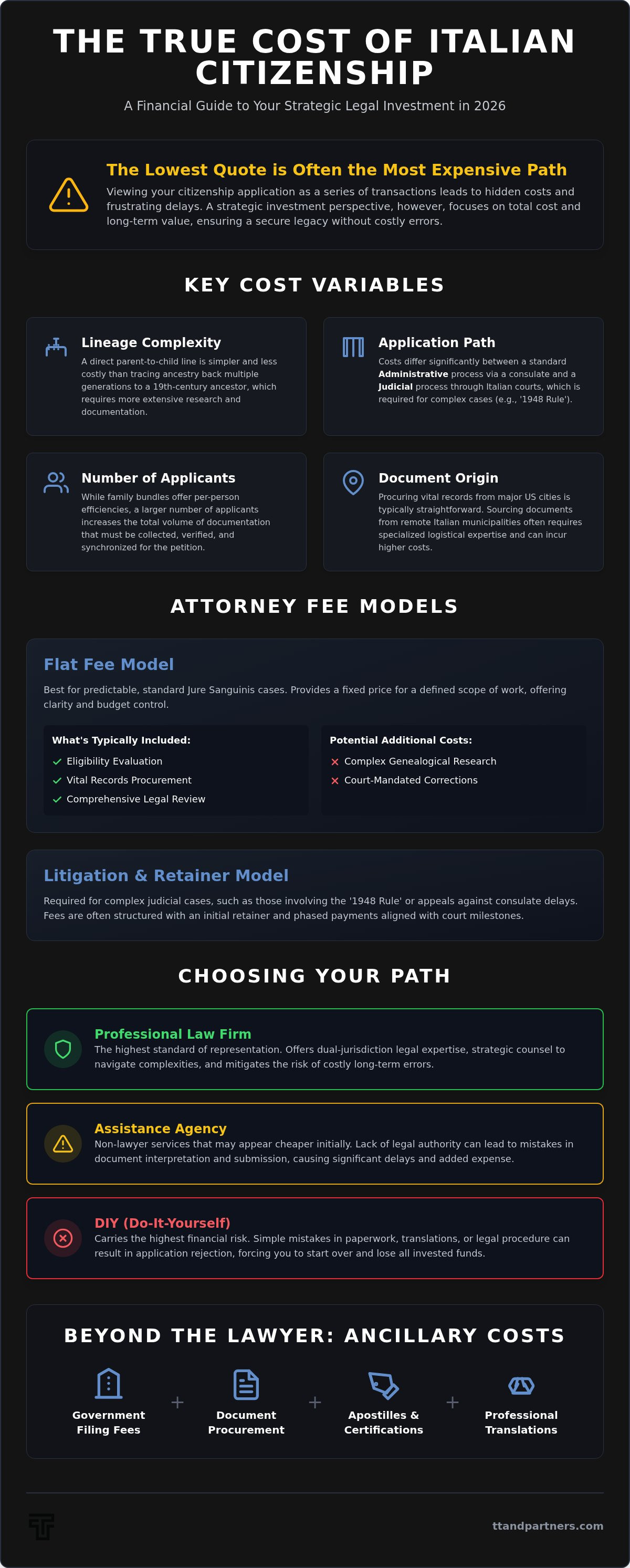
Securing recognition of your heritage is a sophisticated legal undertaking that extends far beyond a simple transaction. When evaluating the italian citizenship lawyer cost, one must adopt a holistic perspective that views the process as a total cost of ownership. This investment encompasses not only the attorney's professional fees but also the cascading administrative expenses, government levies, and the intellectual labor required to bridge two distinct legal systems. The architectural complexity of your family tree dictates the scope of the work; a direct parent-to-child lineage requires less forensic research than a claim tracing back to a nineteenth-century ancestor.
The legal framework governing these claims is rooted in Italian nationality law, which prioritizes the principle of jure sanguinis. However, the path to recognition often diverges based on whether the application is administrative, through a consulate, or judicial, through the Italian court system. Each route carries its own set of financial demands and strategic requirements. For many, the choice is between a standard administrative path and a complex litigation process, such as those involving the 1948 rule or systemic consulate delays.
The Core Variables of Legal Pricing
The structure of legal fees is rarely uniform. Lineage complexity serves as the primary driver of workload. Tracing a great-grandparent involves a higher volume of vital records, each requiring verification, apostilles, and certified translations. Additionally, the number of applicants in a single family petition influences the italian citizenship lawyer cost. While family bundles offer efficiency, they also increase the volume of documentation that must be synchronized. The geographic origin of records also plays a role; obtaining documents from remote Italian municipalities often requires a different level of logistical precision than requesting US-based certificates.
Why 2026 Market Dynamics Matter
Current global shifts have accelerated the demand for EU mobility, creating a unique environment for 2026 applicants. Massive consulate backlogs have shifted the strategic focus toward alternative routes. Many families now choose to apply directly in Italy or pursue judicial appeals based on consulate delays. These paths require specialized litigation expertise, which naturally carries a different pricing profile than standard administrative assistance. A firm’s reputation in 2026 is built on its ability to navigate these systemic delays through precise legal maneuvers. Choosing a partner with dual-jurisdiction expertise ensures that the investment results in a tangible outcome: a valid European passport and a secured legacy.
Anatomy of Attorney Fees: Retainers, Flat Fees, and Litigation Costs
Transparency in legal billing is the cornerstone of a successful citizenship strategy. When you engage a firm, the initial financial commitment usually takes the form of a retainer, which secures professional availability and initiates the preliminary review of your lineage. This system ensures that the italian citizenship lawyer cost is distributed across logical milestones, such as the completion of document procurement or the final filing of the petition. Most reputable firms phase their payments to align with these project stages, providing a clear financial roadmap from the outset.
Standard Jure Sanguinis Fee Frameworks
For most applicants following a linear path of descent, firms often propose a flat-fee model. A flat fee is the most predictable model for standard descent cases, offering a fixed price for a defined scope of professional labor. This typically includes the eligibility evaluation, procurement of vital records, and a comprehensive legal review of all certificates. While this covers the core lifecycle of the application, complex genealogical research or court-mandated document corrections may trigger hourly rates. These hourly charges reflect the forensic nature of resolving historical discrepancies to meet the official citizenship requirements set by Italian authorities.
Litigation Costs for Complex Claims
Cases involving female ancestors who gave birth before 1948 require a judicial approach rather than an administrative one. These '1948 cases' demand a presence in the Italian court system, which introduces a different set of financial variables. Beyond the attorney's professional fee, you must budget for mandatory court filing fees. As of 2025, these were set at €600 per petitioner. Additional expenses include administrative duty stamps and, in rare instances, expert witness costs in Italy.
If the state contests an application, budgeting for appeals becomes a necessary strategic consideration. The intellectual depth required to argue these cases before an Italian judge means the investment is higher than consulate-based tracks. However, for many families, this is the only viable path to recognition. If you're unsure which fee structure applies to your family's unique history, a consultation with a dual-jurisdiction firm can clarify your financial requirements and help you avoid the pitfalls of low-cost, high-risk alternatives. Success in these complex litigation matters depends on the quality of the legal brief and the precision of the supporting documentation.
Choosing Your Path: Law Firms vs. Assistance Agencies vs. DIY
Selecting a methodology for your application is a balance between immediate expenditure and long-term security. While the initial sticker price of a do-it-yourself approach appears attractive, it often masks the cumulative financial impact of procedural errors. Many applicants view the process as a simple collection of certificates, but the reality is a complex alignment of international treaties and local statutes. When you factor in the italian citizenship lawyer cost, you're investing in a shield against the systemic inefficiencies that frequently derail unrepresented petitions.
The True Cost of DIY Mistakes
Rejections are rarely free. When an application is dismissed due to minor discrepancies in names or dates, the applicant often forfeits their hard-won consulate appointment. In 2026, where waiting lists span several years, losing a slot is a significant setback that can't be easily recovered. Correcting these errors requires re-procuring documents and paying Italian government administrative fees a second time. Professional legal review serves as a form of rejection insurance, ensuring that every Apostille and translation meets the exacting standards of the Ministry of the Interior before the first submission.
The Agency vs. Law Firm Value Proposition
Assistance agencies often position themselves as a middle ground, yet they operate under strict legal limitations. They can help with document gathering, but they lack the standing to provide legal representation in Italy. Only registered attorneys can represent clients in judicial proceedings, such as 1948 cases or appeals against consulate delays. Agencies can't offer attorney-client privilege, which is vital when you're sharing sensitive family records and financial data.
A registered law firm provides insurance and liability protections that unregulated agencies simply don't have. If a legal challenge arises during your application, a lawyer has the authority to intervene directly with the Italian authorities. This level of advocacy is a core component of the italian citizenship lawyer cost that agencies cannot replicate. Choosing a partner with the right credentials ensures your heritage isn't left to the whims of administrative clerks. If you're ready to move beyond basic assistance and secure your legal standing, you should Contact our cross-border legal team to discuss a structured, professional approach.
The hidden costs of re-submitting rejected DIY applications often exceed the price of professional counsel. Each failed attempt adds months or years to the timeline, delaying your access to EU benefits and residency rights. By choosing a high-tier legal partner, you prioritize the quality of the outcome over the perceived savings of a fragmented strategy. It's about building a bridge to your future that is as durable as the history you're reclaiming.
Beyond the Lawyer: Budgeting for Ancillary Costs and Administrative Fees
Budgeting for your legacy requires looking beyond the professional retainer. While the italian citizenship lawyer cost is a significant pillar of your investment, the Italian government mandates several non-negotiable fees. These administrative levies are fixed and apply regardless of whether you're working with a top-tier firm or proceeding independently. Precise accounting for these expenses prevents mid-process delays and ensures your financial planning is as robust as your legal strategy.
Mandatory Government and Consulate Fees
As of September 2026, the fee for processing a citizenship application at an Italian consulate is €600 per adult applicant. This is a non-refundable payment made on the day of your appointment. For those whose applications are processed in the July to September 2026 quarter, the USD equivalent is $699.10. For individuals pursuing citizenship by marriage through the Ministry of Interior, similar administrative fees apply. Once recognition is achieved, you'll also need to budget for the issuance of the Italian passport and ensure compliance with AIRE registration requirements. These final steps are the culmination of the process, turning legal recognition into a functional travel document.
The Logistics of Document Procurement
Building a bulletproof case file involves gathering certified copies of vital records from both sides of the Atlantic. In the US, birth, marriage, and death certificates typically range from $5 to $10 each. However, the search for historical records can be more complex. A USCIS genealogy index search costs $30 for online filings as of May 2026, while paper-based requests are $80. Italian municipalities may also charge a research fee of up to €300 for civil status extracts that are over a century old and relate to individuals other than the applicant.
Every foreign document must be legalized with an Apostille, which generally costs between $10 and $20 per record. Professional translations are equally vital; they must be precise and, in many cases, certified by the consulate or an Italian court. These logistics require careful coordination and secure courier services to protect original documents. International shipping rates for secure, tracked envelopes add another layer to the logistical budget. For those whose cases involve multiple generations, these ancillary costs can scale quickly. To ensure every administrative detail is handled with professional precision, you can consult with our experts on document procurement to avoid the financial drain of re-ordering lost or incorrect records.
Strategic Legal Counsel: Securing Your Legacy with TT&P
Investing in your heritage is a sophisticated endeavor that requires a partner capable of bridging the legal divide between the United States and Italy. While the italian citizenship lawyer cost is a primary consideration, the value of that investment is measured by the certainty and efficiency of the outcome. Tosolini, Toniutti & Partners serves as this essential bridge, providing a dual-jurisdiction perspective that standard assistance agencies cannot offer. By maintaining a presence in both legal systems, we eliminate the friction often caused by miscommunications between foreign documents and Italian statutory requirements.
Our approach treats every application as a strategic legal investment in global mobility. This perspective ensures that your project doesn't just result in a passport, but in a secured legacy that benefits future generations. The intellectual labor we provide is focused on reducing the total project time through precise document synchronization and expert litigation support. We don't just process papers; we architect a path to European residency that respects both your family history and your future goals.
The TT&P Advantage in 2026
Working with a dual-jurisdiction firm offers the distinct benefit of direct access to Italian legal experts without the logistical burden of international travel. In 2026, the complexity of cross-border lifestyle management often requires more than just immigration advice. Our firm provides a holistic suite of services, allowing for seamless integration with other strategic needs such as LLC incorporation or real estate closings. This cross-border synergy ensures that your legal architecture is consistent across all jurisdictions, protecting your assets and your status simultaneously.
Next Steps: From Evaluation to Citizenship
The journey toward recognition begins with a comprehensive evaluation of your lineage. This preliminary phase is critical for determining the viability of your claim and identifying potential hurdles before you commit to significant fees. To maximize the value of an initial consultation, you should prepare a clear summary of your Italian ancestor's naturalization history and a basic list of available vital records. This preparation allows our attorneys to provide a more accurate forecast of your specific italian citizenship lawyer cost and a realistic project timeline.
While 2026 application timelines remain influenced by consulate backlogs and court schedules, a structured legal strategy provides the most reliable route to success. The long-term return on this investment is profound, offering your family unrestricted access to the European Union, world-class healthcare, and diverse educational opportunities. If you're ready to transition from research to results, you can Schedule a consultation with our Italian citizenship attorneys to begin building your bridge to Italy. We focus on high-probability cases to ensure that your investment is protected by professional precision and a commitment to excellence.
Architecting Your Future: The Value of Professional Legal Counsel
Securing dual citizenship is a sophisticated project that requires a strategic approach to both financial and legal planning. We've explored how the italian citizenship lawyer cost reflects the complexity of your heritage, from standard descent cases to intricate 1948 litigation. By understanding the interplay between attorney retainers and mandatory administrative fees, you can move forward with a clear budget and a focused strategy. Professional representation doesn't just manage paperwork; it provides a shield against the systemic inefficiencies that frequently stall unrepresented applications.
Choosing a specialized US-Italy cross-border firm ensures your documentation meets rigorous standards while protecting your family history through attorney-client privilege. Our expertise in comprehensive document procurement and complex litigation offers the precision needed to navigate the 2026 legal landscape. You're not just applying for a passport; you're reclaiming a legacy and opening doors to European education, healthcare, and global mobility. Secure your Italian heritage with expert legal counsel and begin the journey toward your recognized citizenship. Your future in the European Union is a well-planned investment away.
Frequently Asked Questions
How much does an Italian citizenship lawyer cost for a family of four?
A family application often benefits from economies of scale during the document procurement and review phases. While the total italian citizenship lawyer cost increases with additional applicants, the per-person rate typically decreases because the lineage research is shared. The legal workload involves synchronizing common ancestors for all four members, ensuring that the entire family's documentation meets the rigorous standards of the consulate or court in a single, cohesive petition.
Is there a difference in cost between applying in the US vs. applying in Italy?
The financial landscape shifts depending on where you establish your legal residency. Applying through a US consulate involves a fixed fee of €600, which equals $699.10 for the late 2026 quarter. Conversely, applying in Italy avoids consulate backlogs but introduces costs for establishing residency and local municipality research fees that can reach €300. Each path requires a different strategic allocation of your legal budget to manage local administrative requirements effectively.
Are legal fees for Italian citizenship tax-deductible in the United States?
Legal fees for securing personal dual citizenship are generally not tax-deductible under current IRS guidelines. These are typically classified as personal expenses rather than costs associated with a trade, business, or the production of income. If your citizenship is a component of a broader international business expansion or an E-2 visa strategy, you should consult a tax professional to determine if specific portions of your legal architecture qualify for deductions.
What happens if my citizenship application is rejected after paying legal fees?
Rejection risks are significantly mitigated through a rigorous preliminary evaluation of your lineage. If an application is dismissed due to minor administrative discrepancies, a professional firm will assist with the necessary corrections, though new government filing fees may apply. If the rejection involves a complex legal interpretation, you might need to pivot toward a judicial appeal. This transition to international litigation involves a new fee structure and a more intensive courtroom strategy.
Do I have to pay the full legal fee upfront or is there a payment plan?
Most reputable firms utilize a milestone-based payment structure rather than requiring the entire fee at the start of the engagement. An initial retainer secures professional availability and funds the forensic review of your family records. Subsequent payments are usually triggered by specific project phases, such as the completion of document procurement or the formal filing of your application. This phased approach ensures your investment aligns with the tangible progress of your case.
How much should I budget for document translations and Apostilles in 2026?
Logistical expenses are a vital part of your overall budget. In 2026, Apostilles for US vital records generally cost between $10 and $20 per document. Professional translations must be precise to meet the standards of the Ministry of the Interior, and their cost depends on the volume of records in your lineage. For a three-generation application, you should account for these recurring costs alongside secure international courier fees to protect your original certificates.
Is a consultation fee usually credited toward the total cost of representation?
High-tier firms often credit the initial consultation fee toward the total italian citizenship lawyer cost if you choose to proceed with a full retainer. This fee covers the attorney's intellectual labor in performing an eligibility check and identifying potential hurdles in your lineage. It ensures that your case is viable before you commit to a long-term investment. This model prioritizes strategic certainty, allowing you to move forward with a high-probability path to recognition.
Why are '1948 cases' more expensive than standard Jure Sanguinis applications?
Judicial '1948 cases' require a higher investment because they bypass administrative consulate channels in favor of the Italian court system. These cases involve a €600 court filing fee per petitioner as of early 2025, plus mandatory duty stamps and litigation expenses. The legal labor is more intensive, requiring the drafting of formal briefs and representation by an attorney with standing in Italy. This expertise is necessary to challenge historical gender discrimination through the judiciary.


Comments