

E-2 Visa Business Plan Requirements: The 2026 Strategic Framework for Success

Updated: Jul 16
Your E-2 business plan is less of a marketing brochure and more of a rigorous legal blueprint for your future in the United States. While many entrepreneurs treat this document as a simple pitch for capital, consular officers in 2026 scrutinize it as the foundational evidence of your venture's economic viability and operational depth. Mastering the specific E-2 visa business plan requirements is the essential step in transforming a visionary concept into a successful, approved entry into the American market.
It’s understandable to feel a sense of uncertainty regarding the subjective nature of a substantial investment or the specific standards that trigger a marginality rejection. You've built your capital with care, and the fear that a lack of technical precision might stall your progress is a valid concern for any serious investor. This article promises to provide you with the strategic framework needed to secure your treaty investor visa on the first attempt. We'll examine the architecture of five year financial projections, the necessity of documented job creation, and the precise ways to demonstrate that your funds are both at risk and irrevocably committed to your American enterprise.
Table of Contents
Defining the E-2 Business Plan: A Legal Document vs. a Commercial Pitch
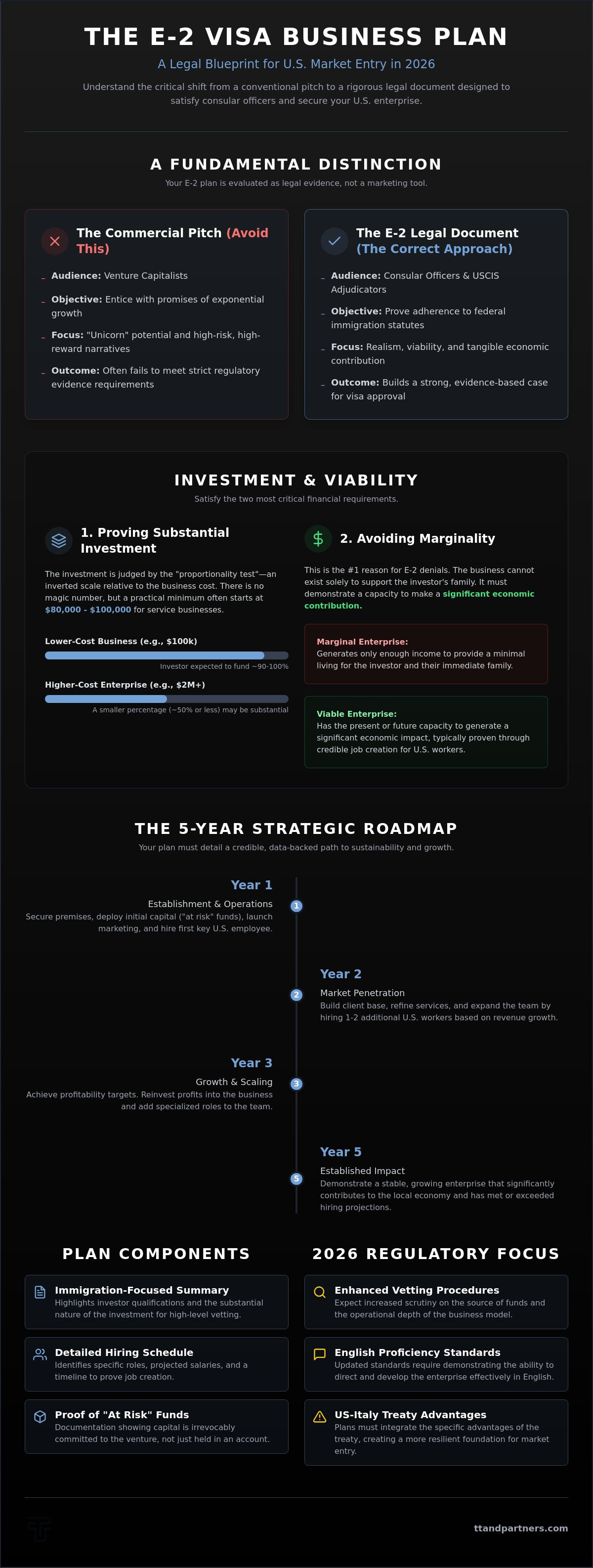
An E-2 business plan is a formal legal evidentiary document that serves as the primary instrument for verifying a treaty investor's adherence to federal immigration statutes. While a traditional commercial pitch seeks to entice venture capitalists with the promise of exponential growth, the E-2 document addresses a different set of stakeholders: consular officers and USCIS adjudicators. These officials aren't looking for the next "unicorn" startup; they're searching for evidence that the enterprise is real, active, and capable of making a tangible contribution to the American economy. The plan acts as a five-year strategic blueprint that bridges the gap between your entrepreneurial vision and the technical demands of US regulatory compliance.
When you're outlining your E-2 visa business plan requirements, you're essentially constructing a case for your right to operate in the United States. This roadmap must prove that your investment isn't "marginal," a legal term meaning the business cannot merely support you and your family. It must have the capacity to generate significant economic impact. This distinction is vital. A plan that focuses solely on the investor's personal income will likely face rejection. Instead, the narrative must pivot toward the broader ecosystem of the business, including its role in local job creation and its integration into the US market.
The Core Objective: Proving Economic Impact
A successful petition hinges on your ability to quantify the enterprise's value beyond your own participation. This is often achieved through a detailed five-year hiring schedule that identifies specific roles and projected salaries. It's not enough to state that you'll hire staff; you must provide a credible, data-backed narrative that justifies these positions within your specific industry. For a broader context on these regulations, an E-2 Investor Visa overview can provide the foundational treaty background. Consular officers prioritize transparency and realism over optimistic marketing fluff. Every projection must be rooted in current market data and operational logic to ensure the business appears both sustainable and beneficial to the local community.
Key Components of a Compliant 2026 Plan
A visa-ready plan for 2026 requires several critical elements that differ from standard business documents. The executive summary must be tailored for high-level immigration vetting, focusing on the treaty investor's qualifications and the "substantial" nature of the investment. You must provide a granular breakdown of funds that are already "at risk" and "irrevocably committed" to the venture. Simply holding capital in a bank account doesn't meet the E-2 visa business plan requirements. Finally, a robust market analysis is required to prove the business's survival in the current US landscape, demonstrating that you've accounted for local competition and regulatory hurdles. This level of precision transforms a simple document into a powerful tool for visa approval.
Proving Substantial Investment and Avoiding Marginality
Securing approval requires more than just capital; it demands a demonstration of proportionality and economic purpose. Within the E-2 visa business plan requirements, the definition of a substantial investment is not fixed by a specific dollar amount but by its relation to the total cost of the enterprise. Marginality is the #1 reason for E-2 denials in 2026. Adjudicators seek to confirm that the business is a dynamic entity capable of thriving within the American economy, rather than a mere vehicle for personal residency. Capital must be active. Simply holding cash in a bank account fails the test of irrevocable commitment.
The Proportionality Test Explained
Adjudicators apply an inverted scale to determine if an investment is substantial. For lower-cost startups, the investor is often expected to contribute nearly 100% of the required capital. Conversely, for multi-million dollar enterprises, a smaller percentage may suffice. This analysis is codified in the USCIS E-2 Visa Policy Manual, which serves as the definitive guide for these calculations. While the law does not set a hard minimum floor, in practice, a minimum investment of $80,000 to $100,000 is generally considered a starting point for most service-based businesses. Proving the at-risk nature of funds requires evidence that capital has been spent on these common business elements:
Signed commercial leases with non-refundable deposits.
Invoices and receipts for industry-specific equipment or vehicles.
Purchase orders for initial inventory or specialized software.
Marketing and branding expenses already incurred for the US market.
In the 2026 landscape, documentation must also satisfy rigorous Anti-Money Laundering (AML) standards. Tracing the source of funds with absolute clarity is essential to avoid delays or requests for evidence.
Strategies to Counter Marginality Claims
A business is considered marginal if it lacks the present or future capacity to generate more than a minimal living for the investor and their family. To overcome this hurdle, your plan must detail a robust hiring strategy for US workers. By using industry-specific benchmarks, you can validate your revenue projections and prove that the business will yield a significant economic contribution. The plan should clearly articulate how the profit margins exceed the investor's personal needs. If you're unsure how your current investment aligns with these standards, you can contact our legal team to discuss a strategic review of your documentation. A well-structured plan demonstrates that your presence is the catalyst for growth, not just a survival strategy.
Personnel and Operational Projections: The 5-Year Roadmap
The operational roadmap within your application serves as the definitive proof that your enterprise is a living, growing entity. While initial capital proves commitment, the personnel and operational projections demonstrate long-term viability. A central pillar of the E-2 visa business plan requirements is the presentation of a clear hierarchy where the investor occupies a "direct and develop" capacity. You aren't simply buying a job; you're building an institution. This means your daily activities must focus on executive management and strategic growth rather than routine tasks that a local employee could perform. Proving this capacity requires a granular look at how the business functions on a day-to-day basis.
Organizational charts are indispensable for E-2 compliance because they provide a visual timeline of your company's evolution. These charts should map out the transition from a lean startup phase to a fully staffed operation, clearly delineating reporting lines and department structures. Adjudicators use these to verify that you'll have sufficient support staff to avoid the marginality trap. Each role should be accompanied by a brief job description that justifies its necessity to the company's five-year growth objectives.
The 5-Year Financial Forecast
Financial integrity is the language of the US consulate. Your five-year forecast must include profit and loss statements that reflect industry-specific profit margins and seasonal fluctuations. Balance sheets should clearly show the initial substantial investment as equity or assets, while cash flow statements must prove the business's ability to sustain its workforce without depleting its reserves. These documents shouldn't just look professional; they must be rooted in the reality of the 2026 US market. Every number must have a corresponding justification in the narrative section of the plan to maintain credibility.
Job Creation and the US Workforce
The US government measures the value of your business by its impact on the local labor market. Consular officers place a higher premium on W-2 employees than 1099 independent contractors, as the former represents a more stable and permanent contribution to the economy. Hiring US citizens or legal permanent residents remains the gold standard for proving your enterprise isn't marginal and fulfills the E-2 visa business plan requirements. For a deeper look at the broader regulatory landscape, you can consult our E-2 Visa Guide 2026. Operational logistics, such as executed leases and vendor agreements, solidify this narrative by showing that your business is ready to open its doors immediately. These contracts act as physical anchors for your financial projections.
Navigating 2026 Regulatory Updates: English Proficiency and Vetting
Regulatory shifts in 2026 have introduced a new layer of complexity to the petition process, requiring investors to demonstrate not just financial capacity but also immediate operational readiness. 2026 applications require more robust documentation of "business acumen" to satisfy increasingly discerning adjudicators who now look beyond the balance sheet. Within the current E-2 visa business plan requirements, your narrative must account for specific executive mandates that prioritize national security and economic integrity. This evolution reflects a broader trend toward qualitative assessment, where the investor's professional history and specialized skills are scrutinized as closely as their capital.
English Proficiency Standards for 2026
Executive Order 14286 marks a significant pivot for certain industries, particularly for those operating in the transportation and logistics sectors. If your enterprise involves the operation of commercial motor vehicles, you must now provide explicit evidence of English proficiency as part of your filing. While a visa issued after June 15, 2026, can serve as proof of this capability for future renewals, initial applications must include standardized exam results or detailed, verifiable statements to avoid processing delays. The Department of State has integrated these standards into the 2026 screening process to ensure that all commercial operators can safely navigate the US regulatory landscape. This requirement adds a technical hurdle that you must address early in the planning phase to prevent unexpected requests for evidence (RFE).
Enhanced Vetting and Source of Funds
International capital movements are now subject to sophisticated digital tracking, making the transparency of your financial history more critical than ever. For Italian entrepreneurs, ensuring "clean" paths for capital entering the US is paramount to passing the enhanced vetting protocols established this year. You should prepare for a comprehensive review of your Source of Funds for E-2 Visa, as adjudicators now utilize automated tools to cross-reference international transfers with global financial databases. This heightened scrutiny aims to safeguard the integrity of the treaty program while ensuring that all funds are legitimately sourced and irrevocably committed to the business.
The introduction of the new $250 Visa Integrity Fee further underscores the government's focus on rigorous oversight. For Italian nationals processing through the U.S. Embassy in Rome, these updates mean that the E-2 visa business plan requirements now include a higher standard of evidentiary proof for every transaction. To ensure your documentation meets these rigorous 2026 standards and survives the enhanced vetting process, you can schedule a strategic consultation with our cross-border specialists. We provide the architectural precision needed to audit your financial trail and align your professional profile with the latest federal mandates before your application reaches the consular officer's desk.
The Italian Investor’s Advantage: Integrating Business Setup and Visa Strategy
Italian entrepreneurs possess a distinct advantage when entering the American market, thanks to the longstanding US-Italy Treaty of Commerce and Navigation. This treaty doesn't just grant eligibility; it provides a framework for favorable terms that must be meticulously reflected in your documentation. Integrating your corporate architecture with your immigration goals is the final, crucial step in meeting the E-2 visa business plan requirements. A fragmented approach, where the business setup and the visa petition are handled in isolation, often leads to inconsistencies that consular officers in Rome are trained to identify. A unified strategy ensures that every lease, contract, and corporate resolution serves as a cohesive testament to your commitment.
Founding the US Entity: LLC Incorporation
Why Professional Legal Oversight is Mandatory
Generic business plan templates are a significant liability for high-stakes visa applications. These one-size-fits-all documents often fail to address the nuance of Italian-US cross-border regulations or the specific E-2 visa business plan requirements that adjudicators demand in 2026. An Italian-focused firm acts as a bridge, translating Italian business culture into the precise legal language required by US authorities. This oversight ensures that your real estate closings, corporate structuring, and immigration filings work in harmony. It's about moving from a collection of documents to a singular, bulletproof strategy that accounts for the dual nature of your professional transition.
The complexity of the 2026 landscape leaves little room for error. From initial LLC formation to the final visa issuance in Rome, every step must be architected with precision to avoid the common pitfalls of marginality or insufficient investment documentation. To ensure your market entry is designed for success from day one, you can contact Tosolini, Toniutti & Partners for a consultation. We provide the strategic legal framework necessary to navigate the intersection of Italian ambition and American regulatory standards with absolute confidence.
Architecting Your American Market Entry
Navigating the complexities of a US market entry in 2026 requires a shift from commercial optimism to rigorous legal precision. You've seen that mastering the technical E-2 visa business plan requirements isn't just about financial projections; it's about proving the irrevocable commitment of your capital and the tangible economic impact of your enterprise. By aligning your corporate structure with the specific advantages of the US-Italy Treaty and preparing for enhanced vetting protocols, you transform a complex regulatory hurdle into a strategic launchpad for growth.
Our firm provides the specialized US-Italy cross-border legal expertise and an integrated corporate and immigration strategy necessary to navigate this transition. We offer a proven track record with E-2 treaty investor visas, ensuring that every element of your plan meets the highest standards of federal scrutiny. We bridge the gap between Italian business culture and the technical demands of the American legal system.
Your vision for the American market is within reach when it's built on a foundation of professional excellence and strategic foresight. We look forward to helping you architect your success in the United States.
Frequently Asked Questions
Is a business plan mandatory for an E-2 visa application in 2026?
Yes, a comprehensive business plan is mandatory. It serves as the primary evidentiary document to satisfy the E-2 visa business plan requirements. Consular officers in Rome and adjudicators at USCIS use it to verify that the enterprise is real, active, and capable of generating sufficient revenue. Without this strategic roadmap, the petition lacks the necessary proof of operational viability and long-term economic purpose.
How many jobs must an E-2 business plan project to avoid marginality?
While no statutory minimum exists, a plan typically projects the creation of 3 to 5 full-time positions for US workers within the first five years. This demonstrates that the business isn't marginal. The focus should be on the quality of the roles and their necessity to the company's growth, proving a tangible contribution to the local economy. Adjudicators look for realistic hiring timelines that align with your industry's standards.
Can I use a business plan I wrote for a bank loan for my E-2 visa?
You shouldn't use a standard bank loan plan for immigration purposes. Bank plans emphasize debt service and collateral, while a visa-ready plan must prove treaty compliance and your capacity to direct and develop the enterprise. The two documents serve different audiences and require distinct technical focuses to be effective. A visa plan is a legal argument for your residency, not just a financial request for credit.
What is the 'substantial investment' threshold for an E-2 visa in 2026?
The substantiality of an investment is determined by the proportionality test rather than a fixed dollar amount. In practice, service-based startups often begin with an investment between $80,000 and $100,000. For higher-cost businesses, the investment must represent a significant portion of the total startup or purchase price to meet the E-2 visa business plan requirements and demonstrate the investor's commitment to the venture's success.
Does the 2026 English proficiency requirement apply to all E-2 investors?
The 2026 English proficiency mandate is sector-specific. It primarily affects investors who will operate commercial motor vehicles as part of their business activities. Most other investors aren't subject to standardized testing, though they must still demonstrate the professional acumen necessary to manage their specific US enterprise effectively. Consular officers evaluate your ability to lead the business during the interview, regardless of the industry's technical requirements.
How long should the financial projections be in an E-2 business plan?
Financial projections must span exactly five years. This duration is the industry standard required by the U.S. Citizenship and Immigration Services (USCIS) and consular posts. It provides enough data to show the transition from initial investment to a profitable, non-marginal entity that supports the US workforce. Shorter projections are often viewed as insufficient evidence of the business's long-term sustainability and economic impact on the American market.
Can I buy a franchise instead of starting a new business for an E-2 visa?
You can certainly invest in a franchise to qualify for the visa. This route often provides a proven model that adjudicators find credible. However, you must still prove that you'll be actively involved in the management. Passive ownership of a franchise doesn't meet the "direct and develop" standard required for approval. Your plan must detail your specific executive role and decision-making authority within the franchise structure.
What happens if my business fails to meet the job creation goals in the plan?
Failing to meet projected hiring goals can complicate your visa renewal process. The business plan is viewed as a good-faith roadmap for the enterprise's growth. If actual performance deviates significantly from the initial projections, you'll need to provide a compelling legal justification during the renewal. This involves proving the business remains viable and non-marginal despite the operational shifts that occurred during the initial visa term.



Comments