

E-2 Visa for Spouse and Children: The 2026 Strategic Guide to Family Relocation
- Gianni Mendes Toniutti, Esq.

- Jul 5
- 12 min read
Updated: Jul 18
What if the true measure of your American expansion isn't found in your quarterly reports, but in the seamless transition of your family to a new life? Relocating across oceans is a complex architectural project where every detail matters. You're likely feeling the pressure of balancing business growth with the very real concerns of spousal career paths and your children's educational stability. Securing an E-2 visa for spouse and children is the essential framework that transforms a high-stakes move into a strategic, unified family relocation.
Professional ambition shouldn't cost you your family's peace of mind. We understand the anxiety surrounding spousal work authorization and the fear of children aging out of their status as they approach adulthood. This guide offers a clear path through the 2026 immigration landscape, confirming how your spouse can exercise work rights immediately upon entry and how to protect your children's academic future. We'll preview the current filing protocols, updated fees; and the specific timelines needed to ensure a continuous, flourishing life for everyone in your household.
Table of Contents
Understanding Derivative E-2 Status for Family Members
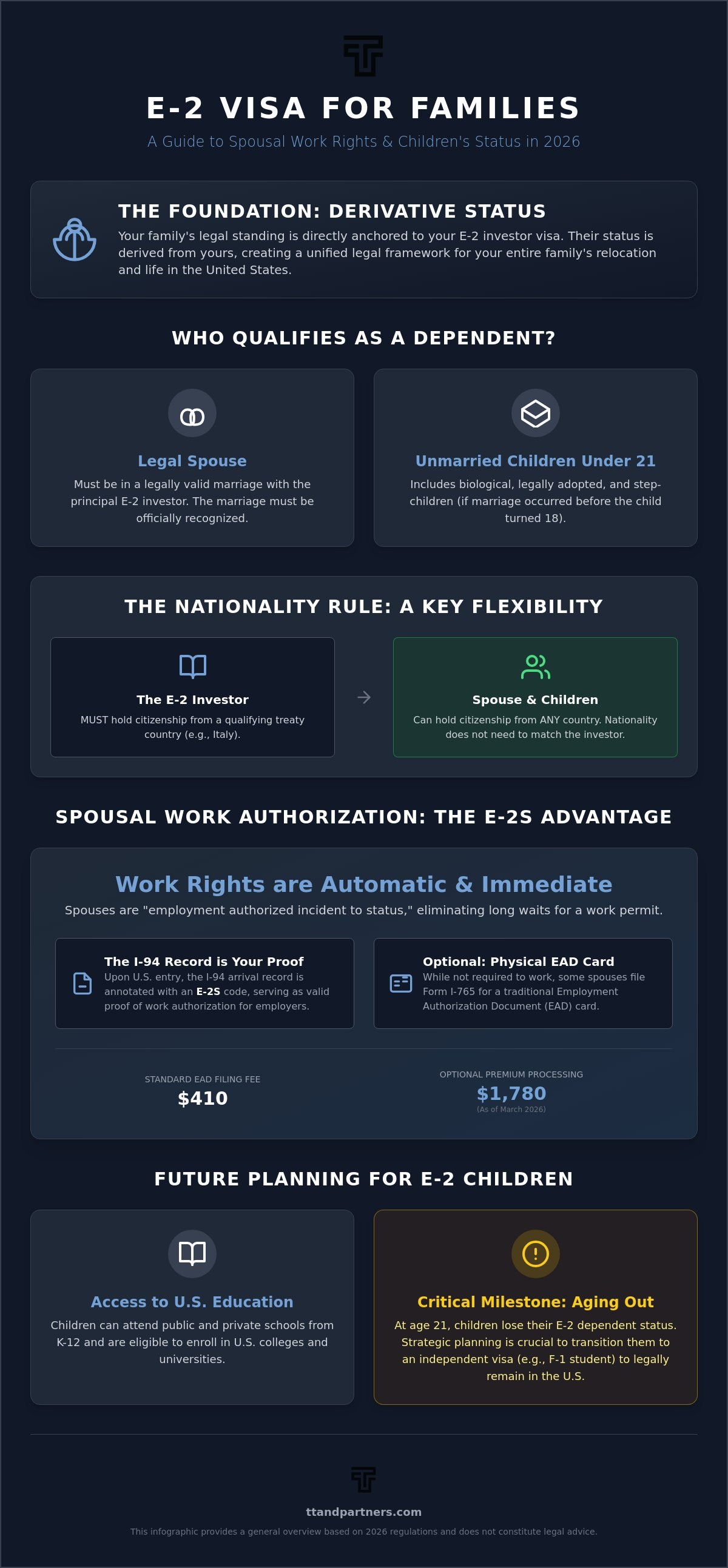
The E-2 treaty investor program is designed to facilitate international commerce, but its success often hinges on the structural integrity of the family unit. Legal standing for your loved ones isn't granted independently; instead, it flows directly from the principal investor's approval. This concept, known as Derivative E-2 Status for Family, ensures that your spouse and children are legally anchored to your business venture. When you secure an E-2 visa for spouse and children, you're creating a shared legal reality that allows your family to reside and thrive within the United States for the duration of your enterprise.
Who Qualifies as a Dependent?
The definition of a dependent under U.S. immigration law is precise. To qualify, a spouse must be joined to the principal investor through a valid legal marriage recognized by the jurisdiction where it was performed. While the U.S. recognizes a broad spectrum of legal unions, documentation is paramount. For children, the criteria are equally specific: they must be unmarried and under the age of 21. This includes biological children, legally adopted children, and step-children, provided the marriage that created the step-relationship occurred before the child reached the age of 18. Once a child reaches the age of 21, they age out and must transition to an independent visa category to remain in the country. Managing these milestones is a critical part of your family’s long-term residency strategy.
Nationality and the E-2 Treaty
One of the most flexible aspects of this program involves the Treaty Country rule. While the principal investor must hold the nationality of a country with a qualifying treaty, such as Italy, this requirement doesn't extend to the rest of the family. Your spouse and children can hold any nationality. This allows for a diverse family structure where, for example, an Italian investor can bring a spouse with French or Brazilian citizenship without additional treaty hurdles. This inclusivity simplifies the relocation process for multi-national families, ensuring that the primary focus remains on the business's potential rather than the complexities of individual passports. Dual citizenship for children doesn't complicate this status; their eligibility remains tied to their relationship with the investor. If you have questions about how your specific family structure fits into these regulations, you can reach out for a detailed assessment at our contact page.
Maintaining this status requires vigilant attention to the principal's standing. If the investor's status lapses, the derivative status for the entire family dissolves. Strategic planning ensures that extensions and renewals are handled with the same precision as the initial application, providing a stable environment for your family to grow alongside your business. For families navigating similar legal complexities in other jurisdictions, such as English speakers in Israel, the Salior Ben Hamou Law Office offers practical legal representation to ensure a seamless transition.
Likewise, if you are looking for legal expertise in the Asia-Pacific region, specifically for matters in Australia, check out Mohan Yildiz & Associates for trusted counsel in Melbourne.
Spousal Work Authorization: Rights and Regulations in 2026
The professional landscape for spouses has undergone a sophisticated transformation as of 2026. While previous years required a tedious wait for a physical work permit, the current regulatory environment prioritizes economic integration. Under modern USCIS Regulations for E-2 Families, spouses are now considered employment authorized incident to their status. This means the right to work is inherent to the visa itself; it's not a separate privilege that must be granted after a long delay. For those securing an E-2 visa for spouse and children, this shift eliminates months of professional stagnation and allows for a synchronized start to the family's American journey.
Automatic Work Authorization vs. EAD
Evidence of work eligibility is now found within the I-94 arrival record rather than a separate plastic card. Upon entry, U.S. Customs and Border Protection annotates the electronic record with the E-2S designation. This specific code serves as valid proof for I-9 employment verification. Some spouses still choose to file Form I-765 for a physical Employment Authorization Document (EAD) to provide a more familiar form of identification to corporate HR departments. As of March 1, 2026, premium processing for certain employment forms has increased to $1,780 for those seeking expedited results. While the standard filing fee for an EAD is $410 for most, the E-2S status provides the immediate legal right to begin working without waiting for the physical document to arrive in the mail.
Professional Flexibility for E-2 Spouses
The E-2S status offers a level of professional freedom that few other visa categories provide. Spouses aren't tied to a specific employer or industry. They can accept positions at established corporations, consult for international firms, or manage remote roles for Italian enterprises. This flexibility extends to entrepreneurship as well. A spouse has the legal authority to form their own LLC, hire employees, and build an independent business venture from the ground up. This dual-income potential significantly strengthens the family's financial architecture in the United States. If you're planning a complex move involving multiple professional paths, consulting with a strategic advisor can help align these rights with your long-term residency goals.
This autonomy ensures that the relocation is a growth opportunity for both partners. By removing the barriers to immediate employment, the 2026 regulations allow the household to integrate into the American economy with speed and precision. The focus remains on building a sustainable future where both the principal investor and the spouse can pursue their respective ambitions without compromise.
Education and Living in the US for E-2 Children
While the investor manages the enterprise and the spouse integrates professionally, the children's experience centers on the American classroom. An E-2 visa for spouse and children provides a stable platform for K-12 education in both public and private institutions. This transition involves adapting to a credit-based system and holistic evaluation methods that differ from the traditional Italian curriculum. It's vital to remember that while spouses have gained expanded work rights in 2026, children remain strictly prohibited from employment. Their role in the relocation project is focused entirely on academic and social development within their new community.
Schooling and University Enrollment
Enrolling in higher education doesn't require a separate F-1 student visa, which simplifies the family's administrative profile and avoids the need for additional status changes. When reviewing the Department of State Visa Application guidelines, it's clear that derivative status facilitates full-time study at any accredited university. However, tuition classification is a state-level decision. Some states allow E-2 dependents to qualify for in-state tuition after a year of residency, while others may apply international rates. Early preparation of academic records and health documentation is essential for a smooth registration process.
The 'Aging Out' Challenge at 21
The most significant milestone for families is the child's 21st birthday. On this day, derivative status expires regardless of the principal's visa validity. This hard deadline requires a proactive shift in strategy to ensure the child isn't forced to depart unexpectedly. We recommend initiating a transition plan to an F-1 student visa or an independent work category at least 24 months in advance. This foresight prevents a sudden loss of residency and ensures the child can complete their degree or start their career without legal interruption. For families approaching these critical dates, reaching out for a strategic consultation provides the necessary roadmap for the next generation's future.
Living in the U.S. as an E-2 dependent offers unparalleled exposure to global networks and diverse cultural perspectives. By understanding the boundaries of this status, parents can build a secure foundation for their children's future ambitions. The goal is to move beyond mere relocation and toward a sustainable, multi-generational presence in a new environment.
The Application Process: Consular Processing vs. USCIS
Applying for the E-2 visa for spouse and children requires a synchronized approach to administrative precision. While those already in the U.S. on a different valid status might look toward USCIS for a change of status, Italian nationals typically find the most direct path through consular processing at the U.S. Embassy in Rome or the Consulate General in Naples. This route grants a physical visa foil in the passport, providing the international travel flexibility that a mere change of status lacks. Each family member, regardless of age, must submit an individual Form DS-160. As of June 2026, the nonimmigrant visa application fee is $315 per applicant. This investment in the application phase is the first step toward building your family’s new foundation in the United States.
Applying at the US Consulate in Italy
Scheduling a collective appointment is the standard practice for families. This ensures the Consular Officer can evaluate the household's intent and the business's viability in a single session. In 2026, processing times at Italian posts generally range from 90 to 180 days; however, high-volume periods can extend this timeline to 210 days. Italian applicants must provide specific civil documents, such as plurilingual versions of birth and marriage certificates. These documents act as the legal bridge between your Italian heritage and your American future, proving the relationships that underpin derivative eligibility. Planning your departure around these windows is essential for a stress-free relocation.
Documentation Requirements for Dependents
The officer's primary focus during the interview is the "bona fide" nature of the family unit. You'll need to present evidence that your marriage is genuine and that the E-2 enterprise has the financial capacity to support the entire family without the investor needing to seek outside employment. This involves presenting detailed business projections alongside personal financial statements. For children, ensure passports are valid for at least six months beyond the intended stay and that photographs meet the strict biometric standards. Coordinating these details requires a strategic mindset to avoid administrative delays. If you're ready to begin this transition with professional oversight, contact our firm to schedule a strategy session for your family’s relocation.
Success at the interview stage relies on presenting a unified narrative. The Consular Officer isn't just reviewing numbers; they're assessing the stability and legitimacy of the move. Once approved, visa issuance typically takes about five to seven business days. At this point, the family can finalize travel logistics and begin the physical transition to their new environment with the confidence that their legal standing is secure.
Strategic Planning for Long-Term Family Residency
Building a life in the United States under the E-2 visa for spouse and children is a project that evolves from initial relocation to long-term residency. While the E-2 is technically a non-immigrant category, its ability to be renewed indefinitely makes it a powerful tool for families who view their American move as a permanent shift. Success in this final phase requires more than just business growth; it demands a synchronized legal strategy that accounts for every family member’s future. The focus shifts from merely entering the country to maintaining a seamless status and, eventually, exploring pathways to permanent residency.
Maintaining Status and Extensions
Maintaining legal standing is a collective responsibility. If the principal investor’s status lapses, the derivative status for the entire family dissolves instantly. We recommend filing extension petitions at least six months before the current expiration date to avoid any gap in work or study authorization. For those using USCIS for extensions, the Form I-129 fee is $1,015 as of 2026, with premium processing available for $2,965 if a 15-day decision is required. International travel also plays a role. Every time a family member re-enters the U.S., they must ensure their I-94 record is correctly updated. For spouses, confirming the E-2S designation remains on the record is vital to preserving their automatic right to work without interruption.
Transitioning to a Green Card as a Family
The transition from an E-2 visa to a Green Card is a sophisticated maneuver that many families overlook. Since the E-2 doesn't lead directly to permanent residency, you must identify an independent immigrant pathway. This often involves the EB-2 or EB-3 employment-based categories. A unique advantage of the E-2 visa for spouse and children is the professional autonomy it grants the spouse. Because the spouse can work for any U.S. employer, they may find a company willing to sponsor them for a Green Card independently of the E-2 business. This dual-track strategy provides the family with multiple safety nets. Whether you choose to pursue sponsorship through the investment or a spouse’s career, the process requires an integrated approach. To define the specific trajectory for your household, you should Schedule a Consultation with a cross-border legal expert.
Strategic foresight ensures that your family’s presence in the U.S. is not just a temporary chapter but a lasting foundation. By monitoring the principal investor’s business compliance and staying alert to the professional opportunities available to the spouse, you can secure a future that extends far beyond the initial visa term. The goal is to transform a tactical business move into a permanent legacy for the next generation.
Building Your American Legacy as a Unified Family
A successful relocation to the United States is more than a commercial expansion; it's a profound transformation of your family's daily life. By leveraging the specific 2026 regulations for the E-2 visa for spouse and children, you ensure that your professional ambitions don't come at the cost of your household's stability. Spouses now enter with automatic work authorization, while children gain access to a world-class educational landscape, provided you manage the critical "aging out" milestones with precision.
Navigating the nuances of US-Italy cross-border immigration requires a partner who understands both your business goals and your family's needs. We bring specialized expertise and a proven track record with Italian treaty investors to every relocation project, offering comprehensive support for your business and your loved ones. Secure your family’s future in the US; contact Tosolini, Toniutti & Partners for a strategic E-2 consultation to ensure a high-standard, seamless transition. Your vision for growth deserves a foundation built on professional excellence and emotional security. We look forward to helping you design your new life.
Frequently Asked Questions
Can my spouse work for any employer on an E-2 visa?
Yes, your spouse has the absolute professional freedom to work for any U.S. employer across any industry. Under the current 2026 regulations, the E-2S designation on their I-94 record serves as automatic proof of work authorization. They don't need a specific company to sponsor their stay. This allows for a flexible, dual-career household that strengthens your family’s overall financial architecture in America.
Do my children need a separate student visa to attend school in the US?
No, your children don't need a separate student visa for their education. The E-2 visa for spouse and children covers enrollment in public and private K-12 schools, as well as higher education institutions. This administrative simplicity allows your children to focus on their academic integration without the burden of maintaining a separate F-1 status. It's a significant advantage for families seeking a unified relocation experience.
What happens to my family if my E-2 visa is not renewed?
Their legal standing is directly tied to yours. If your status terminates or isn't renewed, your family's derivative status ends on the same day. This structural dependency means everyone must either depart the United States or secure an independent visa category. Proactive planning for extensions is essential to avoid sudden disruptions to your spouse’s career or your children’s schooling.
Can my spouse start their own business while on an E-2 dependent visa?
An E-2 spouse is legally permitted to establish and operate their own business, including the formation of an LLC. This flexibility is a hallmark of the E-2S status. Unlike the principal investor, who must work for the treaty business, the spouse can pursue independent entrepreneurial ventures. This autonomy provides your household with diverse revenue streams and the opportunity to build a multi-faceted professional presence.
How long can my children stay in the US on an E-2 visa?
Dependent children can remain in the United States on an E-2 visa until their 21st birthday, provided the principal investor maintains valid status. At this specific milestone, they "age out" and lose their derivative eligibility. To remain in the country, they must transition to an independent status, such as an F-1 student visa. We recommend beginning this strategic transition at least 24 months before their birthday.
Is there an age limit for a spouse on an E-2 visa?
There is no maximum age limit for a spouse to qualify for derivative status. As long as you maintain a valid legal marriage, your spouse remains eligible regardless of their age. This contrasts with the strict age limit for children. The E-2 visa for spouse and children is designed to keep the core family unit together throughout the entire duration of the investment enterprise in the United States.
Can my family apply for the E-2 visa after I have already moved to the US?
Your family members can apply for their visas at a later date, even if you have already relocated to the United States. They must complete their own DS-160 forms and pay the $315 application fee per person. While many families prefer to interview together, the "follow-to-join" process allows for flexibility if professional or educational commitments in Italy require a staggered relocation timeline.
Do children need to attend the visa interview at the US Consulate?
Consular policies regarding children's attendance vary, but many posts in Italy require children age 14 and older to attend the interview. Younger children may have their interview requirement waived depending on the specific mission's protocol in Rome or Naples. Always verify the current mission-specific protocols before your scheduled date to ensure your family's appointment at the consulate is handled with precision.


Comments