

L-1 Visa Guide 2026: The Strategic Bridge for Intracompany Transferees
- Gianni Mendes Toniutti, Esq.

- Apr 25
- 13 min read
Expanding a global presence into the United States is less about crossing a border and more about the structural integrity of your corporate hierarchy. You likely recognize that the L-1 Visa acts as a vital conduit, yet the precision required to establish a qualifying relationship between foreign and domestic entities often feels like designing a skyscraper on shifting sand. We agree that the technical hurdles, particularly the strict 365-day window for new office startups and the rigorous burden of proving specialized knowledge, can stall even the most visionary expansion.
This guide provides the strategic blueprint you need to master the L-1 Visa, ensuring your key personnel transition seamlessly into the American market by 2026. You'll gain the clarity required to address complex USCIS requirements, effectively avoiding the common Requests for Evidence (RFEs) that delay growth. We'll examine the specific frameworks for securing executive transfers, managing the 365-day new office limit, and building a reliable path toward permanent residency through the EB-1C category.
Key Takeaways
Master the distinction between executive leadership and specialized knowledge roles to align your staffing strategy with US regulatory frameworks.
Establish the necessary corporate structures and operational continuity required to secure an L-1 Visa for your intracompany transferees.
Navigate the specific requirements for launching a new US office, from securing physical premises to developing a compliant, visionary business plan.
Compare strategic alternatives to ensure your expansion utilizes the most efficient immigration path relative to investment and treaty availability.
Map the transition from temporary placement to permanent residency through the EB-1C pathway, creating a sustainable long-term presence in the American market.
Table of Contents The L-1 Visa Framework: Intracompany Transferees in 2026 Qualifying for the L-1: Corporate and Individual Requirements Launching a US Subsidiary: The L-1 New Office Petition Strategic Alternatives: Comparing L-1 with E-2 and O-1 Visas From L-1A to Permanent Residency: The EB-1C Green Card Pathway
The L-1 Visa Framework: Intracompany Transferees in 2026
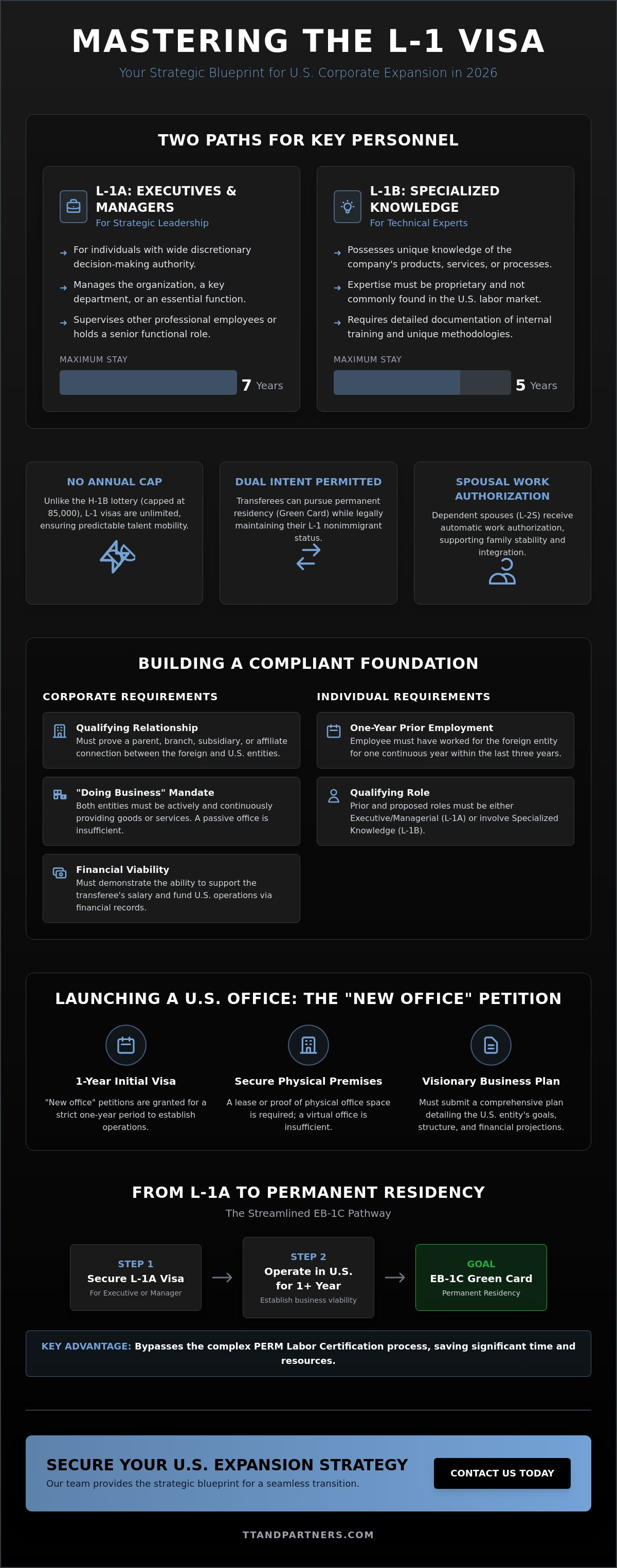
The L-1 Visa serves as a foundational pillar for multinational organizations seeking to integrate their global operations within the United States. It's a nonimmigrant classification designed specifically for the seamless movement of personnel from foreign offices to domestic branches, subsidiaries, or affiliates. In 2026, as the corporate fabric becomes increasingly decentralized, this visa acts as a structural bridge, allowing firms to transplant their cultural and technical DNA across borders with architectural precision.
Strategic expansion requires more than just capital; it demands the presence of leaders and experts who understand a company's internal logic. Within the L-1 visa framework, businesses find a predictable path for talent mobility that bypasses the volatility of other visa categories. Unlike the H-1B program, which remains constrained by a strict annual cap of 85,000 petitions, the L-1 category has no numerical limit. This absence of a quota ensures that a company's growth isn't dictated by a lottery, but by its own operational timeline and project milestones.
Benefits extend beyond mere entry. The L-1 classification permits dual intent, meaning transferees can maintain their nonimmigrant status while simultaneously pursuing permanent residency. It's a vision of stability for the professional and the firm alike. Additionally, as of the 2022 USCIS policy updates that remain relevant in 2026, dependent spouses (L-2S) receive automatic work authorization. This holistic approach to relocation acknowledges that the success of a professional often depends on the stability of their family unit.
L-1A for Executives and Managers
Defining "Executive Capacity" requires proof that the individual has wide latitude in making discretionary decisions and oversees the organization's goals. "Managerial Capacity" focuses on the supervision of professional employees or the management of an essential function at a high level. The L-1A is the preferred instrument for leadership because it offers a maximum stay of 7 years. It also provides a streamlined transition to an EB-1C green card, bypassing the lengthy labor certification process. This efficiency is vital for maintaining continuity in long-term corporate strategy.
L-1B for Specialized Knowledge Professionals
Modern innovation relies on "specialized knowledge," which USCIS defines as expertise in a company's product, service, or proprietary interests that's not easily found in the general labor market. In 2026, this often involves advanced AI integration or niche engineering protocols. A common pitfall is failing to distinguish proprietary knowledge from general industry skills. Successful petitions document specific internal training and unique methodologies. The L-1B allows for a 5-year total stay, providing a sufficient window to complete complex technical implementations or knowledge transfers. For tailored advice on structuring your global team, you can reach out to us at https://www.ttandpartners.com/contact.
Qualifying for the L-1: Corporate and Individual Requirements
The L-1 Visa demands a structural foundation as rigorous as a technical blueprint. To succeed, the petitioning entity must demonstrate a qualifying relationship with the foreign company. This isn't a mere suggestion of partnership; it requires clear evidence of common ownership or control. The "Doing Business" mandate requires that both the U.S. and the foreign entity provide goods or services in a regular, systematic, and continuous manner for the duration of the beneficiary's stay. Merely having an agent or a passive office is insufficient for these purposes.
Establishing financial viability is equally critical. USCIS examiners look for evidence that the organization can support the transferee's salary and business operations. This often involves submitting 2024 tax returns, audited financial statements, or bank records showing sufficient liquidity. For those planning a complex expansion, ensuring your corporate structure aligns with these legal parameters is vital. You can contact our team to discuss the strategic alignment needed for your international growth.
The Corporate Connection: Parent, Branch, Subsidiary, or Affiliate
Qualifying structures include parent companies, branches, subsidiaries, or affiliates. USCIS recognizes complex arrangements where a parent holds at least 50% of a subsidiary, or even 50/50 joint ventures where both parties have equal control and veto power. Minority ownership might qualify if the petitioner proves "de facto" control over the business operations through proxy agreements or management contracts. A qualifying organization is a United States or foreign legal entity that meets the specific ownership and control requirements to facilitate the transfer of personnel between related business components.
The Continuous Employment Requirement
The transferee must have worked for the foreign entity for one continuous year within the three years immediately preceding their admission to the U.S. This 365-day period is strict. While brief trips to the U.S. for business or pleasure don't interrupt the continuity of employment, those days spent on American soil don't count toward the one-year requirement. You can review the specific USCIS L-1A requirements to see how they define these roles. Petitioners must use detailed organizational charts and payroll records to prove the foreign role was truly executive, managerial, or specialized.
To provide a clear picture of eligibility, the following evidence is typically required:
Proof of Affiliation: Stock certificates, articles of incorporation, or partnership agreements.
Operational Activity: Recent invoices, shipping manifests, or 2025 service contracts.
Physical Premises: A signed lease agreement for the U.S. office, usually spanning at least 12 months.
Employment History: Pay stubs or tax documents confirming the beneficiary's one-year tenure abroad.
The L-1 Visa process rewards precision. Every document must serve as a pillar supporting the claim that the business is a single, cohesive unit operating across borders. By treating the application like a high-stakes design project, companies can ensure their global talent moves seamlessly into the U.S. market.
Launching a US Subsidiary: The L-1 New Office Petition
The L-1 Visa provides a sophisticated pathway for organizations aiming to embed themselves within the American market. Establishing a new office isn't merely a logistical hurdle; it's a strategic design choice that requires a clear vision of the future. Unlike standard transfers, the "New Office" petition allows a foreign entity to send an executive or manager to the US specifically to build a new subsidiary from the ground up. This initial phase is characterized by a one-year validity period, a condensed timeframe that demands immediate operational momentum and architectural precision in business planning.
Success begins with the physical environment. Authorities require proof that the company has secured a physical premise. A residential address or a mere P.O. box won't suffice; the space must reflect the functional needs of the business and its projected growth. This physical footprint serves as the first tangible evidence of the company’s commitment to the new territory, acting as the anchor for all future operations.
Requirements for New Office Petitions
A petition's strength rests on its financial foundation. The parent company must demonstrate the fiscal capacity to sustain the US operations and compensate the beneficiary during the startup phase. This isn't about vague promises. It requires detailed bank statements and audited financials from the foreign entity. Central to this process is a comprehensive five-year business plan. This document functions as the project’s blueprint, detailing the organizational structure, market analysis, and revenue projections. If you're still in the early stages of structural planning, understanding LLC Incorporation is a vital step in defining your US business architecture.
The USCIS L-1A Visa Requirements emphasize that the entity must maintain a qualifying relationship. This means the US office must be a branch, subsidiary, or affiliate of the foreign company. Precision in these legal definitions prevents structural failures during the adjudication process and ensures the L-1 Visa remains a viable bridge for the organization.
The First Year Roadmap to Success
The first twelve months are a high-stakes proof of concept. By the end of this period, the office must have matured beyond a shell entity. It needs to support a managerial or executive position. This usually means hiring a minimum of three to five full-time employees by the end of year one to handle day-to-day tasks, allowing the L-1 holder to focus on high-level strategy rather than clerical duties. Documenting these active operations is critical for the extension petition.
Hiring milestones: Ensure the organizational chart evolves according to the business plan, showing a clear hierarchy.
Financial transparency: Maintain meticulous records of capital investment and operational expenses to prove the office is "doing business."
Avoid RFE triggers: Ensure the office space is sufficient for the planned headcount and that the manager's duties remain strictly executive.
The transition from a startup to a standard L-1 extension depends on the integrity of the first year's data. It's a period of intense construction where every hire and every contract serves as a brick in the foundation of a permanent US presence. If you need guidance on aligning your corporate structure with these requirements, you can reach out to our team through our contact page.
Strategic Alternatives: Comparing L-1 with E-2 and O-1 Visas
Selecting the appropriate legal framework for US expansion requires the same precision as drafting a master plan for a complex architectural site. Every detail must align with the broader vision of the organization. While the L-1 Visa offers a robust bridge for established firms, it's essential to analyze how it compares to other specialized pathways. The choice isn't merely about entry; it's about the structural integrity of your long-term residency goals and how they fit into the global corporate fabric of 2026.
L-1 vs. E-2 Treaty Investor Visa
The primary distinction between these two paths lies in nationality and investment focus. The E-2 visa is restricted to citizens of approximately 80 countries that maintain specific commerce treaties with the United States. For entrepreneurs from India or China, the E-2 is generally unavailable, making the L-1 Visa the essential alternative. While the E-2 focuses on the "substantiality" of the capital investment, the L-1 prioritizes the existing organizational hierarchy. It's a transfer of human capital rather than just financial assets. This makes the L-1 ideal for firms that don't want to tie up excessive liquidity but have a proven management structure abroad. For a deeper look at investment-led entry, see our E-2 Visa Guide.
L-1 vs. O-1 Extraordinary Ability Visa
If the L-1 is about the company, the O-1 is about the individual. The O-1 visa caters to those who possess a "distinguished" reputation in their field, such as technology, science, or architecture. An entrepreneur might choose the O-1 to avoid the L-1 requirement of one year of prior employment at a foreign affiliate. However, the L-1 offers a clearer path to permanent residency through the EB-1C category, which mirrors the L-1A requirements. The O-1 requires proof of international awards or high-impact press, whereas the L-1 relies on the functional relationship between the foreign and US entities. You can explore this talent-based route in our guide on the O-1 Visa for Entrepreneurs.
Evaluating these options requires a holistic view of your professional context. Consider these factors:
Nationality: E-2 requires treaty status; L-1 and O-1 are open to all.
Duration: L-1 has a firm 5 or 7-year cap; O-1 and E-2 can technically be extended indefinitely.
Ownership: L-1 requires a qualifying corporate relationship; O-1 is more flexible regarding the employer-employee bond.
Green Card Path: L-1A provides a direct, non-labor-certification route to a green card.
The right choice depends on whether you're building a personal legacy or scaling a corporate entity. Each visa functions as a different tool in your strategic toolkit, designed to solve specific challenges of international mobility. If you're ready to define your US entry strategy with the precision your business deserves, contact our strategic advisors to discuss your structural requirements.
From L-1A to Permanent Residency: The EB-1C Green Card Pathway
The L-1 Visa offers a unique legal architecture through the dual intent doctrine. Unlike many nonimmigrant categories that require applicants to prove they intend to return home, the L-1 framework explicitly allows for permanent residency goals. This creates a safe harbor for executives and managers. It means you can lead a US expansion while simultaneously building a foundation for a future in the United States without risking your current status. It isn't just a temporary permit; it's a strategic blueprint for long-term stability.
Transitioning from an L-1A to an EB-1C green card is often the most logical progression for multinational leaders. The EB-1C category mirrors the L-1A requirements, focusing on managerial or executive roles held abroad and within the US entity. Timing is the most critical element in this design. While an L-1A for a "new office" is initially granted for one year, the I-140 immigrant petition usually requires the US company to be active and operational for at least 12 months before filing. We recommend initiating the green card process once the US branch demonstrates the structural complexity needed to support a permanent executive role.
The transition requires precision in documentation. Every duty performed under the L-1 Visa must align with the rigorous standards of the EB-1C. This consistency ensures that the professional narrative remains coherent from the first day of the transfer to the final approval of the green card. It's about building a legacy of corporate growth that justifies a permanent presence in the American market.
The EB-1C Advantage: No Labor Certification Required
The primary benefit of the EB-1C pathway is the exemption from the PERM Labor Certification process. In current 2024 and 2025 processing cycles, the Department of Labor often takes 12 to 18 months to certify a position. By bypassing this phase, multinational managers save significant time and reduce administrative hurdles. This efficiency allows for a direct filing of the I-140 petition. You can learn more about the financial and logistical components of this journey in our guide on How Much is a Green Card. Matching L-1A duties to EB-1C requirements early on prevents future evidentiary gaps.
Implementation with TT and Partners
We provide a customized legal strategy for US-Italy cross-border operations, ensuring that the transition from nonimmigrant to immigrant status is seamless. Our approach manages the complexity of international litigation and corporate compliance with the same rigor applied to a master architectural plan. We focus on the harmony between your corporate goals and the strict demands of USCIS. For a comprehensive review of your eligibility and a tailored L-1 strategy consultation, our expert team is ready to assist you in designing your professional future in the United States.
Architecting Your Global Expansion
Establishing a presence in the United States requires the same structural integrity as a master-planned development. The L-1 Visa serves as a foundational pillar for organizations bridging the Atlantic; it offers a clear path from initial subsidiary setup to the EB-1C permanent residency status. Success hinges on precise alignment with 2026 USCIS regulatory frameworks and a meticulous approach to the New Office Petition. Whether your strategy involves a direct transfer or evaluating alternatives like the E-2 or O-1 categories, the objective remains the same: sustainable growth within the American market. Our firm brings specialized expertise in US-Italy cross-border law to every engagement. We've managed a diverse portfolio of successful petitions, providing comprehensive support that spans from initial LLC incorporation to final Green Card approval. Your international expansion deserves a partner who understands both the legal architecture and the visionary goals behind the move. We're ready to help you build your future across borders.
Frequently Asked Questions
Can I apply for an L-1 visa if I am the sole owner of my foreign company?
Yes, you can apply for an L-1 visa as a sole owner if the U.S. entity functions as a distinct legal corporation. The structural framework must demonstrate that the company exists independently of your personal identity. In 2024, USCIS clarified that self-petitioning is viable as long as a board of directors or similar body retains the power to supervise or terminate your employment.
What is the minimum investment required for an L-1 New Office visa?
There's no statutory minimum investment for an L-1 visa new office petition. However, industry data from 2025 indicates that initial capital between $100,000 and $150,000 typically demonstrates the financial capacity to sustain operations. This investment ensures the physical premises and operational infrastructure align with the projected business growth within the first 12 months of the entity's existence.
How long does the L-1 visa processing take in 2026?
Standard processing for an L-1 visa currently ranges from 3 to 6 months depending on the specific service center workload. You can utilize the Premium Processing Service for an additional fee of $2,805 to receive a decision within 15 calendar days. This accelerated timeline allows for precise strategic planning and timely mobilization of executive talent across international borders without unnecessary delays.
Can my spouse work in the US if I have an L-1 visa?
Yes, your spouse is eligible to work in the United States immediately upon entry under L-2S status. The Department of Homeland Security's 2021 policy update confirms that L-2 spouses have work authorization incident to their status. They don't need to apply for a separate Employment Authorization Document; their I-94 record serves as sufficient proof for employers during the hiring process.
Is there a minimum salary requirement for L-1 visa holders?
No specific prevailing wage requirement exists for L-1 visa holders, unlike the H-1B category. The compensation must still reflect the executive or managerial nature of the role within the local market context. If a manager's salary falls below the 25th percentile for their specific metropolitan area, USCIS may question whether the position truly qualifies as a high-level leadership role.
What happens if my L-1 extension is denied after the first year?
You must stop working immediately and depart the United States if your L-1 extension is denied after the initial one-year New Office period. There's no grace period for work authorization once the denial notice is issued. Most professionals have 30 days to settle their affairs or file for a change of status to avoid accruing unlawful presence in the country.
Can a non-profit organization sponsor an L-1 worker?
Non-profit organizations can sponsor L-1 workers provided they meet the definition of a qualifying legal entity. The organization must maintain a structured relationship between the foreign office and the U.S. branch, such as an affiliate or subsidiary bond. This allows religious, charitable, or educational institutions to transfer specialized talent to support their mission-driven objectives within the American urban fabric.
Does the L-1 visa require a specific educational degree?
The L-1 visa doesn't mandate a specific university degree as a statutory requirement for approval. While a bachelor's degree is standard for L-1B specialized knowledge workers, L-1A managers can qualify based on their professional experience and organizational rank. Evidence of managing a department or a functional team carries more weight than a specific academic credential in the eyes of immigration officers.


Comments