

How to Get Italian Dual Citizenship: The 2026 Strategic Guide to Lineage and Law
- Gianni Mendes Toniutti, Esq.

- Apr 26
- 13 min read
What if the legacy your ancestors left behind isn't just a memory, but a structural blueprint for your future in the European Union? You likely feel the pressure of the March 2025 legislative shifts and the reality of consulate wait times that now often exceed 730 days. It's natural to worry that a specific naturalization date or a perceived break in your lineage might collapse your entire claim. Understanding how to get italian dual citizenship requires the same precision as restoring a historic landmark; it demands an appreciation for the original foundation and a mastery of modern legal frameworks.
We've designed this 2026 strategic guide to provide you with a definitive roadmap through the complexities of descent, marriage, and judicial appeals. You'll gain a clear "yes or no" on your eligibility while discovering how a professional partner can manage the cross-border legal intricacies on your behalf. We'll examine the specific impact of recent legislative updates and the exact steps to securing your Italian passport for global travel and investment.
Key Takeaways
Understand how the March 2025 legislative reforms have reshaped the procedural landscape, establishing a new timeline for citizenship recognition in 2026.
Navigate the complexities of how to get italian dual citizenship by identifying the specific legal framework that applies to your lineage, including standard jure sanguinis and 1948 Rule judicial appeals.
Learn to verify the "unbroken line" through a precise analysis of your Last Italian Ancestor’s naturalization history and the specific impact of the 1912 Law.
Master the strategic roadmap for document acquisition, utilizing "One and the Same" court orders to harmonize discrepancies between international vital records.
Explore how to leverage an EU passport as a pillar of a broader international strategy, integrating citizenship with treaty investor frameworks and global business structures.
Table of Contents The Landscape of Italian Dual Citizenship in 2026 Pathways to Recognition: Jure Sanguinis, Marriage, and the 1948 Rule Eligibility and the 'Unbroken Line' Requirement The Strategic Roadmap: Document Gathering and Judicial Appeals Securing Your Legacy: How TT & Partners Bridges the US-Italy Divide
The Landscape of Italian Dual Citizenship in 2026
The principle of jure sanguinis, or the "right of blood," serves as the structural foundation of Italian nationality law. This legal framework asserts that citizenship is an inherent birthright passed through lineage, regardless of where an individual was born. Understanding how to get italian dual citizenship in 2026 requires a precise grasp of how this ancestral right interacts with modern statutory evolutions. While the core philosophy remains unchanged, the practical application has moved toward a more rigorous, evidence-based model that prioritizes the integrity of the Italian civil registry.
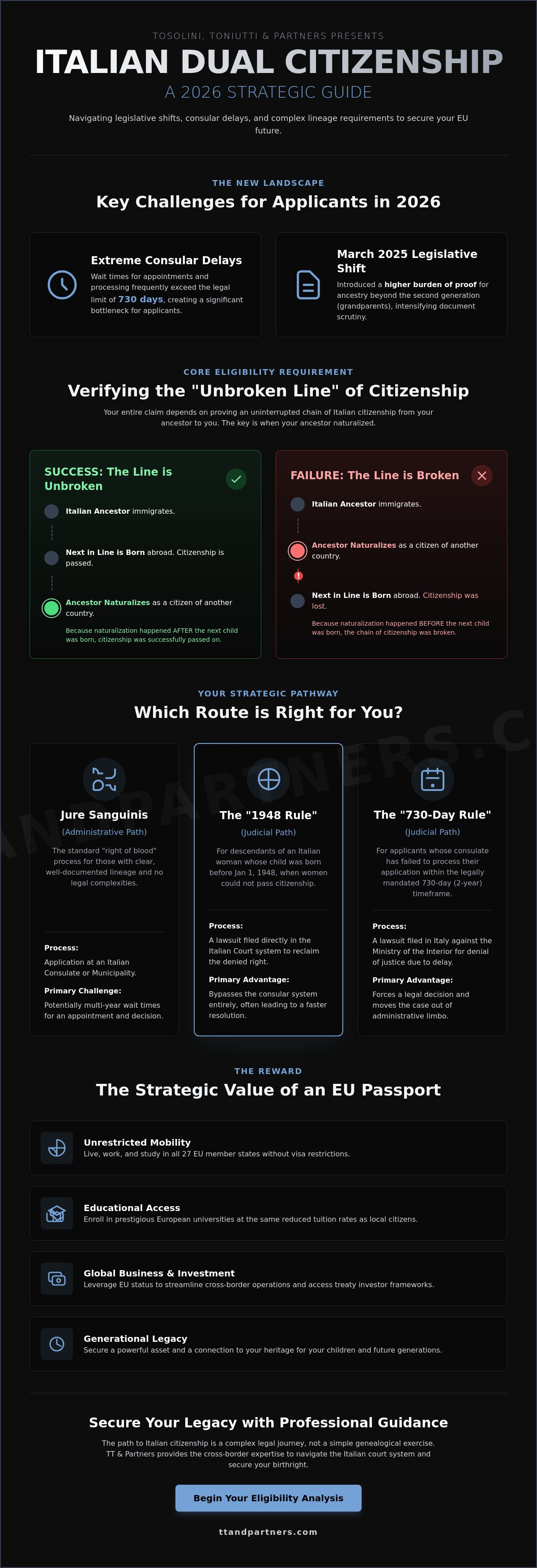
The current environment distinguishes clearly between administrative recognition and judicial reclamation. Administrative paths are typically managed through Italian consulates or local municipalities for those with clear, documented lineages. Judicial reclamation, however, has become the primary vehicle for complex cases, such as "1948 cases" involving female ancestors or instances where consulates fail to meet the legal 730-day processing window. This distinction is critical for applicants who need to bypass the systemic bottlenecks that have defined the last decade of citizenship applications.
Understanding the 2025 Legislative Shift
A decree from the Council of Ministers in March 2025 introduced a pivotal shift in how lineage is verified. This legislation aims to address the massive backlog by tightening the requirements for applicants tracing their heritage beyond the second generation, or their grandparents. While the right still exists for those with more distant ancestors, the burden of proof regarding the "unbroken line" has intensified. The unbroken line is the continuous chain of citizenship where no ancestor in the direct path renounced their Italian nationality before the birth of the next descendant.
For applicants in 2026, these changes mean that documentation must be more than just present; it must be perfectly synchronized across multiple jurisdictions. The 2025 decree has made it harder for those beyond the second generation to use simple administrative routes, often pushing these files toward the Italian court system for a more formal legal determination. This shift reflects a move toward quality and precision in the "urban fabric" of the Italian citizenry.
The Value of an Italian Passport in a Global Economy
Securing an Italian passport is a strategic move that extends far beyond sentimental value. It grants the holder full rights within the 27 member states of the European Union, including the freedom to live, work, and study without the need for restrictive visas. For US citizens, this status facilitates a seamless transition into European markets, providing a competitive edge in professional mobility and residency planning. This legal standing is especially relevant for those involved in international litigation or cross-border business ventures where EU status simplifies regulatory hurdles.
Educational Access: Enrollment in prestigious European universities at the same tuition rates as local citizens.
Healthcare Security: Access to the Italian national health service, known for its high standards and lower costs compared to US private insurance.
Strategic Mobility: The ability to move assets and operations across borders with the protection of EU law.
If you're evaluating how to get italian dual citizenship under these new regulations, professional guidance is essential to ensure your lineage meets the 2026 standards. You can reach out to our team at TT and Partners to discuss the specifics of your family history and legal standing.
Pathways to Recognition: Jure Sanguinis, Marriage, and the 1948 Rule
Establishing a legal connection to Italy requires a precise understanding of historical frameworks and legislative evolution. For most applicants, the investigation into how to get italian dual citizenship begins with the principle of Jure Sanguinis, or the right of blood. This pathway recognizes citizenship as an inherent trait passed through generations; it doesn't impose a limit on how far back one can trace their lineage, provided the chain remains unbroken by formal renunciation or untimely naturalization. To ensure the structural integrity of your application, it's essential to consult the official requirements for citizenship by descent before gathering vital records from Italian communes.
While lineage is the most common route, the Italian legal landscape offers alternative entries for those outside the direct paternal line. Naturalization remains a viable, albeit longer, process for residents. Non-EU citizens must maintain legal residency for 10 years to qualify; this period is reduced to four years for EU nationals. This path demands a holistic commitment to the Italian social fabric, including consistent tax contributions and a clean criminal record. Understanding how to get italian dual citizenship through these varied channels allows for a strategic approach tailored to your specific family history and future mobility goals.
The '1948 Case' and Maternal Lineage
Until the Italian Constitution took effect on January 1, 1948, women didn't possess the legal right to pass citizenship to their children. This gender-based discrimination created a "1948 Rule" that blocked many from administrative recognition. However, a landmark 2009 Supreme Court ruling established that this inequality was unconstitutional. Today, descendants of Italian mothers born before 1948 can secure citizenship through a judicial motion. Since June 22, 2022, these cases are no longer centralized in Rome; they're heard in the regional court where the ancestor was born. This shift has decentralized the process, often resulting in more efficient rulings against the Ministry of Interior.
Citizenship by Marriage (Jure Matrimonii)
Recognition through marriage, or Jure Matrimonii, is governed by strict residency and language criteria. Under the 2018 Salvini Decree, all applicants must achieve a B1 level of Italian language proficiency. The timeline for eligibility is three years for those living abroad, or two years for those residing in Italy. If the couple has children under 18, these timelines are reduced by 50%. This pathway is particularly effective when integrated with a Green Card strategy, allowing spouses to maintain seamless residency rights in both the United States and the European Union. If you're ready to design your future across borders, you may reach out to our team for a consultation on document preparation.
Eligibility and the 'Unbroken Line' Requirement
The core of understanding how to get italian dual citizenship rests on the principle of jure sanguinis, or right of blood. This legal framework functions like a structural blueprint where every connection must be load-bearing. Your Last Italian Ancestor (LIA) serves as the foundation. This individual must have been alive and an Italian citizen on or after March 17, 1861, which marks the date of Italy's unification. Precision is mandatory. If the ancestor died or naturalized before this date, the line of transmission failed before it truly began.
The 1912 Law, specifically Law n. 555/1912, remains the most critical historical reference for US-born descendants. It established that an Italian citizen who naturalized in another country lost their original citizenship. Many Americans discover they are eligible for Italian citizenship because their ancestor didn't naturalize until after the next generation was born. This "unbroken line" ensures the right was passed down at birth. While the 1992 transition (Law n. 91/1992) finally allowed Italians to hold dual citizenship without penalty from August 15, 1992, it doesn't retroactively repair breaks that occurred in previous decades.
The Naturalization Cutoff Analysis
Verifying the naturalization date is the most rigorous phase of the process. You'll need to coordinate searches through the United States Citizenship and Immigration Services (USCIS) and the National Archives and Records Administration (NARA). If your ancestor never became a US citizen, you must obtain a "Certificate of Non-Existence" to prove they remained Italian until their death. The birth of the next in line must precede the ancestor's US naturalization. This chronological sequence is the only way to ensure the Italian status wasn't forfeited before it could be inherited.
Addressing the 'Minor Issue' Controversy
The legal landscape shifted significantly following several 2024 and 2025 court rulings in Italy. These decisions focus on the "Minor Issue," where Italian authorities question the lineage if a parent naturalized while their child was still a minor. Some courts now argue that the child's citizenship was lost along with the parent's, even if the child was born in the US.
Navigating how to get italian dual citizenship in 2026 requires a strategy that anticipates these contested interpretations. Success depends on presenting a robust legal architecture that emphasizes the child's independent right to citizenship under international law. Because these cases are increasingly complex, you can contact specialized legal experts to ensure your documentation survives this heightened scrutiny. Professional representation is no longer optional for lineages involving ancestors who naturalized before their children reached adulthood.
The Strategic Roadmap: Document Gathering and Judicial Appeals
Building a successful application for recognition of lineage requires the same structural integrity as a masterfully designed architectural project. The process unfolds in five distinct phases. It begins with the procurement of vital records from Italian Comuni, which serves as the foundation. Following this, you'll acquire US records and secure "One and the Same" (OATS) court orders to resolve any historical discrepancies. The third phase involves the Apostille process and certified translations to ensure every document meets international legal standards. From there, you must choose between the traditional Consulate path or an "Against the Delay" lawsuit. The final phase concludes with AIRE registration and the issuance of your Italian passport.
Document Procurement: The Foundation of the Case
The integrity of your claim depends on the precision of your documentation. When communicating with Italian Comuni for birth, marriage, or death certificates, you're often reaching back into 19th-century archives. Accuracy is paramount. If your ancestor's name changed from "Giovanni" to "John" upon arrival at Ellis Island, you'll likely need an OATS order from a US court to prove they're the same person. This legal bridge prevents Italian authorities from rejecting your file due to clerical inconsistencies. Once gathered, every US document must receive an Apostille, a specific certification under the 1961 Hague Convention that validates the record for use in Italy. Without this seal, the document holds no legal weight abroad.
Bypassing the Consulate: The Judicial Appeal
Understanding how to get italian dual citizenship in 2026 often means looking beyond the crowded consulate system. For many, the "Against the Delay" lawsuit is the most efficient path. Since the landmark reform on June 22, 2022, these cases are no longer centralized in Rome. Instead, they're heard in the regional Tribunali corresponding to your ancestor’s place of birth. This decentralization across Italy's 26 judicial districts has streamlined the process, though it requires local expertise in specific regional court behaviors.
If a consulate cannot provide an appointment within 730 days, you have the legal right to petition the Italian courts for recognition. Success rates for these judicial cases remained exceptionally high in 2025, with over 97% of well-documented files receiving a positive ruling. The timeline for a court decision currently averages 12 to 18 months, which is significantly faster than the decade-long wait times reported at major consulates in New York or San Francisco. This judicial route offers a transparent, calendar-based alternative to the administrative backlog. It's a strategic choice for those who value certainty and professional oversight in their citizenship journey.
If you're ready to begin your ancestral research or require professional guidance on the judicial path, contact our strategic team today to review your lineage.
Securing Your Legacy: How TT & Partners Bridges the US-Italy Divide
Establishing a multi-generational legacy requires more than just administrative filing; it demands a sophisticated understanding of the structural intersection between American documentation and Italian jurisprudence. We view the process of how to get italian dual citizenship as an architectural challenge where every record serves as a foundation stone. Our dual-jurisdiction approach ensures that US vital records are not only collected but are legally optimized to withstand the scrutiny of Italian regional courts, particularly following the June 22, 2022, decentralization reforms that shifted cases from Rome to local jurisdictions.
For entrepreneurs, this path isn't an isolated endeavor. We provide a cohesive framework where citizenship works in tandem with your commercial interests. Whether you're exploring an E-2 Visa for transatlantic investment or refining your corporate structure through LLC Incorporation, our team ensures your legal identity supports your business architecture. We don't just process papers; we design a comprehensive status that integrates with your global tax and residency profile to ensure long-term functionality.
The distinction between "document preparation" and attorney-led litigation is vital. While basic services might gather certificates, they lack the standing to represent you in the Italian judicial system. This is critical for 1948 cases or instances where "OATS" (One and the Same) court orders are required to resolve discrepancies. We manage the entire lifecycle of your application, ensuring the structural integrity of your lineage remains intact from the initial search to the final decree. This professional oversight prevents the 12 to 18-month delays often caused by improperly formatted petitions.
Why Professional Legal Counsel is Non-Negotiable
The legal landscape is shifting. With the 2025 procedural updates, the precision required for name consistency and dates has reached a new threshold. Errors that were overlooked in 2021 now lead to immediate rejections. Our attorneys specialize in navigating these complexities, handling "OATS" orders to fix 19th-century spelling variations that often sink DIY attempts. We also ensure your future compliance with Italian tax laws and AIRE registration, protecting your assets from unforeseen liabilities after your passport is issued.
Contact TT & Partners for a Strategic Consultation
Our process begins with a deep dive into your family history to identify structural weaknesses before they become legal roadblocks. We treat every client relationship as a partnership, moving beyond the transactional to provide visionary guidance on how to get italian dual citizenship in a way that serves your long-term goals. If you're ready to bridge the divide between your current reality and your European future, reach out via our contact page to begin your journey.
Securing Your Italian Heritage for 2026 and Beyond
The journey to reclaiming your heritage requires more than just nostalgia; it demands a strategic architectural framework. Navigating the complexities of how to get italian dual citizenship involves verifying an unbroken lineage and understanding the specific judicial precedents surrounding 1948 Rule cases. Since the 2022 reform shifted judicial citizenship cases to local courts, the landscape for recognition has transformed, making precise document procurement essential for success.
TT & Partners approaches these legal landscapes with the same rigor we apply to structural design. Our firm provides dual-jurisdiction expertise in both US and Italian law, ensuring your application withstands the scrutiny of the 2026 legal climate. We specialize in complex 1948 and "Consular Delay" judicial cases, offering comprehensive support from initial document gathering to the final issuance of your passport. This isn't just a legal process; it's the construction of a permanent bridge between your past and your future.
Schedule a Strategic Citizenship Consultation with TT & Partners to begin your transition into global citizenship. Your legacy is ready for its foundation.
Frequently Asked Questions
Is Italian dual citizenship still available after the 2025 law changes?
Yes, Italian dual citizenship remains a valid legal pathway in 2026. While the 2025 legislative reforms introduced stricter document verification standards, the core principle of jure sanguinis remains unchanged. You can still secure your status if you provide a clear genealogical link. Current data shows that over 80 percent of applications are successful when documentation meets the updated technical specifications required by the Italian Ministry of the Interior.
How long does it take to get Italian dual citizenship in 2026?
You should expect a timeline of 18 to 36 months to finalize your application. Processing times at Italian consulates are legally capped at 730 days, but administrative backlogs often extend this period. If you choose a judicial path through regional courts, cases typically resolve within 24 months. Understanding how to get italian dual citizenship involves navigating these specific administrative durations with a structured, long term perspective on your legal heritage.
Can I get Italian citizenship if my ancestor naturalized as a US citizen?
You qualify if your ancestor naturalized after the birth of their child. Under the 1912 Law, an Italian citizen who took foreign nationality before June 14, 1912, automatically lost their citizenship. If they naturalized after their child was born and after this 1912 date, the lineage remains unbroken. This specific sequence acts as the structural foundation for your claim. Verification requires a official letter from USCIS if naturalization never occurred.
What is the '1948 Case' and does it apply to my maternal lineage?
The 1948 Case applies if your female ancestor gave birth before January 1, 1948. Prior to this date, Italian law didn't allow women to pass citizenship to their children. A 2009 Supreme Court ruling deemed this discriminatory. You can now challenge this through a civil lawsuit in the Italian court system. These cases have a success rate exceeding 95 percent when the ancestral link is clearly documented through vital records and historical context.
Do I need to speak Italian to qualify for citizenship by descent?
You don't need to speak Italian for a lineage based application. While the 2018 Salvini Decree mandates a B1 level language certificate for citizenship by marriage or residency, it excludes jure sanguinis applicants. Your eligibility relies on the precision of your historical records rather than linguistic proficiency. This distinction ensures the process remains accessible to the global diaspora. Learning the language is a personal choice rather than a functional requirement for your legal success.
What happens if I cannot find my ancestor's Italian birth certificate?
You must search the State Archives or the specific Comune registry where they were born. If records were destroyed during World War II, you can often substitute baptismal records combined with a letter of non existence from the local civil office. Approximately 15 percent of applicants face missing records due to historical conflict. In these scenarios, secondary evidence like military records or census data helps reconstruct the necessary genealogical framework for the Italian authorities.
Can I live and work in any EU country once I have an Italian passport?
You gain full mobility rights within the 27 European Union member states. Once you've mastered how to get italian dual citizenship, your Italian passport allows you to live, work, and study in countries like France or Germany without a visa. This right stems from the 1992 Maastricht Treaty. It provides a borderless environment for your professional and personal life. You'll enjoy the same social security and healthcare benefits as any local citizen in your chosen EU country.
What is the cost of applying for Italian dual citizenship with a lawyer?
Legal fees for judicial cases generally range from $4,000 to $10,000. These costs fluctuate based on the complexity of your family tree and the number of family members joining the petition. Government application fees are fixed at 300 Euros per adult applicant at consulates. Investing in professional legal counsel ensures your documents align with the rigorous standards of the Italian court system. This strategic approach minimizes the risk of procedural delays or rejection.


Comments