

E-2 Visa Investment for Italians: 2026 Strategic Guide

Updated: Aug 24
What if the success of your American expansion depended less on the total capital you commit and more on the mathematical relationship between your funds and your industry? For many entrepreneurs, the E-2 visa investment amount for Italian citizens feels like a moving target shrouded in legal ambiguity. You might worry about the risks of transferring significant capital from Italy before a single document is signed or a visa is issued. It's a valid concern, especially when official guidelines replace hard numbers with the elusive concept of a substantial investment.
We understand that navigating the intersection of Italian financial structures and U.S. immigration law requires more than just a bank transfer; it demands a strategic architectural plan. This guide provides the precise financial benchmarks and legal proportionality tests required to secure your status in 2026. You'll discover how the U.S. Embassy evaluates your commitment and the specific steps needed to transform your capital into a viable, job-creating enterprise. We'll outline the path from initial entity formation to your final consular processing, ensuring your investment meets every regulatory threshold with professional precision and visionary clarity.
Table of Contents
Defining Substantial Investment for Italian E-2 Applicants
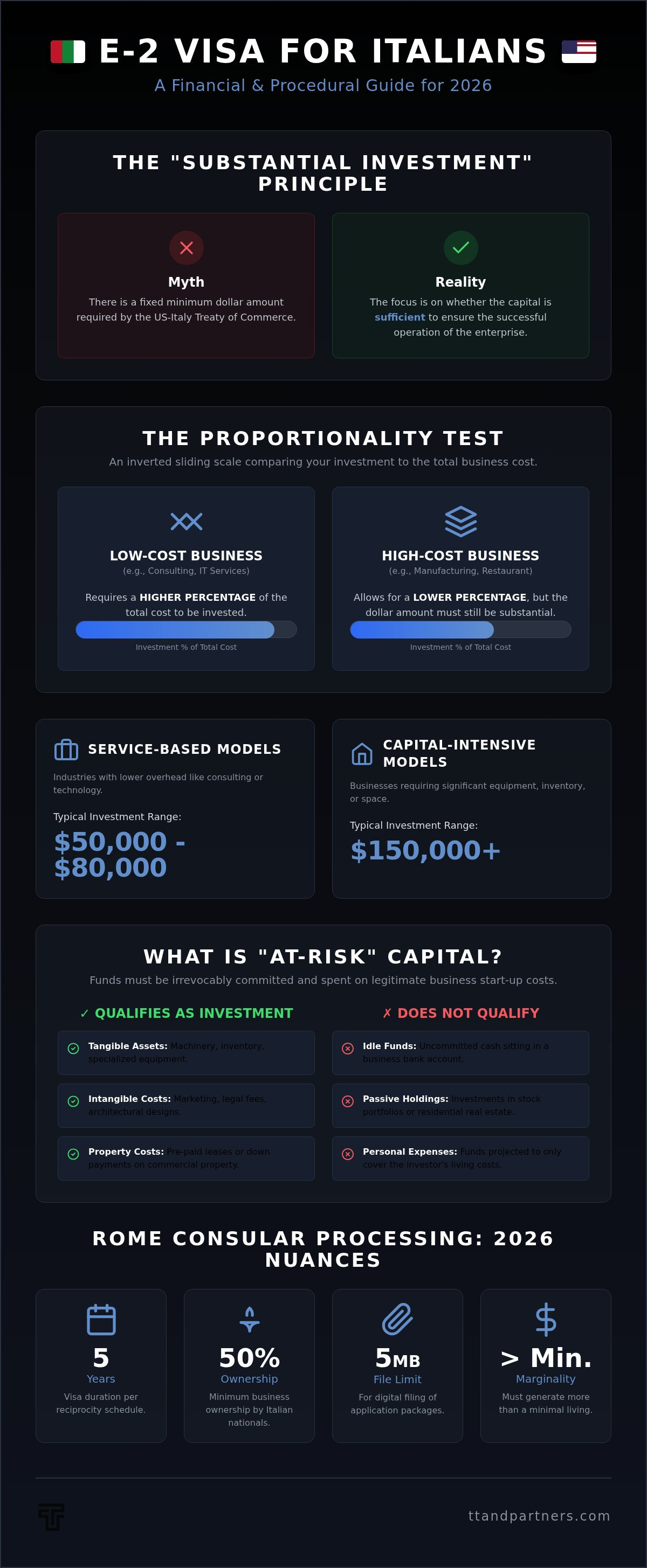
The concept of a substantial investment is the cornerstone of any successful application. It's often the primary source of anxiety because US law deliberately avoids setting a hard floor. Determining the ideal E-2 visa investment amount for Italian citizens is a qualitative exercise rather than a quantitative one. It requires demonstrating that the capital is sufficient to ensure the successful operation of the enterprise. This is not about a minimum check; it's about the financial viability of the business model itself. Consular officers in Rome look for a clear alignment between the funds committed and the specific requirements of the industry.
In 2026, the reciprocity schedule for Italian nationals remains set at five years. This duration provides a stable horizon for business planning, yet the visa's longevity is tied directly to the active nature of the investment. Passive holdings, such as residential real estate or stock portfolios, don't qualify. The investment must involve a real, operating commercial enterprise that produces a service or commodity. For a detailed E-2 visa overview, one can see how these requirements have evolved to prioritize economic impact over mere wealth transfer.
The Treaty of Commerce and Navigation
The legal foundation of this opportunity rests upon the historic 1871 and 1948 treaties between the United States and Italy. These agreements establish the unique eligibility of Italian nationals to enter the US market as treaty investors. To qualify, the enterprise must possess treaty nationality, meaning at least 50% of the business must be owned by Italian citizens. The E-2 visa serves as a professional non-immigrant bridge for Italian entrepreneurs seeking to scale their vision within the American economy.
Investment vs. Operating Capital
Identifying what constitutes the E-2 visa investment amount for Italian citizens requires distinguishing between spent capital and idle funds. Consular officers look for at risk capital that has been irrevocably committed to the business. This includes:
Tangible assets like machinery, inventory, and specialized equipment.
Intangible costs such as marketing expenses, legal fees for LLC incorporation, and architectural designs.
Pre-paid leases or down payments on commercial property.
Uncommitted funds sitting in a business bank account generally don't count toward the substantiality requirement in 2026. The business must also avoid being categorized as marginal. It must demonstrate the capacity to generate more than just a minimal living for the investor and their family. If projections show only enough profit to cover personal expenses, the application will likely fail the marginality test. Success depends on showing that the business will create jobs for US workers and contribute to the local economy. When budgeting for these initial outlays, it is helpful to explore Professional Legal Service Fees to ensure your capital allocation accounts for necessary legal support.
The Proportionality Test: Benchmarks by Industry
The U.S. Embassy in Rome doesn't view capital through a static lens. Instead, they apply a proportionality test, which functions as an inverted sliding scale. This means the percentage of the investment must increase as the total cost of the business decreases. When determining the E-2 visa investment amount for Italian citizens, the consular officer compares the amount of funds actually invested against the total cost of establishing or purchasing the enterprise. This total cost is the benchmark for substantiality, representing the fair market value of the business or the actual cost to create it from the ground up.
In 2026, the Official USCIS E-2 Investor Criteria remain the foundational guide, yet Rome adds its own layer of scrutiny. They evaluate whether the investment is sufficient to ensure the investor's financial commitment to the successful operation of the enterprise. It's a sophisticated balance between the vision for growth and the concrete capital at hand. The goal is to prove that the investor has a significant stake in the business's success, making the failure of the enterprise a personal financial risk.
Service-Based vs. Capital-Intensive Models
For consulting or IT firms, where overhead is low, the investment benchmarks often range between $50,000 and $80,000. These service models require less physical infrastructure, so a higher percentage of the total startup cost must be invested to meet the treaty requirements. Conversely, restaurants or manufacturing plants typically demand $150,000 or more because the baseline costs for inventory, specialized equipment, and commercial space are significantly higher. Consular officers are well aware of these industry variations and expect the investment to match the reality of the American market.
The business plan serves as the most critical document in this process. It must articulate why the chosen E-2 visa investment amount for Italian citizens is adequate for that specific industry. A well-constructed plan bridges the gap between raw numbers and operational reality, showing how the capital will drive job creation and revenue. If you're preparing your strategy, you can contact our legal team to ensure your financial projections align with current consular expectations.
2026 Proportionality Thresholds
For startups with total costs under $100,000, the proportionality requirement is often 75% to 100%. If the business costs $80,000 to launch, the investor should ideally commit the full amount to demonstrate substantiality. For multi-million dollar acquisitions, the threshold may drop to 50% or lower, provided the dollar amount is objectively large and the business is fully operational. A $100,000 investment may be substantial for a florist but insufficient for a car dealership. This distinction is vital because the embassy evaluates the investment relative to the nature of the specific enterprise rather than applying a universal minimum.
At Risk Capital and the Path of Funds from Italy
Capital must be at risk to qualify for a treaty investor visa. This means the funds must be irrevocably committed to the enterprise before your interview at the U.S. Embassy in Rome. You can't simply show a bank statement with the E-2 visa investment amount for Italian citizens and expect approval. The money must be subject to partial or total loss if the business fails. This requirement often necessitates spending a significant portion of the capital before the visa is even issued. Escrow accounts offer a sophisticated solution for this dilemma. They allow funds to be released to a seller only upon visa approval, protecting the investor's interests while meeting the legal standard of irrevocability.
Documenting the Source of Wealth
Proving the lawful origin of your capital is a rigorous requirement that demands absolute transparency. Under 2026 anti-money laundering standards, the path of funds must be documented with surgical precision. This involves tracing the money from its Italian origin directly to the US enterprise. Italian entrepreneurs should prepare a comprehensive dossier including tax returns, property sale records, or inheritance papers. The Bonifico Estero record is a vital piece of this narrative. It serves as the official link between your Italian financial history and your American future. Every transaction must have a clear, documented trail. Valid sources can include personal savings, gifts from family, or loans secured by personal assets, provided the business itself isn't the collateral. Consular officers are trained to identify gaps in this history, so precision in your record-keeping is non-negotiable.
Safe Investment Strategies
Simply holding cash in a US business account is usually insufficient. Consular officers want to see active deployment of the E-2 visa investment amount for Italian citizens. Evidence of at risk capital typically includes signed commercial lease agreements, purchase orders for specialized equipment, and inventory invoices. These expenditures prove the business is real, active, and ready to operate. In contrast, unspent cash is viewed with skepticism. If the funds aren't actively being used for business purposes, they aren't considered at risk. This distinction is critical for service-based models where physical assets are limited. In such cases, pre-paid marketing contracts or professional service agreements can help demonstrate the required commitment.
Using an integrated strategy is essential for protecting your assets during this transition. Strategic LLC incorporation provides a professional structure to house your investment capital. It separates your personal liabilities from the commercial enterprise while serving as the formal recipient for transferred funds. This architectural approach ensures that every dollar spent contributes directly to the substantiality of your application. If you have questions about specific transfer protocols or Italian banking regulations, you can contact our legal advisors for a tailored consultation.
Rome Consular Processing: 2026 Procedural Nuances
The U.S. Embassy in Rome serves as the exclusive processing hub for all E-2 applications within the Italian territory. In 2026, the procedural landscape demands a high degree of technical finesse, particularly regarding digital submissions. The embassy currently enforces a strict 5MB limit for electronic PDF files. This constraint requires investors to be highly selective, focusing on high-impact evidence rather than exhaustive documentation. You've got to compress files without sacrificing legibility, as a blurry financial statement can lead to immediate administrative delays. It's about presenting a lean, professional dossier that communicates your strategy with surgical precision.
Before submitting your digital package, you must register with the Yatri system. This portal manages the logistics of your appointment and the delivery of your passport. The non-immigrant visa fee for E-category applications is $315 in 2026. Once the fee is paid and the DS-160 is filed, you can proceed with the electronic submission. Current processing times for first-time applicants range between two and five months. This timeline depends on the complexity of your business model and the embassy's current volume of treaty investor cases.
Structuring the E-2 Submission Package
The Rome E-visa unit expects a precise 7-Tab structure. This organizational framework ensures that consular officers can navigate your case with ease. Tab E is dedicated specifically to the evidence of substantial investment. This is where you prove that the E-2 visa investment amount for Italian citizens has been fully committed and is already at risk. You'll need to include bank transfers, wire confirmations, and detailed invoices. Professional translation of all Italian financial documents into English is mandatory. Don't rely on automated tools; the embassy requires certified translations to ensure the integrity of your financial narrative.
The Interview Experience in Rome
The final step is the in-person interview. Officers often focus on the viability of the business and the investor's specific role in its management. Expect detailed inquiries regarding the proportionality of your capital and whether the business is marginal. You must demonstrate that the enterprise will grow beyond a mere source of income for your family. The Rome E-visa unit prioritizes the clarity of the financial narrative over the sheer volume of documents. Be prepared to explain your five-year projections and your plan for hiring U.S. workers. When you're ready to navigate this complex procedural landscape, you can consult with our Rome-based specialists to ensure your package meets every consular standard.
Legal Precision: Maximizing ROI on Your E-2 Investment
The financial commitment involved in an E-2 application is significant, but the true cost of the process often lies in administrative delays. Attempting a DIY approach frequently results in a Request for Evidence (RFE), which can stall your business launch by six months or more. When calculating the E-2 visa investment amount for Italian citizens, you've got to account for the opportunity cost of these delays. A rejected or delayed application doesn't just postpone your entry; it disrupts your operational momentum and market entry strategy. Precision in the initial filing is the only way to protect your return on investment.
Success requires an integrated legal framework that treats the visa as one component of a larger corporate architecture. This means coordinating your immigration strategy with Real Estate Closings and business acquisitions from the outset. Tosolini, Toniutti & Partners manages this US-Italy cross-border legal gap by providing a bilingual bridge between two distinct regulatory environments. We ensure that your capital isn't just spent but strategically deployed to meet the rigorous standards of the U.S. Embassy in Rome. Our approach minimizes the risk of financial loss and maximizes the speed of your American expansion.
Holistic Business Architecture
A fragmented approach to business setup creates unnecessary friction. Our firm synchronizes LLC incorporation, EIN acquisition, and visa filing into a single, streamlined workflow. This coordination ensures that the E-2 visa investment amount for Italian citizens is reflected accurately across all corporate documents and banking records. We also provide International Litigation support to protect your interests should disputes arise during the acquisition or lease phase. Strategic timing is also vital. We help you determine when to transfer funds to minimize currency exchange risks between the Euro and the Dollar, preserving the value of your initial capital.
Securing Your US Business Future
Your journey shouldn't end with a five-year visa. Many Italian entrepreneurs eventually look toward transitioning from E-2 status to Permanent Residency. Having a long-term strategy in place from day one ensures that your business growth aligns with future Green Card eligibility. Our bilingual, cross-border counsel provides the peace of mind necessary to focus on your enterprise while we handle the legal complexities. Before you commit your capital, ensure you've checked every box for the 2026 landscape:
Verified treaty nationality of the US entity through majority Italian ownership.
Documented "at risk" status of all committed funds with clear wire confirmations.
A comprehensive five-year business plan with realistic job creation projections.
Expertise is the most valuable asset in your expansion toolkit. Contact Tosolini, Toniutti & Partners for a strategic evaluation of your E-2 investment and secure your professional future in the United States.
Architecting Your American Expansion
Success in the U.S. market begins with a shift from viewing capital as a hurdle to seeing it as a strategic foundation. The E-2 visa investment amount for Italian citizens is defined by the proportionality of your enterprise rather than a rigid minimum. By ensuring your funds are irrevocably committed and your financial narrative is documented with precision, you satisfy the rigorous standards of the U.S. Embassy in Rome. This process isn't merely about legal compliance; it's about building a sustainable business architecture that supports your long-term vision.
Navigating the complexities of cross-border banking, LLC formation, and real estate acquisitions requires a partner who understands the nuances of both systems. Our bilingual team provides the specialized authority needed to manage this transition with professional precision and aesthetic care. We invite you to Schedule a Strategic E-2 Consultation with Our US-Italy Legal Experts to ensure your investment is positioned for maximum impact. Your journey toward American entrepreneurship is a bold step, and with the right strategic framework, your vision can flourish in the world's most dynamic economy.
Frequently Asked Questions
What is the minimum E-2 visa investment amount for Italians in 2026?
There is no official minimum E-2 visa investment amount for Italian citizens set by US law. Instead, the investment must be substantial relative to the total cost of the enterprise. While service-based businesses might succeed with $80,000, capital-intensive ventures often require $150,000 or more. The U.S. Embassy in Rome focuses on whether the capital is sufficient to ensure the business's success and job creation potential within the American market.
Can I use a loan from an Italian bank as my E-2 investment?
You can use a loan from an Italian financial institution provided the debt is secured by your personal assets, such as Italian real estate or personal savings. The E-2 regulations prohibit using the assets of the US enterprise as collateral for the investment funds. Consular officers will require documentation proving the loan's terms and the lawful source of the collateral used to secure the credit line during the application process.
Does buying real estate in the US count as an E-2 investment?
Purchasing residential real estate for personal use or passive rental income does not qualify for an E-2 visa. The investment must be in an active, commercial enterprise. However, if the real estate is an integral part of an operating business, such as a boutique hotel or a commercial development firm, the purchase price may contribute to the total investment amount. The key is demonstrating active management and a broader economic impact beyond simple ownership.
What happens to my investment if the E-2 visa is denied?
Because the capital must be irrevocably committed before the interview, a denial can lead to financial loss if the E-2 visa investment amount for Italian citizens was already spent on equipment or leases. To mitigate this risk, many entrepreneurs use specialized escrow agreements. These contracts ensure that funds are only released to a seller or landlord upon the successful issuance of the visa, protecting your capital while satisfying the legal requirement.
Do I need to hire US employees before my E-2 visa is approved?
You aren't required to have U.S. employees on the payroll at the moment of application, but you must demonstrate a clear capacity to hire them. Your business plan should include a detailed five-year hiring schedule supported by financial projections. For the U.S. Embassy in Rome, showing that the enterprise is not marginal means proving it will create jobs for American workers rather than just providing a minimal living for the investor.
How long can an Italian citizen stay in the US on an E-2 visa?
Italian citizens are typically granted a visa with a five-year validity period under the current reciprocity schedule. However, upon each entry into the United States, Customs and Border Protection officers generally grant a two-year period of authorized stay. You can extend this status indefinitely as long as the business remains operational and continues to meet all treaty investor requirements. It's a flexible status that supports long-term business growth and operational stability.
Can my spouse work in the US if I have an E-2 visa?
Spouses of E-2 visa holders are authorized to work in the United States without restrictions. They don't need to apply for a separate Employment Authorization Document to begin employment. This benefit allows the spouse to work for any employer or even start their own business, providing significant flexibility for Italian families relocating to the US. Children under 21 can also reside in the US and attend school as part of the family unit.
Is the US Embassy in Rome the only place that processes E-2 visas for Italians?
The U.S. Embassy in Rome is the only consular post in Italy authorized to process E-visa applications. While other consulates may handle different visa categories, all treaty investor packages must be submitted electronically to Rome's specialized E-visa unit. This centralized processing ensures that the officers reviewing your case have specific expertise in the US-Italy Treaty of Commerce and the unique financial structures often found in Italian corporate and personal banking.


Comments