

E-2 Visa Investment Requirements for Italians: The 2026 Strategic Guide
- Gianni Mendes Toniutti, Esq.

- Jul 3
- 12 min read
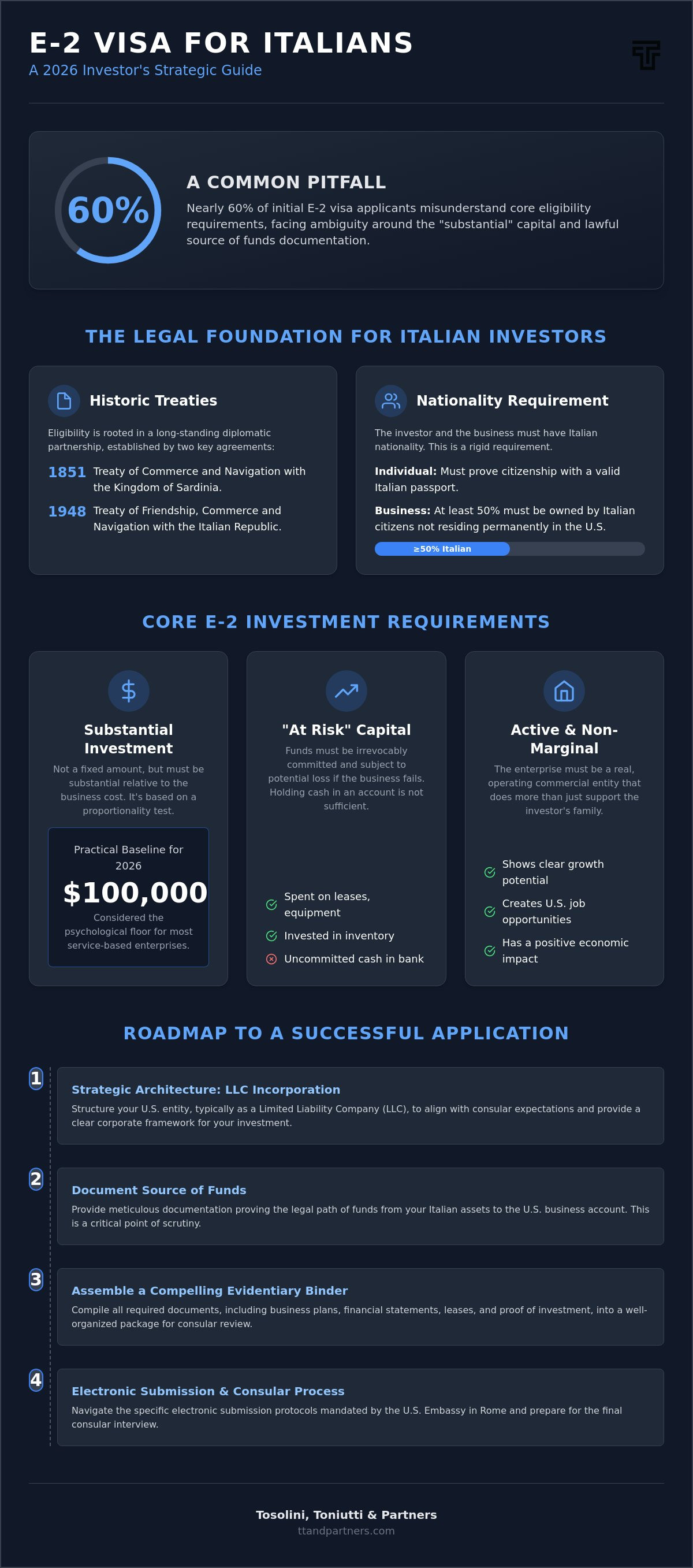
Nearly 60% of initial E-2 visa applicants fail to grasp the core eligibility requirements before they reach the filing stage. If you're an Italian entrepreneur, you've likely encountered the persistent ambiguity surrounding the "substantial" nature of capital or the complexity of documenting the lawful source of funds from European assets. Mastering the E-2 visa investment requirements for Italians isn't just about meeting a specific dollar amount; it's about the strategic alignment of your corporate architecture with U.S. consular expectations. It's natural to feel a sense of hesitation when the path between committing capital and securing your future in the United States seems obscured by technical jargon.
This guide provides the intellectual rigor and practical clarity you need to move forward with confidence in 2026. You'll gain a precise understanding of current financial thresholds, including why a $100,000 investment is now considered the practical baseline for most successful applications. We'll outline the roadmap for LLC incorporation and the specific electronic submission protocols mandated by the U.S. Embassy in Rome. By the end of this analysis, you'll possess a clear vision of how to transform your investment into a resilient, legally sound bridge to the American market.
Table of Contents
Treaty Investor Status: Why Italian Nationals Qualify for the E-2 Visa
Defining "Substantial Investment" for Italian Entrepreneurs in 2026
Beyond the Money: Ensuring Your US Business is "Active and Non-Marginal"
Strategic Architecture: LLC Incorporation and Source of Funds
Navigating the Application Process at the US Consulates in Italy
Treaty Investor Status: Why Italian Nationals Qualify for the E-2 Visa
The eligibility of Italian citizens for the E-2 Investor Visa isn't a modern development or a temporary policy. It's the result of a long standing diplomatic partnership. This relationship allows entrepreneurs from Italy to enter, stay, and work in the United States based on their investment in a U.S. enterprise. In 2026, Italy remains one of the most active treaty partners, reflecting a vibrant exchange of capital and innovation. Understanding the E-2 visa investment requirements for Italians starts with these historical foundations. This status provides a unique dual benefit. It secures residency for the primary investor and creates a streamlined path for essential Italian employees to join the U.S. operation.
The US-Italy Treaty of Commerce and Navigation
The legal architecture rests upon the 1851 Treaty of Commerce and Navigation with the Kingdom of Sardinia and the subsequent 1948 Treaty between the United States and the Italian Republic. These agreements establish reciprocal rights for citizens of both nations to engage in trade and investment. For 2026 consular adjudications, these treaties ensure that Italian nationals aren't subject to the same restrictive quotas or reciprocity fees seen in other visa categories. They provide a predictable framework where the intent of the law is to foster economic growth through mutual cooperation. This historical continuity allows for a level of professional precision when drafting applications, as the precedents are well established.
Qualifying as an Italian Treaty Investor
Qualifying as a treaty investor requires a clear demonstration of nationality. This applies to both individual applicants and the business entities they control. For individuals, proving citizenship through a valid Italian passport and birth records is the first step. For corporate entities, the rules are more nuanced. The business itself must possess Italian nationality. This is achieved when at least 50% of the company is owned by Italian citizens who aren't permanent residents of the United States. This 50% ownership threshold is a rigid requirement. Consular officers at the U.S. Embassy in Rome scrutinize capitalization tables and shareholder agreements to verify this link. Meeting the E-2 visa investment requirements for Italians depends on maintaining this majority ownership throughout the life of the visa.
Beyond the owner, the treaty extends its benefits to managers, executives, and specialists who share the investor's nationality. This allows an Italian firm to transplant its core culture and expertise to the U.S. market by bringing over key personnel from Italy. The synergy between the investor's vision and the specialized skills of their team creates a more resilient enterprise. If you're unsure if your current structure meets these nationality standards, it's wise to contact a professional to review your corporate documents before filing.
Defining "Substantial Investment" for Italian Entrepreneurs in 2026
The concept of a substantial investment is often the most misunderstood aspect of the E-2 visa investment requirements for Italians. Rather than a static figure, the U.S. government applies a proportionality test to determine if the funds are sufficient to ensure the business's success. According to the USCIS E-2 Investor Requirements, the investment must be significant in relation to the total cost of either purchasing an established enterprise or creating a new one. This ensures the investor is financially committed to the venture's long term viability.
Capital must be "at risk" in the commercial sense. This means the funds are irrevocably committed to the enterprise and subject to loss if the business fails. Simply holding money in a personal or even a corporate bank account doesn't meet the requirement. The investor must demonstrate that the money is already working. It should be spent on leases, equipment, or inventory before the interview at the U.S. Embassy. In the current 2026 environment, $100,000 has emerged as the psychological floor for most service based businesses. While lower amounts are technically possible, they face much higher scrutiny regarding the business's viability.
The Inverted Proportionality Scale
Consular officers utilize an inverted proportionality scale to evaluate these applications. This means the lower the total cost of the business, the higher the percentage of that cost the investor must contribute. For a startup requiring $100,000 or less, a 100% investment is typically expected. Conversely, for a multi million dollar industrial project, an investment of 25% or 30% might be considered substantial. This sliding scale ensures that the investor's commitment is meaningful relative to the project's scale. It prevents "marginal" businesses from qualifying while allowing large scale capital projects to move forward with realistic equity ratios.
Real-World Investment Examples for Italians
Consider the difference between an Italian design consultancy and a boutique furniture manufacturing plant. For the consultancy, the investment might include office leases, high end workstations, and specialized software. For the plant, it involves heavy machinery, raw material stock, and industrial facility upgrades. What counts toward the investment is diverse:
Tangible Assets: Equipment, inventory, and furniture.
Intangible Assets: Intellectual property or specialized software licenses.
Operational Costs: Prepaid rent, marketing expenses, and legal fees for LLC incorporation.
Only funds from personal savings, gifts, or loans secured by personal assets qualify. Unsecured loans or loans secured by the business assets themselves aren't permitted. If you're navigating these complexities, speaking with a strategic advisor can help clarify your specific financial path.
Beyond the Money: Ensuring Your US Business is "Active and Non-Marginal"
Capital is merely the foundation of a successful application. While the financial threshold is vital, the E-2 visa investment requirements for Italians demand that the enterprise be more than a vehicle for personal residency. A qualifying business must be "non-marginal." In the eyes of a consular officer, this means the company cannot exist solely to provide a minimal living for the investor and their family. It must possess the present or future capacity to make a significant economic contribution. Italy's inclusion on the Official List of Treaty Countries grants you the right to apply, but the burden of proving the business's vitality rests entirely on your strategic documentation.
The 2026 economic standards place a high premium on job creation. With 43,128 E-2 visas approved in fiscal year 2025, the competition for attention at the U.S. Embassy in Rome is intense. Adjudicators look for evidence that your business will hire U.S. workers. This impact is often what distinguishes a visionary startup from a marginal lifestyle business. If your projections show only enough profit to cover your mortgage and groceries, your application faces a high risk of denial. You must demonstrate a trajectory of growth that benefits the local American community through employment and tax revenue.
The Five-Year Growth and Employment Projection
The most critical document in your filing is a comprehensive, five-year business plan. It acts as the intellectual heart of your case. This plan should include detailed financial forecasts and a clear hiring schedule for U.S. employees. Consular officers use these projections to evaluate the "non-marginal" nature of your venture. Your forecasts should be ambitious yet grounded in reality, reflecting both Italian industry standards and the specific competitive landscape of your chosen U.S. market. A professional plan transforms abstract numbers into a credible narrative of success.
The "Real and Active" Enterprise Test
An E-2 visa requires a "real and active" commercial enterprise. Passive investments are strictly excluded. This means you cannot secure a visa by purchasing undeveloped land, holding stocks, or buying residential real estate for personal use. The business must produce a service or a physical product. Evidence of this activity includes:
Physical Presence: A signed commercial lease for an office, warehouse, or retail space.
Operational Readiness: Necessary business licenses, permits, and active utility accounts.
Tangible Proof: Invoices from U.S. vendors, inventory purchase orders, and marketing materials.
Establishing this physical footprint before your interview is essential to proving the business isn't a "paper company." If you're concerned about whether your business model meets these activity standards, you should consult with a legal strategist to refine your approach before committing further capital.
Strategic Architecture: LLC Incorporation and Source of Funds
The structural integrity of your U.S. venture depends on more than just the capital you commit. It requires a deliberate choice of legal architecture. For many entrepreneurs, the Limited Liability Company (LLC) represents the ideal balance of operational flexibility and tax efficiency. This is particularly true when navigating the E-2 visa investment requirements for Italians, as the LLC structure allows for a clear delineation of ownership and control. By establishing a U.S. entity, you create the necessary vessel to hold "at risk" capital, satisfying the requirement that funds be irrevocably committed to the enterprise before the visa interview. This setup phase is where the vision of the investor meets the precision of the law.
Choosing the Right Business Structure
While C-Corporations offer certain advantages for businesses seeking future venture capital, the LLC remains the preferred vehicle for treaty investors. It provides a pass-through tax treatment that can be highly beneficial under the existing U.S.-Italy tax treaty. The way you structure this entity directly impacts visa eligibility for your family members and essential employees. A well-designed ownership model ensures that the Italian nationality of the company remains undisputed. For a deeper dive into these technical nuances, consult our comprehensive resource on LLC Incorporation: A Strategic Guide to US Business Architecture in 2026. This strategic foundation is what allows your vision to take a physical and legal form in the American market.
Proving the Legality of Your Investment Capital
The "Path of Funds" is perhaps the most scrutinized element of the modern application. Consular officers in Rome require a transparent, unbroken chain of documentation tracing the capital from its origin in Italy to the U.S. business account. Whether the funds come from professional dividends, the sale of Milanese real estate, or a family inheritance, every Euro must be accounted for. You'll need to provide Italian tax returns, bank statements, and sale contracts that prove the capital was earned through legal means. The paper trail must be absolute.
If your investment includes gifts or personal loans, the documentation must be even more robust. A Source of Funds memorandum is an essential tool here. It serves as a narrative guide for the officer, explaining the financial history and preventing the dreaded Request for Evidence (RFE). This level of professional precision ensures that the focus remains on your business potential rather than administrative ambiguities. It's about building a bridge of trust with the adjudicator. To ensure your financial architecture meets these rigorous standards, you can schedule a strategic consultation to review your documentation path.
Navigating the Application Process at the US Consulates in Italy
The final phase of securing your future in the United States involves a rigorous engagement with the U.S. diplomatic missions in Italy. While the Consulate General in Milan serves as a vital hub for Northern Italy's business community, the U.S. Embassy in Rome remains the primary center for E-2 treaty investor adjudications. Mastering the E-2 visa investment requirements for Italians requires a deep familiarity with the specific procedural preferences of these offices. In 2026, the process is almost entirely digital. The "E-2 Binder" is no longer a physical artifact but a mexticulously indexed electronic submission sent directly to the Rome visa unit. This document must weave together your corporate architecture, proof of "at risk" capital, and your five year growth projections into a single, persuasive narrative.
Adjudicators in Rome are known for their professional precision. They expect a submission that respects their time and follows strict electronic formatting guidelines. Each tab of your digital application should serve as a pillar of your legal strategy. This includes the DS-156E and the clear documentation of your source of funds discussed in previous sections. Once your package is reviewed, you'll be invited to an interview. This is the moment where your persona as an investor is tested. It's the culmination of your strategic preparation, where the abstract nature of your filing becomes a personal conversation about your vision.
The Consular Interview Strategy
Italian entrepreneurs often face questions that probe the depth of their operational involvement. You must be prepared to discuss your business plan without relying on notes, demonstrating that you're the driving force behind the U.S. enterprise. A key requirement is proving your "intent to depart." Even if your long term vision involves American expansion, the E-2 is a non-immigrant visa. You must satisfy the officer that you'll return to Italy or move to another country once your status expires. Presenting yourself with the confidence of a seasoned executive, coupled with a thorough knowledge of your financial forecasts, is essential for a successful outcome.
Post-Visa Logistics and Compliance
Securing the visa is the beginning of a five year journey. While the visa itself is valid for five years, each entry into the U.S. grants a stay of only two years. Maintaining compliance requires active management of the business as described in your application. As your venture grows, you may eventually consider a more permanent solution, such as transitioning from an E-2 to a Green Card. This strategic shift requires careful timing and a robust record of business success. If you're ready to begin this journey, you can schedule a consultation with our specialists to ensure your filing meets the highest standards of professional excellence.
Architecting Your American Legacy
Securing a professional presence in the United States requires a sophisticated blend of financial commitment and strategic foresight. As this guide has detailed, mastering the E-2 visa investment requirements for Italians is less about reaching a rigid dollar amount and more about demonstrating the proportionality and active nature of your capital. By establishing a robust LLC structure and meticulously documenting the legal path of your funds from Italy, you transform a complex regulatory hurdle into a clear roadmap for international growth. Success at the U.S. Embassy in Rome hinges on your ability to present a non-marginal business that promises a tangible impact on the American economy.
Our firm offers specialized US-Italy cross-border legal expertise to guide you through every nuance of this transition. With decades of experience navigating the specific preferences of the Consulates in Rome and Milan, we provide comprehensive support from initial LLC incorporation to the final visa issuance. Secure your US business future; Consult with our E-2 visa experts today. Your vision for transatlantic expansion deserves a legal foundation built with the same precision and care you bring to your enterprise. We're ready to help you build that bridge.
Frequently Asked Questions
What is the minimum investment for an E-2 visa for Italians in 2026?
There is no legally mandated minimum dollar amount, though a practical threshold of $100,000 is widely recognized for service enterprises. The E-2 visa investment requirements for Italians rely on the proportionality test, where the investment must be substantial relative to the business's total startup or purchase cost. For low cost ventures, you'll likely need to invest 100% of the capital required to begin operations.
Can I use a loan as part of my E-2 visa investment?
You can utilize loan proceeds only if the debt is secured by your personal assets, such as a primary residence in Italy. Loans secured by the assets of the U.S. business itself aren't permitted under treaty rules. The capital must be considered "at risk," which means you're personally liable for the funds if the venture doesn't succeed.
How long does the E-2 visa process take for Italian citizens?
The average processing time at the U.S. Embassy in Rome typically ranges between 2 and 4 months from the date of electronic submission. This timeline includes the initial review of your evidentiary binder and the scheduling of your consular interview. Proficiency with digital document preparation is essential to avoid administrative delays during this period.
Does my spouse receive a work permit under the E-2 visa?
Yes, the spouse of an E-2 investor is authorized to work in the United States without applying for a separate Employment Authorization Document. Their work authorization is granted automatically upon entry, reflected by a specific annotation on their I-94 record. This provides significant flexibility for families establishing a new life in the American market.
Can I buy an existing business or franchise for an E-2 visa?
Buying an established business or a franchise is a common and effective strategy for securing an E-2 visa. This approach often makes it easier to demonstrate that the enterprise is "real and active" since it has a documented history of revenue and employment. Consular officers often view franchises favorably due to their proven operational models and existing brand recognition.
Is the E-2 visa a direct path to a US Green Card?
The E-2 is a non-immigrant visa and doesn't provide a direct, automatic path to permanent residency. However, many investors use their successful business as a foundation to transition into immigrant categories later. While the visa can be renewed indefinitely, you must maintain the intent to depart the U.S. once your status expires.
Do I need a physical office in the US to qualify for an E-2 visa?
A physical office or commercial space is almost always required to prove the business isn't a passive or marginal investment. Virtual offices or residential addresses are rarely sufficient to satisfy the "real and active" enterprise test. Having a signed commercial lease demonstrates that your capital is irrevocably committed and that the business is ready to serve clients.
What happens if my US business fails while I am on an E-2 visa?
If the U.S. enterprise ceases operations, your legal basis for staying in the country ends. You'd be required to either change to a different visa category or depart the United States within a short grace period. Maintaining the E-2 visa investment requirements for Italians throughout your stay is essential for preserving your lawful status and future renewal eligibility.


Comments