

E-2 Visa Renewal for Italian Citizens: The 2026 Strategic Framework
- Gianni Mendes Toniutti, Esq.

- 2 hours ago
- 12 min read
Your E-2 visa renewal is not a routine administrative formality; it is a rigorous performance audit of your American enterprise. For many Italian investors, the approach of the five-year mark brings a complex mix of professional pride and legitimate concern regarding the evolving vetting standards at the US Embassy in Rome. You've successfully bridged the gap between Italy and the United States, yet the fear that your business might be labeled as marginal remains a significant psychological and strategic hurdle.
Securing a successful E2 visa renewal for Italian citizens in 2026 requires more than just operational success. It demands an intimate understanding of the Rome Embassy’s specific electronic submission tabs and the newly emphasized English proficiency requirements. This strategic framework offers the expert guidance needed to navigate these complexities with the precision of a seasoned architect. We will explore the exact documentation structures and financial benchmarks necessary to ensure seamless business continuity and a full five-year extension, transforming a period of uncertainty into a definitive statement of your business’s enduring value and future potential.
Table of Contents
Understanding the E-2 Visa Renewal Landscape for Italians
An E-2 renewal isn't a simple administrative update; it's a comprehensive re-adjudication of your entire business enterprise. The US government views the renewal process as a fresh opportunity to verify that your investment continues to meet every legal requirement. You must demonstrate that your business has moved beyond the initial projections and has become a living, breathing part of the American economy. The E-2 Investor Visa framework demands constant compliance, meaning your previous approval doesn't guarantee future success. Each application is a performance audit where your past five years of operations are scrutinized under the latest 2026 standards.
For Italian investors, the stakes are uniquely high. The US Embassy in Rome acts as the definitive arbiter of your business's longevity. While the initial application focused on potential, the E2 visa renewal for Italian citizens focuses on realized results. You're no longer selling a vision; you're documenting a track record of financial growth, job creation, and operational maturity. This shift from projection to proof requires a sophisticated approach to documentation and a deep understanding of how the treaty between the United States and Italy functions in practice.
The 5-Year Reciprocity Rule for Italy
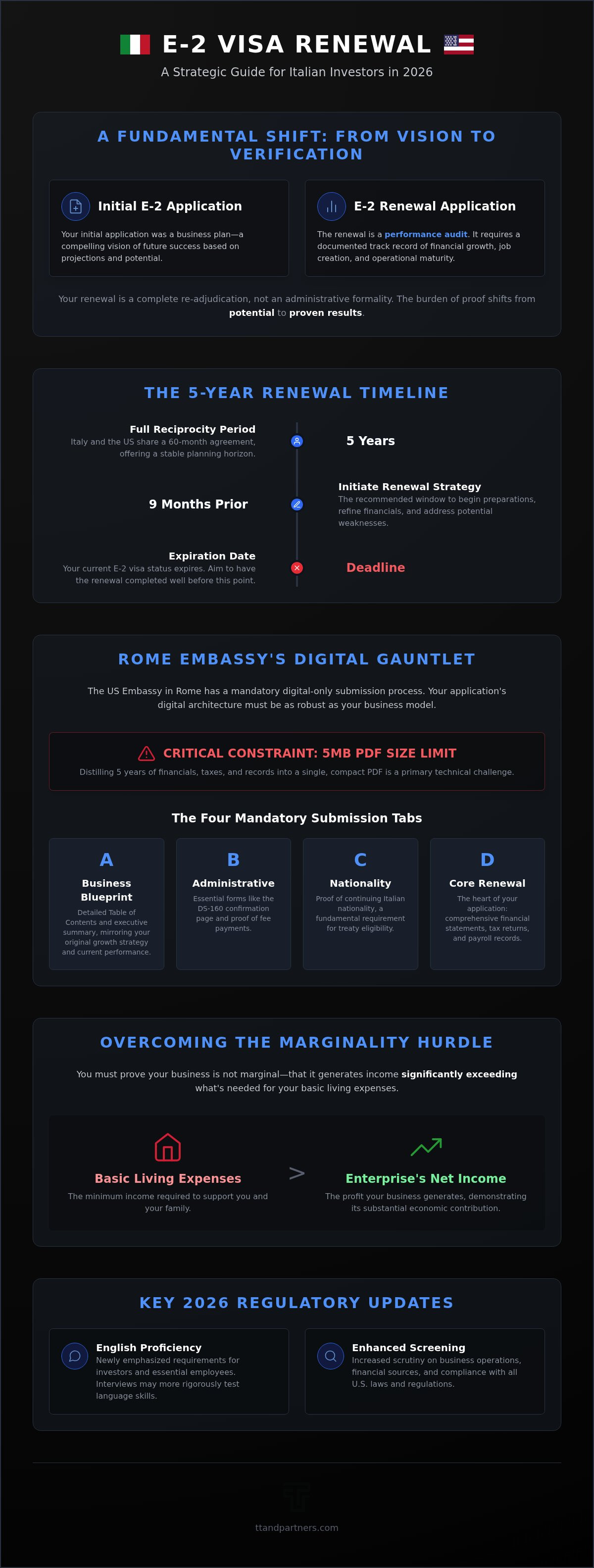
Italy and the United States share a robust 60-month reciprocity agreement. This means that Italian E-2 visas are typically issued for a full five-year term, providing a stable horizon for business planning. This duration is one of the most generous available, yet it creates a specific pressure point at the end of the cycle. Don't wait until the final months to begin your preparations. We recommend initiating the strategy for your E2 visa renewal for Italian citizens at least nine months before the expiration date. This window allows you to refine your financial statements and address any potential weaknesses in your hiring or revenue trends before they reach a consular officer's desk.
Consular Processing vs. Extension of Stay
A common point of confusion for many investors is the difference between a USCIS extension and a true visa renewal. If you're currently in the US, you can file for an extension of stay through USCIS. This keeps you legal domestically, but it's a fragile status. It doesn't provide a travel document. If you leave the US with only a USCIS extension, you won't be allowed to return until you visit the US Embassy in Rome for a formal interview. Consular processing is the only way to secure a physical visa foil for international transit. For the modern executive who manages interests in both Rome and the US, the consular path is the only one that ensures true business continuity. It requires an in-person interview and a comprehensive submission that adheres to the Embassy's strict electronic protocols.
The Rome Embassy Protocol: Technical Submission Requirements
The US Embassy in Rome has transitioned to a purely digital environment for treaty investor cases. This shift isn't merely a matter of convenience; it's a structural mandate that requires engineering-level precision from every applicant. When pursuing an E2 visa renewal for Italian citizens, your digital architecture must be as robust as your business model. The primary instrument for this process is the DS-156E form. This document acts as the executive summary of your enterprise, distilling complex corporate data into a format the Consular Section can audit with speed and accuracy.
Technical compliance starts with the 5MB file size limit. This is a hard constraint that often catches investors off guard. Distilling five years of high-resolution financial records, tax filings, and payroll data into such a compact PDF requires sophisticated document management. You must balance visual clarity with data compression. While you're expected to meet all E-2 Treaty Investor Visa Requirements, the Rome Embassy's specific vetting process adds an extra layer of technical scrutiny that can't be ignored.
Organizing the Four Mandatory Tabs
The Embassy requires a strictly indexed four-tab submission. Tab A serves as your blueprint, containing a detailed Table of Contents that should mirror your original business growth strategy. Tab B handles the administrative essentials, including the DS-160 confirmation and fee receipts. Tab C is dedicated to proving your continuing Italian nationality, a fundamental requirement for treaty eligibility. Finally, Tab D is the core of your renewal. It must house your US federal tax returns and comprehensive payroll records. This section must clearly demonstrate that your business is a contributing force in the American market rather than a marginal enterprise.
Common Technical Pitfalls in Rome
Applications are frequently rejected for technical errors before a Consular Officer even reviews the merits of the business. A primary cause of failure is the email subject line. Rome utilizes an automated sorting system; if your subject line doesn't follow the exact prescribed format, your submission might be deleted without notice. Don't include "linked" files from cloud storage or non-PDF formats like Excel or JPEG. These are blocked by government firewalls for security reasons. Every Italian document, from Chamber of Commerce records to bank statements, must be accompanied by a certified English translation. If the technical complexity of the Rome portal feels overwhelming, seeking specialized legal support can ensure your submission meets these exacting 2026 standards.
Proving Business Success: Overcoming the Marginality Hurdle
The marginality hurdle represents the single most significant barrier to a successful E2 visa renewal for Italian citizens. In the eyes of the US government, a marginal business is one that lacks the present or future capacity to generate more than a minimal living for the investor and their family. While a startup may be granted leniency during its initial phase, the renewal process is a rigorous evaluation of your actual economic footprint. You must prove that your enterprise has evolved from a theoretical plan into a robust commercial entity that actively contributes to the American economy.
Consular officers at the Rome Embassy perform a comparative analysis between your original five-year business plan and your actual financial performance. Discrepancies aren't necessarily fatal, but they require a sophisticated narrative. If your revenue didn't meet initial projections due to strategic pivots or market shifts, your renewal package must explain these as part of a mature business trajectory. The goal is to demonstrate that the business is a viable, growing structure that provides value far beyond the investor's personal needs.
Financial Growth and Tax Compliance
Your US federal tax returns, specifically Form 1120 for corporations or Form 1065 for partnerships, serve as the primary evidence of your commercial viability. We analyze these documents to ensure the narrative of growth remains consistent over the five-year period. It's a common misconception that a business must show massive profits every year to avoid a marginality finding. Legitimate business losses, often resulting from high capital expenditures or reinvestment into the company's infrastructure, are viewed differently than a lack of revenue. The key is to document these investments clearly, showing that the "loss" was a calculated step toward greater future capacity.
Impact on the US Economy
Job creation is the most persuasive evidence against a claim of marginality. Consular officers prioritize the hiring of US citizens and legal permanent residents, as this directly fulfills the treaty's intent to benefit the American labor market. While independent contractors (1099) provide operational flexibility, W-2 employees carry significantly more weight in a renewal application. They demonstrate a permanent commitment to the US workforce and a more stable business architecture.
IRS Form 941: These quarterly tax filings are the definitive proof of your payroll history and the number of employees on your staff.
Future Capacity: Even if your current staff is small, you must show the business has the financial strength to expand its hiring in the next term.
Strategic Documentation: Clear organizational charts and detailed job descriptions help the officer understand the complexity of your US operations.
Proving that your business isn't marginal requires a bridge between your accounting data and the legal standards of the Rome Embassy. If you're concerned about how your financial trends might be interpreted, seeking professional legal analysis can help you frame your success in the most compelling light.
2026 Regulatory Updates: English Proficiency and Screening
The regulatory environment for 2026 introduces a new layer of scrutiny that goes beyond financial balance sheets. Executive Order 14286 has redefined the expectations for treaty investors. While initially focused on commercial transport and safety sectors, its influence now permeates the entire E2 visa renewal for Italian citizens process. Consular officers in Rome are increasingly viewing linguistic competence as a primary indicator of an investor's ability to direct and develop a US enterprise. This isn't just about communication; it's about the practical exercise of managerial control within an American corporate structure. If you cannot effectively lead your US staff in the primary language of the jurisdiction, your role as an active manager may be called into question.
Screening at the US Embassy in Rome has become more sophisticated, moving away from static document reviews toward a dynamic assessment of the investor's total profile. This holistic approach ensures that the business isn't just a paper entity but a functioning part of the US economy. The 2026 standards demand that every element of your renewal application is synchronized with your real-world operations. Any dissonance between your tax filings and your operational reality can lead to exhaustive delays or denials.
The English Proficiency Standard
The 2026 standards prioritize sectors where complex communication is vital, such as professional services, logistics, and high-level consultancy. Investors must provide tangible evidence of their linguistic capabilities within their submission package. Standardized test results offer a clear metric, but the Embassy also accepts signed statements detailing years of successful American business operations or proof of degrees from English-speaking institutions. The Consular interview remains the ultimate filter. A lack of fluency during the discussion can lead an officer to conclude that the investor is not truly "directing" the business, which is a core requirement for E-2 status. You must be prepared to articulate your five-year growth strategy and hiring plans with technical precision.
Enhanced Vetting for Treaty Investors
Vetting now extends into your digital architecture. In 2026, screening procedures at the US Embassy in Rome include an exhaustive review of social media and public corporate records. Officers look for harmony between your immigration narrative and your online professional presence. Discrepancies in job titles, business descriptions, or even listed office locations can raise immediate red flags. You should also expect more rigorous questioning regarding any new capital injections or changes in ownership structure since your last approval. Proving the lawful source of these funds is essential for maintaining the integrity of your E2 visa renewal for Italian citizens. This level of scrutiny ensures that treaty benefits are reserved for those who maintain the highest standards of corporate transparency. If you need to verify that your digital and corporate profile meets these rigorous standards, contact our legal team for a comprehensive strategy session.
The Strategic Advantage of Professional Legal Counsel
Navigating the legal currents between Rome and the United States requires more than just documentation; it requires a unified architectural vision. For the sophisticated investor, an E2 visa renewal for Italian citizens is the culmination of years of operational discipline. Our firm acts as the essential bridge, translating the complexities of American corporate law into the specific context of the Italian entrepreneur. We don't view the renewal as an isolated event but as a milestone within a broader cross-border journey. This perspective ensures that every corporate decision, from the initial LLC incorporation to the final submission package, is aligned with the rigorous vetting standards of the US Embassy in Rome.
The interview atmosphere in Rome is distinct, demanding a level of professional poise and technical clarity that can only be achieved through meticulous preparation. Consular officers expect a deep familiarity with your business’s financial health and its role in the American market. By harmonizing your immigration goals with your corporate structure, we transform the renewal process from a source of anxiety into a strategic victory. This high-level coordination allows you to focus on your enterprise’s growth while we manage the intricate legal requirements that ensure your continued presence in the United States.
Comprehensive Cross-Border Support
Success in a 2026 renewal depends on managing corporate compliance with an eye toward future eligibility. We coordinate closely with your Italian tax and business advisors to ensure that your global financial narrative remains consistent across both jurisdictions. This prevents the discrepancies that often trigger marginality concerns or administrative delays. A seamless renewal requires a holistic audit of your business's performance over the last five years. To ensure your enterprise meets these exacting standards, you should contact our team for a strategic renewal audit before your current term expires.
Beyond the Renewal: Your US Future
While the E-2 is a powerful tool for business continuity, many Italian investors eventually seek more permanent solutions. We guide families through the complex transition from an E-2 to a Green Card, evaluating various paths to permanent residency. For those with exceptional professional achievements, the O-1 Visa may offer a compelling alternative that bypasses the treaty investor requirements entirely. As you prepare for your E2 visa renewal for Italian citizens, consider this final checklist for a successful 2026 submission:
Verify that all corporate filings are current and reflect your active management role.
Ensure your payroll records demonstrate consistent hiring of US workers.
Confirm that your digital and social media footprint is consistent with your corporate disclosures.
Prepare a comprehensive narrative that justifies any strategic pivots in your business model.
Secure certified English translations for all Italian legal and financial documents.
Securing Your American Legacy in 2026
Success in the modern immigration landscape requires more than just operational talent; it demands a sophisticated alignment with the US Embassy in Rome’s technical and linguistic standards. Your enterprise has already proven its initial value, but the renewal phase is about documenting a sustainable, non-marginal impact on the US economy. By mastering the Embassy’s four-tab submission protocol and proactively addressing the 2026 English proficiency requirements, you ensure that your business remains a vital, uninterrupted bridge between Italy and the United States.
The E2 visa renewal for Italian citizens is a high-stakes performance audit where your past five years of growth are scrutinized with clinical precision. Our firm brings decades of US-Italy cross-border legal expertise to this process, offering a specialized focus on the evolving protocols of the US Embassy in Rome. We've built a proven track record in high-stakes renewals, helping investors transform technical complexities into clear strategic advantages. Don't leave your business continuity to chance. Secure your E-2 renewal with a strategic legal consultation today. Your vision for the future deserves a foundation built on professional excellence and visionary planning.
Frequently Asked Questions
Can I renew my E-2 visa if my business is not yet profitable?
Yes, profitability isn't the sole metric for success, provided you can prove the business isn't marginal. You must demonstrate that the enterprise has the present or future capacity to generate more than a minimal living for you and your family. If you've reinvested revenue into hiring US workers or purchasing equipment, a paper loss on your tax returns is often acceptable with the right strategic explanation.
Does my spouse need to attend the E-2 renewal interview in Rome?
Generally, all family members seeking a visa renewal should attend the interview at the US Embassy in Rome. While the Consular officer's questions will focus primarily on the investor's business performance, the presence of dependents is a standard requirement for the issuance of their visa foils. It's best to check the specific 2026 scheduling confirmation for any age-based interview waivers for minor children.
How long is the current processing time for E-2 renewals at the US Embassy in Rome?
Processing times in 2026 fluctuate based on the volume of treaty investor filings and the complexity of the digital submissions. Once you've emailed your package to the Embassy, the review period typically spans several weeks or months before an interview date is offered. We recommend starting the preparation of your renewal package at least nine months before your current visa foil expires to avoid any travel disruptions.
What happens if my E-2 renewal is denied while I am in the United States?
If your consular renewal is denied, you won't be able to re-enter the US using that visa if you leave the country. A denial at the Embassy doesn't immediately terminate a valid I-94 stay, but it creates a precarious legal situation. You'll need to consult with legal counsel to evaluate your options, which might include filing a new case or exploring alternative paths like the O-1 visa.
Do I need to prove my initial investment amount again during the renewal?
You don't need to re-prove the source of your original capital, but the focus of an E2 visa renewal for Italian citizens shifts toward how that capital was used. The officer wants to see that the investment remained "at risk" and generated real economic activity. Your primary evidence will be your federal tax returns and payroll records rather than the bank transfers used during your initial 2021 application.
Can I change my business model between the initial E-2 and the renewal?
You can certainly evolve your business model, but you must show that the new activities still meet the treaty's requirements. If your enterprise shifted from retail to consultancy, for example, your renewal narrative must explain how this transition utilized the original investment. The key is proving that the core of the business remains active and continues to support the American labor market as originally intended.
Is there a limit to how many times an Italian citizen can renew an E-2 visa?
There is no legal limit on the number of times you can renew your status. As long as your business remains operational and continues to meet the non-marginality standards, you can secure indefinite five-year extensions. This allows for a successful, long-term E2 visa renewal for Italian citizens who maintain their commitment to their US enterprise and continue to comply with all evolving regulatory standards.
How does the 2026 English proficiency rule affect my E-2 renewal as an owner?
The 2026 rule emphasizes that an investor must be able to "direct and develop" the business, which requires effective communication in English. During your interview in Rome, the officer will assess whether you can manage your US staff and navigate the American market without a translator. If your linguistic skills don't match your managerial responsibilities, it could lead to questions about your actual role in the company's daily operations.


Comments