

US Italy Real Estate Dispute Lawyer: Strategic Cross-Border Litigation in 2026
- Gianni Mendes Toniutti, Esq.

- 3 days ago
- 12 min read
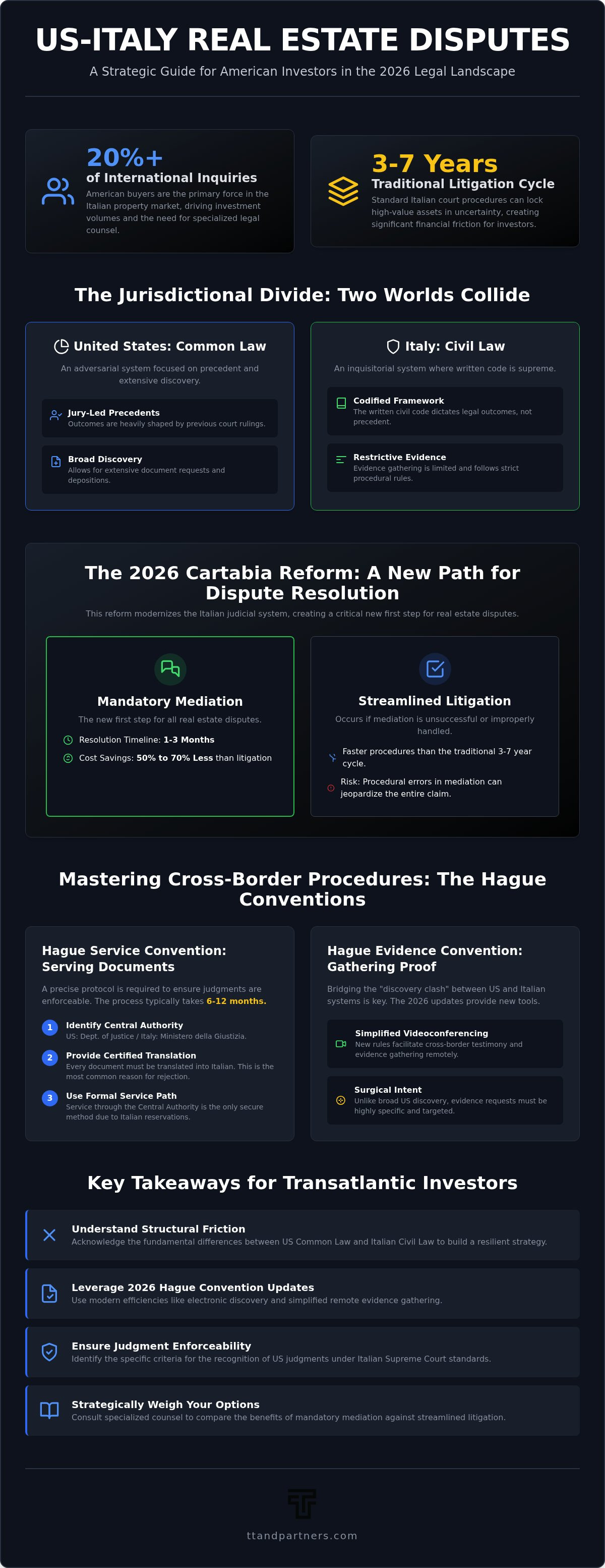
In the first half of 2026, American buyers emerged as the primary force in the Italian property market, driving over 20% of all international inquiries. As investment volumes climb, the need for a specialized US Italy real estate dispute lawyer has become a strategic necessity for protecting these high-value assets. You've likely felt the friction between the fast-paced American legal philosophy and the intricate, often slower procedural realities of the Italian court system. It's exhausting to watch a potential resolution stretch into a three-to-seven-year litigation cycle while your capital remains locked in uncertainty.
This guide provides a sophisticated framework for resolving cross-border property conflicts with surgical precision. We'll show you how to leverage the 2026 judicial reforms and the latest Hague Evidence Convention updates to bypass traditional delays and minimize legal risk in transatlantic contracts. You'll gain a clear roadmap for gathering evidence via simplified videoconferencing, serving process across borders, and ensuring your judgments are enforceable within the Italian Civil Code. We are here to bridge the gap between Roman Civil Law and American Common Law, transforming complex jurisdictional conflicts into manageable, successful outcomes.
Table of Contents
The Architecture of US-Italy Real Estate Disputes in 2026
The structural integrity of a transatlantic property claim depends on more than just the merits of your case; it requires a deep understanding of how two fundamentally different legal philosophies interact. In 2026, cross-border real estate litigation between the US and Italy is defined by a jurisdictional tug-of-war. American investors often expect the broad discovery and jury-led precedents of Common Law, yet they find themselves operating within the rigid, codified framework of the Italian Civil Code. This friction is where most cases falter. A generalist firm might understand the contract, but they often lack the technical precision to manage the procedural hurdles that arise when these two worlds collide. Engaging a specialized US Italy real estate dispute lawyer is the only way to ensure your strategy isn't lost in translation.
The Civil Law vs. Common Law Divide in Property
The primary challenge is reconciling the role of judicial precedent with statutory law. In the United States, courts rely heavily on previous rulings to shape outcomes. Italy, however, operates on a civil law system where the written code is supreme. This leads to a significant divergence in "discovery." While US litigation allows for extensive document requests and depositions, Italian proceedings are far more restrictive. Evidence must be gathered with surgical intent, following strict procedural economy rules that prioritize efficiency over exhaustive inquiry. Serving documents also requires adherence to the Hague Service Convention, a process that can take six to twelve months if handled without strategic foresight. It's a delicate balance that requires counsel capable of bridging these disparate systems.
2026 Regulatory Landscape: The Cartabia Reform
The 2026 legal environment is shaped by the full implementation of the Cartabia Reform. This initiative aims to modernize the Italian judicial system by streamlining first-instance procedures. For US investors, this is a double-edged sword. While the reform seeks to reduce the traditional three-to-seven-year litigation timeline, it also enforces mandatory mediation for real estate disputes. This mediation phase is designed to conclude within one to three months. It's a critical gateway. If handled correctly, it can resolve a dispute for 50% to 70% less than the cost of full litigation. However, failing to navigate this stage with specialized counsel can result in procedural bars that jeopardize the entire claim. Strategic planning at this stage is essential, and engaging with a specialized team can prevent costly jurisdictional errors before they become permanent.
Navigating Hague Evidence and Service Conventions in 2026
Success in transatlantic property litigation is frequently decided before the first hearing. It hinges on the technical execution of service and evidence gathering. A US Italy real estate dispute lawyer must act as a procedural architect, ensuring every document adheres to international treaties to avoid jurisdictional dismissal. Central to this process is the "Central Authority," the designated government body in each nation that facilitates judicial requests. In the US, this involves the Department of Justice, while in Italy, the Ministero della Giustizia manages incoming requests. Misunderstanding these roles often leads to months of wasted effort and high legal costs.
Mastering the Hague Service Convention
Serving process on an Italian entity from the US requires a strict three-step protocol to ensure the resulting judgment remains enforceable in 2026. First, you must identify the correct Central Authority to receive the request. Second, every document must be translated into Italian; failure to provide a certified translation is the most common reason for rejection. Third, you must navigate the specific method of delivery. While Article 10 of the Convention discusses service by mail, Italy has historically maintained reservations that make formal service through the Central Authority the only truly secure path. Given that this process typically takes six to twelve months, starting with precision is non-negotiable; to assist with these international requirements, you can discover Stellar Konsulting.
The "discovery clash" occurs because the US legal system permits broad inquiries, whereas Italy follows a restrictive model where judges control the evidence-taking process. To obtain testimony or documents located in Italy for a US trial, parties must use Letters Rogatory or the Hague Evidence Convention. In 2026, new protocols have significantly modernized this exchange. Following the 2026 updates implemented across Europe, taking evidence via secure videoconference is now a streamlined reality. These digital forensic protocols allow for the electronic transmission of judicial requests, reducing the procedural friction that previously plagued international property disputes. This shift makes it easier to secure testimony from foreign witnesses without the need for expensive, time-consuming travel.
Navigating these technicalities requires a partner who understands the nuances of both systems. If you're facing a complex property conflict, reaching out to an expert international litigation team can provide the clarity needed to secure your interests across borders.
Enforcing Foreign Judgments: Bridging US and Italian Jurisdictions
A judgment obtained in one jurisdiction is a hollow victory if it cannot be liquidated across the Atlantic. For property owners, this often means translating a US court order into a lien on Italian soil or vice versa. The mechanism for this in Italy is known as delibazione, a specialized proceeding where the Court of Appeal verifies the foreign judgment’s compliance with local public policy and procedural fairness without re-litigating the facts. A US Italy real estate dispute lawyer must architect the original case with this final stage in mind, as even minor procedural flaws during the initial trial can render a judgment unenforceable abroad. Strategic precision at the trial level is the only way to ensure the eventual recognition of your rights.
Enforcing an Italian Judgment in the United States
Recognition in US courts typically follows the Uniform Foreign-Country Money Judgments Recognition Act, which has been adopted by a majority of states. While US courts generally respect international comity, they strictly scrutinize whether the Italian proceeding provided a system of procedures compatible with the requirements of due process. Common grounds for non-recognition include a lack of personal jurisdiction over the defendant or a failure to provide adequate notice. Success requires the international litigation expertise to demonstrate that the Italian judgment is final, conclusive, and enforceable in its country of origin. Without this proof, the US court may refuse to grant the judgment the same status as a domestic order.
Enforcing a US Judgment in Italy
The Italian Supreme Court recently provided significant clarity in this area, which is vital for US investors. In Judgment No. 31244, published on November 30, 2025, the court reaffirmed that US judgments awarding punitive damages can be recognized in Italy, provided they aren't ontologically incompatible with the Italian legal order. This means that while excessive damages might still face public policy hurdles, the historical blanket ban on punitive awards has softened. To ensure a US judgment passes the Italian Court of Appeal's mandatory checks, it must meet several criteria:
The US court must have had jurisdiction according to Italian legal principles.
The defendant must have been properly served in accordance with the Hague Service Convention.
The judgment must be res judicata, meaning it's final and not subject to further appeal.
The award must not conflict with a pre-existing Italian judgment on the same matter.
Navigating these requirements demands a strategic foresight that only a specialized US Italy real estate dispute lawyer can provide. By aligning the initial litigation strategy with the enforcement standards of the target country, we ensure that a legal victory in one nation translates into tangible recovery in another.
Strategic Dispute Resolution: Arbitration vs. Litigation
Choosing between the courtroom and an arbitral tribunal is a decision of architectural significance for any transatlantic investor. While 2026 judicial reforms have streamlined Italian litigation, the average first-instance case still consumes three to seven years. In contrast, international arbitration proceedings typically conclude within six to twelve months. For high-stakes property assets, this speed is often worth the higher upfront administrative fees. A specialized US Italy real estate dispute lawyer evaluates these paths based on the need for confidentiality and the specific location of the counterparty's assets. Arbitration remains the superior choice for complex commercial real estate ventures where time-sensitive liquidation is a priority.
Drafting Resilient Cross-Border Contracts
Standard boilerplate clauses are liabilities. They fail to account for the intricate interplay between US state law and the Italian Civil Code. Strategic investors often integrate LLC incorporation structures to wall off liability and create a more favorable jurisdictional anchor. Selecting a neutral third-country forum, such as Switzerland, has become increasingly attractive in 2026 due to simplified videoconferencing protocols for evidence gathering. These clauses must be precise; they aren't just legal text but a blueprint for risk management. A well-drafted forum selection clause prevents the procedural chaos of parallel proceedings in two different countries.
The New York Convention and Arbitral Awards
Enforcing an arbitral award is often more straightforward than enforcing a court judgment. This is because both the US and Italy are signatories to the New York Convention. Under this framework, Italian courts have very limited grounds to refuse enforcement, focusing primarily on procedural fairness rather than the merits of the case. In 2026, challenging an award remains difficult as courts prioritize the finality of the process. Selecting an arbitration seat that balances US and Italian interests ensures that the final award remains a liquid asset rather than a procedural dead end. This treaty-based enforcement provides a level of certainty that traditional litigation simply cannot match in the transatlantic corridor.
Secure your transatlantic investments by consulting with our international litigation experts today to design a dispute strategy that protects your capital.
Securing Your Transatlantic Interests with Specialized Counsel
Success in the transatlantic corridor isn't merely about winning a single case; it's about the long-term preservation of capital within a shifting regulatory environment. A generalist firm might provide a reactive defense, but a specialized US Italy real estate dispute lawyer acts as a strategic architect. They harmonize the disparate requirements of American and Italian law to create a unified legal posture. This approach ensures that a victory in one jurisdiction won't become a liability in another. By bridging the cultural and linguistic gap, we eliminate the technical misunderstandings that often derail international property ventures. Our communication is rooted in technical accuracy and a future-oriented vision, providing the intellectual content necessary to resolve even the most complex jurisdictional conflicts. We don't just translate words; we translate legal philosophies to ensure our clients maintain a position of strength across borders.
A Holistic Approach to International Legal Conflicts
Your property dispute doesn't exist in a vacuum. Often, litigation strategy must align with broader investment objectives, such as maintaining status under an E-2 Visa. We view these legal challenges through a wide-angle lens, ensuring that a dispute resolution strategy supports, rather than hinders, your immigration or business expansion goals. Having a single point of contact for dual-jurisdiction cases provides a level of technical precision that fragmented legal teams cannot match. This holistic outlook is rooted in our brand's belief in professional excellence and visionary thinking. We believe that a well-executed legal strategy should be as harmonious and durable as a well-designed structure, reflecting the intellectual depth of our clients' investments. This mindset allows us to navigate the complexities of the 2026 judicial landscape with the same care an architect uses to design a skyline.
Taking the Next Step in Your Legal Strategy
The most effective way to manage legal risk is to address it before it reaches the courtroom. We encourage investors to review their current transatlantic contracts for jurisdictional gaps that could be exploited in the 2026 legal landscape. Identifying these vulnerabilities early can prevent the procedural delays and conflicting philosophies discussed in previous sections. If you're currently facing a conflict, we invite you to contact us for a comprehensive case assessment. Our team will analyze your position through both the lens of Roman Civil Law and American Common Law to identify the most efficient path forward. Cross-border litigation is a proactive asset protection tool designed to secure your interests in an increasingly complex global market.
Architecting Success in Transatlantic Property Litigation
The 2026 legal landscape offers unprecedented opportunities for those who approach cross-border property conflicts with technical precision. Success requires harmonizing the rigid statutes of the Italian Civil Code with the procedural expectations of the American legal system. By mastering Hague Convention protocols and leveraging recent judicial reforms, investors can bypass traditional delays and secure their capital with confidence. Our firm provides bilingual and bicultural legal representation, ensuring that your strategy is never lost in translation. We offer a proven track record in US-Italy judgment enforcement, transforming complex jurisdictional friction into tangible results.
Don't leave your transatlantic interests to chance. You can schedule a strategic consultation with our cross-border litigation experts to build a resilient roadmap for your assets. Engaging a specialized US Italy real estate dispute lawyer is the proactive step needed to turn legal challenges into manageable, successful outcomes. Your vision deserves a legal foundation as durable as the properties you invest in.
Frequently Asked Questions
What is the role of a cross-border litigation attorney in US-Italy disputes?
A US Italy real estate dispute lawyer acts as a strategic architect who bridges the gap between US Common Law and Italian Civil Law. Their role involves managing jurisdictional conflicts, ensuring proper service of process, and identifying the most efficient path for judgment enforcement. They provide the technical precision needed to navigate foreign courts while protecting their client's domestic interests. This specialized oversight prevents procedural errors that typically derail international property claims.
How long does it typically take to enforce a US judgment in Italy in 2026?
Enforcing a US judgment through the Italian delibazione process generally takes twelve to eighteen months, depending on the Court of Appeal's docket. This timeline assumes all procedural requirements, such as Hague Service Convention compliance, were met during the original US trial. While 2026 reforms have streamlined some civil procedures, the recognition of foreign orders remains a distinct technical phase. Strategic preparation at the trial level is essential to avoid further delays during the enforcement stage.
Can I serve a lawsuit on an Italian company via email under the Hague Convention?
Serving a lawsuit on an Italian company via email isn't recognized as valid service under Italy’s current declarations to the Hague Service Convention. While Article 10 discusses alternative methods, Italy maintains specific reservations that prioritize formal service through the designated Central Authority. Attempting service via email often leads to the judgment being unenforceable in Italian courts. Most experts recommend using the formal Central Authority channel, which typically takes six to twelve months to complete.
What are the main differences between US discovery and Italian evidence gathering?
The primary difference lies in the scope and control of the inquiry. US discovery is party-led and broad, allowing for extensive document requests and depositions. Conversely, Italian evidence gathering is judge-led and strictly limited to specific facts relevant to the case. Under 2026 protocols, Italy has enhanced its use of videoconferencing for testimony, but the judge still maintains absolute authority over which questions are permitted and which documents are admitted into the record.
Is arbitration better than litigation for US-Italy real estate contracts?
Arbitration is frequently the superior choice for high-stakes real estate contracts due to its speed and the ease of international enforcement. While litigation in Italy can last three to seven years, arbitration proceedings are typically completed within six to twelve months. Additionally, the New York Convention provides a robust framework for enforcing arbitral awards in both nations. This makes arbitration a more predictable tool for protecting capital in complex transatlantic property ventures.
Will Italian courts recognize US punitive damages in 2026?
Italian courts will recognize US punitive damages in 2026, provided the award isn't ontologically incompatible with the Italian legal system. This follows the landmark Supreme Court ruling from November 30, 2025. While the court has softened its stance against punitive awards, damages must still respect the principle of proportionality. A specialized US Italy real estate dispute lawyer can help structure US claims to ensure they meet these specific Italian public policy requirements.
How does the Cartabia Reform affect US companies litigating in Italy?
The Cartabia Reform streamlines Italian civil proceedings by introducing tighter procedural timelines and enhancing the efficiency of the first-instance trial. For US companies, the most significant impact is the mandatory mediation requirement for real estate disputes. This process is designed to reach a conclusion within one to three months. Mediation can reduce legal costs by 50% to 70% compared to full litigation, making it a vital first step in any 2026 dispute strategy.
What is the statutory interest rate for legal disputes in Italy for 2026?
The statutory interest rate for legal disputes in Italy is updated annually by the Ministry of Economy and Finance. For 2026, this rate applies to civil litigation and commercial transactions where no specific contractual rate was agreed upon. It's essential to consult with counsel to confirm the exact percentage, as this rate impacts the total recovery value of your claim. Accurate calculation of these interests is a critical component of successful judgment enforcement.


Comments