

US Italy Immigration Lawyer: Navigating Cross-Border Legal Complexity in 2026
- Gianni Mendes Toniutti, Esq.

- 2 days ago
- 12 min read
The bridge between the United States and Italy is no longer built on heritage alone. It's a sophisticated architectural challenge defined by Law No. 74/2025 and rigorous digital vetting systems. You likely feel the weight of these shifting regulations, where a single bureaucratic delay can stall a significant investment or a lifelong dream of dual residency. Finding a qualified US Italy immigration lawyer is the first step in managing these systems, especially when conflicting advice leaves your future in limbo amid new fees and extended processing windows.
Securing your cross-border future requires more than just filing paperwork. It demands an approach that views your visa, your corporate structure, and your citizenship claim as elements of a unified structure. We'll show you how to achieve a seamless relocation, ensuring your assets are protected and your legacy is secured. This guide examines the strategic requirements for E-2 and O-1 visa success, the new reality of Italian citizenship by descent, and the integration of corporate law into your international journey.
Table of Contents
What Defines a Specialized US Italy Immigration Lawyer?
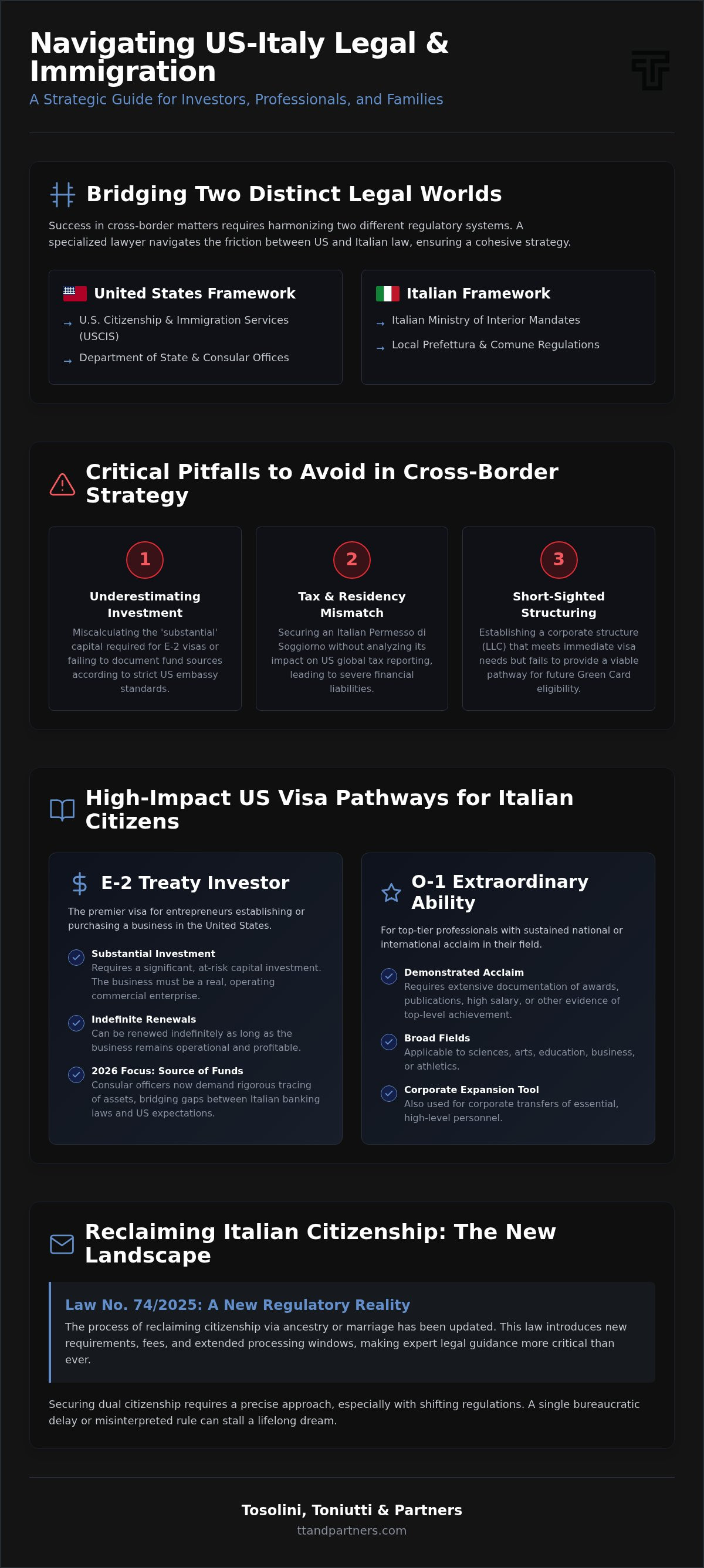
A specialized US Italy immigration lawyer functions as an architect of international mobility. They aren't merely document preparers but legal professionals admitted to practice in cross-border jurisdictions who manage the intricate friction between two distinct legal frameworks. This dual-role requirement demands a simultaneous mastery of the regulations governed by U.S. Citizenship and Immigration Services (USCIS) and the Department of State, as well as the mandates issued by the Italian Ministry of Interior. Generalist immigration lawyers often fail at complex treaty-based cases because they lack the specific jurisdictional bridge necessary to harmonize these systems.
Success in high-stakes applications depends on bilingual legal capacity and cultural bridge-building. It's not enough to translate words; a practitioner must translate legal concepts. Explaining an Italian corporate hierarchy to a US consular officer requires a deep understanding of the diplomatic history found within Italy-United States relations. This specialized knowledge ensures that the narrative of an application aligns with both the legal standards and the cultural expectations of the reviewing authorities.
The Strategic Importance of Cross-Border Licensing
Navigating international law without dual-system expertise introduces significant risks regarding the Unauthorized Practice of Law (UPL). Many clients suffer because domestic counsel in one country provides advice that inadvertently violates the statutes of the other. A US Italy immigration lawyer prevents these conflicts by ensuring that residency filings in Italy don't trigger unexpected tax or status complications in the United States. For the 2026 investor, a cross-border attorney serves as the primary guardian of structural integrity, synthesizing disparate regulations into a singular, cohesive strategy for global expansion.
Common Pitfalls in US-Italy Relocation Strategy
Strategic errors often arise when the 'Italian side' of the process is ignored during US planning. These are the most frequent obstacles encountered by applicants:
Underestimating 'Substantial Investment': Italian entrepreneurs frequently miscalculate the risk-capital requirements for E-2 visas by failing to document the source of funds according to US embassy standards.
Tax and Residency Mismatch: Securing an Italian Permesso di Soggiorno without analyzing its impact on US global tax reporting can lead to severe financial liabilities.
Short-sighted Corporate Structuring: Establishing an LLC or branch that meets immediate visa needs but fails to provide a viable pathway for future Green Card eligibility.
Avoiding these errors requires a partner who understands the long-term implications of every filing. If you're ready to build a secure cross-border foundation, it's vital to contact a professional who can manage both sides of the Atlantic simultaneously.
US Visa Pathways for Italian Citizens and Businesses
Italian citizens enjoy unique access to the U.S. market through treaty-based visas, representing a legacy of cooperation that facilitates modern mobility. The E-2 Treaty Investor visa remains the most versatile path for entrepreneurs looking to build a life across the Atlantic, allowing for indefinite renewals as long as the business remains operational. However, the complexity of these filings often requires the precision of a US Italy immigration lawyer who can bridge the gap between Italian financial documents and American legal standards. For those with high-volume trade operations, the E-1 Treaty Trader visa offers a similar advantage, provided the majority of international trade is conducted between the United States and Italy.
The E-2 Visa: A 2026 Framework for Italian Investors
In 2026, the definition of a "substantial" investment has evolved alongside global economic shifts. Consular officers at the US Embassy in Rome evaluate whether the capital is sufficient to ensure the business isn't marginal or solely for the purpose of earning a living for the investor. Documenting the source of funds is equally vital. Italian gift laws and banking regulations differ significantly from US expectations, making clear tracing of assets essential for approval. Our E-2 Visa Guide 2026 provides the strategic framework needed to navigate these hurdles with technical accuracy.
O-1 and L-1 Options for Corporate Transfers
Corporate expansion often necessitates moving key talent to oversee new operations. The L-1 visa allows Italian companies to transfer executives or managers to a qualifying US subsidiary, provided a parent, branch, or affiliate relationship exists. For individuals with "Extraordinary Ability," the O-1 visa offers a path that doesn't rely on capital investment. Italian professionals in the arts, sciences, or business must demonstrate their standing through specific evidence:
Receipt of nationally or internationally recognized prizes or awards for excellence.
Published material in professional or major trade publications about the applicant's work.
Evidence of original scientific, scholarly, or business-related contributions of major significance.
Translating these achievements into the USCIS evidentiary framework is a delicate task that demands both intellectual rigor and an appreciation for the nuances of Italian professional life.
Long-term stability often leads to the pursuit of a Green Card. Whether through the EB-1A for high-level talent or the EB-5 for larger investments, the transition must be planned years in advance. Aligning your current visa with permanent residency goals ensures that your family's future remains secure. A US Italy immigration lawyer can help you integrate LLC incorporation with your visa strategy to build a durable foundation. If you're planning a multi-year expansion, you might consider reaching out to Tosolini, Toniutti & Partners to discuss a holistic approach to your cross-border journey.
Italian Citizenship and Residency for US Nationals
Reclaiming a heritage or establishing a new life in Italy requires more than a sentimental connection; it's a legal reconstruction of your status. Transitioning to Italy in 2026 involves navigating a landscape fundamentally altered by Law No. 74/2025. This legislation has narrowed the administrative pathway for jure sanguinis, generally limiting claims to those with an Italian-born parent or grandparent. For Americans seeking to reclaim their ancestry, a US Italy immigration lawyer is essential to determine if an administrative application remains viable or if a judicial route is required. Current legal standards set a maximum processing time of three years for citizenship by descent applications, making long-term strategic planning a priority.
For spouses of Italian citizens, the jure matrimonii process involves specific residency and language requirements. Processing times for marriage-based citizenship typically range from 24 to 36 months. High-net-worth individuals might instead look toward the Investor Visa for Italy, often called the Golden Visa. This path prioritizes strategic capital placement and offers greater flexibility than the Elective Residency Visa (ERV), which is designed for retirees with passive income and strictly prohibits any form of work.
Navigating the 1948 Case and Ancestry Claims
When the administrative route is blocked due to a female ancestor who couldn't pass on citizenship before January 1, 1948, the judicial "1948 case" remains a robust alternative. This process bypasses the consulate and proceeds directly through the Italian court system. Success depends on the meticulous procurement of records, bridging US vital documents with the archives of the specific Italian Comune. Our Italian Citizenship Guide details the nuances of document authentication and the structural requirements of these contested ancestry claims.
Residency Permits and the 'Permesso di Soggiorno'
The physical move to Italy begins with an entry visa, but the legal foundation of your stay is the Permesso di Soggiorno. You must apply for this residency permit within eight days of arrival in the country. Maintaining legal status requires a deep understanding of renewal timelines and physical presence mandates to avoid revocation. While the Italian Digital Nomad Visa has gained popularity for remote workers, its requirements differ significantly from the ERV. Professional counsel ensures that your residency permit aligns with your long-term goals, whether you seek eventual permanent status or a temporary Mediterranean base. This technical transition is the final pillar in securing your cross-border future.
Criteria for Selecting Your US Italy Legal Partner
Selecting the right representation is the most critical decision in your cross-border journey. A specialized US Italy immigration lawyer must possess a proven track record specifically with the US Embassy in Rome and the Consulate in Naples. These locations operate with distinct administrative preferences that can influence the speed and success of your application. Your legal partner should offer a transparent communication protocol that accounts for international time zones, ensuring you aren't left in the dark during sensitive filing windows. Beyond document preparation, evaluate their litigation capacity. High-stakes applications often face a Request for Evidence (RFE), and you need a partner who can defend your case with technical precision if a denial is issued.
Integration is the hallmark of a sophisticated practice. If your counsel doesn't understand how your US corporate structure impacts your treaty investor status, the foundation of your relocation is fragile. A firm that manages both the immigration filing and the underlying business architecture provides a unified defense against bureaucratic scrutiny. This synergy prevents the common "silo" effect where domestic and foreign counsel provide conflicting advice that stalls your progress.
The Integrated Legal Approach
For elective residency applicants, real estate closing expertise is not a luxury; it's a necessity. The Italian authorities require specific proof of suitable housing, and a lawyer who understands property law can ensure your purchase or lease meets these residency standards. Likewise, entrepreneurs must align their corporate filings with their visa goals from day one. You can explore the technical requirements for this in our LLC Incorporation Strategy guide. This holistic view ensures that your business and personal life move in harmony across borders.
Fee Structures and Value in Cross-Border Cases
Predictability in legal costs is essential when managing an international move. Many specialized firms offer flat fees for standard immigration matters, while complex international litigation may require hourly billing. It's vital to identify potential hidden costs early, such as international document translation and the legalization of vital records. The return on investment for expert counsel is measured in the avoidance of multi-year visa bans or investment losses. A single error in a 2026 application can lead to significant delays, making the precision of a dual-market expert invaluable. To secure a partner who understands the complexities of both jurisdictions, contact our team for a strategic evaluation of your case.
Strategic Counsel with Mattia Riberto and Tosolini, Toniutti & Partners
Mattia Riberto brings a visionary perspective to the firm's cross-border practice, where the focus remains on the intellectual substance of international law rather than mere administrative processing. The Tosolini, Toniutti & Partners methodology is an exercise in precision and aesthetic clarity, ensuring that every legal structure we build is as durable as it is effective. We don't view immigration as a hurdle to be cleared but as a strategic architecture that must be designed with foresight. As a specialized US Italy immigration lawyer, the firm synthesizes the requirements of two distinct legal systems into a single, harmonious path for our clients.
Our case management approach is designed for a national US audience and international Italian entities alike. We provide a bridge between jurisdictions, handling the "Italian side" of the process with the same professional magistery we apply to US federal regulations. This holistic oversight is vital for those managing complex transitions, from LLC incorporation to the final acquisition of a Green Card or Italian citizenship. By integrating corporate and real estate services with immigration strategy, we ensure that your relocation is supported by a stable and legally sound foundation.
A Legacy of US-Italy Legal Excellence
The firm's history is defined by its commitment to bridging the legal gap for Italian talent in the United States. We've established a reputation for helping entrepreneurs and high-level professionals navigate the E-1, E-2, and O-1 visa pathways with technical accuracy and an appreciation for the cultural nuances involved. Initiating a consultation is the first step in constructing your visionary legal architecture. We focus on results that respect the heritage of our clients while embracing the technological and regulatory shifts of 2026.
Contacting the Cross-Border Team
Preparing for your initial strategy session is essential for a productive review of your international goals. We suggest gathering your core documentation, such as corporate records, proof of investment, or vital records for ancestry claims, prior to our meeting. For our national US clients, we offer both virtual and in-person consultation options to accommodate your location and schedule. This initial review serves as the blueprint for your cross-border journey, identifying the most efficient path forward while mitigating the risk of bureaucratic delays. You can coordinate your 2026 relocation strategy by visiting our contact page to schedule a session with our cross-border team.
Architecting Your Future Between the US and Italy
The landscape of 2026 immigration requires more than standard paperwork; it demands a strategic vision that bridges two distinct legal cultures. We've examined how E-2 and O-1 visas provide essential access for Italian talent, and how ancestry claims now require navigating the nuances of Law No. 74/2025. Protecting your investment means aligning your corporate structure with your residency goals from the very first filing to ensure long-term stability and growth. It's a complex process, but it's manageable with the right architecture and foresight.
Choosing a dedicated US Italy immigration lawyer ensures that your cross-border journey is built on a foundation of technical precision and intellectual rigor. Our firm offers specialized E-2 and O-1 visa expertise combined with comprehensive US-Italy corporate and real estate support. We provide national US representation rooted in a deep understanding of the Italian legal system. This allows you to move with confidence between these two worlds without the risk of bureaucratic friction. It's about creating a lifestyle that spans continents with grace.
Ready to begin? Schedule a Strategic Consultation with Our US-Italy Legal Team and take the first step toward a secure international future. We're here to help you build a legacy that lasts across borders.
Frequently Asked Questions
What is the difference between a US immigration lawyer and a cross-border US-Italy lawyer?
A cross-border lawyer manages the intersection of both American and Italian legal systems simultaneously. While a standard US attorney focuses only on domestic regulations, a specialized practitioner understands the mandates of the Italian Ministry of Interior. This dual capacity is vital for preventing conflicting tax filings and residency complications. It ensures that documents move between the US and Italy with the technical precision required for international mobility cases.
How much investment is needed for an Italian citizen to get an E-2 visa in 2026?
The E-2 visa doesn't require a fixed dollar amount but instead demands a "substantial" investment relative to the business's needs. Consular officers at the US Embassy in Rome evaluate whether the capital is sufficient to ensure the entity isn't marginal. In 2026, your investment must be enough to establish a viable, operational business. The funds must be clearly traced from Italian records to meet rigorous US evidentiary standards.
Can an Italian citizenship lawyer help with the 1948 Case?
Yes, a specialized lawyer is essential because the 1948 Case must be litigated through the Italian court system. This judicial route applies to descendants of female ancestors who couldn't pass on citizenship before January 1, 1948. The attorney manages the procurement of US vital records and represents you directly in Italy. This path is often the only alternative when administrative consulate routes are blocked by historical gender discrimination laws.
How long does it take for an Italian citizen to get a US Green Card?
Processing times depend on the specific category and current 2026 backlogs. For marriage-based applications, the estimated time for Form I-485 is between 12 and 24 months. Employment-based petitions vary based on priority dates and labor certification requirements. A US Italy immigration lawyer can help streamline this transition from a nonimmigrant visa like an O-1 or L-1 by ensuring your corporate structure remains compliant throughout the multi-year process.
What are the benefits of having dual US-Italian citizenship?
Dual citizenship provides the right to live, work, and own property in both the United States and all EU member states. It simplifies international business expansion and offers access to European healthcare and education systems. For families, it preserves a cultural legacy and provides legal security across generations. You'll enjoy unmatched global mobility, as it eliminates the need for residency permits or visas when moving between these two jurisdictions.
Do I need a lawyer for a Permesso di Soggiorno application?
While you can apply independently, professional counsel ensures your residency permit aligns with your long-term immigration strategy. You must apply within eight days of arrival in Italy, and any error can lead to revocation. A lawyer verifies that your permit type, whether for work or elective residency, doesn't conflict with US tax reporting obligations. This foresight is critical for maintaining legal status while building a life across borders.
Can Mattia Riberto assist with both business visas and real estate in Italy?
Mattia Riberto provides integrated support that covers US business visas and Italian real estate transactions. This holistic approach ensures that your property acquisition meets the specific housing standards required for residency permits. By managing LLC incorporation alongside your immigration filings, the firm prevents the legal silos that often cause delays. This synergy is particularly valuable for investors who need to secure a physical base in Italy before final approval.
How do I prove my source of funds for a US investor visa from Italy?
Proving the source of funds requires a meticulous paper trail from the original earning to the final US investment. You'll need to provide Italian tax returns, bank statements, and documentation for any gifts or inheritances. Italian banking regulations must be reconciled with US standards to satisfy consular scrutiny. A qualified US Italy immigration lawyer ensures that all financial documents are properly legalized and translated to meet the specific requirements of the US Department of State.


Comments