

E-2 Visa Requirements: The 2026 Investor’s Eligibility Checklist

The success of a U.S. market entry isn't measured by the volume of capital alone, but by the architectural precision of the investment structure. You've likely realized that meeting the E-2 visa requirements involves more than just a bank transfer; it demands a narrative of economic impact and a transparent lineage of every dollar committed. The ambiguity surrounding "substantial" investment often creates a barrier for visionary entrepreneurs, yet the 2026 regulatory landscape offers a clear, structured path for those who approach it with technical rigor.
We'll provide a professional framework designed to eliminate the anxiety of source-of-funds documentation and the complexities of international legal alignment. By following this 2026 investor's checklist, you'll gain the confidence to execute your strategy with the same care you'd apply to a master-planned development. We're going to break down the specific capital thresholds, the 50 percent ownership rule, and the essential documentation required to secure your professional future in the United States.
Key Takeaways
Confirm your eligibility by reviewing the updated 2026 list of qualifying treaty nations to ensure your nationality provides a valid foundation for your application.
Master the proportionality test to determine how your capital investment aligns with the total cost of your enterprise, moving beyond arbitrary minimum dollar amounts.
Learn to structure a "real and operating" business that avoids the marginality trap by demonstrating its capacity to generate significant economic impact.
Navigate the specific E-2 visa requirements regarding non-immigrant intent and the strategic preparation of essential legal exhibits and forms.
Discover how to synthesize complex business data into a compelling narrative through a high-level legal cover letter designed for consular precision.
Table of Contents Treaty Nationality: The Foundation of E-2 Visa Requirements The 2026 Substantial Investment Checklist: Quantifying Your Capital The 'Real and Operating' Enterprise: Beyond Marginality Intent to Depart and Non-Immigrant Intent Assembling the E-2 Application: Precision and Strategy
Treaty Nationality: The Foundation of E-2 Visa Requirements
The E-2 Treaty Investor classification serves as a strategic bridge for entrepreneurs seeking to establish a footprint in the United States. It's a non-immigrant status reserved for nationals of countries that maintain a qualifying treaty of commerce and navigation with the US. As of January 2026, the list of eligible nations remains a critical filter for entry. For example, the US-Italy Treaty of Commerce and Navigation, originally signed in 1871 and supplemented in 1951, continues to provide a robust framework for Italian investors. Meeting the E-2 visa requirements begins with this fundamental alignment between your citizenship and the bilateral agreements currently in force.
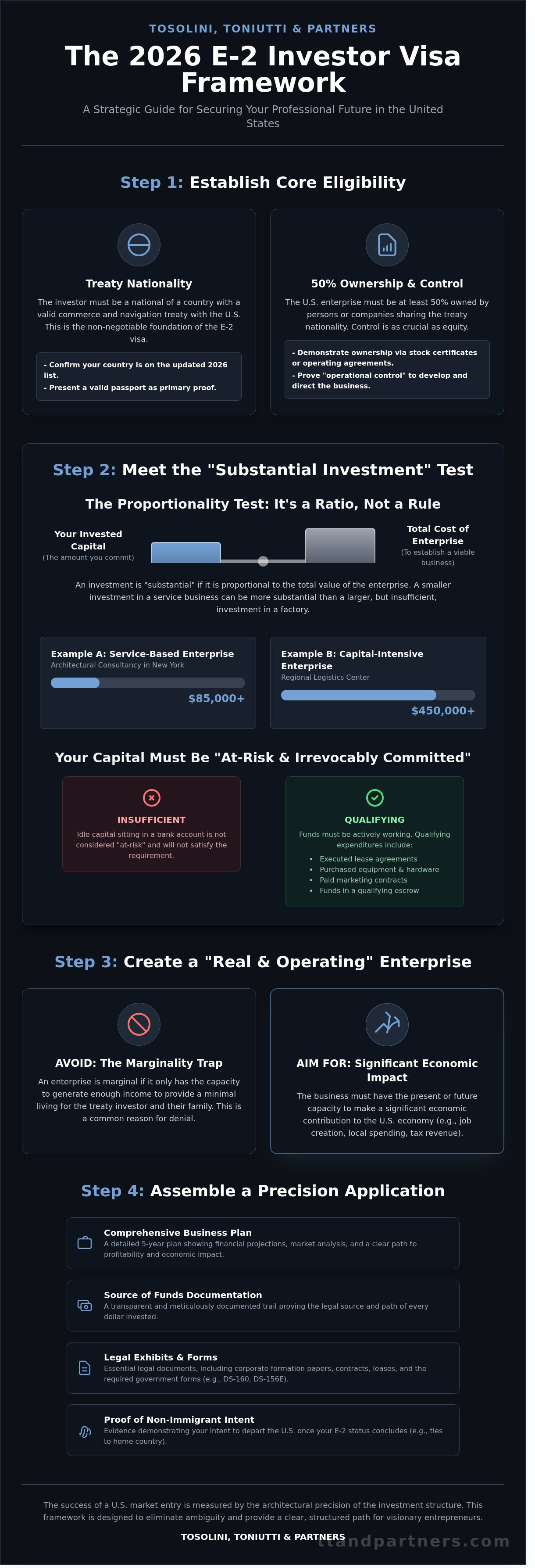
The enterprise must be at least 50% owned by persons who share the nationality of the treaty country. This isn't just about equity; it's about the source of control. While the individual investor often takes the lead, the classification also extends to "essential employees" who possess specialized skills or executive authority. These individuals must share the same nationality as the treaty investor or the primary owner of the US entity. This distinction allows a firm to scale its operations by bringing in key technical or managerial talent from the home country, provided their role is vital to the US enterprise's success.
Verifying Your Treaty Country Status
Proving eligibility requires meticulous documentation. Individual investors must present a valid passport from a treaty nation. For corporate structures, the "nationality" of the business is determined by the citizenship of its individual owners, not its place of registration. If a UK company owns a US subsidiary, you must trace the ownership layers back to individual UK citizens. Dual nationals must select one nationality to lead their application, which dictates the treaty rules they'll follow. If you're structuring a complex international partnership, professional consultation is vital. You can reach our team at https://www.ttandpartners.com/contact to discuss your specific corporate architecture.
Ownership and Control Standards
To satisfy E-2 visa requirements, you must demonstrate at least 50% ownership through stock certificates, operating agreements, or capitalization tables. Control is more than a percentage; it's the "operational control" to develop and direct the business. This means the investor must play an active role in the firm's strategic trajectory. When multiple partners are involved, the business structure must clearly define voting rights to ensure at least one treaty-national partner maintains the authority to steer the enterprise. This structural clarity ensures the business remains compliant even as it grows and attracts new capital.
The 2026 Substantial Investment Checklist: Quantifying Your Capital
The 2026 landscape for E-2 visa requirements emphasizes the "Substantiality Test" over arbitrary minimums. Adjudicators evaluate your capital through the lens of the Proportionality Test; this framework compares the amount invested against the total cost of creating a functional business in its specific market. For example, a specialized architectural consultancy in New York might require an $85,000 investment to be considered substantial, while a regional logistics center would likely need upwards of $450,000 to meet the same standard.
Distinguishing between active investment and idle capital is vital for a successful application. Funds sitting in a corporate bank account are generally viewed as "uncommitted" and won't satisfy the E-2 visa requirements on their own. The capital must be working. In 2026, service-based industries typically see approval at 75% to 90% of total startup costs. High-capital ventures, such as manufacturing, may qualify with a lower percentage if the absolute dollar amount is high enough to ensure the business's success. It's a matter of ensuring the investment is sufficient to ensure the investor's financial commitment to the enterprise's success.
At-Risk Capital Requirements
To secure approval, your capital must be irrevocably committed. This means the investor has already assumed the risk of loss. Qualifying expenditures include executed lease agreements, purchased hardware, and paid contracts for initial marketing phases. Many 2026 applicants utilize escrow accounts to manage this risk effectively. Under an escrow agreement, funds are transferred to the business account only upon visa issuance, satisfying the "at-risk" criteria while protecting the investor’s principal. If you're looking for guidance on how to structure these financial commitments within your business plan, you can connect with our team for a detailed consultation.
Proving the Legality of Your Source of Funds
The "Audit Trail" is a non-negotiable requirement. You must document the path of every dollar from its origin to the US business account with absolute precision. Acceptable sources include personal savings, documented inheritances, or gift affidavits accompanied by the donor's own financial history. Secured loans are also permitted, provided they aren't collateralized by the assets of the US enterprise itself. Conversely, capital derived from criminal activity or unsecured loans is strictly prohibited. In 2026, transparency is the highest priority; detailed bank records and tax returns are essential to prove the funds were legally obtained and transferred.
The 'Real and Operating' Enterprise: Beyond Marginality
An E-2 enterprise functions as a living entity within the US economy. It isn't a passive holding or a static paper company. To satisfy current E-2 visa requirements, the business must be an active, commercial endeavor that produces tangible services or goods for profit. Speculative investments, such as land banking or a personal stock portfolio, don't meet this threshold. The 2026 regulatory environment demands proof that the business is currently operational or possesses the architectural readiness to begin operations immediately upon visa issuance.
Central to this evaluation is the "Marginality" Rule. A business is considered marginal if it lacks the capacity to generate more than enough income to provide a minimal living for the investor and their family. Consular officers look for a vision that extends beyond personal sustenance. Your enterprise must demonstrate a significant economic contribution to the local community, which is typically evidenced through its ability to scale, generate robust profits, and support a US based workforce.
Establishing a Bona Fide US Business
The physical presence of your business serves as the primary evidence of its legitimacy. You must provide a signed lease for a dedicated commercial space, as residential addresses or virtual offices rarely suffice for modern adjudications. High resolution photographs of the premises, utility bills dated within the last 60 days, and a Certificate of Occupancy create a narrative of a ready to work environment. The structural integrity of the venture often starts with professional LLC incorporation, which aligns the business architecture with US legal standards. You'll also need to secure an Employer Identification Number (EIN) from the IRS and all necessary local permits to prove compliance with the regional urban fabric.
Financial Viability and Growth Projections
A 5-year comprehensive business plan is the blueprint that proves your project isn't marginal. This document must include a detailed market analysis that accounts for the 3.2% projected inflation rate expected in late 2026 and shifting consumer behaviors. Your financial forecasts should show a clear trajectory toward profitability that supports the investor and at least two full-time employees by the end of year two. Adjudicators favor plans that rely on concrete data rather than optimistic guesses. Using professional market research to support your revenue claims adds a layer of precision that reflects professional magistery.
Job creation remains the most persuasive metric for demonstrating economic impact. While the law doesn't mandate a specific number of employees on day one, the intent to hire US workers is a core component of the E-2 visa requirements. Successful applications in 2026 typically outline a hiring schedule that includes:
The recruitment of at least one specialized US manager by the 18 month mark.
A total staff of five to seven full-time equivalent employees by the fifth year of operation.
Proof of payroll taxes or detailed job descriptions for future roles to show the functional need for labor.
This commitment to human capital transforms the business from a private asset into a collaborative contributor to the American workforce. It shows you aren't just buying a job, but building an institution.
Intent to Depart and Non-Immigrant Intent
The E-2 visa operates within a specific legal framework that demands a clear distinction between temporary stay and permanent residence. A critical component of the 2026 E-2 visa requirements involves proving you intend to leave the U.S. once your status concludes or the business ceases to function. Unlike H-1B or L-1 visas, which explicitly recognize dual intent, the E-2 classification requires applicants to satisfy consular officers that their stay is temporary. It's a structural necessity. You can renew your status every few years indefinitely, but each renewal rests on the premise that your presence is tied to the functional needs of the investment.
Proving Ties to Your Home Country
Consular officers look for evidence that you've kept a foothold outside the United States. While you'll be managing a U.S. operation, your application package should include a signed statement of intent to depart. This document is a formal declaration of your commitment to follow federal regulations. In 2026, the Department of State has placed increased scrutiny on the continuity of foreign ties for investors who have been in the U.S. for more than 10 years. You should provide a concrete documentation checklist to support your claim:
Foreign property deeds or long-term residential lease agreements dated within the last 24 months.
Evidence of immediate family members residing in your home country.
Financial records or tax filings for secondary business interests held abroad.
Strategic planning often involves choosing an Italian lawyer to bridge the gap between foreign legal obligations and U.S. investment goals. This ensures your cross-border ties are presented with professional precision and reflect an authentic connection to your place of origin.
E-2 to Permanent Residency: Strategic Considerations
Investors often look for a path from E-2 to Green Card without compromising their current non-immigrant intent. Transitioning requires careful timing and a shift in legal positioning. You might compare E-2 visa requirements with the O-1 extraordinary ability criteria if your professional background is highly specialized. The O-1 doesn't require a specific investment amount but demands proof of high-level achievement, providing a different architectural route to long-term residency.
Transitioning requires a delicate balance. If you apply for a Green Card, you must show that your original intent was non-immigrant, but your professional circumstances evolved. Long-term treaty investors must navigate these 2026 policy updates with a focus on functional compliance. It's about maintaining the integrity of your current status while building the foundation for future residency. Every document must align with the broader vision of your business and personal goals.
If you're ready to align your investment vision with these complex legal requirements,
for a consultation.
Assembling the E-2 Application: Precision and Strategy
The final phase of securing your status involves more than just gathering documents; it requires a strategic synthesis of your entire business vision. The legal cover letter serves as the structural frame of the application. It's the executive summary that translates complex financial data into a narrative that meets the E-2 visa requirements. A well-crafted letter guides the consular officer through the investment's logic, ensuring they understand the source of funds and the business's potential for growth by 2026.
Your submission package must include specific forms and meticulously indexed exhibits. The DS-160 captures your biographic data, while the DS-156E focuses on the treaty investor's specific business details. Supporting evidence should be organized with clinical precision, including:
Detailed wire transfer receipts and escrow agreements.
Lease contracts for physical business premises.
Tax returns and payroll records for existing enterprises.
A comprehensive five-year business plan with hiring projections.
Preparing for the consular interview is the final site visit in this process. Officers in 2026 focus heavily on the "marginality" of the business and your direct control over the investment. You'll need to answer questions about your professional background and the specific path your capital took from your home country to the United States. Clarity and professional confidence during this 10-minute window are as vital as the paperwork itself.
Common Pitfalls and RFE Triggers
Requests for Evidence (RFEs) often occur when there's a disconnect between the business plan and the actual capital committed. If your projections show a staff of 12 by the second year but your initial investment doesn't cover the first six months of operating costs, the officer will likely flag the case. We see many denials based on "weak" investment evidence, such as unverified personal loans or vague "sweat equity" that lacks a clear valuation. Every document must undergo professional translation and international certification; a single linguistic error in a 2026 filing can lead to months of delays.
The TT and Partners Advantage for 2026
We leverage decades of US-Italy cross-border experience to navigate the most complex investor cases. Our approach treats immigration not as a standalone hurdle, but as a strategic element of your business formation. We ensure that your corporate structure and investment narrative align with both legal standards and your long-term vision. Our team focuses on the harmony between your architectural business goals and the strict E-2 visa requirements of the current year. To begin building your future in the United States, schedule a specialized E-2 consultation with our experts today.
Architecting Your 2026 American Expansion
Building a commercial presence in the United States requires the same structural precision as a landmark development. Success hinges on mastering the E-2 visa requirements, specifically the 2026 standards for substantial capital commitment and the rigorous 5 year business plan projections. Your investment must be 100% at risk before filing. The enterprise must also prove it's more than a marginal venture by creating at least 2 full-time jobs for US workers within its first 24 months of operation. These metrics form the foundation of a resilient application.
At TT and Partners, we bring 20 years of cross-border experience in US-Italy law to every high-net-worth investor strategy. We focus on the harmony between your vision and the legal framework, maintaining a proven track record with complex E-2 and O-1 filings. Our boutique approach ensures that every detail of your application is as deliberate as a master-planned project. We don't just process papers; we engineer the path for your international growth.
Your journey toward a sustainable US presence starts with a single, well-placed stone. We look forward to building that future together.
Frequently Asked Questions
What is the minimum investment required for an E-2 visa in 2026?
The U.S. government hasn't set a fixed minimum dollar amount for the E-2 visa requirements in 2026, though a substantial investment typically starts at $100,000 for most service-based enterprises. While lower amounts like $50,000 might succeed for low-cost consulting firms, consular officers favor capital that covers 100% of the business setup costs. Your capital must be fully committed to the venture before you submit your application to the embassy.
Can I use a gift from a family member as my E-2 investment capital?
You can use a gift from a family member as your primary investment capital as long as you provide a clear paper trail documenting the source of the funds. The donor must sign a gift affidavit confirming that the money isn't a loan and doesn't require repayment. In 2026, USCIS expects bank statements and tax records from the donor to prove the capital was earned through lawful means.
Does a franchise purchase qualify for E-2 visa requirements?
A franchise purchase qualifies for the E-2 visa requirements because it offers a proven business model and clear financial projections. Consular officers often view franchises favorably since they come with established brand recognition and operational support. You'll need to include the signed franchise agreement and proof of the initial franchise fee payment in your documentation to satisfy the regulatory criteria.
How long can I stay in the United States on an E-2 visa?
You can stay in the United States for an initial period of up to 5 years, depending on the reciprocity agreement between your home country and the U.S. While the visa stamp has a specific expiration date, each entry into the country usually grants you a 2-year period of authorized stay. You can renew your status indefinitely as long as the business remains operational and continues to meet all regulatory criteria.
Can my spouse work in the US if I have an E-2 visa?
Your spouse is authorized to work anywhere in the United States without applying for a separate Employment Authorization Document. Their work authorization is granted incident to status upon entry, meaning they'll receive an I-94 record with an E-2S designation. This allows them to seek employment with any American company or even start their own separate business venture while you manage the primary investment.
Is it possible to change from a B-1/B-2 visitor visa to E-2 status while in the US?
You can change from a B-1/B-2 visitor visa to E-2 status by filing Form I-129 with USCIS while you're physically present in the United States. It's important to wait at least 90 days after your arrival to avoid allegations of preconceived intent regarding your immigration goals. Remember that a change of status only grants you the right to stay; if you leave the country, you'll still need to attend a consular interview to obtain a physical visa stamp for re-entry.
What happens to my E-2 status if the business fails?
Your E-2 status terminates immediately if the business fails or ceases operations, as your legal residency is tied directly to the enterprise's viability. You'll typically have a 60-day grace period to depart the United States or file for a change to a different visa category. To avoid this risk, many investors maintain a contingency plan or transition to permanent residency options when the business reaches 10 employees.


Comments