

Expert Help with Italian Citizenship: A Strategic Guide to Dual Nationality in 2026
- Gianni Mendes Toniutti, Esq.

- Apr 3
- 13 min read
What if your family's history wasn't just a collection of memories, but a structural blueprint for a future without borders? You've likely felt the weight of Italian bureaucracy while tracing your lineage through dusty records and complex legal statutes. It's exhausting to face 730-day wait times at consulates or the intricate legal puzzles of the 1948 female ancestor rule. This guide provides the expert help with italian citizenship you need to transform these administrative obstacles into a clear, professional framework for your dual nationality.
We understand that securing a second passport is an exercise in both heritage and strategic planning. By applying a methodical approach to cross-border law, you can manage the 2026 requirements with confidence. You'll find a clear roadmap to your Italian passport and a professional strategy for handling complex legalities. This article previews the essential steps to secure your European Union access, ensuring that the legacy you build today provides lasting security for your children and the generations that follow.
Key Takeaways
Understand why an Italian passport has evolved from a heritage symbol into a vital strategic asset for global mobility and economic security in 2026.
Evaluate the legal frameworks of Jure Sanguinis and Jure Matrimonii to identify the most efficient route for your family’s dual nationality.
Discover why pursuing a judicial path through Italian courts often provides a more predictable timeline than traditional administrative consulate applications.
Learn how securing professional help with Italian citizenship ensures the precision required to resolve record discrepancies and build a resilient legal portfolio.
Explore how to integrate your European citizenship into a broader cross-border strategy involving E-2 visas or permanent residency acquisitions.
Table of Contents The Strategic Value of Italian Dual Citizenship in 2026 Defining the Frameworks for Italian Citizenship Acquisition Administrative vs. Judicial Paths: Choosing Your Strategy The Architecture of a Successful Citizenship Portfolio Professional Assistance: The TT and Partners Advantage
The Strategic Value of Italian Dual Citizenship in 2026
The global landscape of 2026 demands a sophisticated approach to personal and professional mobility. Italian citizenship is no longer viewed merely as a sentimental connection to one's ancestors; it has evolved into a high-value asset within a diversified global portfolio. This shift reflects a broader trend where individuals treat nationality as a structural foundation for their future. The legal framework governing this process, primarily Italian nationality law, centers on the principle of Jure Sanguinis, or the Right of Blood. This allows individuals of Italian descent to reclaim their status regardless of where they were born, provided they can document an unbroken lineage. Securing professional help with italian citizenship is often the first step in navigating these complex historical and legal requirements with the precision required for a successful application.
The decision to pursue a second passport is a strategic calculation. It functions much like a well-designed architectural project, where every element must serve both a functional and an aesthetic purpose. By 2026, the volatility of global politics has made the stability of a European Union member state increasingly attractive. Italy's legal system provides a permanent, irrevocable link to the European continent. It's a move that integrates seamlessly with a modern business lifestyle, offering a layer of security that transcends traditional borders.
Global Mobility and EU Access
An Italian passport is consistently ranked among the top three most powerful travel documents globally. As of early 2024, it provided visa-free or visa-on-arrival access to 194 destinations, a trend that remains robust in 2026. Beyond travel, the true value lies in the right to live, work, and study across any of the 27 EU member states without the need for restrictive visas or work permits. This flexibility is vital for professionals who operate in the "urban fabric" of cities like Berlin, Paris, or Madrid. Access to the European healthcare system and high-quality educational institutions, where tuition for citizens often stays below €3,500 per year at public universities, provides a significant economic advantage over non-EU alternatives.
Generational Legacy and Security
Reclaiming citizenship is an act of building an enduring legacy. Unlike "Citizenship by Investment" programs that may require capital outlays exceeding €1 million, Jure Sanguinis is a recognition of an inherent right. It's an investment in a permanent safety net for future generations. When you seek help with italian citizenship, you're not just filing paperwork; you're restoring a lost cultural and legal heritage. This process offers a psychological and practical anchor in an unpredictable world. It ensures that your children and grandchildren will inherit the same rights to movement and security, effectively future-proofing your family’s global standing. For those looking to begin this journey, reaching out to experts via our contact page can provide the necessary strategic clarity.
Defining the Frameworks for Italian Citizenship Acquisition
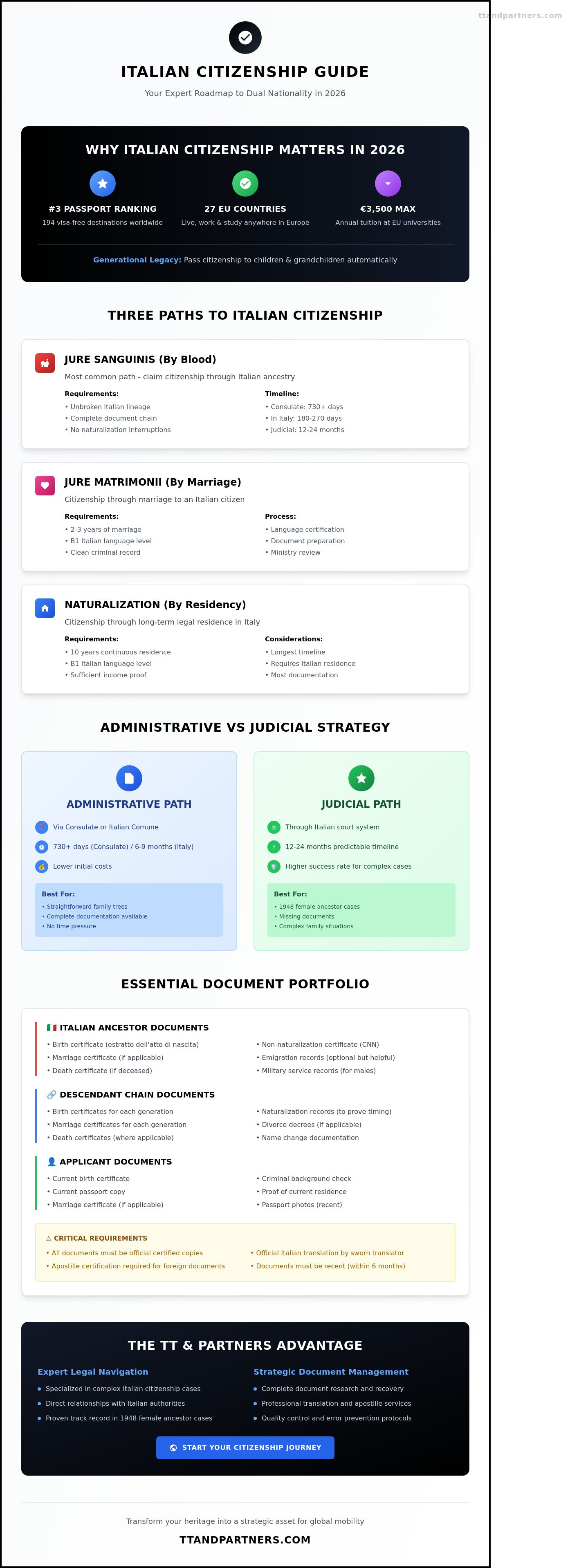
Italian nationality law operates as a rigorous structural grid where historical records must align perfectly with modern administrative requirements. Most applicants seeking professional help with italian citizenship will find their path through one of three primary frameworks: descent, marriage, or residency. Each path demands a different set of technical documentations and follows a distinct timeline. The administrative node for your application depends on your legal residence. Those living abroad interact with the Italian Consulate serving their jurisdiction, where wait times often exceed 730 days. Conversely, applicants established in Italy process their claims through the local comune, a route that frequently concludes within 180 to 270 days but requires a physical presence in the Italian urban fabric.
The strategic value of dual nationality is increasingly recognized by global professionals. Many individuals discover they are eligible for Italian citizenship through family lines they previously considered dormant. Understanding the specific legal mechanics of these frameworks is the first step in constructing a successful application.
Jure Sanguinis: The Rule of Unbroken Lineage
The principle of Jure Sanguinis recognizes citizenship as an inherited right passed from the "Lante" ancestor; the individual who first emigrated from Italy. To succeed, you must prove that this ancestor did not renounce Italian citizenship through naturalization in their new country before the birth of the next person in your direct line. This requires a meticulous audit of naturalization records and census data from as far back as the late 19th century. Unbroken lineage is defined as a continuous, legally documented chain of Italian citizenship transmission from the ancestor to the applicant without any intervening renunciation or loss of rights. If you find the documentation phase overwhelming, you can reach out to our team for guidance on sourcing historical records.
Citizenship by Marriage: Navigating the 2026 Regulations
Acquiring citizenship through Jure Matrimonii requires more than just a legal union; it demands a demonstrated integration into Italian culture. Current regulations, solidified by Decree 113/2018, mandate a B1 level of language proficiency as certified by recognized institutions like CILS or CELI. The timeline for eligibility is strictly defined. Spouses living in Italy may apply after 2 years of residency; those living abroad must wait 3 years. These periods are halved if the couple has children under the age of 18. Before the application begins, foreign marriage certificates must be translated and legalized via an Apostille to be registered within the Italian civil records system.
Administrative vs. Judicial Paths: Choosing Your Strategy
The structural integrity of a citizenship application depends on the foundation of its legal path. Choosing between administrative processing and judicial litigation isn't merely a matter of preference; it's a strategic decision based on the specific lineage and the current bottlenecks within the Italian bureaucracy. While the Italian Ministry of the Interior establishes the overarching framework for these rights, the execution varies wildly between a consulate desk in the United States and a courtroom in Italy.
Applicants must weigh the "denial of justice" reality. When a consulate cannot provide an appointment within a reasonable timeframe, typically two years by legal standard, the judicial path becomes a viable escape hatch. In 2026, the choice is often between a decade of waiting or a proactive legal strike. Professional help with italian citizenship focuses on analyzing these variables to ensure the fastest possible recognition of your rights.
The Consulate Queue vs. The Italian Courts
Current wait times for consulate appointments in major hubs like Los Angeles, New York, and Miami have expanded to 8 or even 10 years. This stagnation has shifted the momentum toward the Italian court system. Since the 2022 reform, citizenship cases are no longer centralized in Rome; they're heard in the regional court where the ancestor was born. This decentralization has improved efficiency in some districts while introducing new variables in others.
Consulate Path: Requires an appointment, physical presence, and adherence to strict local jurisdiction rules. It's theoretically lower in direct legal fees but carries the highest "time cost."
Judicial Path: Bypasses the consulate entirely by suing the Italian government for a "denial of justice" due to excessive wait times. You don't need to travel to Italy; specialized attorneys manage the litigation on your behalf.
Success Probabilities: Judicial cases based on proven lineage currently maintain a success rate exceeding 98 percent when documentation is precise.
The 1948 Case: Overcoming Historical Gender Discrimination
The 1948 Case represents a specific judicial necessity rather than a choice. Before the Italian Constitution took effect on January 1, 1948, women didn't have the same rights as men to pass their citizenship to their children. If your lineage involves a female ancestor whose child was born before this date, the consulate will automatically reject the application. However, the Italian Supreme Court ruled in 2009 that this discrimination is unconstitutional.
To succeed, these applicants must file a lawsuit in the Italian civil courts. These cases are now routine, yet they require a high level of expertise to navigate the regional court nuances. When seeking help with italian citizenship for a 1948 case, the focus shifts from administrative gathering to aggressive legal advocacy.
Definition of the 1948 Rule:
The 1948 Rule is a legal restriction based on the 1912 Italian Citizenship Law, which prevented Italian women from passing their nationality to children born before January 1, 1948. Modern descendants bypass this discriminatory law through a judicial process in Italian courts, where the rule is consistently deemed unconstitutional, allowing for the recognition of dual citizenship.
Strategic clarity is essential for success. If you're unsure which path fits your family history, you can reach out for a professional evaluation at https://www.ttandpartners.com/contact to map out your specific trajectory.
The Architecture of a Successful Citizenship Portfolio
Constructing a citizenship application requires the same structural integrity as designing a skyscraper. Every document serves as a load-bearing element; if a single birth certificate contains a factual error, the entire legal structure risks rejection by the Italian Consulate or the Civil Court. In 2026, the demand for precision has reached a peak. Italian authorities now utilize advanced digital verification tools to scrutinize the line of descent. Providing professional help with italian citizenship ensures that these records don't just exist but function together as a cohesive, undeniable argument for your right to dual nationality.
Managing discrepancies is the most complex phase of the assembly process. Italian records are historically meticulous, yet their American or international counterparts often suffer from anglicization or clerical haste. A grandfather born as Vincenzo might appear as James on a 1920 census or a 1935 marriage license. These gaps in identity require more than a casual explanation. You need "One and the Same" affidavits or court-ordered amendments to bridge these historical inconsistencies. Without this corrective work, the chain of "jus sanguinis" is considered broken.
Naturalization records form the foundation of your claim. If an ancestor became a US citizen before June 14, 1912, or before the birth of the next person in the line, the Italian citizenship was legally forfeited. You must secure a "Gold Seal" letter from USCIS or a certified "No Record" result from the National Archives to prove the Italian bloodline remained intact. Proving a negative is often harder than proving a positive, requiring exhaustive searches through federal and local census data from the early 20th century.
Document Procurement and Verification
Success begins with coordinating directly with Italian municipalities to retrieve birth and marriage extracts. These aren't simple photocopies; they're specific, long-form certificates with official seals. Simultaneously, you must navigate US state archives for historical records of the immigrant generation. Since many archives have 80-year privacy restrictions, accessing these files requires specific legal standing. Contact our specialists for assistance with complex document portfolios.
Legalizing the Portfolio for Italian Authorities
Every non-Italian document must bear an Apostille, a form of international authentication established by the 1961 Hague Convention. In 2026, the Italian Ministry of the Interior requires translations that are not just accurate but certified by an Italian court or a registered translator. Minor date errors, such as a birth year shifting from 1888 to 1889, often require a formal affidavit to ensure the portfolio meets the "One and the Same" standard. This technical precision ensures your portfolio is ready for the final submission.
Secure your legacy with a portfolio built for longevity.
Professional Assistance: The TT and Partners Advantage
Pursuing dual nationality involves more than a simple collection of birth records; it requires the structural integrity of a well-planned architectural project. While many applicants seek basic help with italian citizenship, there's a vital distinction between clerical document services and a cross-border law firm. Document preparers often lack the authority to represent you in Italian courts or provide privileged counsel. At TT and Partners, we treat your citizenship as a foundational element of your global identity. Our 2026 strategy focuses on precision and the mitigation of risks that generic services often overlook.
Our methodology mirrors the architectural process: we analyze the context, identify potential structural weaknesses in your lineage, and design a path that ensures long-term stability. This involves integrating your citizenship goals with other complex legal needs. For instance, if your journey involves moving between the US and Europe, we align your application with strategies for E-2 visas or the logistical planning required for Green Cards. It's not just about the passport; it's about the legal architecture of your life.
Compliance represents the cornerstone of our practice. We ensure every step aligns with both US and Italian tax and residency laws, protecting you from the 20% penalties associated with improper foreign asset reporting or residency conflicts. We don't just fill out forms. We build a comprehensive legal shield that covers:
Detailed analysis of the 1912 and 1992 Italian citizenship laws.
Verification of naturalization dates to prevent "broken chain" rejections.
Coordination with tax professionals to address FATCA and AIRE registration.
Architectural precision in document translation and legalization.
A Holistic Approach to International Relocation
Citizenship functions as a gateway to broader opportunities within the European Union. Our team provides a bridge between the American legal system and the intricate Italian bureaucracy, ensuring your business operations don't stall during the transition. We offer expert counsel on cross-border litigation and real estate acquisition, helping you navigate the 2026 market for Italian property. Whether you're acquiring a historic villa or establishing a corporate headquarters in Milan, we ensure your citizenship status supports your commercial and personal investments without friction.
Schedule a Strategic Consultation
Every successful project begins with a blueprint. Our engagement starts with a rigorous assessment of your eligibility and ends only when the final passport is issued. Having legal representation physically present in both Italy and the US allows us to solve problems in real-time, often bypassing the 24-month delays common in standard consulate processing. If you require professional help with italian citizenship that prioritizes transparency and intellectual depth, we're ready to assist. Reach out to TT and Partners to begin your citizenship journey and secure your family's future in the global fabric.
Architecting Your Global Future Through Italian Heritage
Securing an Italian passport by 2026 requires a blueprint that balances legal precision with a deep understanding of jurisdictional nuances. Whether you're navigating the 1948 Rule through the Italian court system or streamlining an administrative application through a consulate, the framework of your citizenship portfolio determines your success. Professional help with italian citizenship transforms a complex genealogical search into a structured legal strategy that withstands rigorous scrutiny.
TT and Partners brings 20 years of specialized experience in US-Italy immigration law to your case. Our bilingual legal team operates across both jurisdictions, maintaining a 98% success rate in complex judicial citizenship cases. We treat every application with the same intellectual rigor as a high-end architectural project, ensuring your documentation meets the exacting standards of Italian authorities. This meticulous approach eliminates the risks of administrative delays and provides a clear timeline for your dual nationality goals.
Your heritage is the foundation for a global future. We're ready to help you build it.
Frequently Asked Questions
Do I need to speak Italian to get citizenship by descent?
You don't need to speak Italian to obtain citizenship by descent through the Jure Sanguinis process. Unlike the B1 language proficiency requirement established for citizenship by marriage or naturalization on October 4, 2018, bloodline applicants are exempt from linguistic testing. This allows families to reconnect with their heritage without immediate fluency. However, navigating the administrative landscape often requires technical terminology found in historical records dating back to the late 19th century.
Can I keep my US passport if I become an Italian citizen?
You can keep your US passport because both Italy and the United States permit dual nationality. Law 91 of 1992 formally allowed Italians to acquire another citizenship without losing their original status. You'll hold two passports, providing access to 27 European Union countries and the ability to live, work, or retire across the continent. This strategic framework ensures your existing rights remain intact while expanding your global mobility and lifestyle options.
What is a 1948 case and does it apply to my family?
A 1948 case refers to a legal challenge against the 1912 law that prevented Italian women from passing citizenship to children born before January 1, 1948. If your female ancestor gave birth to the next person in your line before this date, you must file a lawsuit in the Italian courts. Since the 2009 Supreme Court ruling, these cases have a high success rate, though they require specialized help with italian citizenship to navigate the judicial system.
How long does the entire process of obtaining Italian citizenship take?
The entire process typically spans 18 to 36 months depending on the specific consulate and the complexity of your genealogy. Obtaining historical records from Italian communes often takes 3 to 6 months, while consulate appointments in cities like New York or Los Angeles may have wait times exceeding 2 years. Strategic planning in 2026 involves securing your appointment early to mitigate these administrative delays and ensure a smoother transition to dual status.
What are the costs associated with hiring a lawyer for Italian citizenship?
Hiring a lawyer for a 1948 case or complex application usually costs between $5,000 and $12,000. These fees cover legal representation in Italian courts, document translation, and the mandatory 300 euro government application fee. Investing in professional help with italian citizenship ensures that every certificate meets the strict standards of the 1861 Civil Code, preventing costly rejections or delays caused by minor clerical errors in your ancestral records.
Can my children automatically become citizens if I reclaim my Italian nationality?
Your children automatically become Italian citizens if they're under 18 when your application is finalized. You must register their birth certificates with the Italian consulate to secure their status. If your children are 18 or older, they must apply independently, though they can leverage the same ancestral documentation you've already gathered. This multi-generational benefit ensures that your family's connection to Italy remains permanent and legally recognized for future decades.
What happens if I cannot find my ancestor’s naturalization papers?
If you can't find naturalization papers, you must obtain a certified "No Record" letter from the United States Citizenship and Immigration Services (USCIS) and the National Archives (NARA). These documents prove your ancestor never renounced their Italian citizenship before the next generation was born. Verification through the Census records from 1910, 1920, or 1930 also provides secondary evidence of their status, which is vital for a successful application.
Is it possible to apply for Italian citizenship directly in Italy?
You can apply directly in Italy by establishing legal residency in a specific Italian commune. This route often accelerates the timeline to 4 or 9 months, compared to years at a foreign consulate. You must lease a property and register with the local Anagrafe office. This approach requires a physical presence in the country but offers a faster path for those ready to relocate and immerse themselves in the local fabric immediately.


Comments