

How to Get a Permesso di Soggiorno in Italy: The 2026 Strategic Guide
- Gianni Mendes Toniutti, Esq.

- Apr 2
- 13 min read
Your presence in Italy isn't just a change of address; it's a structural integration into a new social fabric. Data from recent years shows that many of the 160,000 annual applicants struggle with the strict 8-day deadline for residency registration, leading to unnecessary legal friction. The complexity of the "Kit Giallo" shouldn't be an obstacle to your long-term vision. This guide offers a precise architectural framework for how to get a permesso di soggiorno in Italy. We've refined these 2026 protocols to ensure your application is functional, compliant, and successful from the very first filing at the post office.
It's natural to feel overwhelmed by the linguistic and bureaucratic barriers inherent in the Italian Questura system. We've designed this resource to transform that confusion into a streamlined process, moving you from temporary visitor to recognized resident. You'll learn exactly how to secure the "ricevuta" receipt that grants your initial legal rights. We'll also map out the timeline for your appointment and the eventual transition to permanent residency. This isn't just about paperwork; it's about building a stable foundation for your life abroad.
Key Takeaways
Understand the essential distinction between an entry visa and the residence permit to establish a secure legal foundation for your stay in Italy.
Navigate the administrative landscape of Poste Italiane with a precise guide to obtaining and correctly filing the mandatory "Kit Giallo" application.
Master the strategic framework on how to get a permesso di soggiorno in Italy by preparing for the critical biometric phase and fingerprinting at the Questura.
Learn the timeline and requirements for permit renewals and conversions to ensure your residency remains uninterrupted and adaptable to your professional evolution.
Mitigate the structural risks of rejections or legal delays by integrating an architectural, expert-led approach into your relocation strategy.
Table of Contents Understanding the Permesso di Soggiorno: The Legal Framework Step 1: The Application Process via Poste Italiane Step 2: The Questura Appointment and Biometrics Strategic Management: Renewals and Conversions Why Professional Legal Counsel is Essential
Understanding the Permesso di Soggiorno: The Legal Framework
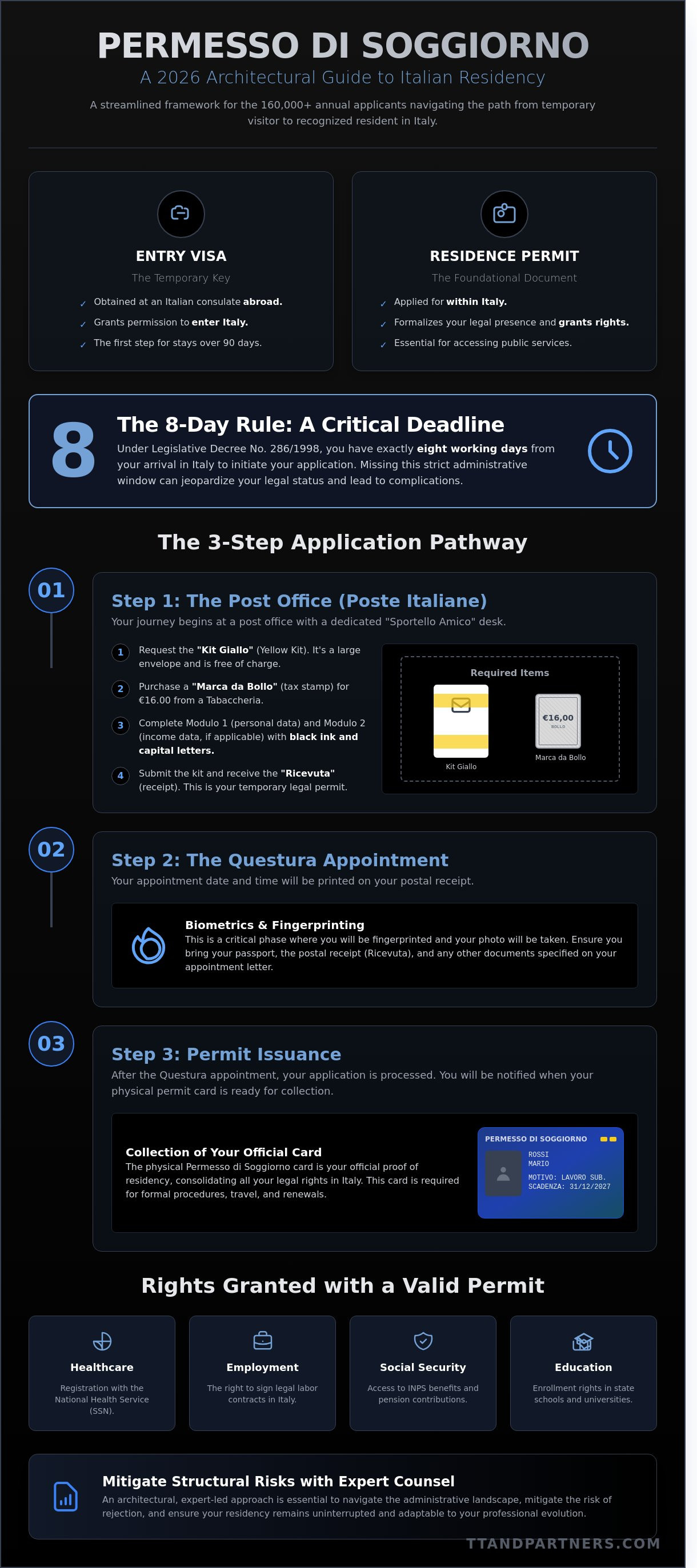
The Permesso di Soggiorno serves as the structural foundation for any non-EU citizen intending to reside in Italy for more than 90 days. While an entry visa, obtained at an Italian consulate abroad, functions as a temporary key to cross the border, the residence permit is the document that formalizes your presence within the country's legal and social fabric. The Permesso di Soggiorno is the essential bridge between a foreign visa and Italian civil rights. Without this permit, your stay lacks the functional stability required to access essential public services or maintain long-term residency.
Timing is the most critical element of this process. Under the Consolidated Law on Immigration (Legislative Decree No. 286/1998), you have exactly eight working days from your arrival in Italy to initiate your application. This "8-Day Rule" is a strict administrative deadline. Missing this window can lead to complications with the Questura (police headquarters) and may jeopardize your legal status. Understanding how to get a permesso di soggiorno in Italy requires a commitment to this immediate timeline, ensuring your transition into Italian life remains seamless and compliant.
Once you hold a valid permit, you gain access to a comprehensive suite of rights that integrate you into the community. These include:
Healthcare: Registration with the Servizio Sanitario Nazionale (SSN) for public medical care.
Employment: The right to sign legal labor contracts and participate in the Italian economy.
Social Security: Access to INPS benefits and pension contributions.
Education: Enrollment in state schools and universities under the same conditions as Italian citizens.
Who Needs a Residence Permit in 2026?
In 2026, the requirement remains mandatory for all non-EU nationals, including citizens from the United States, Canada, and the United Kingdom, who plan to stay for work, study, or family reasons. Short-term visitors staying under 90 days for tourism don't need a permit; they typically only require a "Dichiarazione di Presenza" (Declaration of Presence) if arriving from a Schengen country. For everyone else, the permit is the primary tool for legal integration.
The Relationship Between Your Visa Type and Your Permit
The permit category must align precisely with the visa used for entry. The Questura won't issue a permit that contradicts the original intent of your stay. For example, if you enter on a "Lavoro Subordinato" visa, your permit will reflect your status as an employee. Other common categories include "Lavoro Autonomo" for the self-employed and "Residenza Elettiva" for those with significant passive income. Consistency in your legal narrative is vital. Learning
how to get a permesso di soggiorno in Italy
involves ensuring that your initial visa application and your subsequent permit request form a coherent, legally sound path toward your new life in the Italian urban landscape.
Step 1: The Application Process via Poste Italiane
The journey to legal residency begins at a local post office. You cannot use just any branch; you must locate one featuring the "Sportello Amico" desk. This dedicated service point handles immigration filings and public administration tasks. At this desk, you will request the "Kit Giallo," a yellow-striped envelope containing the forms necessary for your application. The kit itself is free of charge. Receiving this envelope marks the first tangible step in understanding how to get a permesso di soggiorno in Italy through the postal system.
Inside the kit, you will find several forms and an instruction booklet. While the documents might look daunting, they represent the structural foundation of your legal status. Before you return to the post office to file, you must visit a local "Tabaccheria" to purchase a Marca da Bollo. This administrative stamp is a mandatory requirement for 2026, costing exactly €16.00. You will stick this stamp onto the first page of your application form in the designated space. Once you submit the completed kit, the postal clerk provides a "Ricevuta" (receipt). This paper is your most valuable asset, as it serves as your legal permit until the physical card is issued.
Filling Out the Kit Giallo with Precision
Accuracy in the Kit Giallo is non-negotiable. Modulo 1 is designed for personal data, including your passport details and current address in Italy. If you are applying based on employment or have an independent income, you must also complete Modulo 2. Every entry should be written in black ink and capital letters to ensure machine readability. Precision here prevents the bureaucratic friction that often stalls applications for months.
Your application must include a specific set of attachments to be considered complete:
Photocopies of every page of your passport, including blank pages and previous visas.
A copy of your current Italian visa or existing permit if you are renewing.
Proof of accommodation, such as a registered lease or a declaration of hospitality.
Proof of health insurance or registration with the National Health Service.
Clerical errors are the primary cause of delays. Common mistakes include using correction fluid, leaving the signature field blank until you are at the post office counter, or failing to provide a consistent Italian address. If you find the administrative requirements complex, reaching out for professional guidance can help ensure your documentation meets every technical standard.
2026 Fees and Administrative Costs
The financial investment for a residency permit is standardized across the country. In 2026, the total cost is divided into three distinct payments. First, there is a €30.46 fee for the production of the electronic permit card. Second, Poste Italiane charges a €30.00 service fee for processing the kit. Finally, an additional contribution fee is required, which varies based on the duration of the permit you seek.
As of January 2026, these contribution rates are fixed at:
€40.00 for permits valid between three months and one year.
€50.00 for permits valid between one and two years.
€100.00 for long-term residents (Permesso di Soggiorno UE per soggiornanti di lungo periodo).
You will pay these amounts at the post office using a pre-printed payment slip (Bollettino) found inside the kit. It's vital to keep the original Bollettino receipt stapled to your Ricevuta. The police (Questura) will demand to see this original proof of payment during your fingerprinting appointment. Without it, the process cannot move forward, regardless of how well you know how to get a permesso di soggiorno in Italy.
Step 2: The Questura Appointment and Biometrics
After filing the postal kit, your journey transitions from administrative paperwork to physical verification. The Assicurata, or the registered mail receipt you received at the post office, functions as your temporary legal shield; it verifies your legal presence while you wait for the final electronic card. This document contains your login credentials for the Portale Immigrazione and lists your specific appointment date at the local Questura. It's vital to respect this schedule precisely. Missing an appointment can delay your residency by several months, especially in high-volume processing centers where backlogs are common.
The biometrics visit involves a photolithographic survey where officials record your digital fingerprints. This technical phase ensures the integrity of the Italian immigration database. During the interview, officers verify the consistency of your narrative. They'll ask about your housing, your professional activities, and your long-term intentions. Understanding how to get a permesso di soggiorno in Italy requires recognizing that this isn't just a formality; it's a rigorous assessment of your integration into the local social and economic fabric. Once biometrics are complete, you can track the progress of your application via the official Polizia di Stato portal using the 10-character file number from your receipt.
Document Checklist for the Questura Visit
Precision in your documentation prevents unnecessary delays. You must present the original version of every document included in your postal kit. Essential items include your current passport and four identical 35x45mm photographs with a white background. You also need updated proof of financial resources; for 2024, the minimum social allowance baseline is €6,947.33 for single applicants. Entrepreneurs and investors must provide specific dossiers, such as the Nulla Osta or evidence of capital maintenance for cross-border business ventures. Ensure your health insurance policy remains active and covers the entire duration of your requested stay.
Navigating Potential Challenges at the Police Station
The Questura might issue a request for an Integrazione, which is a formal demand for additional evidence or updated certificates. You typically have a window of 10 to 15 days to comply with these requests. Language barriers often complicate these interactions, leading to misunderstandings that can stall an application. Engaging a professional can mitigate these risks and ensure your file remains moving through the system. Contact Tosolini, Toniutti & Partners for representation during complex Questura filings to ensure your communication with the authorities remains clear and legally sound. Expert oversight provides the structural stability needed to navigate Italian bureaucracy without setbacks.
Strategic Management: Renewals and Conversions
Maintaining a legal presence in Italy requires the same foresight and precision as structural engineering. You don't just wait for an expiration date; you plan for the transition long before the deadline arrives. Italian law, specifically Legislative Decree 286/98, stipulates that you should initiate your renewal process at least 60 days before your current permit expires. This window is vital for ensuring your "ricevuta" (receipt) remains valid, allowing you to maintain access to the national healthcare system and employment rights without interruption.
Converting your status is a strategic pivot often seen when students transition into the professional sphere. Moving from a Permesso per Motivi di Studio to one for Lavoro (work) is a common path. If you've completed a degree at an Italian university, you're eligible to convert your permit outside the restrictive annual quotas set by the Decreto Flussi. This allows you to integrate into the Italian workforce immediately upon graduation. For those without an Italian degree, the process depends on the specific slots opened by the government, typically announced in the first quarter of each year.
Continuity is the cornerstone of residency. If you leave the Italian territory for more than six consecutive months, or for a period exceeding half the duration of your permit, the authorities may revoke your status. This interruption also resets the clock for long-term residency. Understanding how to get a permesso di soggiorno in Italy that lasts is about more than just the initial application; it's about managing your physical presence to protect your future rights.
The Long-Term Vision: Permanent Residency and Citizenship
After reaching the 60-month mark of legal and continuous residency, you qualify for the EU Long-Term Residence Permit. This status offers indefinite stay and greater mobility within the European Union. You'll need to demonstrate a minimum annual income, which for 2024 is set at €6,947.33 for a single applicant. Additionally, you must pass an A2 level Italian language test and sign the Accordo di Integrazione. Explore the path from residency to Italian Citizenship to understand how this permanent status serves as a bridge to full civic participation.
Compliance for Business Owners and Investors
Holders of Lavoro Autonomo permits must ensure their corporate structure remains robust enough to support their residency. The Italian authorities require proof that your business generates enough income to exceed the social subsidy threshold. For 2024, this means showing a taxable income that reflects professional stability. Strategic US-Italy Business Architecture can help you align your commercial interests with your long-term residency goals.
For tailored assistance with your renewal or conversion strategy,
for a consultation.
Why Professional Legal Counsel is Essential
Relocation is a structural undertaking that requires more than a simple checklist. It's a complex assembly of legal, financial, and personal elements that must fit together with precision. Attempting a DIY approach often exposes applicants to systemic failures that are difficult to rectify. The Italian Ministry of Interior processes thousands of applications annually, but data from 2023 indicates that administrative errors lead to significant delays or outright rejections for many independent filers. These aren't just inconveniences; they carry heavy consequences. A rejected application can result in a deportation order under Legislative Decree 286/98, which often includes an entry ban for the entire Schengen Area lasting between 3 and 5 years.
We apply an architectural methodology to your residency. We don't just facilitate a move; we design a sustainable framework for your life in Europe. Understanding how to get a permesso di soggiorno in Italy involves analyzing the interplay between your current assets and local statutes. We build this foundation with the same precision we apply to physical structures, ensuring every legal pillar is sound and every regulatory requirement is met with engineering level accuracy.
Mitigating Risks in the Italian Bureaucratic Landscape
Our legal experts conduct a rigorous audit of your profile to identify "Red Flags" before they reach a government desk. These issues often involve inconsistencies in financial statements or lease agreements that don't meet the specific "idoneità alloggiativa" standards required by local municipalities. Professional document review provides the certainty that your file is beyond reproach. You'll find that a Permesso di Soggiorno is not just a card, but a legal shield for your international lifestyle.
The peace of mind that comes from this preparation is invaluable. By resolving potential conflicts early, we prevent the "pre-avviso di rigetto" notice of intent to reject that stalls so many independent applications. We ensure your documentation aligns with the latest 2024 circulars from the Ministry of Foreign Affairs, providing a clear path through the Questura's requirements. Our role is to foresee complications in the bureaucratic fabric and reinforce your application before it's ever submitted.
Your Partners in Cross-Border Success
TT and Partners specializes in bridging the cultural and procedural gap between US legal expectations and Italian administrative reality. While US systems often prioritize digital speed, the Italian bureaucracy values physical presence and specific paper based formalities. We manage these expectations, acting as your dedicated point of contact for compliance and potential cross-border litigation. Our expertise ensures your residency permit isn't an isolated document but a component of your broader financial and business objectives. Knowing how to get a permesso di soggiorno in Italy is only the first step; maintaining it requires ongoing vigilance.
We treat your relocation as a long term partnership. By integrating your immigration status with tax planning and asset protection, we create a holistic strategy that serves your future. We don't believe in temporary fixes, but in durable solutions that respect both the heritage of the Italian legal system and the modern needs of global citizens. If you're ready to begin this process with professional precision, schedule a consultation with our immigration experts to start building your new life in Italy.
Navigating Your Future in the Italian Landscape
Securing residency is a structural undertaking that requires precision from the initial Poste Italiane filing to the final biometric appointment. Understanding how to get a permesso di soggiorno in Italy involves more than just paperwork; it's a strategic alignment with current 2026 immigration protocols. Success rests on meticulous documentation and timely renewals to maintain your legal standing. TT and Partners brings 20 years of US-Italy cross-border legal expertise to ensure your application meets every regulatory requirement. We specialize in high-net-worth investor visas and provide multilingual support during complex Questura negotiations. Our approach treats your residency as a foundational project, built to last within the Italian social fabric. Don't leave your legal status to chance when professional foresight can streamline the entire journey. We're here to transform complex bureaucracy into a seamless transition for your life abroad.
Italy offers a vibrant canvas for your next chapter, and with the right strategy, your place within it is well within reach.
Frequently Asked Questions
Can I travel outside of Italy while waiting for my first Permesso di Soggiorno?
You can't travel to other Schengen countries while waiting for your initial residency permit. The Poste Italiane receipt only permits direct travel between Italy and your home country, provided you don't transit through any other European states. Border authorities require the original passport and the receipt with the holographic watermark for verification at all exit and entry points during your journey.
How long does it take to receive the physical Permesso di Soggiorno card in 2026?
Current administrative projections for 2026 suggest a processing timeline of 120 to 270 days. This duration fluctuates based on the specific Questura's workload in major metropolitan centers like Rome or Milan. You'll receive an automated SMS notification once the electronic card is ready for collection at your local police station, ensuring a structured transition to legal residency within the Italian territory.
What happens if I miss the 8-day deadline to apply for the permit?
Missing the 8-day window creates a risk of administrative rejection under Article 5 of the Consolidated Law on Immigration. While authorities often accept late applications if you provide a valid justification, a delay exceeding 60 days can lead to a formal expulsion order. You should submit your application kit at a designated Post Office immediately to maintain your legal standing and professional security.
Do I need a separate Permesso di Soggiorno for my spouse and children?
Every family member requires an individual permit regardless of their age. Since the 2013 legislative updates, children no longer appear on a parent's card; they receive a personal Permesso di Soggiorno per motivi familiari. This ensures each individual's legal status remains independent and secure within the Italian urban fabric and social system, reflecting a modern commitment to individual rights and administrative precision.
Is the Permesso di Soggiorno the same as a Codice Fiscale?
The Permesso di Soggiorno is a residency authorization, while the Codice Fiscale is a 16-character alphanumeric tax identifier. You need the tax code for signing contracts and accessing healthcare, but it doesn't grant legal stay. Mastering the details of how to get a permesso di soggiorno in Italy requires a clear distinction between these two essential administrative pillars of your new life.
Can I work in Italy with just the "Ricevuta" from the post office?
You can legally work with the Post Office receipt if you're renewing a permit or applying for a first permit for work or family reasons. Legislative Decree 40/2014 confirms that the receipt grants full employment rights until the physical card is issued. Employers must verify the receipt's authenticity through the Portale Immigrazione website to ensure the professional relationship stays within the legal framework.
What should I do if my application for the residence permit is rejected?
You have 60 days to file a formal appeal with the Regional Administrative Court if your request is denied. A "Preavviso di Rigetto" is typically sent first, giving you 10 days to provide missing documentation or structural explanations. Engaging a legal specialist ensures your response aligns with the complex framework of how to get a permesso di soggiorno in Italy and protects your future residency.


Comments