

E-2 Visa Substantial Investment Amount 2026: A Strategic Legal Framework
- Gianni Mendes Toniutti, Esq.

- May 26
- 13 min read
The most dangerous mistake a treaty investor can make in 2026 is treating "substantiality" as a fixed floor to be reached rather than a dynamic ratio of commitment. Many applicants feel a deep sense of unease when faced with the inherent ambiguity of the E-2 visa substantial investment amount 2026, fearing that a lower figure might trigger a Request for Evidence or a flat denial. It's natural to seek a safe harbor in specific dollar amounts, yet the reality of consular adjudication remains rooted in the proportionality of your capital to the specific operational needs of your enterprise. We recognize that for the visionary entrepreneur, this ambiguity feels like an unnecessary barrier to a well-conceived American venture.
This article provides the expert legal insights you need to master the proportionality test and construct a defensible investment budget that meets the sophisticated expectations of 2026 consular officers. Precision is your strongest asset. You'll gain a clear understanding of how to differentiate between qualified and unqualified expenses while ensuring your funds are irrevocably committed to the business. We will examine the strategic framework required to transform a simple budget into a compelling narrative of investment; this approach gives you the confidence to move forward with your E-2 visa or Green Card aspirations through a lens of professional precision.
Key Takeaways
Decipher the legal nuances of 9 FAM 402.9 to move beyond arbitrary minimums and toward a defensible, case-specific investment strategy.
Master the proportionality test to determine the ideal E-2 visa substantial investment amount 2026 based on your specific business sector and operational scale.
Identify the critical differences between qualified expenditures and working capital to ensure your funds meet the mandatory "at-risk" requirement.
Prepare for rigorous source-of-funds audits by understanding the documentation standards necessary for gifted or personal capital in the current regulatory climate.
Discover how a unified legal and corporate perspective transforms a standard application into a strategic asset for your long-term international expansion.
Table of Contents
Defining Substantiality in the 2026 E-2 Visa Landscape
The legal architecture of the E-2 Investor Visa doesn't rely on a rigid numerical floor. It operates on a sophisticated principle known as substantiality. According to the guidelines set forth in 9 FAM 402.9, an investment is deemed substantial when it's sufficient to ensure the investor's financial commitment to the successful operation of the enterprise. This definition purposefully avoids a hard dollar figure; it creates a flexible framework that adapts to diverse industries. While the myth of a "minimum amount" persists in casual conversation, strategic investors understand that the E-2 visa substantial investment amount 2026 is a product of the business's specific capital requirements rather than a government-mandated threshold.
Economic shifts in 2026 have redefined what "sufficiency" looks like for U.S. startups. With rising costs in professional services and technology infrastructure, an investment that appeared substantial five years ago might now be viewed as insufficient to sustain a new enterprise through its initial growth phase. Defining the E-2 visa substantial investment amount 2026 requires a holistic view of the business ecosystem. Consular officers now scrutinize the depth of the initial capital infusion to ensure the business won't fail due to lack of liquidity. For comparison, while an EB-5 immigrant investor visa requires a minimum of $800,000 in specific areas, the E-2 remains accessible for smaller, high-impact ventures that prove their economic viability through meticulous budgeting.
The Core Principles of E-2 Investment
Success in 2026 requires more than just capital; it demands an irrevocable commitment. To be considered "at risk," funds must be active in the commercial sphere. This means they're subject to partial or total loss if the venture fails. Consular officers distinguish sharply between personal savings sitting in a dormant account and capital that's been spent on leasehold improvements, equipment, or inventory. Additionally, the investment must transcend "marginality." It shouldn't merely provide a living for the investor and their family. It must possess the present or future capacity to contribute significantly to the American economy, often measured through job creation or community impact.
Investment vs. Total Capitalization
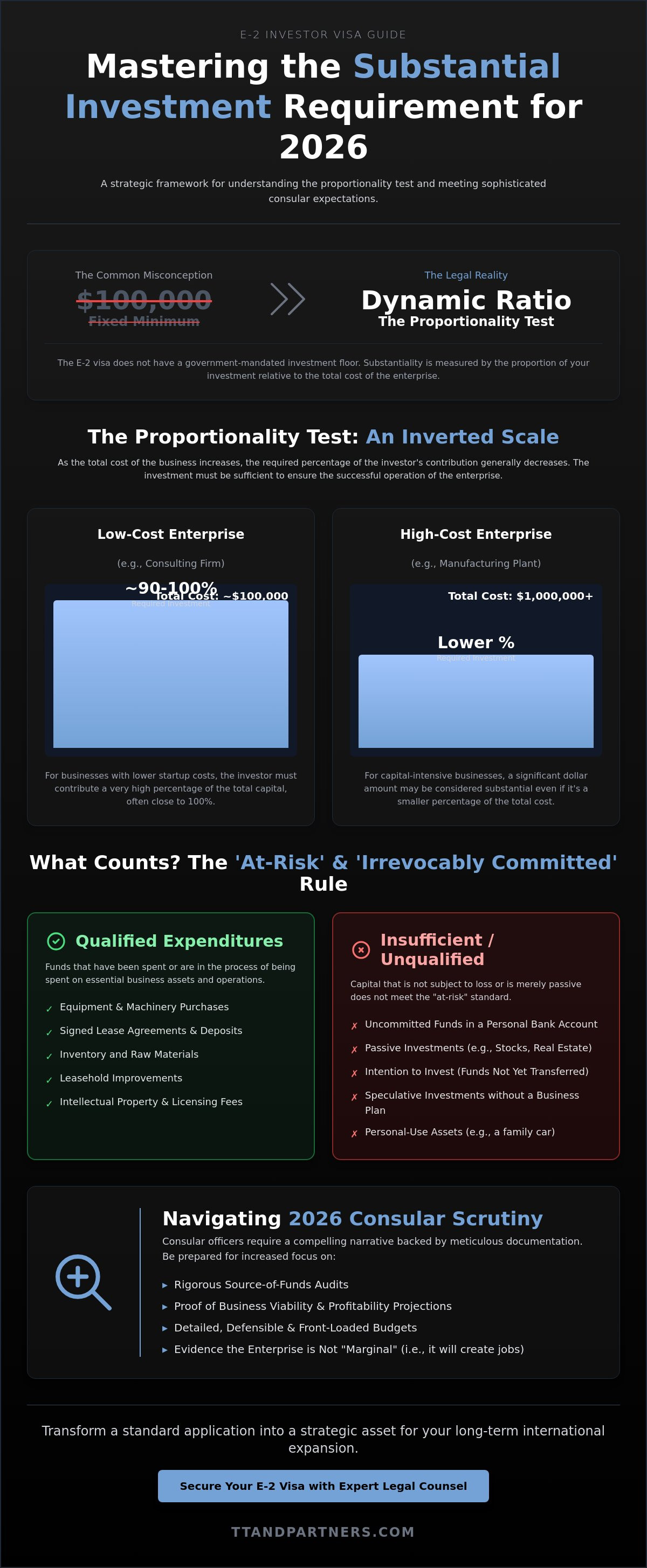
The proportionality test functions as an inverted scale. For a startup with a low total capitalization, such as a consulting firm where costs might range between $80,000 and $120,000, the investor might need to contribute nearly 100% of the required capital. Conversely, for high-cost enterprises like manufacturing plants, a lower percentage may suffice. Current 2026 market conditions require a precise evaluation of fair market value when purchasing an existing business. Officers now place higher scrutiny on intangible assets like intellectual property or brand equity. If you're navigating these complexities, our team at TT&P provides the precise legal architecture needed to align your budget with consular expectations when securing your E-2 VISA.
The Proportionality Test: A Strategic Budgeting Framework
The proportionality test is the intellectual engine behind every successful application. It compares the amount of qualifying funds invested against the total cost of establishing the enterprise. According to the official E-2 visa requirements, the investment must be substantial in a proportional sense. This means there's no single dollar figure that guarantees success. Instead, the E-2 visa substantial investment amount 2026 is determined by an inverted scale. As the total cost of the business increases, the required percentage of the investor's contribution decreases.
Strategic budgeting involves more than just listing expenses. It requires architecting a financial narrative that demonstrates long-term viability. Consular officers look for evidence that the capital infusion is sufficient to carry the business to profitability. A well-designed budget doesn't just cover the basics; it front-loads operational costs to show the business is ready to thrive immediately. This foresight is what distinguishes a visionary investor from a mere applicant. Precision in your financial planning is your strongest defense against scrutiny.
Low-Cost Service Models (Under $150,000)
For service-based businesses like consulting or digital agencies, the total startup cost often falls between $80,000 and $120,000. In these lean paradigms, a high proportionality ratio is essential. Consular officers typically expect the investor to provide 75% to 100% of the total capitalization. Defending a $100,000 budget in high-cost jurisdictions like New York or San Francisco requires meticulous detail. You must prove that this specific E-2 visa substantial investment amount 2026 covers all necessary licenses, initial marketing, and at least six months of operational runway.
Capital-Intensive Enterprises (Over $500,000)
Large-scale ventures like manufacturing plants or real estate developments operate under different rules. For a multi-million dollar project, a ratio of 30% to 50% can be considered substantial. If a project costs $1,000,000, a $400,000 equity investment might qualify if the remaining $600,000 is secured through qualifying commercial debt. This approach allows investors to leverage their capital while still meeting the mandatory "at-risk" requirement. Successfully navigating these high-stakes financial structures often requires a strategic consultation to ensure the debt-to-equity ratio aligns with current consular trends. Precision in these figures is what secures your path to the United States.
Qualified Expenditures vs. Working Capital: What Counts?
Distinguishing between active capital and passive reserves is the cornerstone of a successful filing. In 2026, the definition of an investment requires funds to be "at risk" in the commercial sense. This means the investor must demonstrate that the capital is subject to partial or total loss if the business fails. Simply placing a large sum into a corporate bank account does not constitute an investment. To reach a defensible E-2 visa substantial investment amount 2026, you must shift funds from a state of potentiality to a state of active commitment. Escrow accounts and conditional contracts serve as vital instruments here. They allow you to commit funds to a purchase or lease contingent upon visa approval; this satisfies the legal requirement while protecting your capital from premature loss.
Adjudicators look for evidence that the money has already been spent or is irrevocably committed. In the current regulatory environment, the "intent to invest" is insufficient. You must provide a clear paper trail showing the movement of funds from your personal accounts to the business entity and then to third-party vendors. This structural transparency is essential. It proves that the investment is not a mere financial placeholder but a functional engine for economic activity. Precision in documenting these transactions is your primary defense against a Request for Evidence.
Tangible Assets and Pre-Operational Costs
Every dollar spent before the doors open contributes to the total investment. Leasehold improvements, equipment procurement, and initial inventory are classic examples of sunk costs that consular officers readily accept. In the 2026 logistics environment, supply chain commitments often require significant upfront payments. These are highly defensible expenditures. Legal and professional fees also play a structural role. The costs associated with LLC INCORPORATION, specialized immigration counsel, and market research are legitimate components of your startup budget. Even intangible assets, such as proprietary software or intellectual property, can be valued and included if they're essential to the business model.
The Working Capital Strategy
Consular officers often scrutinize cash reserves with high intensity. While a business needs liquidity to survive, "excessive" cash in a bank account is frequently discounted in the proportionality test. A strategic 5-year business plan is the only way to justify these reserves. It must detail exactly how the cash will be deployed. Marketing spend, initial payroll for U.S. workers, and rent for the first six months are common justifications. In 2026, a lean service business might defend a E-2 visa substantial investment amount 2026 where 30% of the total is reserved for working capital; however, this requires a granular breakdown of anticipated burn rates. Without this level of detail, uncommitted cash remains a red flag for adjudicators.
Navigating 2026 Consular Scrutiny and Red Flags
Consular officers in 2026 have adopted a forensic approach to adjudication. The focus has shifted from the mere presence of capital to the structural integrity of the entire investment narrative. A common red flag is the "passive investor" trap. The E-2 is not a portfolio investment; it's a mandate to direct and develop. If the documentation suggests you'll be a silent partner rather than an active manager, the application will likely face rejection regardless of the E-2 visa substantial investment amount 2026. This active role must be reflected in your daily operational plans and corporate structure.
Economic shifts have also changed the baseline for what constitutes a "substantial" commitment. In 2026, inflation has naturally raised the entry costs for service sectors. A budget that might've seemed robust in 2021 could now be viewed as marginal or insufficient to sustain a competitive U.S. presence. Adjudicators are acutely aware of these market realities. They look for a capital infusion that reflects the current cost of doing business in your specific American jurisdiction. Precision in your financial disclosures is the only way to navigate this heightened environment of skepticism.
The Source of Funds Architecture
Tracing the origin of your capital is now a multi-layered process. Adjudicators require an unbroken chain of custody for all funds. If you've liquidated non-traditional assets like cryptocurrency, you must document the original purchase, the growth of the asset, and the final exchange into U.S. dollars. Precision is mandatory. Gifted funds face unprecedented scrutiny. You must prove the donor's own lawful source of funds with the same level of detail as your own. Whether you're documenting an inheritance or the sale of real estate, every transaction must be verified through official bank statements and tax filings.
Avoiding the Marginality Rejection
The marginality requirement is a frequent pitfall for solo entrepreneurs. Your business cannot exist solely to provide a living for you and your family. In 2026, the economic impact of your venture is measured by its capacity to contribute to the local U.S. economy. A robust 5-year business plan with specific job creation projections is the primary tool to combat this. Your E-2 visa substantial investment amount 2026 must signal that the enterprise is scaled for growth. If you're concerned about how your initial capital infusion will be perceived, contact our legal team to architect a strategy that emphasizes your venture's economic significance.
Strategic Legal Counsel for Complex E-2 Investments
Navigating the complexities of international expansion requires more than a simple filing. It demands a fusion of immigration law and corporate strategy. At TT&P, we view the E-2 visa substantial investment amount 2026 as a dynamic element within a larger architectural plan. For cross-border investors, especially those moving capital between Italy and the United States, a unified perspective is vital. You can't separate the visa requirements from the tax implications or the corporate governance structure. A feasibility audit at the start of your journey ensures that every dollar spent serves both your business goals and your legal eligibility. Italian investors must be particularly mindful of how their domestic financial structures translate into the U.S. commercial environment.
Success in 2026 depends on the quality of your intellectual preparation. Adjudicators no longer accept generic business plans; they demand a forensic level of detail regarding capital allocation and market entry. We believe in building a defensible narrative from the ground up. This involves verifying that your investment is truly "at risk" and that the proportionality of your funds matches the scale of your ambition. By merging legal precision with a future-facing vision, we transform the ambiguity of "substantiality" into a strategic advantage for your enterprise.
Integrating LLC Incorporation and Visa Strategy
The foundation of your U.S. presence is your corporate entity. Our Strategic Guide to US Business Architecture details how the right structure supports long-term growth. When drafting an operating agreement for an E-2 venture, we ensure that the control requirements are explicitly met. The investor must demonstrate the capacity to direct and develop the enterprise. This isn't just about ownership percentages; it's about the legal authority to make high-level decisions. Aligning your LLC INCORPORATION with these specific mandates prevents common pitfalls during consular review. We focus on creating a structure that reflects the committed nature of your capital while providing the operational flexibility needed for a modern U.S. startup.
Your Path to the United States
Securing your future in the American market requires a customized, data-driven legal narrative. We don't just submit forms; we architect a compelling case for your investment's economic impact. Following our E-2 Visa Strategic Framework 2026 allows you to move forward with clarity. Whether you're pursuing an E-2 Visa, an O-1 Visa, or a Green Card, the precision of your initial filing dictates your success. The nuances of the US-Italy treaty require a deep understanding of local and international law. Consular officers in 2026 look for investments that demonstrate a clear path to job creation and profitability. To ensure your venture meets the highest standards of substantiality and avoids the marginality trap, schedule a strategic consultation with our cross-border experts.
Architecting Your American Expansion
Mastering the E-2 visa substantial investment amount 2026 requires a shift from viewing capital as a static entry requirement to seeing it as a strategic architectural element. You've discovered that "substantiality" is a dynamic ratio of commitment that must be architected with intellectual rigor to withstand modern consular scrutiny. By precisely differentiating between active expenditures and strategic reserves, you create a financial narrative that signals both stability and growth. This structural clarity is what allows your business to transcend marginality and prove its economic value from the first day of operations.
Navigating these cross-border complexities demands a partner who understands the nuances of US-Italy legal frameworks. With decades of experience in Treaty Investor visas, our team merges corporate strategy with immigration law to ensure your venture is both compliant and competitive. We provide the comprehensive integration of corporate architecture and visa strategy necessary for a seamless transition into the American market. It's our mission to provide the professional precision your investment deserves.
Secure your US investment future; contact Tosolini, Toniutti & Partners today.
Your vision for a U.S. enterprise is within reach when built upon a foundation of legal precision and strategic foresight. It's a journey that requires professional excellence, and we look forward to helping you transform your international ambitions into a lasting reality.
Frequently Asked Questions
Is there a fixed minimum investment for the E-2 visa in 2026?
No officially mandated minimum dollar amount exists for the treaty investor visa. Instead, adjudicators use a proportionality test to determine if the E-2 visa substantial investment amount 2026 is sufficient to establish and operate the specific type of business proposed. While a service-based startup might succeed with $100,000, a capital-intensive manufacturing plant would require a much higher figure to meet the legal standard of substantiality.
Can I use a loan to fund my E-2 visa investment?
You may use loan proceeds provided the debt is secured by your personal assets rather than the assets of the E-2 business itself. U.S. immigration law requires the investor to be personally "at risk" for the capital. If the business fails, the financial loss must fall on you. This ensures that the investment represents a genuine commitment to the success of the American enterprise.
What happens if my E-2 business fails after the investment?
If the enterprise ceases operations, the legal basis for your E-2 status typically ends. Since the visa is granted specifically to allow you to direct and develop that business, you'd likely need to change your status or depart the United States. Because the funds must be irrevocably committed, capital spent on equipment, leases, or inventory is generally lost; this is the nature of the "at-risk" requirement.
Does the investment have to be spent before I apply for the visa?
Yes, your capital must be irrevocably committed to the business before the application is submitted. Consular officers don't accept funds that are merely sitting in a personal bank account or a "plan" to invest in the future. You must demonstrate that the money is already active in the commercial sphere through executed contracts, purchase receipts, or funds held in a qualifying escrow account contingent on visa approval.
Can I include my salary in the substantial investment amount?
No, your anticipated personal salary doesn't count toward the investment total. The capital infusion must be used for the setup and operational costs of the business entity itself. The purpose of the investment is to create a viable commercial venture that contributes to the U.S. economy. Since the business cannot be "marginal," it must have the capacity to earn more than just a living for you and your family.
How does inflation in 2026 affect the proportionality test?
Inflation increases the "total cost" of establishing a business, which naturally raises the E-2 visa substantial investment amount 2026 required to meet the proportionality ratio. If the fair market value of equipment or commercial rent has risen, your investment must increase accordingly to be considered substantial. Your budget must reflect these current economic realities to prove the business is properly capitalized for the 2026 market.
Can I qualify for an E-2 visa by buying a franchise?
Buying a franchise is a common and effective strategy for E-2 applicants. Franchises often provide a clear, documented breakdown of startup costs, which simplifies the proportionality test for consular officers. Successful franchise investments in 2026 often range between $150,000 and $300,000. This structure offers a transparent financial narrative that demonstrates the business is not a marginal enterprise and is ready for immediate operation.
What is the difference between E-2 and EB-5 investment requirements?
The primary difference lies in the capital thresholds and the path to permanent residency. The E-2 is a non-immigrant visa with no fixed minimum, while the EB-5 is an immigrant program with a standard minimum of $1,050,000 as of 2026. While the EB-5 leads to a green card, it requires a much higher capital commitment. The E-2 offers a more accessible entry point for entrepreneurs who prioritize business control over immediate residency.


Comments