

E-2 Visa to Green Card for Italian Citizens: The 2026 Strategic Transition Guide
- Gianni Mendes Toniutti, Esq.

- Jun 29
- 13 min read
The E-2 visa is often perceived as a temporary arrangement, a status that offers no clear horizon for permanent residency. For many Italian investors, this perception creates a lingering sense of precariousness, especially when considering the long-term stability of their families and businesses. You've likely felt the weight of this uncertainty, wondering if years of capital investment could be undone by a single renewal denial or a shift in consular scrutiny. It's a valid concern, but the reality is that the E-2 visa to green card for Italian citizens isn't a closed door; it's a strategic foundation.
The transition is not a matter of luck, but a result of deliberate planning within the U.S. immigration framework. By understanding the interplay between non-immigrant intent and the dual-intent nature of immigrant petitions, you can navigate this evolution with professional precision. This guide clarifies the specific legal frameworks, from EB-5 thresholds of $800,000 to the rigorous EB-2 NIW standards, ensuring your future remains as durable as the enterprises you've built. We'll explore the exact pathways and timing strategies required to secure your permanent residency in 2026.
Table of Contents
The E-2 Visa Landscape for Italian Citizens in 2026
The US-Italy Treaty of Commerce and Navigation remains a cornerstone of transatlantic economic cooperation in 2026. This longstanding agreement provides a unique legal bridge for Italian entrepreneurs, allowing them to deploy capital and talent within the American market with a degree of agility that other visa categories rarely match. Italian citizens continue to be among the most frequent users of the E-2 Investor Visa, driven by a cultural affinity for innovation and a strategic desire to expand European footprints into the United States.
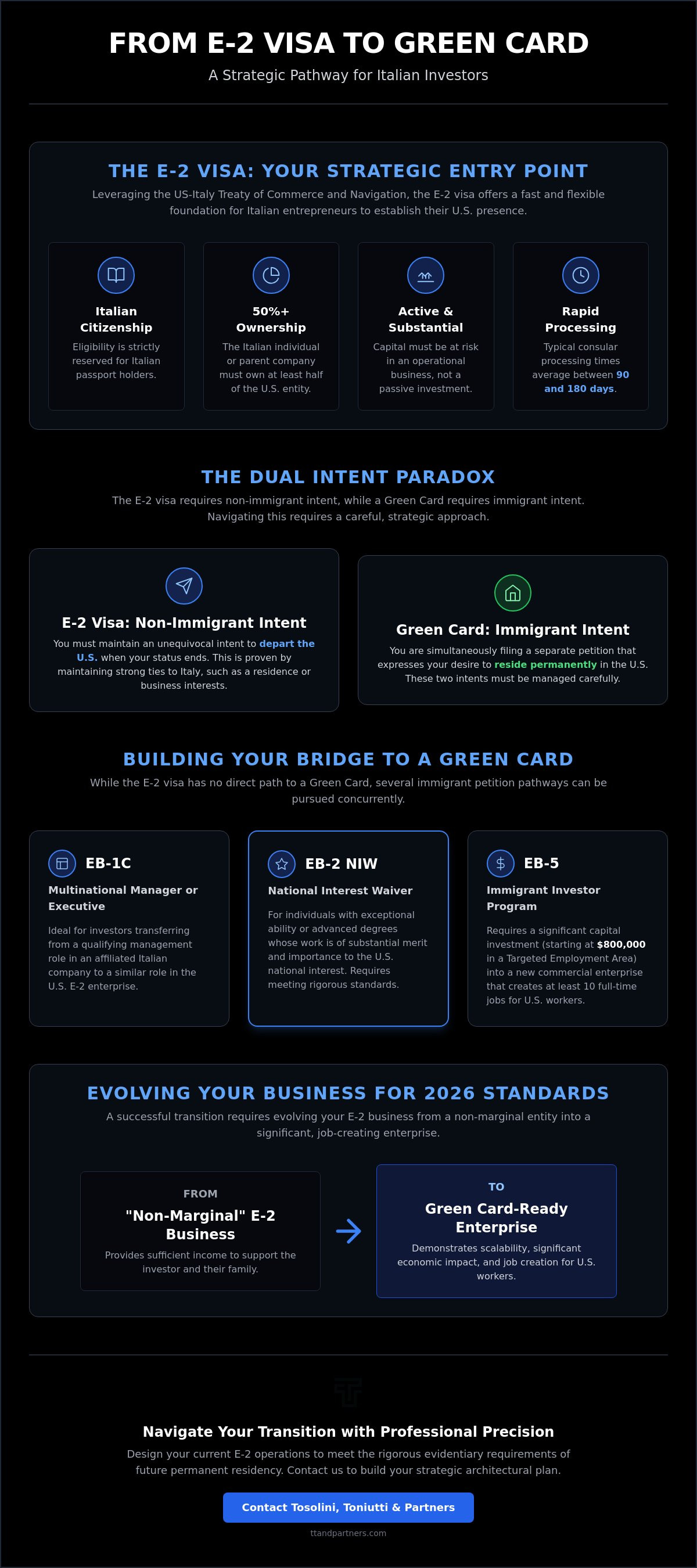
In 2026, the concept of a substantial investment is interpreted through the lens of proportionality. It isn't defined by a rigid minimum dollar amount, but rather by the investment's ability to ensure the successful operation of the specific enterprise. While smaller boutique firms might qualify with lower capital, those looking toward a future transition from an E-2 visa to green card for Italian citizens should consider investments that demonstrate scalability and long-term economic impact. A business that is merely marginal, providing only enough income to support the investor and their family, will not suffice for those eyeing permanent residency. Success in 2026 requires a shift from mere subsistence to active job creation and market integration.
Understanding the Treaty Investor Framework
Eligibility is strictly reserved for those holding an Italian passport, requiring that the individual or the Italian parent company owns at least 50 percent of the U.S. entity. The investment must be active, meaning the capital is at risk and the business is operational. Passive investments, such as undeveloped land or stock portfolios, don't meet the treaty's requirements. The E-2 visa is a non-immigrant status with no direct path to a Green Card. This distinction is vital; it requires a sophisticated approach to bridge the gap between temporary investment and permanent residency through secondary filings.
Why the E-2 is the Preferred Entry Point for Italians
Speed is a primary advantage. With consular processing times averaging between 90 and 180 days in 2026, entrepreneurs can establish their presence far more quickly than through immigrant visa channels. The classification also allows for the transfer of essential Italian staff, including executives and specialized knowledge workers, ensuring the brand's DNA remains intact during the American expansion. This flexibility supports a diverse range of ventures, from high-end design ateliers to sophisticated technology startups, allowing the investor to build the operational history necessary for a future immigrant petition.
The Non-Immigrant Paradox: Understanding Dual Intent and Bridging
The E-2 classification presents a unique legal tension. It's strictly a non-immigrant status. This requires you to maintain an unequivocal intent to depart the United States when your authorized stay ends. Yet, many Italian investors seek a permanent future. Transitioning from an E-2 visa to green card for Italian citizens isn't a direct path, but a strategic bridge. You aren't altering the E-2 itself. Instead, you're layering an immigrant petition over your existing status. This process requires careful management of your legal intent to avoid conflicts during renewals or international travel.
The Doctrine of Immigrant Intent
USCIS adjudicators look for consistency. They evaluate your intent during every renewal and entry. If you've already filed an I-140 or I-130, your non-immigrant intent is tested. The USCIS E-2 Investor Qualifications demand that you still intend to depart, even if you hope to stay permanently. It's a delicate balance. Italian investors should maintain strong ties to Italy. Keeping a residence in Florence or business interests in Turin provides essential evidence of your ties abroad. A pending immigrant petition can also restrict your travel. You might lose the ability to re-enter on your E-2 without specific safeguards in place.
Bridging the Gap: Strategic Status Management
Italian investors must choose between Adjustment of Status (AOS) and Consular Processing. AOS allows you to remain in the U.S. while your green card is processed. However, it requires a "quiet period" where travel is restricted. You must wait for an Advance Parole document to avoid abandoning your application. Consular Processing, typically handled at the U.S. Consulate in Naples, allows for more international movement but requires a valid E-2 for re-entry. Your business architecture must also evolve. It's not enough to just run a profitable shop. You must transition your role from a hands-on investor to a high-level executive or manager. This structural change is what truly enables the move from an E-2 visa to green card for Italian citizens.
Strategic timing is the final piece of the puzzle. Filing too early can jeopardize your E-2 renewals. Filing too late might leave you vulnerable to policy shifts. Most investors wait until their business shows significant job creation and operational maturity. If you're navigating these complexities, discussing your timeline with a specialist can prevent costly errors. The goal is to ensure the transition is a deliberate progression rather than a desperate scramble.
Managing these risks requires a proactive stance. A denial of an E-2 renewal because of immigrant intent can be devastating. It disrupts your business operations and your family's life in the U.S. By aligning your corporate growth with your immigration timeline, you turn a legal paradox into a manageable process. This ensures that your American dream rests on a stable, permanent foundation.
Primary Pathways from E-2 to Green Card for Italians
The journey from an investment focused entry to permanent residency requires selecting a vehicle that matches your business's maturity and your professional profile. While the E-2 provides the initial operational freedom, the transition to a Green Card involves meeting more rigorous evidentiary standards. Italian investors typically find success through four distinct channels, each requiring a specific strategic alignment of their U.S. and Italian interests. According to the Department of State E-2 Visa Rules, the underlying treaty facilitates commerce, but the immigrant path is governed by separate statutory requirements that demand a shift in how your enterprise is structured.
The EB-1C Pathway for Established Italian Businesses
For those whose U.S. venture is a subsidiary or affiliate of a pre-existing Italian firm, the EB-1C Multinational Manager or Executive category is often the most logical progression. This pathway requires a qualifying relationship between the two entities and proof that the applicant served in a high-level capacity in Italy for at least one of the three years prior to entry. In 2026, USCIS has increased scrutiny on "function manager" roles within smaller organizations. Your U.S. business must have evolved beyond a small team to support a truly executive role. This structure often mirrors the requirements found in the E-1 Treaty Trader Visa, where the focus remains on robust cross-border activity.
EB-2 NIW: The 'Exceptional' Entrepreneur Route
The National Interest Waiver (NIW) is ideal for Italian entrepreneurs whose work has substantial merit and national importance. Unlike other employment-based categories, the NIW allows you to bypass the labor certification process if you can prove your endeavor benefits the U.S. economy or culture. However, the approval rate for EB-2 NIW petitions dropped to approximately 55 percent in FY2025, reflecting a more rigorous adjudication of what constitutes "national interest" in a post-AI economy. If your Italian background provides a unique technological or cultural advantage, this might be your best route. Many investors find that the O-1 Visa for Entrepreneurs serves as a useful intermediary step to build the necessary profile for an NIW filing.
EB-5: Scaling Your E-2 Investment
If capital is your primary lever, the EB-5 Immigrant Investor Program allows you to apply your E-2 investment toward the permanent residency threshold. In 2026, the minimum investment stands at $800,000 for Targeted Employment Areas (TEA) and $1,050,000 for other regions. The challenge for many Italians lies in the "Source of Funds" documentation, which requires a meticulous audit of how the original assets were acquired in Italy. When calculating your total budget, it's essential to understand How Much Is a Green Card? beyond the capital itself, accounting for legal and administrative costs. This route is the most direct way to convert an E-2 visa to green card for Italian citizens who have the capacity to scale their operations significantly.
Finally, family-based sponsorship remains a viable, if less predictable, option. Marriage to a U.S. citizen or sponsorship by an immediate relative can simplify the legal hurdles, provided the relationship is bona fide. Regardless of the chosen path, the transition is a deliberate evolution of your status.
Strategic Requirements: Investment, Employment, and 2026 Standards
Transitioning from an E-2 visa to green card for Italian citizens requires a shift in how your enterprise is documented and managed. While the initial E-2 status focuses on the "non-marginality" of the business, an immigrant petition demands evidence of sustained economic contribution. Your venture must evolve from a platform for personal investment into a structured, job-creating entity that meets the rigorous standards set for 2026. This evolution is often anchored by a comprehensive 5-year business plan that details not just projected revenue, but the specific architecture of your American workforce. It's about building a legacy that justifies permanent residency.
English Proficiency and Regulatory Compliance in 2026
A significant shift in 2026 involves the heightened scrutiny of English proficiency for commercial operators. Under the frameworks influenced by Executive Order 14286, USCIS and the Department of State now place greater emphasis on an applicant's ability to manage U.S. operations effectively within the local regulatory environment. For Italian investors, this means providing concrete documentation of language skills, such as professional certifications or evidence of previous international business management. These vetting changes at the Department of State are designed to ensure that those seeking permanent residency can navigate the complexities of the American market without linguistic barriers hindering corporate compliance. It's a move toward ensuring that every permanent resident can fully integrate into the commercial fabric of the country.
Corporate Structure and LLC Integration
The legal framework of your business is just as critical as its commercial success. Many Italian entrepreneurs utilize a Limited Liability Company (LLC) for its flexibility, yet the architecture of that LLC must be meticulously maintained to support an immigrant petition. Adhering to corporate formalities is essential to prevent "piercing the veil" during a USCIS audit. A well-structured entity provides the transparency required for "Source of Funds" verification and cross-border tax compliance. If you are in the early stages of planning, consulting our LLC Incorporation Guide can help you design a structure that anticipates future Green Card requirements.
Financial transparency remains a non-negotiable pillar of the transition. Adjudicators in 2026 require a clear trail for every Euro transferred from Italian accounts to U.S. enterprises. This includes proof of tax compliance in both jurisdictions and a detailed accounting of how the capital was originally earned. By integrating these strategic requirements early in your E-2 journey, you create a seamless narrative that leads toward permanent residency. If you're ready to audit your current business structure against these 2026 standards, contact our specialized team for a strategic consultation. Success depends on the precision of your preparation today.
Navigating the Transition with Tosolini, Toniutti & Partners
The evolution from an E-2 treaty investor status to permanent residency isn't a journey to be taken in isolation. It requires a partner who understands the intricate nuances of the US-Italy legal corridor. At Tosolini, Toniutti & Partners, we don't just process applications; we design the strategic architecture of your American future. By aligning your initial investment with the long-term requirements of a permanent stay, we ensure that your business growth and your immigration goals move in perfect harmony. Transitioning from an E-2 visa to green card for Italian citizens requires this level of foresight, where every corporate decision today is weighed against the residency standards of tomorrow.
Our firm operates at the intersection of professional precision and cultural empathy. We speak the language of Italian business culture while navigating the complexities of U.S. law. This dual perspective is vital when managing the high stakes of international expansion. Whether you're navigating the 90.1 percent approval landscape of E-2 issuances or facing the more rigorous 55 percent approval rate of the EB-2 NIW, our involvement provides the intellectual depth necessary to overcome modern adjudicatory hurdles. We believe that a well-designed legal structure is as essential as the business itself.
Our Cross-Border Legal Methodology
We synchronize Italian corporate law with U.S. immigration strategy to create a seamless transition. This holistic approach extends beyond visa filings to include essential commercial services such as LLC incorporation, real estate closing, and international litigation. By managing these elements under one roof, we protect the integrity of your investment from the moment of inception. We have a long history of assisting Italian citizens with complex status adjustments, ensuring that every legal maneuver serves a broader visionary goal. This comprehensive support means that your source of funds, corporate formalities, and employment records are always audit-ready for USCIS scrutiny.
Commence Your Strategic Residency Plan
Early consultation is the most effective tool in the E-2 lifecycle. Waiting until a renewal is due to consider a Green Card can limit your options and create unnecessary risks. As we navigate the 2026 regulatory environment, including new English proficiency expectations and stricter managerial vetting, proactive planning becomes the differentiator between success and uncertainty. Our experts help you prepare the necessary documentation and business milestones well in advance of your filing date. If you're ready to secure your legacy in the United States, schedule a strategy session with our cross-border experts. We'll help you bridge the gap from an E-2 visa to green card for Italian citizens with the elegance and precision your venture deserves.
Securing Your Permanent Legacy in the American Market
The transition from an E-2 visa to green card for Italian citizens is a deliberate evolution, requiring a harmonious blend of corporate foresight and legal precision. Success in the 2026 landscape depends on your ability to move beyond marginality, transforming your investment into a significant economic engine that meets heightened regulatory standards. By synchronizing your Italian assets with a robust U.S. business architecture, you turn a temporary status into a permanent foundation for your family and your enterprise.
Our firm brings decades of experience in Treaty Investor transitions, offering a specialized focus on the US-Italy legal corridor that few can match. We provide comprehensive support that spans from sophisticated LLC formations to complex real estate closings, ensuring every facet of your American venture is structurally sound and audit ready. This integrated approach allows you to focus on growth while we navigate the intricate shifting tides of immigration policy. Secure your future in the United States, contact our US-Italy legal experts today. Your vision deserves a permanent home; let's build the framework to sustain it.
Frequently Asked Questions
Can I apply for a Green Card immediately after getting an E-2 visa?
You can initiate an immigrant petition at any time, but filing too quickly after entry may trigger scrutiny regarding your original non-immigrant intent. Most legal strategies involve waiting at least 90 days to establish the business operations before pursuing an E-2 visa to green card for Italian citizens. This period allows you to demonstrate that your entry was consistent with treaty investor requirements while building the evidentiary foundation needed for a successful residency application.
What is the minimum investment for an Italian citizen to transition to a Green Card?
The financial threshold depends entirely on your chosen immigrant pathway. For the EB-5 program in 2026, the minimum investment is $800,000 in a Targeted Employment Area or $1,050,000 in other regions. Other routes, such as the EB-1C or EB-2 NIW, do not mandate a specific dollar amount. Instead, they require the enterprise to be non-marginal and capable of supporting a significant American workforce through active job creation and economic contribution.
Does my E-2 business have to be profitable to qualify for a Green Card?
Profitability is less critical than the business's ability to create jobs and demonstrate a "substantial" economic impact. A marginal business that only supports the investor and their family will not suffice for permanent residency. Adjudicators look for entities that contribute to the U.S. economy through payroll and secondary economic activity. While early-stage losses are common, your 5-year business plan must show a clear trajectory toward sustainable growth and employment for U.S. workers.
What happens to my E-2 status if my Green Card application is denied?
A denial of an immigrant petition does not automatically terminate your current E-2 status, but it can complicate future renewals. Once you file for residency, you have officially demonstrated "immigrant intent," which can conflict with the E-2 requirement to intend to depart the U.S. upon status termination. It is vital to maintain your E-2 compliance meticulously throughout the process to ensure you have a legal fallback if your residency track encounters unexpected regulatory hurdles.
How does the 2026 English proficiency rule affect Italian investors?
The 2026 standard requires investors in specific commercial sectors to demonstrate English proficiency through certifications or documented professional history. This rule ensures that operators can effectively navigate U.S. health, safety, and financial regulations without linguistic barriers. For Italian entrepreneurs, this means providing evidence that their language skills are sufficient to manage their specific enterprise and comply with local laws. This requirement is now a standard component of the vetting process for permanent residency applicants.
Can my spouse and children get Green Cards through my E-2 transition?
Your spouse and unmarried children under the age of 21 are eligible for derivative green cards through your principal petition. They will transition their status alongside you, gaining permanent residency and full work authorization. While spouses of E-2 holders are already authorized to work incident to their status, the green card provides lifelong stability and removes the burden of periodic renewals. This family-centered approach is a primary motivation for many pursuing an E-2 visa to green card for Italian citizens.
Is the EB-2 NIW or EB-1C better for an Italian entrepreneur?
The EB-1C is generally preferred for those with a qualifying Italian parent company because it offers a more predictable adjudication path. The EB-2 NIW is a powerful alternative for entrepreneurs with "exceptional ability" whose work has national importance, even without a parent company. However, with NIW approval rates falling to 55 percent in FY2025, the EB-1C remains the more stable bridge for established firms. The choice depends on your specific corporate structure and individual professional profile.
How long does the transition from E-2 to Green Card typically take in 2026?
The transition typically spans 12 to 36 months, depending on the specific immigrant category and current priority dates. Premium processing for Form I-140 is available for $2,965, which guarantees an initial response within 15 business days. While the initial petition can be expedited, the subsequent adjustment of status or consular processing at the U.S. Consulate in Naples adds several months to the total timeline. Precise scheduling and early filing are essential to avoid gaps in your authorized stay.


Comments