

E-2 Visa to Green Card: Strategic Transition Pathways for 2026
- Gianni Mendes Toniutti, Esq.

- Apr 16
- 13 min read
Updated: May 5
What if the business you've meticulously built served as something more than a temporary bridge? For many treaty investors, the inherent fragility of a non-immigrant status creates a persistent undercurrent of anxiety. You've likely realized that while the E-2 provides a functional entry, it lacks the permanence required for true long-term peace. This article outlines how to architect a successful e-2 visa to green card transition by 2026, moving beyond the uncertainty of recurring renewals.
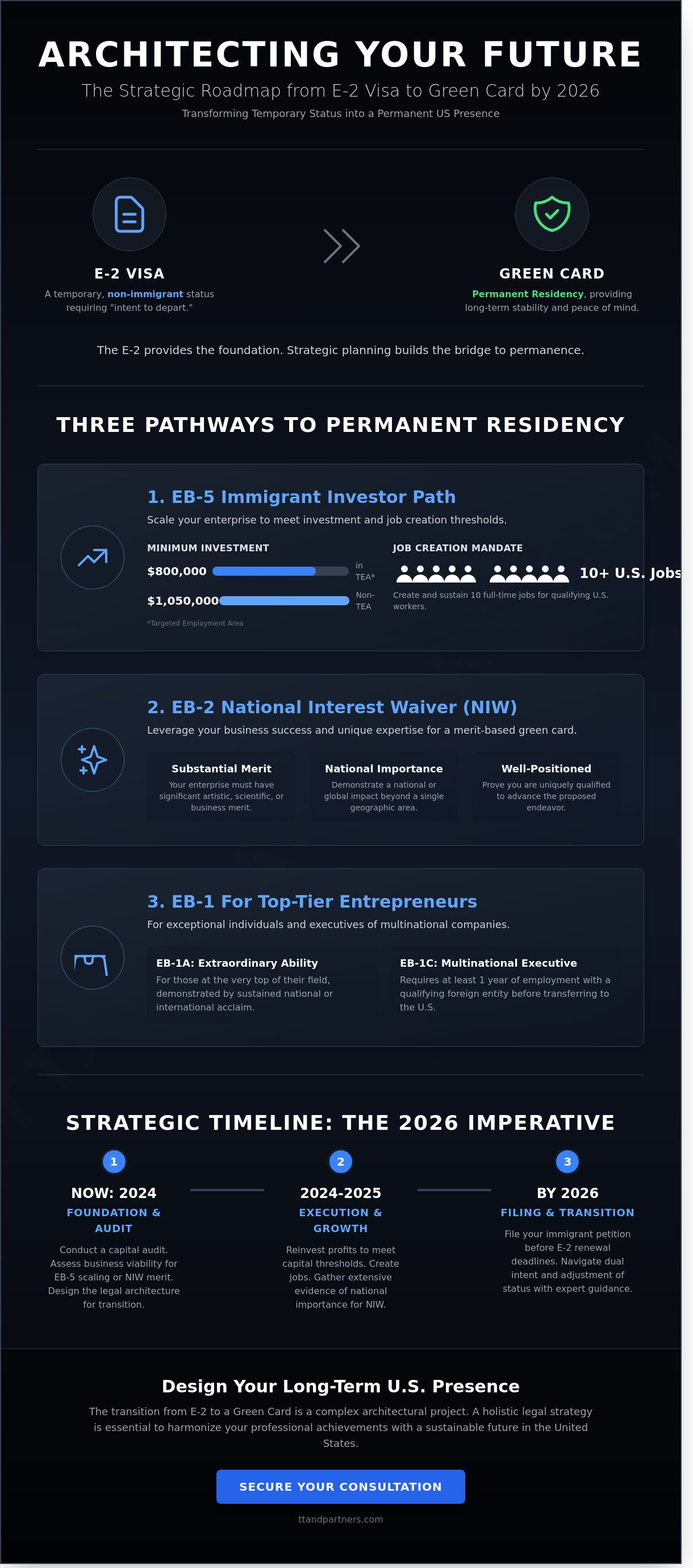
Transforming an E-2 enterprise into a permanent residence vehicle requires architectural precision and a long-term vision. The E-2 to EB-5 Immigrant Investor Path offers a sophisticated route for entrepreneurs ready to scale their operations. Since the EB-5 Reform and Integrity Act (RIA) of 2022, the regulatory landscape has shifted toward greater transparency, making it beneficial to explore EB-5 Immigrant Investor Program Legal Representation options to navigate these evolving rules. By 2026, the framework for capital redeployment and job creation has become more defined. This transition isn't just about capital; it's about evolving from a business that supports a single family into a vital contributor to the American economic fabric.
We understand that scaling a venture to meet the $800,000 or $1,050,000 EB-5 investment thresholds feels like a daunting structural challenge. It's a complex process; however, the 2024 USCIS policy updates have opened specific windows for adjustment of status that didn't exist three years ago. You'll discover a multi-year roadmap designed to protect your current operations while securing permanent residency. We'll examine the technical frameworks of EB-1C, EB-2 NIW, and the revamped EB-5 program to identify which foundation best supports your professional vision.
Key Takeaways
Understand the structural constraints of non-immigrant status and the strategic planning required to bridge the gap toward permanent residency.
Learn how to scale and reinvest in your enterprise to facilitate a seamless transition from an e-2 visa to green card through the EB-5 immigrant investor route.
Explore merit-based alternatives like the EB-2 National Interest Waiver, leveraging your business success to prove substantial merit and national importance.
Master the strategic timing of dual intent to protect your current status while navigating the transition between consular processing and adjustment of status.
Discover how a holistic legal architecture can harmonize your professional achievements with a long-term, sustainable presence in the United States.
Table of Contents Understanding the E-2 Non-Immigrant Status and the Permanent Residency Gap Scaling Your Enterprise: The E-2 to EB-5 Immigrant Investor Path Merit-Based Alternatives: EB-2 NIW and EB-1A for Exceptional Entrepreneurs Navigating Dual Intent: Strategic Timing for Green Card Applications Designing Your Long-Term US Presence with TT and Partners
Understanding the E-2 Non-Immigrant Status and the Permanent Residency Gap
The E-2 Treaty Investor visa functions as a precision tool for entrepreneurs seeking to develop and direct a US enterprise. It's categorized strictly as a non-immigrant status, meaning the legal framework doesn't provide an automatic pathway to residency. Understanding the E-2 Non-Immigrant Status requires recognizing that every applicant must demonstrate an "intent to depart" the United States once their status expires or terminates. This creates a structural boundary for those envisioning a permanent future in the American market.
For Italian investors, 2026 represents a critical juncture in their long-term US architecture. Many who launched ventures during the post-2020 economic shifts will face their first major renewal cycle or the expiration of their initial five-year visa stamps. This date serves as a deadline to evaluate whether their current business model can support a transition through "bridge" categories like the EB-2 National Interest Waiver or the EB-5 immigrant investor program. Strategic planning must happen years before the expiration date to ensure the e-2 visa to green card transition remains viable.
The Legal Distinction: Non-Immigrant vs. Immigrant Intent
The E-2 is often described as a "single intent" visa. Unlike dual-intent categories such as the H-1B, the E-2 doesn't legally acknowledge a concurrent desire to seek permanent residency. This distinction impacts how investors interact with border officials and USCIS. The US-Italy treaty allows for indefinite renewals, yet it doesn't dissolve the requirement to maintain a foreign residence. The e-2 visa to green card gap represents the legal distance between a temporary authorization to manage a US enterprise and the permanent right to reside in the country through immigrant-intent categories.
The Strategic Advantage of Starting with an E-2
An E-2 status provides the necessary time to build a robust professional foundation. It allows entrepreneurs to generate the capital required for high-threshold filings like the EB-5 program, which currently requires an investment of $800,000 in Targeted Employment Areas. Investors use this period to establish a track record of "National Importance," creating the evidentiary weight needed for merit-based green card applications. Successful transitions often begin with a sophisticated LLC incorporation, ensuring the business structure aligns with future immigration goals. This phase isn't just about operations; it's about designing a durable legal legacy within the US urban fabric.
Scaling Your Enterprise: The E-2 to EB-5 Immigrant Investor Path
Transforming an E-2 enterprise into a permanent residence vehicle requires architectural precision and a long-term vision. The E-2 to EB-5 Immigrant Investor Path offers a sophisticated route for entrepreneurs ready to scale their operations. Since the EB-5 Reform and Integrity Act (RIA) of 2022, the regulatory landscape has shifted toward greater transparency. By 2026, the framework for capital redeployment and job creation has become more defined. This transition isn't just about capital; it's about evolving from a business that supports a single family into a vital contributor to the American economic fabric.
Most E-2 holders start with an investment between $100,000 and $250,000. To reach the EB-5 threshold, you'll need to bridge the capital gap to $800,000 in a Targeted Employment Area (TEA) or $1,050,000 in a non-TEA zone. You can use reinvested business profits to meet this requirement, but USCIS mandates these funds be "at-risk." This means the money must be clearly documented as personal capital. Often, this requires distributing profits as dividends and then reinvesting them as a personal contribution to the enterprise.
Step-by-Step Transition from E-2 to EB-5
Capital Audit: Conduct a rigorous audit of your current capital. Identify the exact shortfall to the $800,000 or $1.05M mark based on 2026 valuation standards.
Documenting Source of Funds: Transparency is the foundation of a successful e-2 visa to green card journey. Every dollar must have a clear, legal trail from its origin to the business.
The Hiring Mandate: You must move beyond the E-2 "marginality" rule. While E-2 status only requires the business to support your family, EB-5 mandates the creation of 10 full-time jobs for qualifying U.S. workers within a two-year window.
Investment Strategies for 2026
Location remains a primary factor in your financial planning. Identifying if your business operates within a Targeted Employment Area (TEA) can lower the investment requirement significantly. In 2026, TEA designations are frequently updated based on census data, so verifying your project's status is essential for cost control. Leveraging "Concurrent Filing" is another strategic advantage for those already in the U.S. on an E-2. This allows you to file your I-526E petition and I-485 adjustment of status simultaneously, providing immediate benefits like travel permits and work authorization while your application processes.
Planning for these costs requires a holistic view of the current fiscal environment. You should review the US resident application fee to understand the total financial commitment for 2026. Successful transitions of an e-2 visa to green card require a blend of legal strategy and commercial growth. If you're ready to refine your business structure for long-term residency, consult with our strategic advisors to ensure your path is built on a solid foundation.
Merit-Based Alternatives: EB-2 NIW and EB-1A for Exceptional Entrepreneurs
Transitioning from an e-2 visa to green card status often requires a strategic shift from a purely investment-based narrative to one focused on professional excellence and national impact. While the E-2 is an excellent tool for operational control, it doesn't lead directly to permanent residency. Entrepreneurs who've built successful enterprises can instead look toward Merit-Based Alternatives. The EB-2 National Interest Waiver (NIW) and the EB-1A for Extraordinary Ability provide pathways where the individual's talent, rather than a massive capital injection, serves as the primary catalyst for immigration. These categories allow for self-sponsorship, removing the need for a traditional employer to vouch for the applicant through the lengthy labor certification process.
The Matter of Dhanasar Framework for E-2 Holders
The success of an EB-2 NIW petition hinges on the Dhanasar framework, a legal standard established in 2016. For an E-2 holder, this means proving that their U.S. business does more than just support a family; it must address a challenge of national scope. You've already established a physical footprint and a payroll through your E-2 investment. You can now leverage this operational history to prove you're well-positioned to advance your endeavor. The Dhanasar framework requires an owner to prove their business creates broad national benefits, that their professional background ensures the project's success, and that waiving the labor certification process serves the U.S. interest. Documentation should include:
Business plans showing job creation beyond the immediate local economy
Evidence of contracts with federal or state entities
Detailed records of proprietary technology or specialized methodologies developed within the E-2 firm
High-Impact Industries for EB-2 NIW Success
USCIS updated its policy guidance in January 2022 to clarify how STEM graduates and entrepreneurs in critical fields can qualify for the NIW. For Italian entrepreneurs, industries like green energy, advanced manufacturing, and cross-border technological innovation are particularly strong. These sectors align with current U.S. national priorities, making the argument for "national importance" more robust. If your professional profile includes high-level industry recognition or patents, you might even consider the EB-1A. Some strategies used for the O-1 Visa, such as proving original contributions of major significance, overlap with these high-tier green card categories. Expert testimony from industry leaders is vital here to validate that your presence in the U.S. market provides a structural benefit to the domestic economy.
Comparing these paths to the investment-heavy EB-5 reveals a clear advantage for the skilled professional. Italian nationals often weigh the $800,000 minimum investment required for an EB-5 visa against the merit-based EB-2 NIW, which relies on intellectual capital rather than liquid assets. It's a choice between buying a seat at the table or earning it through the proven success of your e-2 visa to green card journey. By focusing on the "national importance" of your work, you transform your business from a private venture into a public asset.
Navigating Dual Intent: Strategic Timing for Green Card Applications
Transitioning from an e-2 visa to green card status involves a sophisticated architectural shift in your legal standing. The E-2 is fundamentally a non-immigrant classification; it lacks the built-in dual intent protections enjoyed by H-1B or L-1 holders. This distinction creates a delicate environment where your long-term residency goals must be balanced against your current authorization to operate your business. If you signal an intent to stay permanently too early or through the wrong channels, you risk jeopardizing your ability to renew your E-2 or even travel internationally.
Maintaining your E-2 status as a safety net is a critical strategic pillar. Even while your immigrant petition is under review, keeping your underlying E-2 valid ensures you have a legal basis to work and remain in the U.S. if the green card application faces delays. Most investors prefer the Adjustment of Status (Form I-485) pathway because it allows them to stay in the country, whereas Consular Processing requires an interview abroad where an officer might scrutinize your non-immigrant history more strictly.
Consular Risks and Travel Restrictions
The 90-day rule remains a vital metric for timing your filing. USCIS often presumes a willful misrepresentation if an applicant files for a green card within 90 days of their last entry into the U.S. on a non-immigrant visa. For those managing operations between the U.S. and Europe, travel becomes a liability once the I-485 is filed. You shouldn't leave the country without an approved Advance Parole document; doing so effectively abandons your application. Beyond these travel constraints, if you seek a new E-2 stamp at consulates in Rome or Milan while an immigrant petition is active, the officer may find you're no longer eligible for a non-immigrant visa. In some cases, established firms find that E-1 Visa structures provide a more stable foundation for high-volume trade before making the leap to residency.
The 2026 Visa Bulletin and Priority Dates
Success in this transition depends on the Department of State’s Visa Bulletin. As we look toward 2026, the Final Action Dates for EB-2 and EB-3 categories continue to show backlogs that can extend your timeline by 18 to 24 months. You must align your filing with these priority dates to avoid a legal vacuum. Financial planning is equally essential; the cost of a green card has shifted following the USCIS fee schedule updates that took effect on April 1, 2024. These adjustments mean investors should budget for higher I-485 and I-140 fees as part of their 2026 fiscal strategy.
To ensure your business and residency goals remain in harmony, you can contact our team for a strategic consultation on your specific case.
Designing Your Long-Term US Presence with TT and Partners
Transitioning from an e-2 visa to green card requires more than a tactical shift in paperwork. It demands a holistic legal architecture that anticipates future growth while respecting the foundational business structure you've already built. At Tosolini, Toniutti & Partners, we don't view immigration as an isolated filing process. Instead, we treat it as a design challenge where every corporate decision serves as a load-bearing element for your permanent residency. Our approach mirrors the precision of high-end architecture, ensuring that your business and personal status exist in a state of functional harmony.
Success in the American market involves navigating a complex urban fabric of regulations. For the international investor, the goal isn't just to stay, but to thrive without the constant pressure of visa renewals. We provide the structural integrity needed to move from a non-immigrant status to the stability of a Green Card. This transition involves a meticulous analysis of your 2024 business performance and a clear-eyed look at how your current investment meets the stringent requirements of permanent immigrant categories.
Precision in Cross-Border Legal Strategy
Integrating international litigation prevention into your initial business setup is a cornerstone of our philosophy. Disputes can arise from simple misunderstandings of local statutes, and for Italian investors, the friction between the Italian Civil Code and US Common Law is a constant variable. We mitigate these risks by ensuring your corporate compliance is airtight from the moment of LLC formation. This proactive planning protects your path toward a Green Card by keeping your administrative record clean and your business operations transparent.
Our firm understands the nuances of both the US and Italian legal landscapes, allowing us to act as a bridge for investors who value intellectual depth and professional magistery. We don't just fill out forms; we architect a legal environment where your business can scale. By focusing on the context of your specific industry, we ensure that your transition from an e-2 visa to green card is a natural evolution of your American enterprise rather than a disruptive hurdle.
Next Steps for Your Residency Journey
Your journey toward permanent residency begins with a comprehensive audit of your current E-2 status and overall business health. We look at your payroll data, tax filings, and investment trajectory to determine the most viable path forward. This isn't a quick fix; it's a 3 to 5 year roadmap designed to align your commercial milestones with USCIS requirements. We prioritize sustainability and long-term vision over short-term gains, ensuring that your residency status remains as timeless as a well-designed building.
If you're ready to move beyond temporary status and secure your future in the United States, a bespoke legal consultation is the first step. We'll examine the specifics of your case with the same attention to detail we bring to every project. Whether you're refining your corporate structure or preparing for a final adjustment of status, our team provides the visionary guidance necessary for success. Contact Tosolini, Toniutti & Partners today to architect your transition and solidify your presence in the American market.
Architecting Your Permanent American Legacy
Transitioning from an e-2 visa to green card status requires more than a simple application; it demands a structural blueprint that aligns your commercial growth with US immigration law. The 2026 landscape rewards those who plan with surgical precision, whether you're leveraging the EB-2 NIW for exceptional ability or scaling via the EB-5 immigrant investor path. Successful transitions hinge on navigating dual intent during the early stages of a filing to ensure your business operations remain uninterrupted. We've seen that a well-timed strategy prevents the common pitfalls of status gaps. Every decision must be functional and forward-looking.
TT and Partners brings decades of experience in New York and international jurisdictions to your case. Our team specializes in US-Italy treaty law, providing the comprehensive cross-border corporate and immigration support necessary for complex global moves. We treat your residency path like a master-planned project where every detail serves a functional, long-term purpose. It's about more than just a visa; it's about integrating your enterprise into the urban fabric of the United States. Architect your permanent move to the US with TT and Partners and secure the future your innovation deserves. Your vision for a permanent US presence is within reach when built on a foundation of expert strategy.
Frequently Asked Questions
Can I apply for a Green Card while on an E-2 visa?
You can apply for a Green Card while holding E-2 status, but you must bridge the gap through a separate immigrant petition. The E-2 is strictly a non-immigrant classification. However, USCIS allows you to adjust status if you qualify for an employment-based or family-based category. You'll need to maintain your underlying E-2 requirements throughout the process to ensure legal residence remains intact during the transition period.
How much does it cost to transition from E-2 to a Green Card in 2026?
Transition costs depend on the specific immigrant path you select and the USCIS fee schedule active at that time. As of the April 1, 2024, fee update, the I-485 adjustment of status fee is $1,440 for most adults. If you pursue an EB-5 path, the I-526E petition fee is currently $12,160. These figures don't include legal representation, medical exams, or mandatory biometrics fees.
Does the E-2 visa have a direct path to permanent residency?
No, the E-2 visa doesn't offer a direct, automatic path to permanent residency. It functions as a renewable non-immigrant bridge rather than a linear track. To achieve an e-2 visa to green card transition, you must qualify independently for an immigrant category like the EB-2 National Interest Waiver. This requires a deliberate shift in your legal strategy and a new filing with USCIS.
What happens to my E-2 status if my Green Card application is denied?
Your E-2 status remains valid until its expiration date even if a Green Card application is denied. A denial doesn't trigger an immediate loss of your current non-immigrant standing. You must continue running your business and meeting all treaty investor requirements. Be aware that traveling outside the U.S. becomes complicated after a denial because you've officially demonstrated immigrant intent to the government.
Can my spouse apply for a Green Card independently while I hold an E-2?
Your spouse can independently seek a Green Card while you maintain your E-2 status. Because E-2 spouses receive automatic work authorization, they often secure sponsorship through their own U.S. employers. This dual-track approach provides a flexible safety net for the family. In 2023, many families successfully utilized the spouse's professional qualifications to secure permanent residency through EB-2 or EB-3 labor certifications.
Is the EB-5 investment the only way for an E-2 holder to get a Green Card?
The EB-5 investment isn't the only method for an e-2 visa to green card transition. Many investors qualify for the EB-1A category by proving extraordinary ability in their specific field. Others use the EB-2 National Interest Waiver, which doesn't require the $800,000 capital injection mandated for Targeted Employment Areas. Selecting the right path depends on your professional background and the long-term vision for your operations.
How long does the transition from E-2 to Green Card typically take?
Processing times for the transition typically range from 12 to 36 months. EB-1 applications are often resolved within a year, while EB-3 categories can face longer backlogs depending on the Department of State Visa Bulletin. Your specific country of birth and the chosen immigrant category dictate the final timeline. It's a complex structural process that requires careful synchronization with your current visa expiration and business milestones.
Will my E-2 visa renewal be denied if I have a pending immigrant petition?
A pending immigrant petition can lead to a denial of your E-2 visa renewal at a U.S. Consulate. Consular officers require you to demonstrate an intent to leave the U.S. when your status expires. Filing an I-140 or I-130 signals a permanent intent that contradicts this requirement. It's often safer to process your adjustment of status within the U.S. to avoid the scrutiny of overseas consular interviews.


Comments