


E2 Visa: The Complete Guide for Italian Investors and Entrepreneurs (2026)
- Gianni Mendes Toniutti, Esq.

- Mar 20
- 9 min read
Updated: Mar 23
Master the complexities of the E-2 Treaty Investor Visa with our expert legal framework designed specifically for Italian citizens moving to the United States. This guide provides a clear, strategic roadmap for navigating the application process, structuring your investment, and achieving your entrepreneurial vision in the American market.
Understanding the Visa E2: A Strategic Portal for Italian Capital
The E-2 Treaty Investor Visa is a non-immigrant classification that serves as a vital bridge for commerce between the United States and treaty nations like Italy. It is designed for individuals who wish to enter the US to develop and direct the operations of an enterprise in which they have invested a substantial amount of capital. This is not merely a permit for entry; it is a foundational component of your international business architecture.
A Bridge for Commerce: The E-2 visa is authorized under the US-Italy Treaty of Commerce and Navigation, a long-standing agreement that facilitates economic partnership.
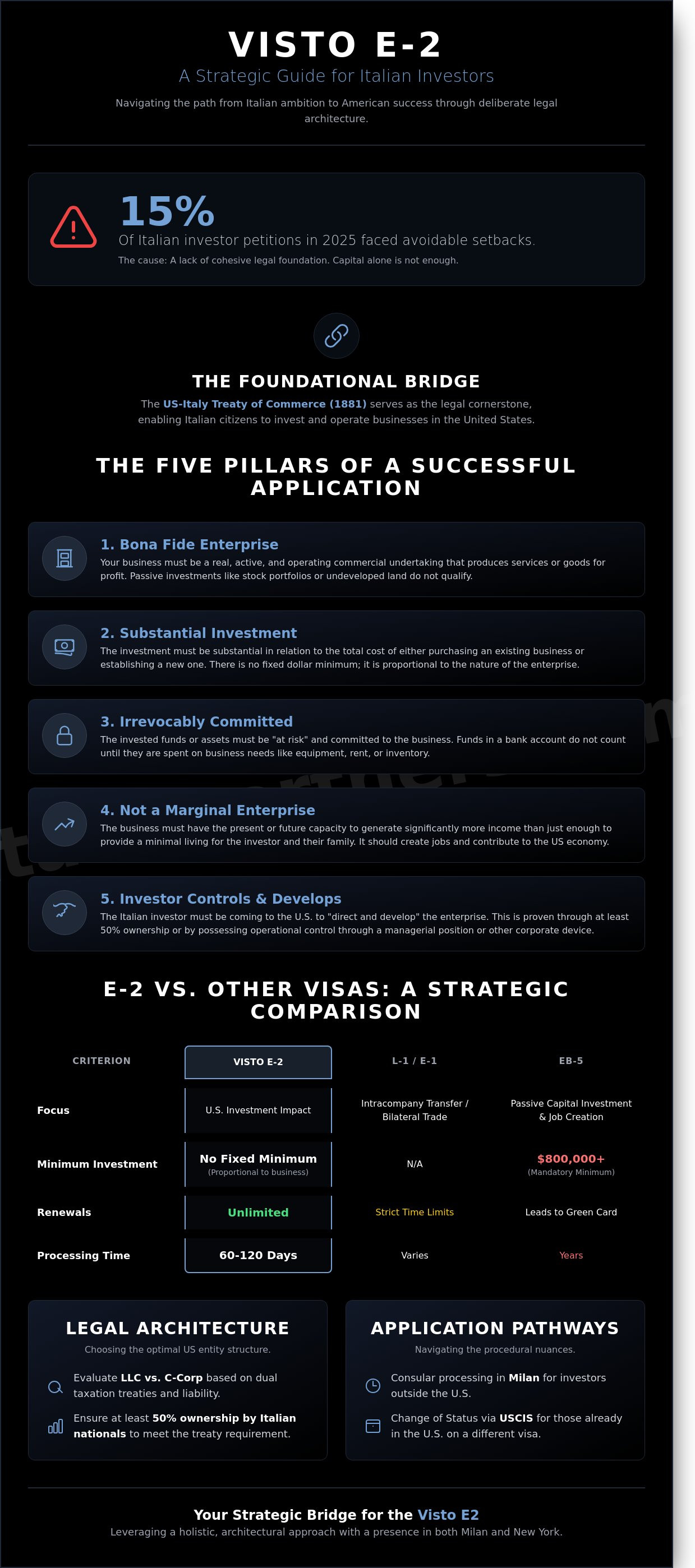
The Architectural Benefit: Unlike many other visas, the E-2 can be renewed indefinitely in five-year increments, provided the US enterprise continues to operate and meet the visa requirements. This allows for long-term planning and stability.
Investor vs. Employee: The visa is available to the principal investor who owns at least 50% of the US business. It can also be extended to key managerial or essential-skills employees who share the investor's Italian nationality.
The Italian Advantage: Why Citizens of Italy Qualify
The eligibility of Italian citizens for the E-2 visa is rooted in a deep historical and legal context. The foundation is the 1881 Treaty of Friendship, Commerce, and Navigation between the United States and Italy, which established the framework for bilateral investment that continues to this day. To qualify, the primary investor must hold an Italian passport. Furthermore, if the investment is made through a business entity, that entity must have "Treaty Nationality," meaning at least 50% of it must be owned by Italian citizens.
E-2 vs. Other Visas: Why Investors Choose the E-2
For Italian entrepreneurs, the E-2 visa often presents the most logical and efficient pathway to the US market.
E-1 Treaty Trader Visa: While similar, the E-1 is specifically for businesses engaged in substantial trade primarily between the US and Italy. The E-2 is more versatile, covering investments in a wide range of service and product-based industries.
L-1 Intra-Company Transferee Visa: The L-1 requires the investor to have an existing, qualifying business in Italy that has been operational for at least one year. The E-2 offers greater flexibility, allowing for the purchase of an existing US business or the creation of a new one without a corresponding Italian entity.
EB-5 Immigrant Investor Program: The EB-5 leads directly to a Green Card but requires a significantly higher investment (currently over $800,000) and involves a much longer and more complex adjudication process. The E-2 visa provides a faster route to market entry.
The Five Pillars of a Successful E-2 Visa Application
A successful E-2 visa application is built upon a solid foundation of five core legal requirements. Each pillar must be meticulously documented and presented to demonstrate the legitimacy and viability of your enterprise.
The "Substantial Investment" Pillar: The investment must be substantial in relation to the total cost of either purchasing an existing business or establishing a new one.
The "At-Risk" Requirement: The capital must be irrevocably committed to the enterprise, subject to partial or total loss if the business fails.
The "Bona Fide Enterprise" Standard: The business must be a real, active, and operating commercial entity producing services or goods for profit.
The "Direct and Develop" Rule: The investor must be in a position to develop and direct the enterprise, typically demonstrated by at least 50% ownership.
Defining "Substantial" in the 2026 US Market
US immigration law intentionally avoids setting a minimum dollar figure for the E-2 visa. Instead, it employs a proportionality test, comparing the amount invested to the total value or startup cost of the business. A $150,000 investment might be considered substantial for a consulting firm but insufficient for a large-scale manufacturing plant. The key is demonstrating that you have invested enough to ensure the successful operation of the enterprise. Substantiality is best understood as a ratio of commitment to the enterprise's total value, not as a raw number.
Avoiding the "Marginality" Trap
An E-2 enterprise cannot be "marginal," meaning it cannot be established solely to earn a living for the investor and their family. The business must demonstrate the capacity to make a significant economic contribution to the US economy.
Proving Viability: The business must have the present or future capacity to generate significantly more income than what is needed to support the investor's family.
The 5-Year Financial Projection: A comprehensive business plan with detailed five-year financial projections (P&L, cash flow, balance sheet) is critical to proving the enterprise is not marginal.
Job Creation: While there is no set number, the plan should project the hiring of US workers. The number and timeline should be realistic for the industry and scale of the business.
The "At-Risk" Capital Requirement
The investment funds must be "at risk" in a commercial sense. This means the capital must be irrevocably committed and not merely sitting in a bank account.
Source of Funds: The capital can come from personal savings, secured or unsecured loans, or the sale of business or personal assets. The source must be legitimate and traceable.
Irrevocable Commitment: "Intent to invest" is insufficient. The funds must be actively used for business purposes, such as purchasing equipment, securing a lease, or hiring staff, before the visa is issued.
Escrow Accounts: For business acquisitions, placing the purchase funds in an escrow account that is contingent only upon the issuance of the E-2 visa is a common and accepted mechanism to meet the at-risk requirement.
Legal Architecture: Structuring Your US Business for the E-2
The E-2 visa is not just an immigration petition; it is the culmination of a carefully designed corporate and legal structure. Your choice of business entity has profound implications for liability, taxation, and visa eligibility.
LLC vs. C-Corp: For most Italian investors, an LLC (Limited Liability Company) is preferable due to its pass-through taxation, which can help avoid the double taxation issues that can arise with a C-Corporation under the US-Italy dual taxation treaty.
The US-Italy Tax Treaty: A properly structured entity, guided by experts familiar with the treaty, is essential to optimize your global tax position and ensure compliance in both countries. For specialized guidance on wealth protection and tax strategies tailored for high-net-worth individuals navigating this process, firms like NJP Law Group can offer valuable expertise.
Proving "Italianity": In complex ownership structures, you must be able to clearly document that at least 50% of the ultimate ownership is held by Italian nationals.
Real Estate Investments: Simply owning property is a passive investment. To qualify for an E-2, a real estate business must be an active enterprise, such as a property management company with multiple clients and employees.
LLC Incorporation for Non-Residents
Establishing a US company from Italy is a precise process that does not require a Social Security Number.
Formation: The first step is to register your LLC in a chosen state, such as Florida, New York, or Delaware.
Federal Tax ID (EIN): After formation, you must obtain an Employer Identification Number (EIN) from the IRS. This is essential for opening a US business bank account, hiring employees, and filing taxes.
Internal Link: [New York LLC vs. Florida LLC for an E-2 Visa Business]
The E-2 Visa Business Plan: A Blueprint for Success
The business plan submitted for an E-2 visa is fundamentally different from one created for a bank loan. It is an evidentiary document designed to persuade a Consular Officer of your project's viability and compliance with immigration law.
Essential Elements: It must include a detailed market analysis, a comprehensive five-year personnel plan showing employee growth, and a full five-year financial projection, including profit and loss statements.
Internal Link: [How to Create an E-2 Visa Business Plan for Miami]
Navigating the Application: Milan vs. Washington
Italian investors have two primary pathways for obtaining E-2 status, each with distinct procedures and strategic considerations.
Option A: Consular Processing: Applying directly for an E-2 visa at a US Consulate abroad, typically in Italy.
Option B: Change of Status: Applying to USCIS to change from another valid non-immigrant status (like a B-1/B-2 tourist visa) to E-2 status while physically present in the United States.
The Interview: For consular processing, a mandatory interview with a Consular Officer is the final step. The officer will assess the credibility of the investment and the investor's intent.
Timeline Expectations for 2026: Timelines can vary, but consular processing generally takes several months from submission to interview. A change of status can take longer, though premium processing may be available.
Consular Processing in Italy
This is the most common and recommended path for Italian investors. A successfully issued visa allows for travel in and out of the United States.
The Application: The process involves submitting a comprehensive package of documents, including the DS-160, DS-156E, and the detailed business plan, through an online portal.
The Milan Consulate: The U.S. Consulate General in Milan is the primary post for processing E-2 visa applications for residents of northern Italy, while the Embassy in Rome and other consulates handle other regions.
Internal Link: [Navigating the Italian Consulate in Miami vs. New York]
Change of Status: Benefits and Risks
Changing status within the US can be a viable option for those already present in a valid status who decide to invest.
The "Travel Trap": A change of status approval grants E-2 status, not an E-2 visa. This means if you leave the US, you cannot re-enter in E-2 status. You must go through consular processing abroad to obtain the actual visa for travel.
Premium Processing: USCIS offers premium processing for an additional fee, which guarantees an adjudication decision within a few weeks.
When to Choose This Path: This option is best for investors who do not have an immediate need for international travel and wish to begin operating their business quickly.
TT and Partners: Your Strategic Bridge for the Visa E2
At Tosolini, Toniutti & Partners, we view law through an architectural lens. An E-2 visa is not a form to be filled; it is a structure to be designed with precision, vision, and deep cross-border expertise. Our unique position with offices in both the United States and Italy provides a seamless bridge for your transatlantic ambitions.
Beyond the Visa: Our services extend to the core components of your expansion, including real estate closings, corporate governance, and international litigation.
Building a Legacy: We are dedicated to helping Italian families successfully transition to American life, providing the legal foundation for a thriving personal and professional future.
A Partnership Built on Precision
Our firm is built on a foundation of dual-country expertise. Our New York and Miami offices provide critical on-the-ground market intelligence, while our Italian-speaking attorneys understand the nuances of "System Italy." This integrated perspective allows us to anticipate challenges and architect solutions with unparalleled precision.
Your Next Steps to the United States
Your journey begins with a comprehensive assessment of your eligibility and investment strategy. This initial consultation is the first step in designing the blueprint for your successful relocation and business launch in the United States.
Frequently Asked Questions (FAQs)
Is there a minimum investment amount for the E-2 visa in 2026? No, there is no official minimum. The investment must be "substantial" relative to the cost of the business. While cases can be approved for under $100,000, a stronger investment, typically in the $150,000 to $250,000+ range, often presents a more compelling case for most business types.
Can my spouse work in the US if I have an E-2 visa? Yes. The spouse of an E-2 visa holder is eligible to apply for an Employment Authorization Document (EAD) upon arrival in the US. Once approved, they can work for any employer without restriction.
Does the E-2 visa lead to a Green Card? The E-2 is a non-immigrant visa and does not have a direct path to a Green Card. However, E-2 visa holders can pursue a Green Card through other avenues, such as an EB-5 investment, a family-based petition, or an employer-sponsored petition if they qualify.
How long is the E-2 visa valid for Italian citizens? The E-2 visa for Italian citizens is typically issued for a validity period of five years and can be renewed indefinitely as long as the business continues to meet the visa requirements.
Can I buy an existing business for an E-2 visa instead of starting a new one? Yes. Purchasing an existing, operational business is a very common and often preferred strategy for an E-2 visa, as it can more easily demonstrate that the enterprise is not marginal.
What happens if my E-2 business fails? If the E-2 enterprise fails and ceases operations, you will no longer be in valid E-2 status. You would be required to either depart the United States or find an alternative legal status to remain.
Do I need to speak fluent English to get an E-2 visa? There is no specific English language proficiency requirement for the E-2 visa. However, you must be able to demonstrate that you can effectively "develop and direct" the business, and the visa interview will be conducted in English.
Can I bring my children to the US on an E-2 visa? Yes. Unmarried children under the age of 21 can receive derivative E-2 visas to accompany the principal investor. They can study in the US but are not authorized to work. They will "age out" of this status upon turning 21.
Disclaimer
The information provided in this website is offered purely for informational purposes. It is not intended to create or promote an attorney-client relationship, and does not constitute and should not be relied upon as legal advice. We intend to make every attempt to keep this information current. We do not promise or guarantee, however, that the information is correct, complete or up-to-date, and readers should not act based upon this information without seeking professional counsel from a licensed attorney. Transmission of information from this newsletter is not intended to create, and its receipt does not constitute, an attorney-client relationship with Tosolini, Toniutti & Partners or any of its individual attorneys or personnel.


Comments