

EB-1 Green Card for Italian Researchers: The 2026 Strategic Guide
- Gianni Mendes Toniutti, Esq.

- May 28
- 12 min read
What if the most significant barrier to your U.S. career isn't your research impact, but how you translate Italian academic prestige into American legal standards? Many scholars feel overwhelmed when trying to align their European achievements with the extraordinary ability threshold required for an EB-1 green card for Italian researchers. It's a common concern that the nuances of the Italian university system, from specific titles to international collaborations, might get lost in the bureaucratic process.
We recognize that your work represents a lifetime of intellectual rigor and visionary thinking. This guide will show you how to master the complexities of the EB-1 visa by leveraging your unique Italian academic background for permanent residency. You'll gain a clear understanding of the differences between EB-1A and EB-1B. We also provide a precise roadmap for documenting your international achievements to meet the May 2026 standards, ensuring your transition to the United States reflects the excellence of your career.
Key Takeaways
Identify the optimal path between self-petitioning and employer-sponsored categories to align with your specific professional autonomy and career stage.
Master the art of contextualizing Italian achievements, such as the Abilitazione Scientifica Nazionale, to satisfy the evidentiary requirements for an EB-1 green card for Italian researchers.
Evaluate your research impact through a structured checklist of ten USCIS criteria, focusing on international peer-reviewed excellence and high-impact academic citations.
Navigate the 2026 timeline with precision by utilizing Premium Processing to reduce adjudication times for your immigrant petition to just 15 days.
Address the broader implications of your relocation, ensuring that your move to the United States remains compliant with both Italian and American legal and residency frameworks.
Table of Contents
Understanding the EB-1 Categories for Italian Academics
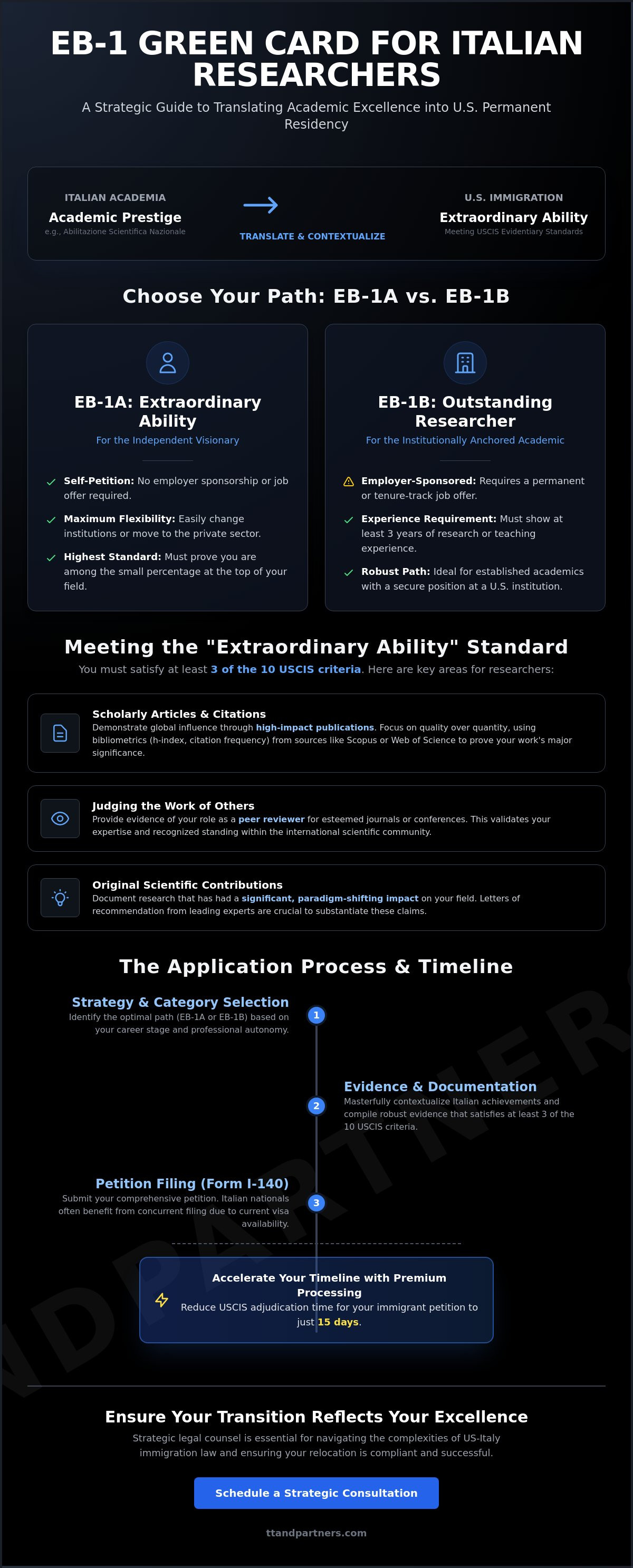
The EB-1 category sits at the summit of the U.S. immigration hierarchy. It offers the most direct path to permanent residency for individuals who demonstrate exceptional professional merit. For those pursuing an EB-1 green card for Italian researchers, the primary advantage in the current 2026 environment is the lack of a visa backlog. Unlike applicants from other regions, Italian nationals can often file their immigrant petition and green card application concurrently. This efficiency is paired with a requirement for sustained national or international acclaim, a standard that demands a meticulous presentation of one's career narrative. This EB-1 visa overview illustrates the distinction between the subcategories, though researchers primarily focus on two specific paths.
The decision between EB-1A and EB-1B isn't merely administrative; it's a strategic maneuver. Italian academics, often coming from systems where research roles are highly structured, must decide if they prefer the autonomy of self-sponsorship or the institutional backing of a U.S. employer. This choice dictates how you'll collect evidence and how much control you maintain over your professional future.
EB-1A: Extraordinary Ability for Individual Researchers
The EB-1A category is the most prestigious and flexible option. It doesn't require a specific job offer or a U.S. employer to act as a petitioner. This freedom allows you to transition between different research institutions or even move into the private sector without restarting your immigration process. You'll need to prove you're among the small percentage at the very top of your field. This top percentile requirement applies to researchers in both academia and industry. It's an ideal choice for the visionary scientist whose work transcends a single institution's boundaries.
EB-1B: Outstanding Professors and Researchers
If you hold a permanent or tenure-track position at a U.S. university, the EB-1B path might be more suitable. This category requires an employer's sponsorship and proof of at least three years of research or teaching experience. While the evidentiary bar is sometimes considered less stringent than EB-1A, the requirement for a permanent job offer can be a limitation for those in shorter-term fellowship roles. It's a robust path for established academics whose careers are anchored in a specific U.S. institution. Securing an EB-1 green card for Italian researchers via this route involves a close collaboration between your university's legal department and your personal counsel. For those managing this transition, a strategic consultation can clarify which category best serves your long-term vision.
The 10 Criteria for Extraordinary Ability: A Researcher’s Checklist
To qualify for an EB-1 green card for Italian researchers under the Extraordinary Ability subcategory, you must provide evidence that satisfies at least three of the ten official EB-1 criteria. This isn't a mere box-ticking exercise. It's a curated presentation of your intellectual influence. Beyond the minimum requirements, USCIS officers perform a final merits determination to see if you've reached the pinnacle of your field. For the modern researcher, this often centers on publication record, peer review activity, and original scientific contributions.
Documenting Scholarly Articles and Citations
Securing an EB-1 green card for Italian researchers requires more than just a high citation count; it requires a narrative of global influence. In the 2026 landscape, raw publication numbers are secondary to impact. Bibliometric data, including your h-index and citation frequency, serves as the objective measure of your work's reach. When documenting articles in major international journals, use tools like Scopus or Web of Science to provide context for your metrics. If you're part of a large European research consortium, you must clearly define your specific role within the group. Co-authorship is standard in modern science, but your individual contribution must remain visible. Highlighting your work's major significance involves showing how your findings have shifted the paradigm in your specific niche.
Judging the Work of Others: Peer Review and Committees
Expertise is validated when the scientific community asks you to evaluate the work of your peers. Peer review is a form of recognized expertise where a researcher's specialized knowledge is utilized to maintain the integrity of scientific literature. Serving as a reviewer for prestigious outlets like Nature or Science provides powerful evidence. Don't overlook domestic contributions; acting as an external examiner on PhD defense committees or serving on grant review panels for Italian national agencies demonstrates high-level authority. These roles prove that you're not just a participant in your field, but a gatekeeper of its standards.
Significant remuneration also plays a role in a successful petition. If your salary or research funding is substantially higher than that of your peers, it serves as a tangible metric of your value. While Italian academic salaries often follow specific scales, private sector research roles or specialized fellowships often provide the necessary data points to meet this criterion. If you're unsure which of your achievements carry the most weight in a U.S. context, discussing your portfolio with a professional can help prioritize your evidence.
Translating Italian Academic Excellence into US Evidence
Bridging the gap between the Italian academic system and U.S. immigration standards requires more than a simple translation of documents. It demands a sophisticated narrative that contextualizes your achievements within the specific hierarchy of Italian intellectual life. For those seeking an EB-1 green card for Italian researchers, the challenge lies in making a USCIS officer understand that a role like "Ricercatore" or an honor from the "Accademia dei Lincei" carries weight far beyond their literal English definitions. These titles aren't just job descriptions; they're markers of competitive selection and national prestige.
The "Abilitazione Scientifica Nazionale" (ASN) serves as a powerful instrument in this process. While the U.S. system lacks a direct equivalent, the ASN should be framed as a rigorous, national-level certification of scholarly excellence. It provides objective proof of national acclaim, as it's a prerequisite for professorial roles in Italy. When you present your portfolio, you must explain the selective nature of this process. This effort aligns with a new policy for extraordinary immigrants that emphasizes a holistic look at an applicant's professional standing. Highlighting the prestige of the "Consiglio Nazionale delle Ricerche" (CNR) as Italy's premier research entity further establishes your position at the top of your field.
Leveraging Italian and EU Research Grants
Securing funding in the competitive European landscape is a significant indicator of "outstanding" status. European Research Council (ERC) grants are globally recognized as the gold standard for individual research excellence. Similarly, being a Principal Investigator for "Progetti di Rilevante Interesse Nazionale" (PRIN) demonstrates that your work has been vetted and funded through a highly selective national process. You should document the low acceptance rates of these grants to prove that your selection was a rare achievement. Mapping the global impact of these EU-funded projects helps transform local success into a narrative of international influence.
The Role of Expert Opinion Letters
Recommendation letters act as the connective tissue of your petition. For an EB-1 green card for Italian researchers, these letters must come from independent experts who haven't collaborated with you directly. These "arm's length" testimonials carry more weight because they reflect an objective assessment of your reputation. The letters should use specific USCIS terminology to describe your "extraordinary" contributions, focusing on how your work has moved the needle in your discipline. Integrating your Italian professional network into this global narrative ensures that your past achievements are viewed as a foundation for future U.S. success. If you need assistance identifying the right experts for your narrative, a strategic legal review can provide the necessary direction.
The EB-1 Application Process and 2026 Timeline
The journey toward an EB-1 green card for Italian researchers centers on Form I-140, the Immigrant Petition for Alien Worker. This document serves as the architectural foundation of your case. For Italian nationals, the May 2026 Visa Bulletin remains current. This status is a significant strategic asset. It means you don't have to wait for a priority date to become available before moving to the final stage of permanent residency. This lack of a backlog allows for a more predictable and streamlined transition compared to applicants from other regions.
Efficiency is often the deciding factor in a successful relocation. Regular processing for the I-140 currently averages between 18 and 20.5 months. However, the strategic use of Premium Processing, which carries a $2,965 fee as of March 1, 2026, guarantees a response within 15 calendar days. This accelerated path provides immediate clarity. It allows you to pivot quickly whether the response is an approval or a Request for Evidence (RFE), which is a common part of the high-level adjudication process.
Step 1: The Evidentiary Audit
Before filing, you must conduct a rigorous audit of your intellectual portfolio. You'll need to scrutinize every citation, publication, and award to ensure they meet the high standards of the 2026 adjudication environment. It's helpful to use the O-1 visa criteria as a baseline for your profile. While the O-1 is a non-immigrant category, its standards for extraordinary ability mirror the EB-1A requirements. Identifying gaps in your profile now allows you to strengthen your evidence, perhaps by seeking additional peer review opportunities or high-impact speaking engagements, before the official submission.
Step 2: Filing and Adjudication
You must choose between Adjustment of Status if you're already in the U.S. or Consular Processing if you're applying from Italy. Because the EB-1 category is current for Italy, concurrent filing of the I-140 and the I-485 application is a viable option for those within the U.S. This allows you to apply for an Employment Authorization Document (EAD) and Advance Parole (AP) simultaneously, granting you the right to work and travel while your green card is pending. The government fees for this process include $715 for the I-140 and a $300 Asylum Program Fee for self-petitioners. If you're adjusting status, the I-485 fee is $1,440.
The final hurdle is the "Final Merits Determination." This is where a USCIS officer evaluates the totality of your evidence to decide if you truly represent the top of your field. Preparing for this level of scrutiny requires precision and a deep understanding of current policy trends. If you're ready to begin this transition, you can reach out to our team to ensure your filing strategy is flawless.
Strategic US-Italy Legal Counsel for Researchers
Securing an EB-1 green card for Italian researchers is a profound professional milestone that requires a legal strategy as sophisticated as the research it highlights. Most practitioners approach immigration through a single lens, yet the Italian academic experience exists within a unique regulatory and cultural framework. Successfully navigating the transition to U.S. permanent residency demands a firm that understands the intricacies of both jurisdictions. It's not just about meeting USCIS criteria. It's about translating a life's work into a narrative that resonates with American legal standards while respecting its Italian origins.
Tosolini, Toniutti & Partners bridges this gap by offering a cross-border perspective that few others can match. We focus on the holistic journey of the professional. This includes managing the delicate interplay of tax residency, international litigation risks, and the preservation of Italian professional standing. Our approach ensures that your move is a strategic expansion of your career rather than a bureaucratic hurdle. When preparing an EB-1 green card for Italian researchers, our focus remains on the global impact of your discoveries and the long-term stability of your U.S. presence.
Beyond the Visa: Building a Life in the US
The approval of your petition is the beginning of a new chapter in business and personal architecture. If your scientific breakthroughs lead to commercial ventures, you'll need to consider LLC incorporation to protect your intellectual property and structure your U.S. operations. Financial transparency is equally vital. Understanding the cost of a Green Card allows for precise budgeting of government fees and administrative expenses. For Italian citizens, long-term residency also introduces dual-taxation complexities that require proactive planning to avoid fiscal friction and ensure compliance with both Italian and American authorities.
Schedule Your EB-1 Strategy Session
We provide a personalized assessment of your CV and research portfolio to identify the most effective path forward. Whether you're pursuing a self-sponsored EB-1A or an employer-backed EB-1B, our team develops a bespoke strategy that highlights your specific Italian contributions. We analyze your citations, publications, and honors to build a case that stands up to the most rigorous merits determination. You can contact our expert team at Tosolini, Toniutti & Partners to begin your U.S. journey with confidence. Our commitment is to provide the precision and vision necessary for a successful international transition.
Advancing Your Intellectual Vision in the United States
Achieving an EB-1 green card for Italian researchers is more than a legal victory; it's the realization of a global professional legacy. We've explored how to translate specific Italian honors like the Abilitazione Scientifica Nazionale into the language of U.S. excellence and how to navigate the 2026 timeline with technical precision. Success in this category requires a holistic approach that balances evidentiary rigor with a visionary narrative of your scientific impact. This process demands a deep understanding of the professional standards that define both the Italian and American academic landscapes.
Our NYC-based Italian attorneys at Tosolini, Toniutti & Partners provide the specialized focus necessary for high-ability professionals. With decades of experience in the nuances of US-Italy immigration law, we ensure that every aspect of your transition is managed with the same intellectual rigor you apply to your research. We believe that your international move should be a strategic expansion of your work. Secure your future in the US; Contact our cross-border legal experts today. Your research has already crossed borders. Now, it's time for your career to do the same with confidence and clarity.
Frequently Asked Questions
Do I need a PhD to apply for an EB-1 Green Card as a researcher?
No, a PhD isn't strictly required by law, though it's the standard for demonstrating extraordinary ability in academic fields. You must prove you're in the top percentile of your discipline through evidence like publications and original contributions. Professional researchers in industry settings often qualify based on high-impact projects and significant remuneration rather than specific degree titles alone.
Can I apply for an EB-1A Green Card while living in Italy?
Yes, you can apply for an EB-1 green card for Italian researchers while residing in Italy through consular processing. You'll file the I-140 petition first. Once approved, your case moves to the National Visa Center and eventually the U.S. Consulate in Naples. This allows you to secure permanent residency without needing to be physically present in the United States during the initial adjudication phases.
What is the difference between an O-1 visa and an EB-1 Green Card for researchers?
The primary difference is that the O-1 is a temporary, non-immigrant visa, while the EB-1 provides permanent residency. While the evidentiary standards for extraordinary ability are similar, the EB-1 requires a higher level of scrutiny and a final merits determination. The O-1 is often a strategic bridge for researchers who need to enter the U.S. quickly while their green card petition is pending.
How many citations are typically required for a successful EB-1 application in 2026?
There is no fixed number of citations because USCIS focuses on the quality and impact of your work rather than raw metrics. A researcher with 100 highly influential citations might be more successful than one with 1,000 self-citations. You should use bibliometric data to prove that your work has significantly influenced the field, placing you among the top tier of international scholars.
Can my spouse and children get Green Cards through my EB-1 petition?
Yes, your spouse and unmarried children under 21 years old are eligible for derivative green cards based on your approved petition. They can either adjust status with you if they're in the U.S. or undergo consular processing in Italy. This ensures your entire family transitions to permanent residency together, maintaining the stability of your professional and personal life during the relocation.
What happens if my EB-1 petition is denied?
A denial is not a permanent bar to future applications. You can re-file with stronger evidence or pursue an alternative path like the O-1 visa. Many researchers use a Request for Evidence (RFE) as an opportunity to clarify their impact before a final decision. If a denial occurs, it's often due to a lack of independent evidence or a failure to meet the final merits determination.
Is it better to apply for EB-1A or EB-1B if I have a job offer at a US university?
The EB-1B is often preferred for those with tenure-track offers because it has a slightly lower evidentiary threshold, though it requires employer sponsorship. However, many researchers still choose the EB-1A for its total professional independence. If you value the freedom to change institutions without affecting your green card process, the EB-1A remains a superior strategic choice despite the higher burden of proof.
How much does the total EB-1 Green Card process cost for an Italian applicant?
The total government fees for an EB-1 green card for Italian researchers typically range from $3,345 to $6,310 depending on your location and processing speed. This includes the $715 filing fee, a $300 Asylum Program Fee, and the $1,440 adjustment of status fee. If you choose Premium Processing for a 15-day response, you'll need to account for an additional $2,965 fee effective as of March 1, 2026.


Comments