

EB-1 Green Card for Italians: The 2026 Strategic Guide to Extraordinary Ability
- Gianni Mendes Toniutti, Esq.

- Jul 14
- 12 min read
For the Italian professional who has reached the zenith of their field, the traditional employer-sponsored visa isn't a bridge, it's a bottleneck. You've likely felt the frustration of confronting restrictive sponsorship requirements or the prolonged uncertainty of standard immigration categories that don't reflect your actual caliber. It's an exhausting reality for those who possess the vision to shape global industries yet find themselves tethered to a single employer's bureaucratic timeline.
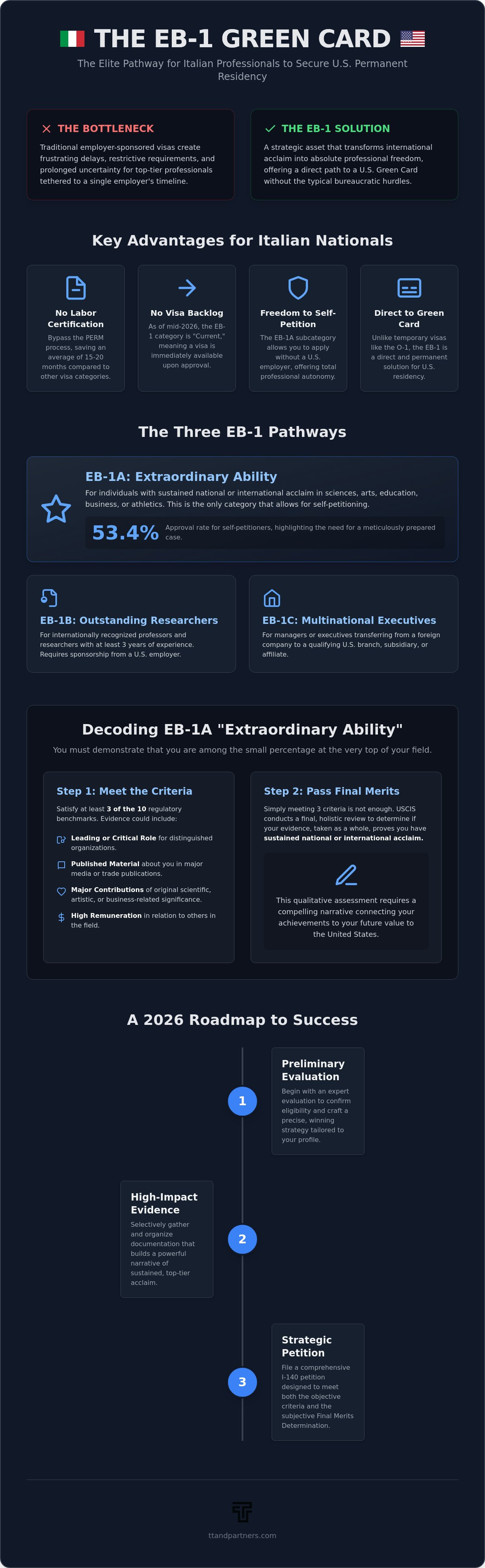
This guide explores the elite pathway of the EB-1 green card for Italians, a strategic asset that transforms international acclaim into absolute professional freedom. You'll discover how to secure US permanent residency without the need for a labor certification or an American sponsor. We'll examine the 2026 adjudication landscape, including the 53.4% approval rate for self-petitioners and the specific evidentiary standards required to prove extraordinary ability. By understanding the intersection of Italian prestige and US legal rigor, you can establish a predictable, independent future in the United States.
Table of Contents
What is the EB-1 Green Card and Why is it the "Holy Grail" for Italians?
The EB-1 category represents the pinnacle of the US employment-based immigration system. Often referred to as the "first preference" visa, it's designed for individuals with extraordinary ability, outstanding researchers, or multinational executives. For a comprehensive EB-1 visa overview, one can see it prioritizes those who have reached the top of their respective fields. It's not just a visa; it's a recognition of professional excellence that grants the holder a direct path to permanent residency.
Italian professionals find this category particularly attractive because it bypasses the systemic hurdles that plague other pathways. Unlike the EB-2 or EB-3 categories, the EB-1 doesn't require the PERM Labor Certification. This omission removes a layer of bureaucracy that typically adds 15 to 20 months to the process. Additionally, as of the July 2026 Visa Bulletin, the EB-1 remains "current" for Italian nationals. This means there's no backlog; a visa number is immediately available upon petition approval. This predictability is a rare luxury in modern immigration law.
The EB-1 green card for Italians is divided into three distinct streams, each tailored to a specific type of professional profile:
EB-1A: For those with extraordinary ability in sciences, arts, education, business, or athletics.
EB-1B: For outstanding professors and researchers with at least three years of experience.
EB-1C: For multinational managers or executives transferred from an Italian parent company to a US branch.
The Freedom of Self-Petitioning (EB-1A)
The EB-1A subcategory offers a level of professional autonomy that's virtually unmatched. Italian individuals of extraordinary ability don't need a US employer to sponsor their petition. They can "self-petition." This allows Italian entrepreneurs, independent artists, and specialized consultants to secure permanent residency based solely on their own merits. It's about professional sovereignty. You aren't tied to a specific firm or job offer. You have the freedom to work for any employer or even remain self-employed once you arrive in the United States.
EB-1 vs. O-1: The Permanent Solution
Many Italian professionals initially enter the US on an O-1 visa. While the O-1 also requires "extraordinary ability," it's a non-immigrant, temporary visa. It's a useful tool, but it doesn't lead directly to a green card. The EB-1 is the permanent evolution of that status. While the evidentiary standards are higher for the EB-1, the outcome is permanent residency. If you've already secured an O-1, you've likely built the foundation for an EB-1 petition. You can find more details on the initial requirements in our O-1 Visa Guide. Transitioning to the EB-1 turns a temporary stay into a lifelong professional asset.
Decoding the Extraordinary Ability (EB-1A) Criteria for Italian Professionals
The path to an EB-1 green card for Italians begins with a rigorous evaluation against the official USCIS EB-1 criteria. While a one-time achievement like an Oscar or a prestigious international prize provides a direct route, most applicants must satisfy at least three of ten specific regulatory benchmarks. These range from original scientific contributions to leading roles in distinguished organizations. However, simply meeting the numerical threshold isn't sufficient. USCIS officers apply a "Final Merits Determination," assessing whether the evidence, in its totality, demonstrates that you've sustained national or international acclaim. It's a qualitative review that looks beyond the checklist to the substance of your career.
Extraordinary ability is a level of expertise indicating that the person is among the small percentage who have risen to the very top of their field. Proving this requires a narrative that connects your past achievements to your future intent in the United States. With the EB-1A approval rate recorded at 53.4% in late 2025, the scrutiny has never been higher. Every document must serve a strategic purpose, reinforcing the claim that your presence will substantially benefit the U.S. national interest.
Translating Italian Accolades into US Evidence
Italian professionals often possess prestigious recognitions that don't always have a direct American equivalent. A "Cavaliere del Lavoro" or a "Stella al merito del lavoro" serves as powerful evidence of national acclaim when contextualized correctly for a US audience. Similarly, memberships in exclusive bodies like the Accademia Nazionale dei Lincei or high-level roles within Confindustria map directly to the "membership" and "leading role" criteria. We also look toward Italy's premier media landscape; a profile in Corriere della Sera or Il Sole 24 Ore isn't just news. It's "published material" that confirms your status as a person of expertise. If you're unsure how your Italian career translates to these benchmarks, it's wise to reach out for a strategic evaluation to ensure your evidence meets current standards.
The Critical Role of Expert Opinion Letters
Expert letters provide the narrative glue for your petition. You'll need testimonials from recognized authorities in both Italy and the United States who can articulate the significance of your work. These aren't simple recommendation letters. They are technical validations that explain why your contributions are groundbreaking. Selecting the right referees is essential. You need individuals whose own prestige lends weight to their assessment of your "extraordinary" status. These letters must bridge the gap between your technical achievements and the legal requirements of the EB-1 category.
EB-1B and EB-1C: Pathways for Italian Researchers and Executives
While the EB-1A offers independence, the EB-1B and EB-1C categories provide structured pathways for those integrated into institutional or corporate frameworks. Securing an EB-1 green card for Italians through these sponsored routes requires a meticulous alignment between the foreign entity and the domestic petitioner. These options are vital for the Italian intellectual and industrial diaspora. They offer a stable transition into the American market backed by the strength of an existing organization. Consulting a Strategic Guide to U.S. Permanent Residence reveals that these categories often enjoy higher approval rates than the self-petitioned route. In late 2025, EB-1B and EB-1C approval rates exceeded 96%, reflecting the USCIS's respect for established institutional backing.
EB-1B for the Italian Academic Elite
Italian researchers have long contributed to global scientific advancement. For these individuals, the EB-1B serves as a recognition of their "outstanding" status. To qualify, an applicant must demonstrate at least three years of experience in teaching or research within their academic field. The evidence must showcase original scholarly research that has garnered international recognition. Unlike the EB-1A, this path requires a permanent job offer from a US university or a private research institution that employs at least three full-time researchers. It's a collaborative milestone that cements an Italian academic's place in the US research infrastructure.
EB-1C: Bridging Italian Corporate Leadership to the US
The EB-1C is the primary vehicle for Italian multinational managers and executives. It's designed for those who have been employed by an Italian parent, affiliate, or subsidiary company for at least one of the three years preceding the petition. This category is particularly effective for Italian SMEs expanding their footprint. The US entity must have been "doing business" for at least one year. This means providing goods or services in a regular, systematic, and continuous manner. It ensures that the green card supports genuine economic activity rather than a mere legal shell.
For those who have already established a presence via an L-1A non-immigrant visa, the EB-1C is the logical progression to a permanent EB-1 green card for Italians. It solidifies the executive's role in the US market without the volatility of temporary status. If you are in the early stages of this expansion, our LLC Incorporation Guide provides the necessary blueprint for establishing a qualifying US structure. This transition ensures that Italian leadership remains a permanent fixture in the American corporate landscape. The 2026 landscape allows for premium processing of EB-1C petitions with a 45-business-day response time, providing the speed necessary for agile corporate moves.
Strategic Transitions: From E-2 and O-1 to the EB-1 Green Card
For many Italian professionals, the initial entry into the United States occurs through non-immigrant pathways like the E-2 treaty investor visa or the O-1 extraordinary ability visa. While these categories provide immediate access to the American market, they remain inherently temporary. Transitioning to an EB-1 green card for Italians is a strategic evolution that transforms a successful stay into a permanent professional legacy. This shift requires more than just meeting criteria; it demands a sophisticated management of "immigrant intent." While the O-1 visa allows for dual intent, the E-2 is technically a non-immigrant category. Balancing your status while pursuing permanent residency is a delicate legal exercise that ensures your ability to travel and operate your business remains uninterrupted.
The O-1 to EB-1A pipeline is a particularly effective route for Italian talent. Because the O-1 and EB-1A share similar "extraordinary ability" standards, the O-1 serves as a practical testing ground. If you've already secured an O-1, you've already cleared a significant evidentiary hurdle. The transition to the EB-1A then becomes a matter of intensifying your evidence to meet the higher "sustained acclaim" standard. It's about taking the momentum of your initial US success and codifying it into a permanent right to remain and work without restriction. Long-term planning is essential here. Entrepreneurs who wait too long to start this transition may find themselves tethered to visa renewals that don't offer the same security as a green card.
The E-2 to EB-1 Bridge for Italian Investors
Italian investors often find that their US enterprises grow beyond the scope of a treaty visa. If your business has expanded significantly, you might qualify for the EB-1C as a multinational executive. Alternatively, if your individual reputation as an industry leader has flourished, the EB-1A self-petition becomes viable. Managing this bridge requires a careful evaluation of your company's growth and your personal accolades. For those still in the early phases of their US journey, our E-2 Visa Guide 2026 outlines the foundational strategies that make these future transitions possible. It's about building a structure today that supports the permanent residency goals of tomorrow.
Timing and Concurrent Filing in 2026
The 2026 regulatory environment offers specific advantages for Italians ready to commit to permanent residency. One of the most powerful tools is "Concurrent Filing," which allows you to submit Form I-140 and Form I-485 (Adjustment of Status) simultaneously when visa numbers are available. This can significantly accelerate your path to work authorization and travel documents. To further expedite the process, the premium processing fee of $2,965 provides a guaranteed response from USCIS. Premium Processing allows for a USCIS decision within 15 to 45 days, depending on the specific EB-1 sub-category. This speed is invaluable for professionals who need a clear, predictable timeline for their relocation. If you're ready to determine which transition strategy fits your profile, you should schedule a strategic consultation to map out your 2026 roadmap.
Navigating the EB-1 Application Process: A 2026 Roadmap
The roadmap to an EB-1 green card for Italians is a sequence of precise legal maneuvers that rewards intellectual rigor and meticulous preparation. It begins with a deep-dive evaluation of your professional standing. This initial audit ensures your profile aligns with the extraordinary threshold before you engage with the formal system. Once your eligibility is confirmed, you'll move to document gathering. This isn't a simple collection process. It's an editorial curation of your life's work, where the emphasis remains strictly on the quality and relevance of evidence rather than sheer volume.
The formal filing of the I-140 Immigrant Petition follows. In 2026, the standard filing fee for this form is $715, supplemented by a $300 Asylum Program Surcharge for self-petitioners and small employers. If your timeline requires speed, the $2,965 premium processing fee ensures a decision within 15 to 45 business days. Upon approval, the final stage involves either an Adjustment of Status within the US (Form I-485, $1,440) or consular processing at the US Consulate in Italy (Form DS-260, $345). Be prepared for the final interview. Current data shows the interview waiver rate has dropped to between 6% and 9% in 2026, making an in-person appointment a near-certainty for most applicants.
Avoiding the "Request for Evidence" (RFE) Trap
The RFE is a common bottleneck that can stall your progress for months. It usually happens when a petition lacks a cohesive narrative or relies on generic evidence. Italian professionals with decades of experience can still face rejection if their accolades aren't translated into the specific language of US immigration law. Pre-empting these challenges requires a petition that connects every award, publication, and membership into a single, undeniable proof of sustained acclaim. You can't rely on the officer to connect the dots; the narrative must be explicit and technically sound.
Why Specialized US-Italy Counsel is Non-Negotiable
Italian professional culture has deep-seated nuances that a standard US immigration firm might overlook. You need a partner who understands the prestige of specific Italian institutions and the complexities of cross-border lifestyle management. A lawyer who recognizes the weight of your Italian career while understanding the rigid expectations of USCIS is essential for success. This dual perspective allows for a more sophisticated strategy that addresses both legal requirements and your long-term professional goals. To begin your strategic evaluation, contact Tosolini, Toniutti & Partners.
Securing Your Professional Legacy in the United States
The transition from high-level achievement in Italy to permanent residency in the U.S. requires a blend of legal precision and strategic vision. You've seen how the EB-1 category bypasses the typical bureaucratic delays of labor certification, providing a clear path for those at the peak of their careers. Whether you choose the autonomy of a self-petitioned EB-1A or the structured growth of the EB-1C, the current availability of visa numbers for Italian nationals creates a unique window of opportunity.
The EB-1 green card for Italians isn't merely a permit; it's the foundation for your long-term impact on the American market. Success depends on a narrative that respects your past accolades while articulating your future potential. With specialized US-Italy immigration expertise and a proven track record, we help translate your extraordinary talent into a permanent reality. To begin this journey, you should schedule a strategic consultation to evaluate your EB-1 eligibility. Your expertise has already earned international recognition; now it's time to secure the professional freedom you deserve.
Frequently Asked Questions
Do I need a job offer for an EB-1 Green Card if I am an Italian citizen?
It depends on the specific sub-category you pursue. The EB-1A Extraordinary Ability category allows for self-petitioning, meaning you don't need a job offer or a US employer to sponsor you. However, the EB-1B for outstanding researchers and the EB-1C for multinational executives both require a permanent job offer from a US-based petitioner. This flexibility makes the EB-1A particularly attractive for Italian entrepreneurs and independent professionals who prioritize professional autonomy.
How long does the EB-1 Green Card process take for Italians in 2026?
The timeline varies based on your filing strategy. Standard I-140 petition processing currently ranges from 16 to 28.5 months. If you utilize premium processing, you'll receive an initial decision within 15 to 45 business days. Once the petition is approved, the adjustment of status process for the EB-1 green card for Italians takes between 8.5 and 36.5 months. Because the July 2026 Visa Bulletin is current for Italy, you don't face the additional multi-year backlogs seen in other employment categories.
Can I apply for an EB-1A if I am currently in the US on an E-2 visa?
Yes, transitioning from an E-2 treaty investor visa to an EB-1A is a viable strategic move. Many Italian investors find that as their US enterprise grows, their personal reputation and professional acclaim reach the "extraordinary" threshold. It's essential to manage the transition carefully to maintain your legal status and travel eligibility while the immigrant petition is pending. This path allows you to move from a temporary, renewable visa to permanent residency based on your individual merits.
What happens if my EB-1 petition is denied?
A denial isn't necessarily the end of your US residency goals. You have the option to file a motion to reopen or reconsider the case, or you can submit a new petition with stronger, more comprehensive evidence. Many Italian applicants choose to maintain their current O-1 or E-2 status while they refine their EB-1 strategy. Understanding the specific reasons for a denial, often found in a Request for Evidence (RFE), is crucial for a successful second attempt.
Can my family join me on an EB-1 Green Card?
Your immediate family is entitled to the same permanent residency benefits. Your spouse and any unmarried children under the age of 21 can apply for derivative green cards alongside your primary petition. Once approved, they'll have the freedom to live, work, and study anywhere in the United States without the restrictions associated with non-immigrant dependent visas. This ensures a stable and unified relocation for your entire household.
Is there a minimum investment required for the EB-1C multinational executive category?
There's no specific dollar amount mandated for the EB-1C category. Unlike the E-2 or EB-5 visas, the focus remains on the qualifying relationship between the Italian parent company and the US subsidiary. The US entity must have been active and "doing business" for at least one year. While there's no investment floor, the US branch must demonstrate the financial capacity to support your executive role and maintain a sustainable corporate structure.
What is the difference between EB-1 and the Green Card Lottery for Italians?
The EB-1 is a merit-based immigrant visa that rewards professional excellence and extraordinary skill. In contrast, the Green Card Lottery, or Diversity Visa program, is a random selection process with no regard for professional background. While Italians are eligible for the lottery, the EB-1 green card for Italians offers a predictable and controllable pathway for elite talent. You aren't relying on chance; you're securing your status through the documented quality of your career achievements.
Can I use premium processing for all EB-1 categories in 2026?
Yes, premium processing is available for the EB-1A, EB-1B, and EB-1C categories. As of March 1, 2026, the fee for this expedited service is $2,965. For EB-1A and EB-1B petitions, USCIS guarantees a response within 15 business days. For EB-1C multinational executive petitions, the guaranteed response time is 45 business days. This service is an invaluable tool for Italian professionals who require a definitive timeline for their strategic relocation and business planning.


Comments