

EB-2 NIW Green Card for Italians: The 2026 Strategic Guide to Self-Sponsorship
- Gianni Mendes Toniutti, Esq.

- Jul 7
- 13 min read
Updated: Jul 11
What if the most direct route to American permanent residency didn't require a job offer or a corporate sponsor at all? For many Italian professionals, the traditional path to a U.S. career feels like a series of compromises, often limited by the temporary nature of E-2 or O-1 visas. You've likely felt the frustration of the PERM labor certification process, where your future depends on an employer's paperwork rather than your own intellectual capital. The EB-2 NIW green card for Italians offers a more refined alternative; it allows you to self-petition based on the national importance of your expertise.
We understand that moving your life and legacy across the Atlantic requires more than just a visa; it requires a strategic vision for your family's security and your professional freedom. This guide reveals how to navigate the Dhanasar three-prong test with the same precision you apply to your own field. You'll learn about the current priority dates for Italy, the $2,965 premium processing path for a 45-day response, and the exact steps to secure a green card that grants you the liberty to work for any employer or launch your own American enterprise.
Table of Contents
Understanding the EB-2 NIW: The Premier Path for Italian Talent
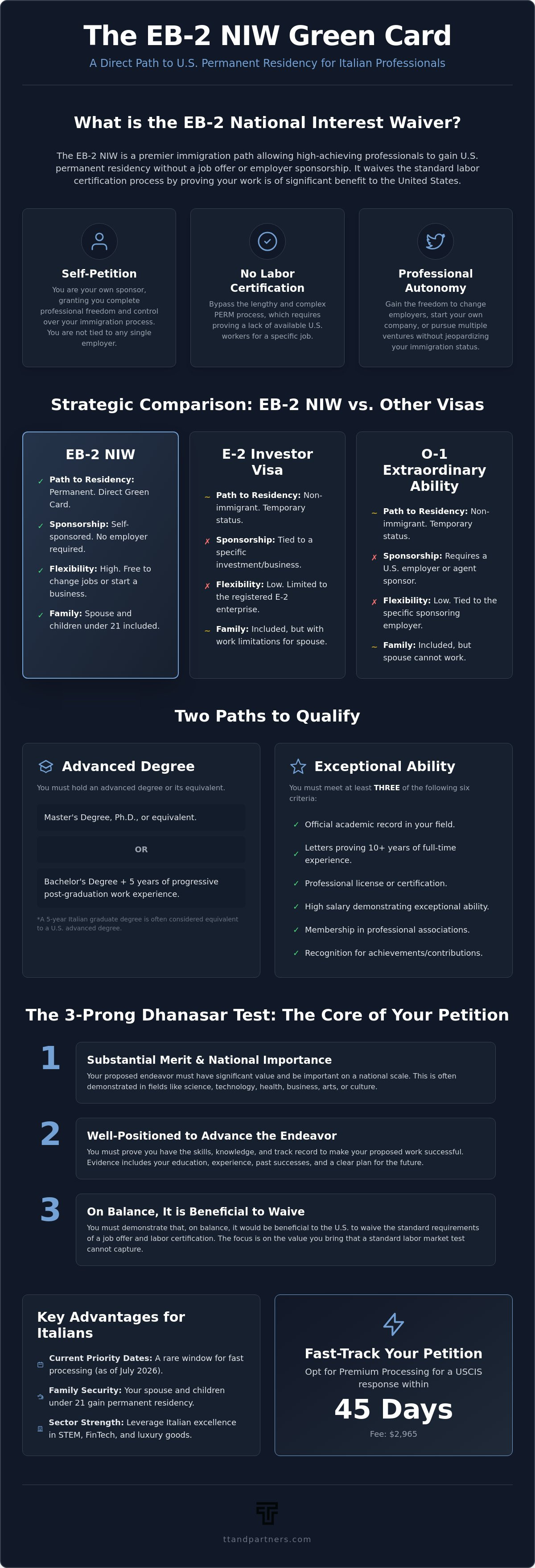
The EB-2 NIW green card for Italians represents a sophisticated shift in how high-achieving professionals approach U.S. residency. At its core, the National Interest Waiver is a sub-category of the second-preference employment-based visa. While most employment visas require a specific job offer and the exhaustive labor certification process, the NIW waives these requirements. This means you don't need to prove that no American worker is available for a specific role. Instead, you demonstrate that your presence in the U.S. provides a benefit so significant that the standard market test should be set aside.
For Italian entrepreneurs and researchers, the self-petition feature is the most compelling aspect. You act as your own sponsor. You aren't tied to a single company's hierarchy or a specific office location. As of July 2026, the priority dates for Italy remain current. This creates a rare window for strategic action. If you're already in the U.S., you can often file your immigrant petition and your adjustment of status application simultaneously, accelerating your path to permanent residency.
The Advanced Degree vs. Exceptional Ability Threshold
To qualify for the EB-2 NIW green card for Italians, you must first meet one of two entry requirements. The first is holding an advanced degree, typically a Master's or a Ph.D. In the context of Italian education, a five-year graduate degree is generally recognized by U.S. evaluators as the equivalent of an advanced degree. Alternatively, a Bachelor's degree followed by five years of progressive post-graduation experience serves the same purpose.
If you lack these specific degrees, you can qualify through "Exceptional Ability." This requires meeting at least three criteria from the USCIS list:
An official academic record showing a degree or certificate related to your area of expertise.
Letters from current or former employers documenting at least ten years of full-time experience.
A license to practice your profession or certification for your industry.
Evidence that you've commanded a salary or remuneration that demonstrates your exceptional ability.
Membership in professional associations.
Recognition for your achievements and significant contributions to your industry or field.
We often see Italian architects and designers succeed here by showcasing their unique professional certifications and the international recognition of their work. The Dhanasar Test then becomes the secondary, more rigorous hurdle to prove your work's national importance.
Why Italians Are Choosing the NIW in 2026
In 2026, many Italian professionals are moving away from the limitations of the E-2 or O-1 visa. While those visas offer entry, they don't provide the permanence or flexibility of a Green Card. The NIW offers a level of professional autonomy that temporary statuses lack. You can pivot between ventures, start a new consultancy, or change employers without restarting a legal process.
The security of the family unit is another primary driver. An approved NIW petition includes your spouse and children under 21, granting them the same path to permanent residency. This creates a stable foundation for your family's future in the U.S., free from the anxieties of visa renewals or employer-dependent status.
For professionals who want to ensure their family's legal interests are fully protected during this transition, Eijo Law Services PLLC provides expert representation in complex immigration and family law matters.
The Dhanasar Test: The Three Prongs of a Successful Petition
The legal architecture of the National Interest Waiver rests upon the Matter of Dhanasar framework. This precedent serves as the definitive gatekeeper for any EB-2 NIW green card for Italians. It moves the conversation away from a simple labor market test and toward a strategic evaluation of your professional value. To succeed, your petition must satisfy three distinct prongs that collectively prove your presence benefits the United States in a way that traditional sponsorship cannot. Adjudicators use these prongs to determine if the standard requirements of a job offer and labor certification should be set aside in your specific case.
Prong one examines the proposed endeavor's substantial merit and national importance. USCIS adjudicators look for projects that offer significant economic impact, advance technological frontiers, or provide cultural enrichment. Following the Official EB-2 NIW Eligibility Criteria, the focus here is on the nature of the work itself. Prong two pivots to the individual, assessing whether you're well-positioned to advance that endeavor. This involves a deep dive into your education, records of success, and current progress. Finally, prong three asks the government to balance the interests, deciding if it's more beneficial to waive the job offer requirement than to enforce it.
Defining "National Importance" in a Global Economy
National Importance doesn't require your work to affect every American citizen simultaneously. A project can be geographically limited yet still carry national weight if it advances a critical industry like AI, biotechnology, or renewable energy. Under the stricter scrutiny introduced by Policy Alert PA-2025-03 in early 2025, the impact must be clearly articulated. We define "National Importance" as a prospective impact that transcends a single employer. For an Italian entrepreneur, this might mean demonstrating how a new software platform scales across the US market rather than just serving one client base.
Proving You Are "Well-Positioned" to Succeed
Prong two is where your history meets your future. It's not enough to have a great idea; you must prove you're the right person to execute it. This is where your Italian professional accolades, such as specialized certifications or leadership in international projects, become vital evidence. A detailed business plan or a robust research statement acts as a roadmap for your US endeavor. If you're unsure how your specific background fits these criteria, you might consider reaching out for a strategic case evaluation to align your narrative with US legal expectations.
Balancing these prongs requires a blend of engineering precision and visionary storytelling. The EB-2 NIW green card for Italians is won or lost on the strength of this narrative. You aren't just applying for a visa; you're presenting a business case for your permanent residency. With approval rates for NIW petitions showing increased scrutiny in 2026, the clarity of your Dhanasar argument is your most important asset.
Strategic Comparison: EB-2 NIW vs. E-2 and O-1 Visas
Entry into the U.S. market for Italian talent often begins with the agility of non-immigrant visas. The E-2 Treaty Investor and O-1 Extraordinary Ability visas provide immediate access, yet they remain inherently temporary. The EB-2 NIW green card for Italians serves as the permanent evolution of these statuses. While an E-2 allows you to manage your investment, it doesn't offer a direct path to residency. Similarly, the O-1 requires constant renewals tied to specific achievements. Transitioning to the NIW allows you to convert your temporary success into a lasting American legacy.
A common question arises: is the NIW more difficult to obtain than the O-1? The answer lies in the focus of the petition. The O-1 standard centers on the individual's "Extraordinary Ability," essentially asking if you're at the very top of your field. The EB-2 visa eligibility criteria for the NIW shift the focus toward the "National Interest." It's possible to be an extraordinary professional whose work has a localized impact that doesn't meet the NIW threshold. Conversely, a professional with a solid advanced degree might secure an NIW by proving their specific project addresses a critical U.S. shortage.
Transitioning from E-2 Treaty Investor to Green Card
The E-2 visa is a powerful tool for Italian entrepreneurs, but it lacks "dual intent." This means you must maintain the intention to depart the U.S. when your status expires. When you apply for an EB-2 NIW green card for Italians while on an E-2, you're signaling a desire for permanent residency. This requires a sophisticated legal strategy to manage travel and status extensions. Your existing U.S. business provides excellent evidence for the Dhanasar test. By showing that your company creates jobs and contributes to the U.S. economy, you prove national importance. For a deeper look at the initial investment phase, see our E-2 Visa Guide 2026: The Strategic Framework for Treaty Investors.
O-1 to EB-2 NIW: Moving Beyond "Extraordinary"
If you've already secured an O-1, you've already cleared a high evidentiary bar. The press coverage, awards, and high salary used for your O-1 are foundational for the "well-positioned" requirement of the NIW. While an O-1 approval doesn't guarantee an NIW success, it demonstrates to USCIS that you have the expertise to advance your endeavor. The challenge lies in re-framing your personal excellence into a broader benefit for the American public. You can explore the criteria for the initial extraordinary status in our guide on the O-1 Visa: The Complete 2026 Guide to Extraordinary Ability Visas for the US.
Evidence for Italians: Showcasing Excellence in Key Sectors
Success in a petition for an EB-2 NIW green card for Italians relies on the quality of the evidence, not just the quantity. In 2026, USCIS maintains a favorable view toward STEM fields, specifically Artificial Intelligence, renewable energy, and biotechnology. Italian researchers often bring a unique cross-disciplinary approach that aligns with U.S. public health goals or national security interests. Similarly, FinTech innovators from Milan's financial hubs can argue that their proprietary algorithms enhance U.S. market stability or cybersecurity infrastructure. This alignment with current U.S. priorities provides a powerful narrative for the substantial merit requirement.
The "Italian Design and Luxury" angle offers a distinct strategic advantage that many generic guides overlook. While competitors often focus on academic citations, we emphasize the economic and cultural impact of the Italian aesthetic. Proving that an Italian designer's work will revitalize U.S. manufacturing or enhance the competitiveness of American luxury brands meets the national importance threshold. This isn't just about style. It's about job creation and the infusion of high-value intellectual property into the U.S. economy. When your work influences a major U.S. industry, it transcends the interests of a single employer.
Advanced manufacturing and agri-tech represent other critical sectors where Italian talent shines. Italian innovation in precision farming and automated production lines directly addresses U.S. supply chain vulnerabilities. By documenting how your specific expertise reduces waste or increases domestic output, you satisfy the first prong of the Dhanasar test. These sectors are particularly relevant as the U.S. continues to prioritize domestic production and environmental sustainability in 2026.
The Role of Expert Opinion Letters
Expert letters of recommendation serve as the bridge between your technical data and the adjudicator's understanding. We prioritize letters from independent U.S. industry leaders over colleagues or former supervisors. These individuals can objectively testify to the prospective impact of your work. Each letter must be structured to address the Dhanasar prongs specifically, rather than offering generic praise. Support from Italian institutional bodies, such as Trade Agencies or professional guilds, adds a layer of credibility that USCIS respects. If you're prepared to translate your professional legacy into a U.S. residency, contact our legal team for a precise evaluation of your evidence portfolio.
Documenting International Impact
Translating your Italian success into a U.S. centric value proposition is essential. Your publications, patents, and awards must be presented in a context that highlights their global relevance. Media coverage in Italian outlets or memberships in elite professional associations serve as secondary evidence of your influence. Ensure that all documents meet strict USCIS translation and certification standards to avoid unnecessary delays. Every word in your evidence file must contribute to the image of a professional who is well-positioned to succeed in the American market.
The Tosolini, Toniutti & Partners Approach: Cross-Border Synergy
The transition to American permanent residency is a complex architectural project. It requires more than just legal knowledge; it demands an understanding of the cultural and professional nuances that define Italian excellence. At Tosolini, Toniutti & Partners, we bridge the gap between your established Italian reality and the rigorous expectations of U.S. immigration authorities. Securing an EB-2 NIW green card for Italians involves a delicate synthesis of your past achievements and your future vision for the American market. We don't just file forms. We translate your professional legacy into a narrative that carries weight in the U.S. legal system.
Our approach is inherently holistic. We don't view the petition in isolation. Instead, we consider the entire lifecycle of your move, from the initial LLC Incorporation to the final approval of your residency. This includes addressing the cross-border tax and legal implications that arise when you become a U.S. permanent resident. A green card changes your global tax status; managing this transition requires the precision and foresight that only a boutique firm can provide. We focus on the quality of the intellectual content within your petition, ensuring every argument reflects the high stakes of your endeavor. Our firm operates on the belief that a well-structured business foundation is the best support for a successful self-petition.
Beyond the Petition: A Strategic Partnership
We act as strategic architects for your "Proposed Endeavor." Our role is to craft a narrative that resonates with USCIS adjudicators while remaining grounded in technical fact. This involves a deep analysis of your specific sector and how it aligns with U.S. national interests. We help you articulate how your presence strengthens the American economy or technological landscape. Understanding the financial landscape is also crucial for long-term security. For a detailed breakdown of the investment required and the associated legal path, you can review our guide on How Much Is a Green Card? The 2026 Cost and Strategy Guide.
Initiating Your EB-2 NIW Journey
The first step in securing an EB-2 NIW green card for Italians is a rigorous eligibility evaluation. We analyze your advanced degrees, professional certifications, and the potential impact of your work. Once a path is clear, we guide you through the I-140 filing process. Depending on your current location, we then navigate either the Adjustment of Status within the U.S. or Consular Processing in Italy. This journey requires patience and engineering-like accuracy. To begin your assessment and explore how your expertise fits the National Interest Waiver, we invite you to contact Tosolini, Toniutti & Partners for a specialized consultation. We believe in building long-term partnerships that respect your professional past while securing your American future.
Securing Your Professional Legacy in the United States
The EB-2 NIW green card for Italians represents more than a legal status; it is a strategic affirmation of your professional value in the global market. By bypassing the PERM labor certification and removing the need for employer sponsorship, this path grants you the autonomy to lead ventures that align with your long term vision. Whether you are transitioning from an O-1 or E-2 visa or applying directly from Italy, the Dhanasar framework provides the structure to showcase how your expertise addresses critical U.S. challenges. Success requires a partner who understands the bridge between Italian innovation and American regulatory precision.
Our firm offers specialized expertise in U.S. Italy cross border immigration, backed by a proven track record of helping elite talent navigate these complex transitions. With bilingual legal support in New York and Italy, we ensure your petition is as refined as the work it represents. Secure your future in the US: Contact Tosolini, Toniutti & Partners for an EB-2 NIW evaluation. Your contribution to the American landscape begins with a single, well placed decision. We look forward to building that future with you.
Frequently Asked Questions
Do I need a job offer for an EB-2 NIW Green Card?
No, you don't need a job offer or a U.S. employer to sponsor your petition. The National Interest Waiver specifically allows for self-sponsorship by bypassing the PERM labor certification process. This provides you with the professional autonomy to work for any employer or manage your own business ventures once your residency is approved.
How long does the EB-2 NIW process take for Italian citizens in 2026?
Standard I-140 processing times for the EB-2 NIW green card for Italians currently range from 8 to 26.5 months. Since the priority date for Italy is current in July 2026, you can often file for an adjustment of status concurrently if you're already in the U.S. on a valid visa. The final residency phase typically adds another 8 to 18 months.
Can I apply for an EB-2 NIW if I am currently on an E-2 visa?
You can apply for an NIW while holding E-2 status, but it requires a sophisticated legal strategy to manage your non-immigrant intent. Because the E-2 visa doesn't inherently support dual intent, you must carefully coordinate your travel and status renewals. Your active U.S. investment often provides excellent evidence of the national importance of your professional endeavor.
What is the "Dhanasar Test" and why is it important?
The Dhanasar Test is the governing legal framework that determines the success of your petition. It consists of three prongs: the substantial merit and national importance of your work, your personal positioning to advance that work, and the overall benefit to the U.S. in waiving the job offer requirement. Every piece of evidence in your file must address these specific criteria.
Can entrepreneurs and business owners qualify for the National Interest Waiver?
Entrepreneurs frequently qualify by demonstrating how their companies drive economic growth or technological innovation in the U.S. market. The EB-2 NIW green card for Italians is particularly well-suited for founders who can show their venture creates jobs or addresses supply chain vulnerabilities. Recent 2025 policy updates have further clarified how entrepreneurs can meet the national importance threshold.
Is premium processing available for EB-2 NIW petitions?
Yes, premium processing is available for a fee of $2,965 as of March 2026. This service ensures that USCIS will provide a response to your I-140 petition within 45 business days. For many high-level professionals, this accelerated timeline is a vital strategic tool to gain certainty and move forward with their long-term American residency plans.
What happens to my family if my NIW petition is approved?
Your spouse and any unmarried children under the age of 21 are included as derivative beneficiaries in your application. They'll receive their own green cards upon approval, granting them the permanent right to live, work, and study in the United States. This ensures the entire family unit gains the same level of security and professional freedom.
Do I need to live in the US while the NIW application is pending?
You don't need to reside in the U.S. while your application is under review. If you're living in Italy, you'll complete the final steps through consular processing at the U.S. Embassy after your initial petition is approved. If you're already in the U.S. on a valid non-immigrant visa, you can choose to remain and adjust your status domestically.


Comments