

Enforcing a Foreign Judgment in the US: The 2026 Legal Strategic Guide
- Gianni Mendes Toniutti, Esq.

- Aug 3
- 12 min read
A victory in the courts of Rome or Milan is merely a theoretical success until it can be converted into tangible assets across the Atlantic. You've secured a favorable ruling, but the prospect of enforcing Italian court judgment in USA can feel like entering a second, even more complex arena. It's a common fear that American judges might insist on re-trying the merits of your case, potentially doubling your litigation costs and extending your timeline by years. You deserve the certainty that your Italian judgment carries weight in American courtrooms without the exhaustion of dual-jurisdiction combat.
We understand that you need more than just a translation; you need a strategic architectural process that bridges two distinct legal cultures. This 2026 guide, presented by Tosolini, Toniutti & Partners, offers a clear roadmap for mastering the state-level recognition process with professional precision and foresight. We'll explore how to satisfy the requirements of the Uniform Foreign-Country Money Judgments Recognition Act, meet critical filing deadlines for judgment authentication, which often include specific timeframes, and move swiftly toward asset attachment. By the end of this analysis, you'll have the clarity required to transform a foreign order into a domestic reality.
Table of Contents
The Legal Framework for Enforcing Foreign Judgments in the United States
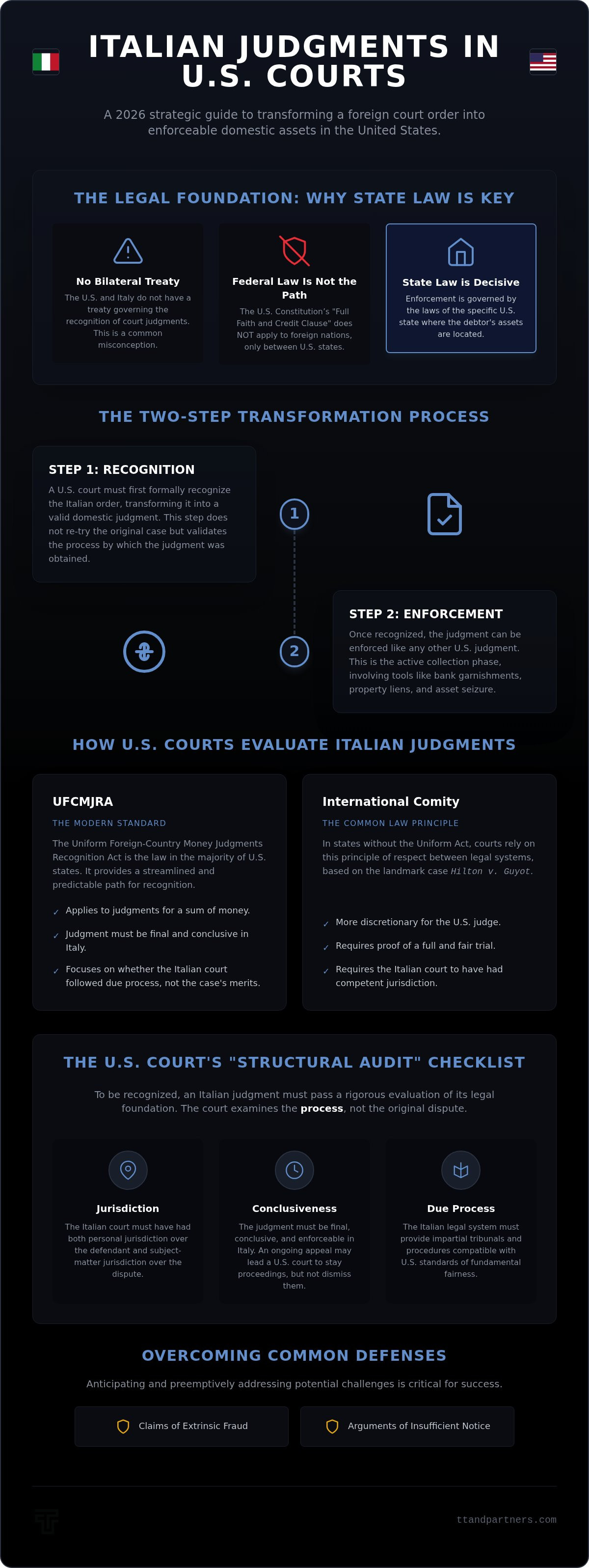
Transforming an Italian judicial decree into an actionable American instrument requires a deliberate architectural approach. Unlike the seamless recognition of judgments between different US states, a foreign court order doesn't enjoy automatic status. The process of enforcing Italian court judgment in USA is essentially a two-step transformation. First, a US court must recognize the foreign order as a valid domestic judgment. Only after this formal recognition can the second stage, enforcement, begin. This second phase involves the actual collection of funds through bank garnishments or property liens.
Many litigants mistakenly look for a federal treaty to guide this process. In reality, no such bilateral agreement exists between the United States and Italy. Because of this treaty void, the Legal Framework for Foreign Judgments relies almost entirely on the laws of the specific state where the assets are located. While the US Constitution’s Full Faith and Credit Clause mandates that states respect each other’s laws, it doesn't extend to foreign nations. This makes the choice of jurisdiction a critical strategic decision.
The Uniform Foreign-Country Money Judgments Recognition Act
As of 2026, the Uniform Foreign-Country Money Judgments Recognition Act (UFCMJRA) serves as the modern standard across the majority of US states. This statute provides a predictable, streamlined path for recognition compared to older common law methods. It specifically applies to judgments that grant or deny the recovery of a sum of money, provided they're final and conclusive in Italy. The Act eliminates much of the guesswork, focusing on whether the Italian court followed due process rather than re-examining the facts of the original dispute. Navigating these statutes is the first hurdle when enforcing Italian court judgment in USA.
The Principle of International Comity
In the few jurisdictions that haven't adopted the Uniform Acts, courts rely on the principle of international comity. We define comity as a gesture of respect between sovereign legal systems, where one nation recognizes the legislative, executive, or judicial acts of another. The foundation for this remains the landmark Supreme Court case Hilton v. Guyot. Under this standard, a US court will generally recognize an Italian judgment if the defendant had a full and fair trial before a court of competent jurisdiction. This common law approach is more discretionary, making professional precision in your initial filing even more vital for success.
Statutory Requirements for Recognition of an Italian Judgment
For a US court to validate an Italian decree, the judgment must pass a rigorous structural audit. This evaluation doesn't reopen the facts of the case. Instead, it examines the legal framework that produced the ruling. Successfully enforcing Italian court judgment in USA requires proving that the Italian court possessed both personal jurisdiction over the defendant and subject matter jurisdiction over the dispute. If the defendant wasn't properly reachable under Italian law, or if the court exceeded its authority, the US recognition process will likely stall. These jurisdictional pillars ensure that the judgment wasn't rendered in a vacuum but through a legitimate exercise of judicial power.
The Conclusiveness Requirement
A judgment must be final, conclusive, and enforceable in its country of origin to be recognized by an American court. This often raises questions when an Italian judgment is currently under appeal. While the existence of an appeal doesn't necessarily strip a judgment of its "final" status, US judges have the discretion to stay the recognition proceedings. They'll often wait for the Italian appellate process to conclude to avoid conflicting rulings. This prevents the administrative chaos of recognizing a judgment that might later be overturned in Rome. Strategic timing is essential here. Filing the recognition petition while the Italian judgment is still fresh can secure your place in the US judicial queue, even if a temporary stay is granted. It ensures that assets aren't dissipated while the parties wait for a final word from the Italian Court of Appeal.
Due Process and Public Policy Standards
The US legal system requires that the foreign judgment originated from a system providing impartial tribunals and procedures compatible with due process. While Italian courts are generally respected for their adherence to these standards, a defendant might challenge the recognition by claiming they didn't receive adequate notice of the proceedings. This "Fairness Test" is the primary shield used by debtors. Beyond procedural fairness, a court may refuse recognition if the judgment is "repugnant" to the public policy of the state. This rarely happens with standard commercial money judgments, but it remains a potential hurdle if the damages awarded feel excessive or punitive by local standards. The burden of proof typically shifts during this phase. Once you demonstrate the judgment is a final money order, the opponent must prove a specific mandatory ground for non-recognition. Understanding the federal statute on enforcement and related state laws helps clarify these evidentiary burdens. If you're navigating these requirements, you can consult with our bilingual legal team to ensure your filing meets every statutory benchmark with professional precision.
Procedural Steps: The Path to Asset Attachment in the US
The transition from a foreign victory to a domestic recovery is a journey defined by procedural rigor. It's not a simple administrative swap. Instead, it requires a formal filing in a US court to bridge the gap between two legal systems. When enforcing Italian court judgment in USA, the first technical hurdle is the preparation of the evidentiary record. You must provide authenticated copies of the Italian judgment, accompanied by certified English translations. In jurisdictions like New York, practitioners must be mindful of the 90-day window following authentication for filing these documents with the court. This timeline is strict; missing it can derail the entire domestication effort.
Service of process represents another critical milestone. You must serve the defendant with the US summons and complaint according to the local rules of civil procedure. This step ensures the defendant's due process rights are respected within the American system. While the total timeline varies by state, obtaining a US judgment based on an Italian decree typically takes several months. The speed of the process often depends on the complexity of the defendant's opposition and the court's current docket.
Initiating the Recognition Action
The choice between filing in Federal or State court remains a pivotal strategic decision in 2026. Filing a new civil action in Federal court, such as the Eastern District of New York, involves a filing fee of $405.00 as of May 2026. While State courts often offer a more accessible entry point with lower fees, Federal courts are frequently preferred for their experience with international disputes. Your complaint must clearly articulate the final and conclusive nature of the Italian order. If you're unsure which venue offers the most efficient path to recovery, you should contact our international litigation team for a procedural assessment.
The Summary Judgment Motion
Most enforcement proceedings don't reach a full trial. Instead, they're resolved through a motion for summary judgment. This is an efficient tool that allows the court to rule when there are no genuine disputes regarding the material facts of the recognition. The goal is to prevent the debtor from using the US court as a venue for a second bite at the apple. The merits of the case are protected from US review because the court's role is to validate the process, not to second-guess the Italian judge’s findings. This prevents the high cost of re-litigating the original dispute and keeps the focus entirely on the recognition of the existing debt.
Overcoming Defenses and Challenges to Enforcement
The path to recovery is rarely unopposed. Once you initiate the process of enforcing Italian court judgment in USA, the judgment debtor will likely deploy a series of defensive maneuvers to shield their assets. These challenges aren't meant to re-evaluate the evidence of the original case but to question the procedural integrity of the Italian proceedings. A primary tactic involves the distinction between extrinsic and intrinsic fraud. US courts generally won't refuse recognition based on intrinsic fraud, such as a witness providing false testimony during the case in Italy. However, extrinsic fraud, which includes conduct that actually deprived the defendant of the opportunity to present their case, is a potent mandatory ground for non-recognition.
Lack of notice remains the most frequent procedural challenge when enforcing Italian court judgment in USA. If the defendant can prove they weren't served in a manner compatible with due process, the US court will likely dismiss the enforcement action. To preempt this, you must meticulously document the Italian service of process. Proving that the defendant had actual knowledge of the proceedings and a reasonable time to respond is vital. Additionally, the "inconvenient forum" defense, which often plagues initial litigation, carries significantly less weight during the enforcement phase. Since the adjudication is already complete, the court's focus shifts from the convenience of witnesses to the physical location of the debtor's property.
Fraud and Procedural Irregularities
Identifying extrinsic fraud requires a deep understanding of the interactions between the parties during the Italian litigation. This defense succeeds if the judgment creditor engaged in deceptive practices that prevented the debtor from appearing or defending themselves. To counter this, we recommend a comprehensive audit of the original case files. Documenting the chain of service and the defendant's active participation in Italian hearings serves to validate the integrity of the proceedings. US judges in 2026 demand high-quality, authenticated evidence to overlook these claims and move toward asset seizure.
Public Policy and Mandatory Rules
A US court may refuse recognition if the Italian decree is repugnant to the public policy of the United States or the specific state where enforcement is sought. This exception is interpreted narrowly. It isn't enough for the Italian law to be different; it must violate a fundamental right or a deep-seated sense of justice. For instance, judgments that infringe on constitutional protections might face scrutiny. However, standard commercial disputes rarely trigger this alarm. If you are navigating a complex dispute involving multiple jurisdictions, see our guide on International Litigation for broader dispute strategies. For a tailored review of potential defenses in your specific case, you can consult with our strategic legal architects to ensure your enforcement action remains resilient.
Strategic Asset Recovery and Cross-Border Execution
Recognition is the foundation, but asset recovery is the completed structure. Once a US court grants recognition, your Italian order gains the same status as a domestic judgment. This shift unlocks the full power of the American judicial system for enforcing Italian court judgment in USA. You move from the abstract world of legal validity into the concrete reality of financial execution. This phase requires a shift in mindset from litigation to investigation, where the focus is on locating and securing tangible value. It's the moment where legal theory meets the practical necessity of capital recovery.
Asset Discovery and Tracing
The US legal system offers broad post-judgment discovery rules that are significantly more aggressive than those found in the Italian civil code. You can compel the debtor to produce bank statements, tax returns, and corporate ledgers under oath. This process allows us to identify real property, securities portfolios, and intellectual property that can be attached to satisfy the debt. Often, debtors use complex corporate vehicles to obscure ownership. Understanding LLC Incorporation and its role in business structures is vital, as these entities can serve as both defensive shields and strategic targets during the tracing process. Professional precision in these inquiries prevents the debtor from dissipating assets before they can be seized.
The Final Execution Phase
Once assets are located, we deploy the tools of the US Marshal through Writs of Execution and Garnishment. A writ of execution authorizes the seizure of physical property, while garnishment allows for the direct interception of funds from bank accounts or third-party payments. If the debtor’s assets are spread across multiple states, we must coordinate a multi-jurisdictional strategy. This involves registering the judgment in each relevant state, often for a registration fee of $52.00 per federal district as of May 2026. This administrative step ensures that your enforcement power follows the debtor’s assets wherever they may be located within the country.
The complexity of enforcing Italian court judgment in USA across state lines highlights why a bi-cultural legal team is essential. We bridge the gap between the original Italian proceedings and the nuances of American state law, ensuring that the final recovery reflects the full value of your hard-won victory. Strategic coordination between your Italian counsel and US execution experts is the final step in closing the distance between a court order and a bank transfer. This collaborative approach transforms a distant legal victory into a tangible domestic reality.
Mastering the Architecture of Cross-Border Recovery
Successfully managing the transition from an Italian courtroom to an American asset seizure requires more than a simple translation. It demands a sophisticated understanding of state-level statutes. You've identified that the absence of a bilateral treaty makes the choice of jurisdiction and the timing of your filing essential for success. By adhering to strict procedural windows, you transform a foreign decree into an enforceable domestic reality. Enforcing Italian court judgment in USA is a process of strategic precision. The right architectural approach ensures that your legal victory yields tangible financial results.
Our firm serves as a strategic bridge between the civil law traditions of Italy and the common law requirements of the United States. We provide comprehensive support from the initial recognition phase through to final asset recovery. No detail's overlooked. When you're ready to secure what you've won, consult with our cross-border litigation experts to build your path toward execution. Your international recovery's within reach. With the right expertise, the complexities of the US legal system become manageable tools for justice.
Frequently Asked Questions
Can I enforce an Italian judgment in the US without a treaty?
Yes, you can enforce an Italian judgment in the US despite the absence of a bilateral treaty. The process relies on state law and the principle of international comity. Most US states have adopted specific statutes that provide a clear legal architecture for recognizing foreign money judgments as long as they meet standards of finality and due process.
Do US courts re-examine the facts of the Italian case?
US courts generally don't re-examine the merits or the underlying facts of the original Italian dispute. Their role is limited to auditing the procedural integrity of the foreign proceedings. They focus on whether the Italian court had jurisdiction and whether the defendant received fair notice. This prevents the high cost of a second trial on the same issues.
How long does the recognition process take in 2026?
The timeline for enforcing Italian court judgment in USA typically ranges from six months to over a year. This duration depends heavily on whether the debtor files an opposition and the current backlog of the specific state or federal court. Streamlined summary judgment motions can often expedite the process once the initial filing and service are complete.
What is the Uniform Foreign-Country Money Judgments Recognition Act?
The UFCMJRA is a state statute designed to standardize how foreign money judgments are recognized across the US. It replaces vague common law principles with a clear checklist of requirements. By 2026, most states have adopted this Act to provide litigants with a more predictable and efficient path toward domesticating their foreign orders.
Can I seize real estate in the US to satisfy an Italian debt?
Yes, you can seize real property once the Italian judgment is formally recognized by a US court. After recognition, the order is treated as a domestic judgment, allowing you to record liens against the debtor's real estate. You can then pursue a judicial sale or wait for the property to be sold to recover the owed funds.
Will a US court recognize a judgment if the defendant was not in the US?
Yes, the defendant's current location doesn't prevent the recognition of a judgment against their US-based assets. The critical factor is whether the Italian court had personal jurisdiction over them at the time the original case was litigated. If the Italian proceedings followed proper jurisdictional rules, the US court will generally respect the resulting decree.
What are the most common reasons a US court will refuse to enforce a foreign judgment?
Recognition's usually denied if the Italian court lacked jurisdiction or if the defendant wasn't properly served with notice. Other mandatory grounds for refusal include judgments obtained through extrinsic fraud or proceedings that are fundamentally incompatible with due process. Courts may also reject orders that are repugnant to the state's public policy or fundamental rights.
Is it possible to enforce an Italian arbitration award in the US?
Yes, Italian arbitration awards are highly enforceable in the US under the New York Convention. This federal framework is actually more streamlined than the process for enforcing Italian court judgment in USA because it's governed by an international treaty. US courts have a strong pro-enforcement bias regarding arbitration, making it a very effective tool for cross-border recovery.


Comments