

Enforcing an Italian Court Judgment in the US: The 2026 Strategic Guide
- Gianni Mendes Toniutti, Esq.

- Jun 2
- 13 min read
Updated: Jun 4
A favorable ruling from a court in Rome or Milan is more than a legal conclusion; it's a dormant asset waiting for the right strategic key to unlock its value. Many creditors believe that winning the case in Italy was the final hurdle, only to find themselves facing a complex web of fifty different American state legal systems. Successfully enforcing an Italian court judgment in the US demands a shift in perspective from mere litigation to a calculated, surgical hunt for assets. You're likely concerned about the high costs of cross-border domestication or whether a US judge will respect the procedural nuances of the Italian civil system.
It's natural to feel uncertain given the lack of a ratified federal treaty, which leaves your recovery efforts at the mercy of state statutes like the Uniform Foreign-Country Money Judgments Recognition Act. This guide provides the clarity you need, offering the technical precision required to navigate jurisdictional thresholds and varying filing fees across different counties. We'll examine the 10 year limitation in California versus the 20 year window in New York, while outlining the tactical steps to move from formal recognition to successful asset collection through garnishment or seizure.
Key Takeaways
Understand why the principle of comity replaces a formal treaty, ensuring your recovery strategy aligns with specific state statutes.
Learn the exact procedural requirements for enforcing an Italian court judgment in the US, from obtaining an apostille to filing a formal Recognition Action.
Identify common legal hurdles, such as service of process disputes, that can derail your domestication efforts if not handled with precision.
Use American discovery tools to locate hidden bank accounts and real estate for efficient judgment execution.
Bridge the gap between the Italian Civil Code and US Common Law to ensure your enforcement strategy is both legally sound and practically effective.
Table of Contents
The Legal Framework for Enforcing Italian Judgments in the US
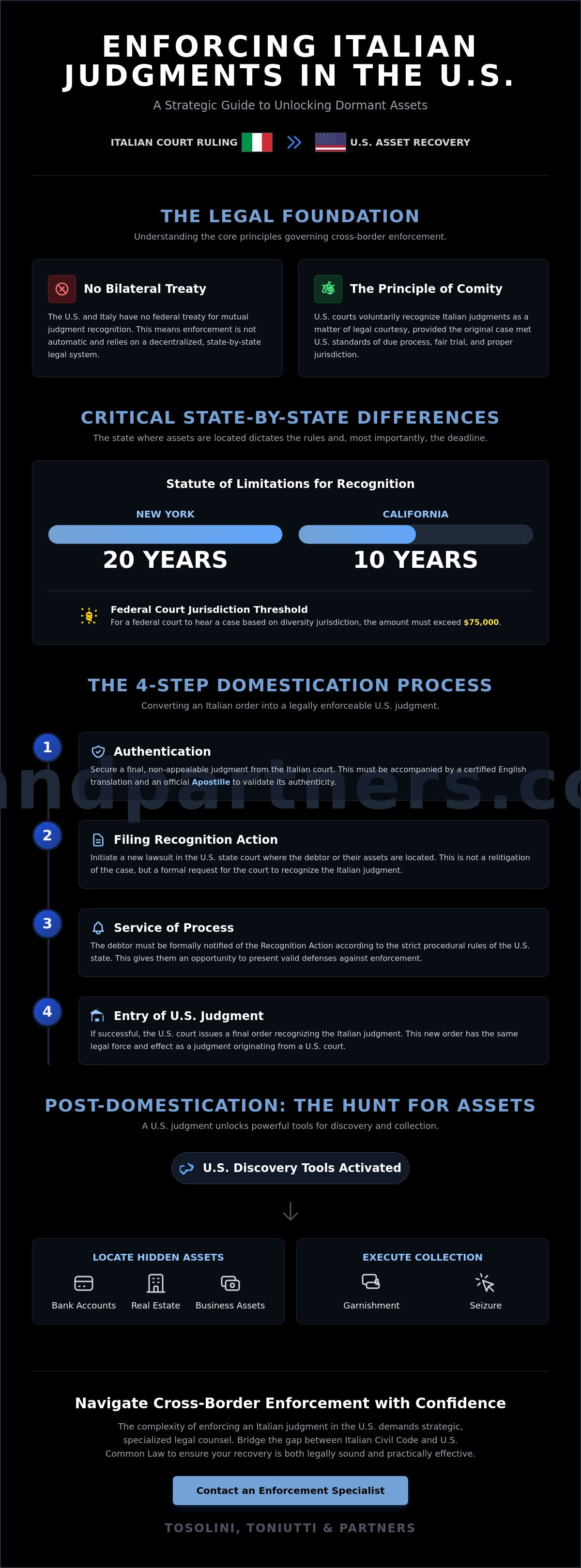
The path to enforcing an Italian court judgment in the US begins with a stark realization: no bilateral treaty exists between these two nations to mandate mutual recognition. Unlike the streamlined procedures found within the European Union's Brussels I bis Regulation, the American legal landscape treats foreign orders with a mix of respect and rigorous scrutiny. This absence of a federal mandate shifts the burden to individual state laws, creating a mosaic of requirements that demand intellectual precision and strategic foresight. It's a decentralized system where the success of your recovery depends on the specific statutes of the state where the debtor's assets reside.
The Principle of International Comity
In the absence of formal treaties, US courts rely on the doctrine of international comity. This concept involves the voluntary recognition of legislative, executive, or judicial acts of another nation. It's not an absolute obligation but a matter of professional courtesy and legal harmony. When considering the Enforcement of foreign judgments, American judges prioritize whether the Italian proceeding provided a full and fair trial before an impartial tribunal. They look for evidence that the debtor received proper notice and that the Italian court possessed valid jurisdiction. If these benchmarks of due process are met, US courts generally uphold the Italian ruling to prevent the relitigation of settled disputes. While some states look for reciprocity, most prioritize the integrity of the original judicial process over whether Italy would reciprocate in an identical manner.
Uniform Acts and State-Specific Variations
Most states have adopted a version of the Uniform Foreign-Country Money Judgments Recognition Act (UFCMJRA). The 2005 version of this act, currently in force in major jurisdictions like New York, California, and Texas, provides a clearer framework than its 1962 predecessor. It shifts the burden of proof to the party resisting recognition, making it a powerful tool for creditors. However, local nuances remain critical to your timeline and budget:
New York: Offers a generous 20 year window for recognition if the country of origin has no limitation.
California: Requires action within 10 years of the judgment becoming effective.
Jurisdictional Thresholds: For federal courts to intervene under diversity jurisdiction, the amount in controversy must exceed $75,000.
Selecting the correct venue isn't just a matter of filing paperwork; it's about identifying where the debtor’s assets, such as real estate or bank accounts, are physically located. While federal courts can occasionally hear these cases, state superior or district courts remain the primary battleground. This decentralized system means that a strategy successful in Miami might require adjustment in Houston. For complex cross-border scenarios, reaching out to specialized counsel at TT&P ensures that your approach respects both Italian civil traditions and American common law requirements.
The Domestication Process: Converting an Italian Order into a US Judgment
Converting a foreign ruling into a collectible American order is a meticulous transformation. It is not a mere translation of text; it is a translation of legal authority. Enforcing an Italian court judgment in the US requires a four-step sequence designed to satisfy the rigorous due process standards of American courts while honoring the finality of the Italian civil process.
Authentication: Secure a final and conclusive order that is no longer subject to appeal, accompanied by a certified translation and an apostille.
Filing: Initiate a Recognition Action in the state court where the debtor’s assets are located.
Notice: Serve the debtor according to American state rules, ensuring they have an opportunity to raise any valid defenses.
Entry of Judgment: Obtain a final American Judgment Order, which carries the same weight as a locally litigated decision.
Documentation and Authentication Requirements
An American judge will not act on a preliminary Italian ruling. The document must be definitive. In 2026, the apostille remains the standardized international certification that validates the authenticity of the Italian magistrate’s signature and the court’s seal for use across borders. Beyond the paperwork, expert testimony often plays a decisive role. Since American judges are not experts in the Italian Civil Code, they frequently rely on affidavits from Italian legal professionals to explain procedural nuances, such as how notice was achieved in Italy. This expert bridge ensures the court that the original proceeding respected the debtor’s rights. While 28 U.S. Code § 2467 provides federal standards for specific foreign judgments, most commercial domestications rely on these state-level authentication protocols.
Managing the Recognition Action
Contrary to common misconceptions, you do not always need a full new trial to domesticate your award. Most states allow for a summary proceeding, which is significantly faster and more cost-effective than a full length lawsuit. Successfully enforcing an Italian court judgment in the US relies on choosing the most efficient procedural path. If the debtor does not contest the filing, the process can be remarkably efficient. However, if they challenge the recognition based on lack of jurisdiction or fraud, the case moves into a more complex phase of international litigation. Timelines vary, but an uncontested domestication might conclude in a few months, whereas a contested battle can extend beyond a year. For those requiring a tailored assessment of their specific case, starting a dialogue through our contact portal is the first step toward recovery.
Potential Obstacles: Why a US Court Might Refuse Enforcement
The transition from a foreign ruling to an American judgment order is not an automated right; it is a contested legal milestone. While the principle of comity suggests a baseline of respect for the Italian judiciary, debtors frequently employ specific statutory defenses to stall or block the process. Successfully enforcing an Italian court judgment in the US requires anticipating these hurdles before the first filing hits the clerk’s desk. American courts are not permitted to relitigate the merits of the case, but they are strictly mandated to ensure the original proceeding aligns with local standards of fairness and public order.
The Public Policy Defense
A primary ground for non-recognition is the public policy exception, often referred to as the repugnancy standard. An American court will refuse to domesticate a judgment if the underlying cause of action or the award itself is deeply offensive to the state’s fundamental values. For instance, while Italian courts focus on compensatory damages, any award that appears to mirror punitive damages without the rigorous evidentiary standards required in the United States might face intense scrutiny. Similarly, judgments involving certain types of speech restrictions that clash with First Amendment protections are frequently rejected. American judges also look closely at Italian default judgments. If a debtor can prove they were not given a meaningful opportunity to defend themselves because of the procedural structure of the case in Italy, the American court may find the result incompatible with local justice requirements.
Procedural Fairness and Due Process
The most common and effective challenges involve due process and jurisdictional integrity. Under the Uniform Foreign-Country Money Judgments Recognition Act, a court must refuse recognition if the judicial system in Italy did not provide impartial tribunals. While the Italian system is highly respected, the specific application of notice in your case must meet American constitutional standards. If the debtor was not served in a manner reasonably calculated to give them actual notice, the domestication attempt will fail.
American courts also apply the minimum contacts test to determine if the Italian court had a valid basis for jurisdiction over the defendant. If a debtor’s connection to Italy was too tenuous to justify being sued there, an American judge will not validate the resulting order. Debtors may also argue that the original court was a seriously inconvenient or inappropriate location for the litigation, suggesting the case should have been heard elsewhere. To navigate these high stakes defenses, it is vital to engage in international litigation strategy that addresses these risks at the outset. Precision in documenting the integrity of the Italian proceeding is the only way to shield your judgment from these aggressive defensive maneuvers. Proactive analysis of how the Italian service was executed can prevent a costly rejection during the recognition phase while enforcing an Italian court judgment in the US.
Finally, allegations of extrinsic fraud, such as the intentional concealment of evidence or bribery during the Italian trial, provide a mandatory basis for refusal. Unlike internal fraud, such as perjury, extrinsic fraud deprives the party of their day in court. Ensuring that the Italian record is unimpeachable regarding these points is the final safeguard in the recognition process.
Post-Domestication: Asset Discovery and Judgment Execution
Obtaining a final US Judgment Order is a significant milestone, but it doesn't automatically move funds into your account. The most technical phase of enforcing an Italian court judgment in the US often begins after the court grants formal recognition. Unlike many civil law jurisdictions, the American legal system provides creditors with aggressive post-judgment "discovery" tools to locate wealth. You can compel the debtor to reveal their financial architecture under oath through a deposition. If they're dishonest, they face perjury charges. If they refuse to answer, they risk being held in contempt of court, which can lead to fines or even imprisonment.
This phase is where legal theory meets surgical precision. We don't just ask where the money is; we use the court's power to find it. If your debtor has attempted to obscure their interests through complex LLC incorporation strategies, we apply specific legal theories to pierce the corporate veil. This ensures that assets hidden behind a business facade remain reachable. Our approach combines an understanding of US business architecture with the relentless pursuit of recovery.
Asset Search and Information Subpoenas
Discovery extends far beyond the debtor's own testimony. You can issue third-party subpoenas to financial institutions, brokerage firms, and digital asset exchanges. These orders require banks to disclose account balances and transaction histories. Tracking cross-border wire transfers becomes a technical exercise in forensic accounting. We often work with investigators who specialize in identifying assets layered through shell companies or offshore accounts. These subpoenas can also be used to freeze assets in US financial institutions, preventing the debtor from moving funds once they realize enforcing an Italian court judgment in the US has reached the execution stage.
Execution Tactics: Seizure and Sale
Once assets are identified, the focus shifts to physical collection. Garnishment allows you to intercept funds directly from the debtor's bank accounts or their US-based customers. If the debtor owns real estate or luxury vehicles, a "Sheriff's Sale" is the standard procedure. The local sheriff seizes the property and sells it at a public auction, with the proceeds satisfying your judgment. Coordinating these efforts across multiple states requires a unified strategy. A lien filed against property in Florida won't automatically affect assets in New York. You need a national recovery plan that accounts for the specific civil codes of each jurisdiction. To turn your recognized order into actual recovery, consult with our international litigation team to begin the asset hunt.
Strategic Litigation: Navigating Cross-Border Enforcement with TT&P
Enforcing an Italian court judgment in the US requires more than just a procedural understanding; it demands a deep intellectual bridge between two fundamentally different legal traditions. While the Italian system is built on the rigid structure of the Civil Code, the American process is shaped by the fluid precedents of Common Law. This divergence creates a friction point where many recovery efforts stall. Our approach focuses on neutralizing this friction by anticipating how a US judge will interpret Italian procedural history. We don't just file papers; we build a narrative of due process that satisfies the high standards of American courts. This foresight is essential when navigating the decentralized nature of the US legal system, where the rules of recognition can shift significantly from one state line to the next.
Every debt carries its own architectural footprint. A judgment arising from a breach of a commercial contract requires a different tactical path than one involving real estate torts, inheritance disputes, or negligence claims; for those seeking dedicated legal representation in Texas for injury-related cases, you can learn more about The Todd Law Group, PLLC. We customize each enforcement strategy based on the nature of the underlying obligation. By identifying the most favorable state jurisdictions early, we minimize the risk of the debtor shifting assets across state lines. This level of strategic planning ensures that the transition from a foreign order to a domestic execution is seamless and cost-effective. Our team manages the complexities of jurisdictional friction, ensuring that enforcing an Italian court judgment in the US remains a focused, goal-oriented process.
The TT&P Advantage in International Disputes
Our firm occupies a unique position within the legal corridors connecting Rome and Milan to major US financial centers. This specialized focus allows us to provide more than just litigation support. Our extensive experience in US corporate law and international litigation informs our asset recovery process, allowing us to identify vulnerabilities in complex business structures that others might overlook. Whether the debtor is hiding behind a series of holding companies or real estate trusts, our team applies the technical precision necessary to reveal and reach those assets. You can contact our team for a strategic case evaluation to determine the most viable path for your specific judgment.
Integrated Legal Solutions
Success in cross-border enforcement depends on the quality of the foundation laid in the original jurisdiction. We coordinate closely with Italian counsel to ensure judgment readiness, verifying that every aspect of the Italian proceeding, from the initial summons to the final decree, is documented to withstand US scrutiny. This proactive collaboration prevents the common procedural pitfalls that lead to non-recognition. In multi-state enforcement actions, we provide a unified command structure, managing local counsel across different American counties to maintain professional precision. Our commitment extends from the initial domestication filing to the final liquidation of assets, ensuring that your legal victory in Italy translates into a tangible financial recovery in the United States.
Transforming International Rulings into Tangible Recovery
Transforming a legal victory in Italy into a financial reality in the United States requires a shift from litigation to strategic asset recovery. Success hinges on navigating the specific statutes of individual American states while anticipating the procedural scrutiny of US judges. The journey is defined by more than mere translation; it's an intellectual bridge between the Italian Civil Code and American Common Law. Whether through summary recognition or aggressive post-judgment discovery, the path to collection is paved with technical precision and a deep understanding of US business architecture.
Successfully enforcing an Italian court judgment in the US demands a partner who understands the nuances of both legal corridors. With decades of cross-border experience and a specialized focus on international litigation, our team provides the strategic presence needed to identify and seize assets across the country. Your ruling doesn't have to remain a static document. Secure your cross-border interests by contacting our litigation experts today. We're ready to help you turn your hard-won judgment into the recovery you deserve.
Frequently Asked Questions
Is there a treaty between the US and Italy for judgment enforcement?
No bilateral treaty or multilateral convention is currently in force between the United States and Italy for the reciprocal recognition of judgments. While the United States signed the 2019 Hague Convention in 2022, it hasn't yet ratified the treaty. Consequently, the process relies on the laws of individual U.S. states and the principle of international comity.
How long does it take to domesticate an Italian judgment in the US?
The timeline for enforcing an Italian court judgment in the US varies based on whether the debtor contests the action. An uncontested recognition proceeding might conclude within three to six months. If the debtor raises jurisdictional or public policy defenses, the process can extend beyond a year as the case moves through discovery and formal motion practice.
Can I enforce an Italian default judgment in a US court?
Yes, default judgments are enforceable provided the Italian court followed procedures compatible with American due process. The most critical factor is proving the debtor received proper notice and had a reasonable opportunity to defend themselves. If the service of process in Italy met these constitutional standards, U.S. courts will typically grant recognition.
What types of Italian judgments are enforceable in the United States?
U.S. courts primarily recognize foreign judgments that are final, conclusive, and enforceable in Italy. This typically includes money judgments for specific sums arising from civil or commercial disputes. Judgments involving taxes, fines, or matrimonial matters like child support often fall outside the scope of the Uniform Foreign-Country Money Judgments Recognition Act.
Will I need to re-litigate the entire case in the US?
No, the recognition process doesn't allow for a full review of the case's merits. Under the UFCMJRA, American judges aren't permitted to second-guess the Italian magistrate's factual findings or legal conclusions. The court's focus remains strictly on the integrity of the Italian judicial system and the fairness of the specific proceeding.
Can I recover my attorney fees during the US enforcement process?
Recovery of attorney fees depends on the specific statutes of the state where you file and the terms of the underlying contract. Some states have specific provisions that might allow for fee recovery in collection actions. However, fees aren't automatically granted in every jurisdiction, so it's essential to review local rules before filing.
What happens if the debtor has moved assets between different US states?
You must domesticate the judgment in every state where the debtor holds significant assets. Once you obtain a judgment in one U.S. state, you can often use the Full Faith and Credit clause to domesticate it in other states more quickly. This multi-state strategy ensures that bank accounts in New York and real estate in California are both reachable.
Do I need an Italian lawyer or a US lawyer for this process?
You'll need a U.S. licensed attorney to handle the domestication and asset discovery phases in American courts. However, coordination with your Italian counsel is vital to authenticate the original order and provide expert testimony regarding Italian law. This collaborative approach ensures that the procedural history of the case is accurately presented to the U.S. judge.


Comments