

Enforcing Foreign Judgments in the US: A 2026 Strategic Guide to Cross-Border Litigation
- Gianni Mendes Toniutti, Esq.

- Apr 11
- 13 min read
A foreign court order isn't a master key; it's a blueprint that requires a local foundation before it can stand on American soil. You've likely realized that securing a favorable verdict in London or Paris is only the first phase of a larger structural challenge. Without a single global treaty to bridge the gap, the effort to enforce foreign judgment in us territory often feels like navigating a fragmented landscape of 50 distinct state jurisdictions. It's a process where procedural precision is just as vital as the legal theory itself.
We recognize the anxiety that stems from the prospect of double litigation and the decentralized nature of American courts. This 2026 strategic guide provides the roadmap you need to domesticate international orders with minimal friction. You'll gain a clear understanding of how to transform a foreign decree into a domestic reality, leading to successful asset seizure and bank garnishment. We'll examine the specific requirements of the Uniform Foreign-Country Money Judgments Recognition Act to ensure your legal framework remains both cost-effective and resilient.
Key Takeaways
Navigate the decentralized landscape of US law by leveraging state-level statutes and the principle of comity in the absence of a federal treaty.
Master the two-pillar domestication process to strategically enforce foreign judgment in us, transitioning from legal recognition to tactical asset collection.
Implement a five-step architectural framework to audit judgment compatibility and identify high-value jurisdictions based on debtor asset locations.
Anticipate and neutralize common procedural hurdles, including public policy exceptions and jurisdictional defenses that often stall cross-border litigation.
Bridge the conceptual divide between international civil law and US common law to ensure foreign legal intent is accurately translated for American judges.
Table of Contents The Landscape of Foreign Judgment Enforcement in the United States Recognition vs. Enforcement: The Two Pillars of Legal Domestication The 5-Step Architecture for Domestication and Collection Navigating Common Defenses and Procedural Hurdles Strategic Litigation: Bridging the US-Italy Legal Gap
The Landscape of Foreign Judgment Enforcement in the United States
The architectural integrity of a legal strategy depends entirely on the stability of its foundation. When a creditor seeks to enforce foreign judgment in us jurisdictions, they quickly discover that the United States isn't a party to any multilateral treaty governing the recognition of civil or commercial judgments. Unlike the unified framework found within the European Union, the American approach is decentralized; it's a structural mosaic defined by state statutes rather than federal mandates. This absence of a federal "bridge" means that an Italian judgment doesn't automatically cross the Atlantic with executive force.
For those looking toward 2026 litigation cycles, the timeline is the most critical element of the design. Debtors often utilize the procedural lag of international service to insulate or hide assets. A proactive strategy requires filing for recognition the moment a judgment becomes final in Italy. Waiting for the debtor to initiate a transfer of wealth often results in a hollow victory. Success requires a meticulous understanding of the local "urban fabric" of the specific state where the debtor's assets reside.
The Principle of International Comity
At the heart of this process lies "comity," a concept of structural respect between sovereign judicial systems. US courts don't simply rubber-stamp foreign orders; they evaluate whether the Italian proceedings adhered to basic standards of due process and impartial justice. This evaluation focuses on the recognition and enforcement of foreign judgments through a lens of fairness. If the foreign court had jurisdiction and the defendant received proper notice, US judges generally grant recognition. However, any hint of fraud or a lack of personal jurisdiction can collapse the entire enforcement effort. It's a delicate balance between respecting foreign sovereignty and protecting the constitutional rights of the parties involved.
State vs. Federal Jurisdictional Frameworks
The enforcement of international claims operates within a complex jurisdictional checkerboard. Most actions to enforce foreign judgment in us territories begin in state courts. This is because the Uniform Foreign-Country Money Judgments Recognition Act (UFMJRA), or its 1962 predecessor, has been adopted by 43 states as of 2024. These acts provide a clear, streamlined path for converting a foreign money judgment into a local one. Each state's adoption varies slightly, creating a nuanced landscape where the choice of venue dictates the speed of recovery.
State Courts: Usually the primary choice for recognition under the UFMJRA or the 2005 Uniform Act.
Federal Courts: Accessible via "diversity jurisdiction" if the amount in controversy exceeds $75,000 and the parties are from different countries.
Asset Location: The physical or digital location of the debtor's property determines which state's laws govern the seizure.
Navigating this environment requires more than just legal knowledge; it demands a visionary approach to asset recovery. One must treat the legal framework like a complex building site, where every structural detail must be verified before the first stone of enforcement is laid. Without this precision, the pursuit of justice remains an unfinished project.
Recognition vs. Enforcement: The Two Pillars of Legal Domestication
Domestication isn't a single event. It's a structured sequence. To
enforce foreign judgment in us
jurisdictions, one must first bridge the gap between Italian civil law and American common law. Recognition acts as the structural foundation. It's the moment a U.S. court acknowledges the Italian order as a valid legal instrument. This phase doesn't always require personal jurisdiction over the debtor. If the debtor holds property in a specific county, quasi in rem jurisdiction allows recognition to proceed even if the individual isn't physically present in the state. The timeline from the initial petition to a domestication order typically spans 60 to 120 days. Delays occur if the debtor files an objection based on lack of notice or systemic fraud. Precision in the initial filing prevents these structural cracks.
Phase 1: The Recognition Process
The process begins with filing a "Notice of Filing of Foreign Judgment" in the appropriate U.S. county. Legal teams must provide a certified copy of the Italian decree, accompanied by a professional English translation and an Apostille, as mandated by the Hague Convention of October 5, 1961. Under the
, which 28 U.S. jurisdictions currently follow, the court verifies that the Italian proceedings met basic due process standards. This verification ensures the judgment is final, conclusive, and enforceable in its country of origin before it's granted U.S. status.
Phase 2: Transitioning to Enforcement
Once recognized, the judgment transitions into the enforcement phase. This is the tactical execution. The clerk of court issues a "Writ of Execution," a document that empowers local sheriffs or marshals to seize assets or garnish bank accounts. A domesticated judgment carries the same legal weight as one issued by a local U.S. court. It also begins accruing U.S. statutory interest.
In New York, the statutory interest rate is set at 9% annually under CPLR 5004.
In California, the rate is generally 10% for unsatisfied judgments.
In Florida, the rate is adjusted quarterly by the Chief Financial Officer.
This financial increment ensures the debt's value remains stable during the collection process. For those seeking a strategic evaluation of their specific case, reaching out for a
The 5-Step Architecture for Domestication and Collection
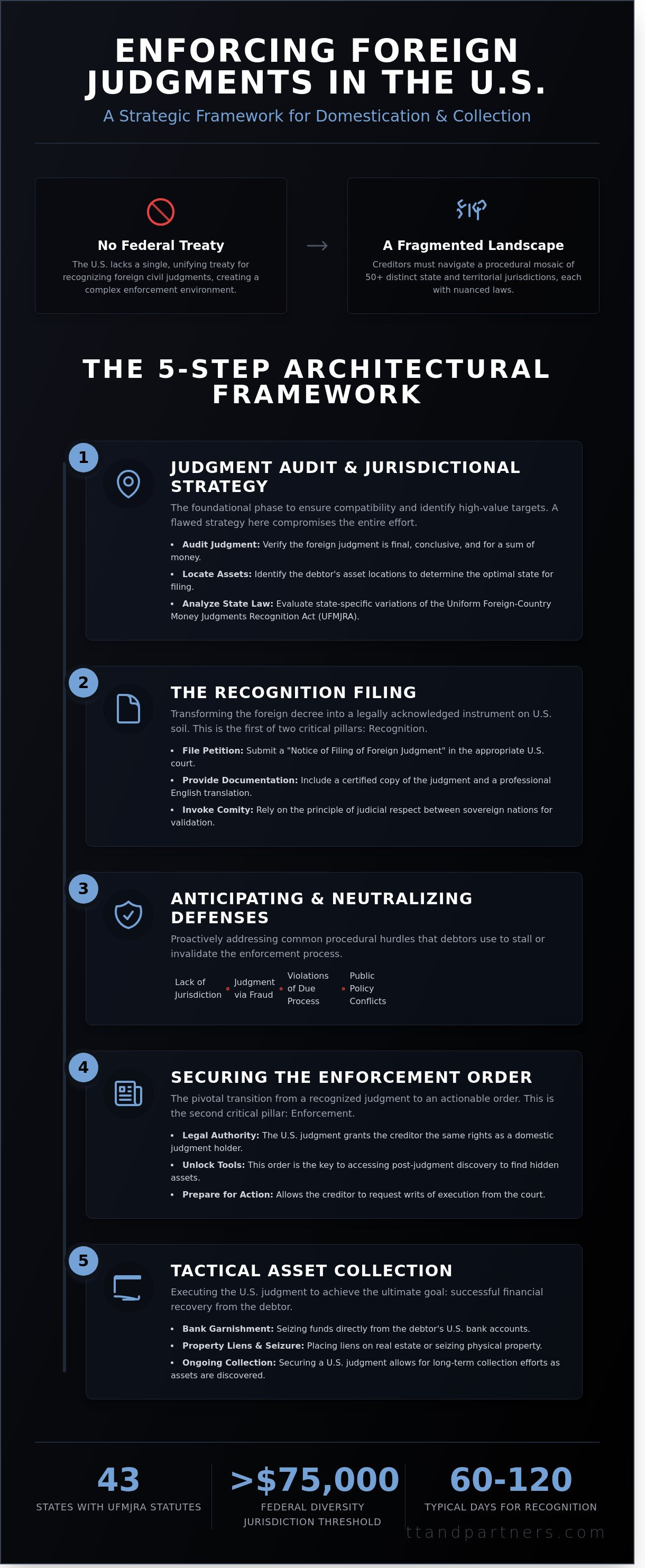
Transforming an Italian judicial decree into a tangible recovery requires a structured methodology. This process, often called domestication, follows a specific sequence to ensure the foreign ruling gains the same weight as a domestic order. To enforce foreign judgment in us jurisdictions, creditors must adhere to a five-stage framework that mirrors the precision of a technical build. Each phase builds upon the previous one to create a stable path toward asset recovery.
Step 1: Technical Audit. We begin with a review of the judgment's finality. An Italian sentenza must be passata in giudicato, meaning all appeals are exhausted. Under the Uniform Foreign-Country Money Judgments Recognition Act, adopted by 28 states as of 2023, the judgment must be final, conclusive, and enforceable in its home country.
Step 2: Jurisdictional Selection. The choice of forum depends entirely on the debtor's urban footprint. We identify where the assets reside. If the debtor holds a property portfolio in New York, the action initiates under CPLR Article 53 to ensure local courts recognize the Italian order.
Step 3: The Filing Phase. This involves submitting the domestication petition and initiating formal notice. It's not a simple administrative task; it's the foundation of the entire enforcement structure. Proper filing prevents the debtor from claiming they weren't aware of the US proceedings.
Step 4: Procedural Resilience. Debtors often attempt to stall through motions. Success here relies on proving the Italian court provided due process and had proper jurisdiction. We deflect challenges regarding public policy or lack of notice with documented evidence from the original trial.
Step 5: Physical Execution. Once recognized, the judgment becomes a tool for asset seizure. This includes placing liens on real estate, issuing garnishments against financial institutions, or seizing physical property to satisfy the debt.
Strategic Asset Discovery
Effective enforcement relies on visibility. We utilize federal discovery rules to uncover hidden financial structures. Subpoenas issued under 28 U.S.C. § 1782 allow creditors to demand records from US banks, revealing accounts that the debtor didn't disclose in Italy. Private investigators complement this technical search by tracing physical assets across state lines. This ensures the enforcement architecture covers every square inch of the debtor's holdings, even if they've moved funds to different jurisdictions.
Service of Process Requirements
Precision in notice is non-negotiable. Improper service remains the primary reason US courts refuse to enforce foreign judgment in us territories. All notice must comply with the 1965 Hague Service Convention. When dealing with elusive debtors, we employ specialized process servers who navigate international protocols to ensure the court's jurisdiction is airtight. Failure to follow these specific delivery methods can collapse the entire legal structure before it even begins. If you need assistance with this complex framework, you can contact our team for a consultation.
Navigating Common Defenses and Procedural Hurdles
The structural integrity of a legal claim faces its most rigorous testing during the recognition phase. When creditors seek to enforce foreign judgment in us territory, they encounter a defense framework designed to protect the constitutional values of the American forum. These challenges aren't mere delays; they represent a deliberate vetting process. The most formidable barrier is the public policy exception. Under the Uniform Foreign-Country Money Judgments Recognition Act, adopted by 26 states as of 2024, a court may refuse recognition if the underlying cause of action is repugnant to local values. This rarely applies to standard commercial debts, but it remains a critical consideration in cases involving punitive damages or specific speech related torts.
Jurisdiction serves as the foundation of any enforceable order. Debtors frequently argue the Italian court lacked personal jurisdiction over them or subject matter jurisdiction over the dispute. To dismantle this defense, the creditor must demonstrate the debtor had sufficient "minimum contacts" with Italy. Proving the tribunal's impartiality is equally vital. Italy consistently ranks high in global legal indices; the 2023 World Justice Project Rule of Law Index placed Italy 32nd globally, ahead of many developed nations. This data helps neutralize claims that the foreign system lacks independent judiciary standards or fair procedures.
The fraud defense focuses on the integrity of the original trial. US courts distinguish between intrinsic fraud, such as perjury, and extrinsic fraud, which involves deceptive tactics that prevented a party from participating in the case. If a debtor was intentionally misled about a hearing date, the judgment's structural validity collapses. Precision in documenting every procedural step in the Italian court prevents these claims from gaining traction.
The Due Process Defense
Success depends on proving the debtor received a fair opportunity to defend the case. US courts scrutinize default judgments with particular intensity. If service of process didn't strictly adhere to the 1965 Hague Service Convention, the judgment's foundation is compromised. Creditors can rehabilitate thin procedural records by providing certificates of service and evidence that the debtor engaged in the Italian proceedings at any stage. It's not enough that the result was right; the path taken must be transparent.
Statutes of Limitations and Finality
Timeframes vary significantly across the American landscape. In New York, CPLR 211(b) allows 20 years for enforcement, whereas other states might limit the window to 10 years or match the Italian expiration date. The judgment must be "final and conclusive" under Article 324 of the Italian Code of Civil Procedure. If a case is currently under appeal in Italy, a US judge won't necessarily dismiss the petition but will often stay the proceedings until the Italian court issues a definitive ruling.
Ensuring your international legal strategy is built on a solid procedural foundation is essential for recovery. Contact our team to discuss the technical requirements for your specific case.
Strategic Litigation: Bridging the US-Italy Legal Gap
Successful asset recovery across borders requires more than just a literal translation of documents. It demands a translation of legal intent. An Italian sentenza carries the weight of a civil law tradition that operates differently than the American common law system. When you seek to enforce foreign judgment in us courts, you aren't just filing paperwork; you're presenting a narrative of finality and fairness that a US judge can recognize under domestic standards of due process.
The synergy between these two systems is where Tosolini, Toniutti & Partners excels. We view the enforcement process as a form of legal architecture. By framing the Italian court's decision within the context of the Uniform Foreign-Country Money Judgments Recognition Act, which over 20 US states have now adopted, we create a structural bridge for creditors. This ensures that the transition from a European decree to an American lien is seamless and functional. We integrate these actions into a broader framework of international litigation to anticipate the debtor's movements before they occur.
Judges in the United States prioritize the principle of comity, but they also require strict adherence to procedural integrity. We don't leave these details to chance. Our team designs a strategy that respects the history of the Italian proceedings while meeting the rigorous demands of the US Federal Rules of Evidence. This dual-lens approach allows us to navigate the complexities of transatlantic disputes with the precision of a master plan.
Cross-Border Expertise as a Competitive Advantage
Understanding the nuance between the Italian 'Sentenza' and the American 'Judgment' is our core strength. We manage the complex logistics involved in real estate closing seizures, ensuring that property assets are secured before they can be shifted or liquidated. Our firm coordinates directly with Italian counsel to ensure all evidence is admissible in US courts, preventing the procedural delays that often stall international collections. We treat every case as a unique project, where the goal is a permanent and enforceable result.
Your Next Steps in the Enforcement Process
The journey toward recovery begins with a structural audit of your current document portfolio. We analyze the finality of your Italian decree and calculate the potential ROI by identifying the debtor's US-based assets, such as investment accounts or commercial holdings. Don't let your judgment lose its value through inaction or expiration. Contact our firm today for a tailored litigation strategy that secures your interests with professional confidence and architectural precision.
Architecting Your Path to Global Judgment Recovery
Success in international litigation isn't a matter of chance. It's the result of a deliberate, architectural strategy that accounts for every technical detail. You've navigated the two pillars of recognition and enforcement, understanding that a judgment's value depends entirely on its domestication. By 2026, the legal landscape demands a sophisticated approach to the Uniform Foreign-Country Money Judgments Recognition Act. We apply a rigorous 5-step framework to ensure your assets aren't just identified but secured through precise legal engineering. Our team's deep fluency in both Civil and Common Law systems allows us to bridge the complex gap between US and Italian jurisdictions with professional confidence.
When you need to enforce foreign judgment in us, the structural integrity of your case matters most. We don't rely on loud marketing; we rely on the intellectual depth of our cross-border litigation experience. Whether you're dealing with specific procedural hurdles or navigating complex defense strategies, our visionary outlook ensures your recovery remains on track. It's time to transform your legal victory into tangible results. Schedule a consultation with our international litigation experts to begin building your enforcement strategy. Your international interests deserve the precision of a master-planned approach.
Frequently Asked Questions
Can I enforce a foreign judgment in the US if there is no treaty?
You can enforce an Italian judgment in the US despite the absence of a bilateral treaty between the two nations. US courts rely on the principle of comity and state laws like the Uniform Foreign-Country Money Judgments Recognition Act. This act has been adopted in over 30 states since 2005. It provides a clear legal framework to enforce foreign judgment in us jurisdictions without needing a federal treaty.
How long does it typically take to domesticate a foreign judgment in the US?
The domestication process generally spans 6 to 12 months depending on the specific state court's schedule. If the debtor doesn't contest the recognition, some jurisdictions complete the process in under 90 days. However, complex cases involving challenges to service of process or jurisdiction can extend beyond 18 months. Efficiency depends on the local court's workload and the responsiveness of the opposing party's legal counsel.
What is the difference between recognition and enforcement of a judgment?
Recognition is the formal court act of acknowledging the Italian judgment as valid, while enforcement is the subsequent legal process of collecting the debt. Recognition converts the foreign order into a domestic US judgment. Once this transition occurs, you can use local legal tools to collect funds. You can't start the collection phase until the US court officially recognizes the Italian decision under the 2005 Uniform Act.
Will I have to re-try my entire case in a US court?
You won't have to re-try the merits of your case in a US court because the legal system respects the finality of foreign decisions. The US judge focuses on the fairness of the Italian proceedings rather than the facts of the original dispute. As long as the Italian court provided due process and had proper jurisdiction, the US court accepts the findings as conclusive. This prevents a second full trial.
What types of foreign judgments are not enforceable in the US?
US courts won't enforce judgments involving taxes, fines, or certain matrimonial matters like child support under the UFCMJRA. Judgments obtained through fraud or those that violate US public policy are also excluded. For instance, the 1895 Supreme Court case, Hilton v. Guyot, established that courts may refuse judgments from systems that lack impartial tribunals. If the Italian proceeding didn't provide basic due process, the judgment is unenforceable.
Can I seize property or bank accounts once the judgment is recognized?
You can seize bank accounts, real estate, and personal property once the court recognizes the Italian order. This recognition gives you the same collection powers as any domestic judgment creditor. You can issue writs of execution or garnishment orders to recover the debt. To enforce foreign judgment in us territories effectively, you must identify specific assets located within the state where the judgment was domesticate.
How much does it cost to enforce an international judgment in the US?
Costs vary based on court filing fees and the complexity of the legal challenge. Filing fees in New York Supreme Court are currently 210 dollars, while other states like California charge around 435 dollars for an initial petition. Legal fees depend on whether the debtor contests the recognition. You'll also face costs for certified translations of the Italian documents. Total expenses fluctuate based on the debtor's level of resistance.
Does the debtor need to be living in the US for me to enforce the judgment?
The debtor doesn't need to reside in the US as long as they have assets located within the jurisdiction. US courts can exercise jurisdiction over property, bank accounts, or business interests held by the debtor. If the Italian entity owns a warehouse in New Jersey, you can domesticate the judgment there even if the company's headquarters remains in Milan. Asset location is more critical than the debtor's physical presence.


Comments