

Enforcing US Judgment in Italy: The 2026 Strategic Guide to International Asset Recovery
- Gianni Mendes Toniutti, Esq.

- Jul 4
- 12 min read
Updated: Jul 17
Winning a substantial verdict in a US courtroom often feels like the final chapter, yet for those with debtors holding assets in Milan or Rome, the real challenge starts at the border. Enforcing US judgment in Italy is no longer the insurmountable hurdle it once was, especially following the landmark 2025 Supreme Court ruling that finally opened the door to recognizing punitive damages. You probably fear that your victory will become lost in translation within a legal system often criticized for its pace. It's a valid concern, as the intersection of two distinct jurisdictions requires more than just a translation; it demands a sophisticated, strategic approach to international law.
We understand the anxiety that comes with the uncertainty of international litigation and the desire for a predictable cost-benefit ratio. This guide simplifies the complex Exequatur process into a clear roadmap for successful asset recovery. You'll learn how the 2026 Cartabia Reform streamlines proceedings to help you seize Italian assets with precision. We'll examine the technical requirements of Law 218/1995 and the updated 2026 court fee structures, providing you with the intellectual clarity needed to turn a paper judgment into tangible results.
Table of Contents
The Legal Framework: Why US Judgments Follow Law No. 218/1995
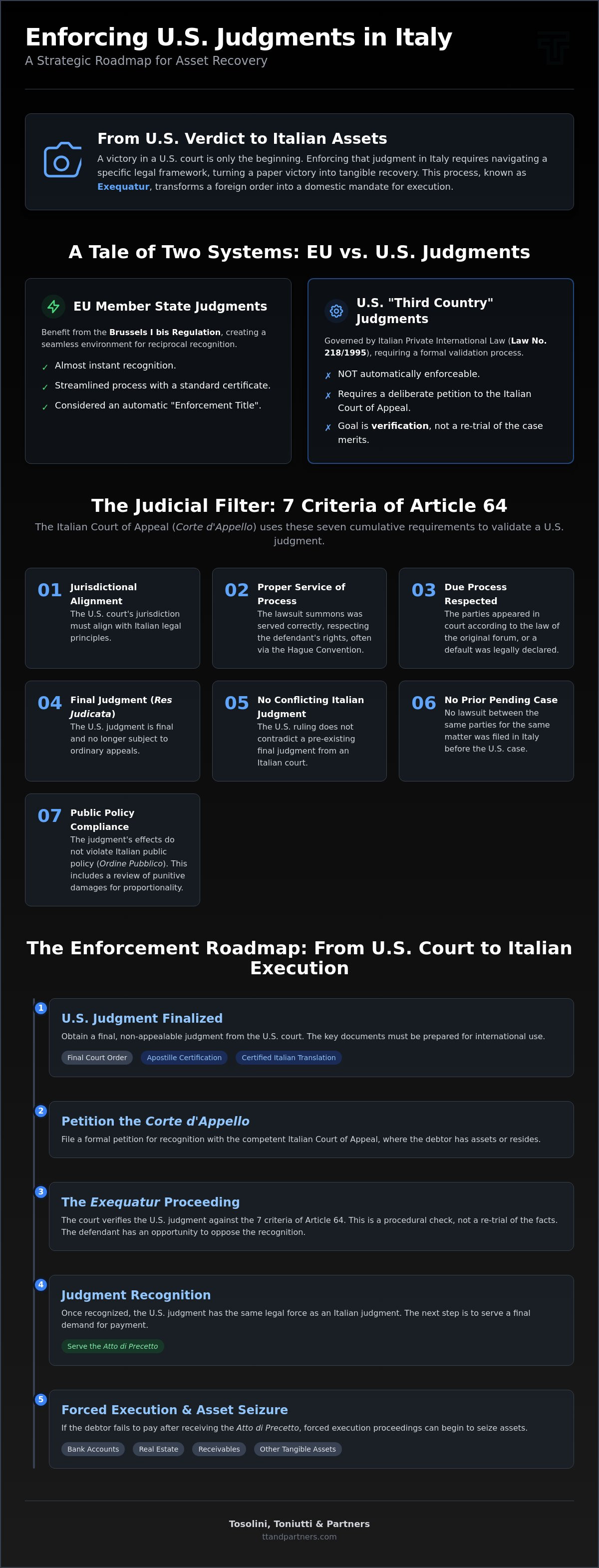
A common misconception in international asset recovery is the assumption that a final verdict from a US District Court carries immediate weight across the Atlantic. Within the European Union, the Brussels I bis Regulation creates a seamless environment for reciprocal recognition, but these streamlined rules don't apply to American verdicts. Because the United States isn't an EU member state, it's classified as a "Third Country" in the eyes of Italian magistrates. Consequently, a US judgment isn't an automatic "Enforcement Title" in Italy. It requires a formal validation process to be integrated into the local legal order.
This procedure is governed by the Italian Private International Law, specifically Law No. 218 of May 31, 1995. This legislation provides the definitive framework for the enforcement of foreign judgments originating from outside the European reciprocal network. Without this judicial filter, the Italian legal system cannot grant the power to seize bank accounts, real estate, or other tangible assets. It's the essential first step in enforcing US judgment in Italy, serving as a protective layer for the Italian jurisdiction while respecting international comity.
US vs. EU Judgments: The Non-Reciprocity Reality
The distinction between EU and non-EU enforcement is stark and often misunderstood. While an outcome from a court in Paris or Berlin is recognized almost instantly through a standard certificate, US judgments require a deliberate petition to the Italian Court of Appeal (Corte d'Appello). As of 2026, Italian legal standards prioritize procedural finality over substantive review. The Court of Appeal doesn't re-examine the merits of the original case. It doesn't act as a second trial. Instead, it functions as a strategic gatekeeper, ensuring the US decision aligns with Italian fundamental principles without relitigating the facts.
The Objective of the Recognition Proceeding
The primary goal of the Exequatur is to verify that the US proceeding respected the debtor's right to a fair trial and that the judgment doesn't conflict with Italian public policy. Following the landmark 2025 Supreme Court shift regarding punitive damages, the focus has moved toward proportionality and predictability. The court checks if the US judge had jurisdiction according to Italian standards and if the service of process was handled correctly. The 'Exequatur' serves as the judicial bridge between US and Italian sovereignty, transforming a foreign order into a domestic mandate for execution.
The 7 Criteria for Recognition Under Article 64
Successful asset recovery hinges on Article 64 of Law 218/1995, which outlines seven cumulative requirements for enforcing US judgment in Italy. This isn't a mere formality; it's a rigorous judicial filter. The Italian Court of Appeal examines whether the US judge exercised authority based on principles that align with the domestic legal order, ensuring the jurisdictional foundation isn't arbitrary. Beyond jurisdiction, the court verifies that the judgment is "Res Judicata," meaning it's final and no longer subject to ordinary US appeals. Additionally, there must be no conflicting Italian judgments or pending cases on the same matter that were initiated before the US proceeding. Each of these elements serves as a pillar supporting the legitimacy of the Italian enforcement procedure, protecting the integrity of the local jurisdiction.
Proper Service of Process and the Hague Convention
Italian magistrates meticulously scrutinize how the defendant was notified of the original US lawsuit. If the defendant is an Italian resident or entity, service must strictly comply with the Hague Service Convention. Default judgments are particularly vulnerable; if the service wasn't impeccably documented, the Italian court will likely deny recognition. US attorneys should prioritize formal service methods over informal waivers to avoid future enforcement roadblocks. Precise documentation at the start of litigation prevents expensive failures during the recognition phase.
The Public Policy Defense: Punitive Damages and Beyond
The "Public Policy" (Ordine Pubblico) hurdle remains the most frequent reason for denial, yet its definition has evolved. In 2026, the landscape is shaped by the 2025 Supreme Court landmark decision which clarified that US punitive damages aren't inherently contrary to Italian law. The focus is now on proportionality. While compensatory awards are standard, "excessive" or unpredictable punitive sums may still be trimmed or rejected. Framing the US judgment to emphasize its remedial and predictable nature is essential to minimize Ordine Pubblico risks. If you're navigating these complexities, consulting with international litigation specialists can help clarify how your specific verdict aligns with these shifting standards.
The final criteria involve ensuring the defendant’s right to a defense was fully respected during the American trial. The Italian court doesn't look for a perfect mirror of its own civil procedure, but it does require that fundamental due process was observed. This includes the right to be heard and the right to present evidence. When these seven criteria are met, the US judgment transforms from a foreign piece of paper into a powerful instrument of debt collection within the Italian borders. This transition marks the end of the recognition phase and the beginning of actual asset seizure.
The Procedural Roadmap: From US Court to Italian Execution
The transition from a US victory to an Italian recovery begins with a formal petition filed before the Corte d'Appello. This isn't a centralized process; you must target the specific appellate district where the debtor’s assets, such as real estate, bank accounts, or corporate shares, are physically or legally situated. This strategic choice is fundamental to the efficiency of enforcing US judgment in Italy. Once the petition is submitted, the court initiates a review focused strictly on procedural integrity rather than the substantive merits of the original dispute. It's a phase defined by technical scrutiny where the goal is to domesticate the foreign award without reopening the underlying case.
Document Preparation and Authentication
The success of your application depends on the technical perfection of your dossier. You must first secure a certified copy of the final US judgment, authenticated with an Apostille according to the 1961 Hague Convention. This international certification verifies the signature's authenticity for use in Italian courts. While the Apostille is obtained in the US, the linguistic bridge must be built in Italy. Italian magistrates require translations performed by court-sworn translators registered within the Italian system to ensure legal terminology aligns with local statutes. During the initial 90 days, the focus remains on this meticulous assembly of evidence and the formal notification of the debtor. Accuracy here isn't just a preference; it's a structural requirement that prevents procedural dismissal.
The Role of the Corte d'Appello
The Italian Court of Appeal operates with a specific, limited mandate. It doesn't act as a venue for a retrial or an opportunity for the debtor to relitigate the facts. Instead, the court verifies that the judgment has attained the status of "Res Judicata," ensuring no further ordinary appeals are possible in the US jurisdiction. This verification process is a cornerstone of legal certainty. To ensure your documentation meets these rigorous standards, you can contact our cross-border litigation team for a comprehensive document audit before filing.
The final stage of the roadmap involves the "contradictory" phase, where the debtor is granted the right to oppose the recognition. This isn't a blank check for delay; opposition is limited to the specific criteria of Law 218/1995 discussed previously. If the court finds the application valid, it issues a Decree of Recognition. This decree is then stamped with the "Enforcement Formula" (formula esecutiva), a powerful judicial mandate that officially grants you the authority to proceed with the forced seizure of assets. This document effectively domesticates the foreign award, turning it into a local instrument of execution that functions with the same authority as an Italian court order.
Practical Asset Seizure: The Execution Phase in Italy
Transitioning from judicial recognition to actual recovery requires a shift from the courtroom to the field. Once the "Enforcement Formula" is obtained, the US judgment is fully domesticated and transformed into a functional tool for "Esecuzione Forzata" (Forced Execution). This phase is overseen by the "Ufficiale Giudiziario" (Judicial Officer), who acts as the state’s official arm in physically or legally securing the debtor’s property. It's a phase that demands tactical speed and local expertise to prevent the dissipation of assets. Enforcing US judgment in Italy at this stage isn't just about legal theory; it's about the precise application of state power to satisfy a debt.
Before any physical seizure occurs, a mandatory procedural step must be completed through the service of the "Atto di Precetto." This document serves as a formal, final warning to the debtor, granting them a ten-day window to satisfy the debt voluntarily. The Atto di Precetto is the mandatory precursor to any physical seizure of assets. If this ten-day deadline passes without payment, the Judicial Officer gains the authority to initiate direct intervention, whether through the seizure of tangible goods or the freezing of financial accounts.
Tracing Assets Within the Italian Territory
Precision in asset recovery depends on the quality of intelligence. In 2026, the Italian legal system offers sophisticated digital tools to the Judicial Officer, allowing for a more transparent view of a debtor’s holdings through centralized databases. We utilize the "Conservatoria" for real estate titles and the "PRA" (Pubblico Registro Automobilistico) for motor vehicles. Placing a lien on immovable property often provides a strategic advantage, as it creates a public encumbrance that prevents the debtor from liquidating real estate during the recovery process. These public registries are the foundation of a data-driven recovery strategy in the Italian jurisdiction.
Garnishment and Third-Party Seizures
Seizing liquid assets often yields the fastest results for creditors. The process of "Pignoramento presso terzi" allows a creditor to garnish funds held by third parties, such as banks or Italian companies that owe money to the debtor. Once the bank receives the formal notice, the funds are immediately frozen. The third party then has a specific window to issue a "Dichiarazione del Terzo" (Declaration of the Third Party), which is a formal statement confirming the amount of available funds. This method is particularly effective within the Italian banking system, where compliance is strictly monitored and digital reporting is now the standard under the Cartabia Reform.
If you're ready to move beyond recognition and begin the recovery of your assets, consult our international litigation experts to design a tailored execution strategy. Successfully enforcing US judgment in Italy requires a partner who understands the nuances of the Italian banking system and the technical requirements of the execution phase. By combining professional precision with modern asset-tracing technology, we ensure that your US court victory results in a tangible financial outcome.
Strategic Counsel for US-Italy Cross-Border Disputes
Effective asset recovery is rarely the result of a reactive process; it's the product of a unified strategy that begins long before a US judge signs the final order. Navigating Law 218/1995 requires a perspective that spans two distinct legal traditions. While a US litigator focuses on the merits of the case under common law, a strategic partner considers how every procedural step will be viewed by the Italian Corte d'Appello years later. This foresight is critical when enforcing US judgment in Italy, as small oversights during the initial US filing can create insurmountable barriers during the recognition phase. Strategic counsel ensures that the jurisdictional foundation and service of process are designed to withstand the scrutiny of Italian civil law from day one.
Pre-litigation planning often involves drafting US contracts with Italian enforcement specifically in mind. By including clear jurisdiction clauses and ensuring that service of process methods are compliant with both US rules and the Hague Convention, you eliminate the most common defenses used by debtors to stall recovery. Managing the "Res Judicata" certificate process also requires precision; the certificate must be worded to meet Italian technical standards, confirming not just that the case is closed, but that no further ordinary appeals are possible. This level of detail transforms a standard litigation win into a mobile, international asset.
The Value of Integrated US-Italy Legal Support
Tosolini, Toniutti & Partners bridges the gap between US litigation wins and Italian recovery by providing a single point of intellectual and procedural continuity. We understand that international disputes are rarely isolated events. For a broader view of how to manage these complexities, see our guide on International Litigation 2026. Our approach integrates enforcement with your wider commercial goals, ensuring that your legal architecture supports your long-term vision. If your dispute involves business setup or corporate structuring, you may also wish to consult our guide on LLC Incorporation to understand the intersection of US business structures and Italian regulations.
Final Steps: Securing Your Recovery
The path from a US judgment to a successful Italian bank transfer is a journey defined by speed and technical accuracy. As 2026 procedural reforms continue to accelerate the Italian court system, the window for effective asset tracing has narrowed. Debtors move quickly to dissipate assets once they realize enforcement is imminent. Acting with professional urgency is the only way to ensure that the "Atto di Precetto" leads to a successful seizure rather than an empty account. Our firm provides the dual-qualified expertise necessary to maintain pressure on the debtor across both jurisdictions.
Securing your financial victory requires more than just a translation of documents; it requires a sophisticated mastery of international private law. If you're ready to turn your US court victory into enforceable assets, contact Tosolini, Toniutti & Partners to begin your enforcement petition. We bring the precision of Italian law and the strategic mindset of US litigation together to ensure that enforcing US judgment in Italy is a predictable, successful conclusion to your legal dispute.
The Future of Cross-Border Asset Recovery
Navigating the 2026 legal landscape requires a sophisticated blend of technical precision and strategic foresight. Successfully enforcing US judgment in Italy is no longer just a procedural hurdle but a strategic opportunity to secure your financial interests within a streamlined, digital-first jurisdiction. By mastering the nuances of Law 218/1995 and leveraging the efficiency of the Cartabia Reform, you can transform a US court victory into tangible assets across the Italian territory. The key lies in impeccable documentation and a deep understanding of Article 64 criteria to bypass common defense tactics.
Our bilingual legal team bridges the gap between US and Italian jurisdictions with a proven track record in Corte d'Appello proceedings. We provide the intellectual clarity and professional rigor needed to manage complex international litigation goals from inception to bank transfer. Don't let your legal victory remain a paper win. Schedule a Consultation for US-Italy Judgment Enforcement to begin your petition with a team that respects the past while embracing modern legal solutions. Your path to successful recovery starts with a single, decisive step toward expert counsel.
Frequently Asked Questions
Can I enforce a US default judgment in Italy?
Yes, you can enforce a default judgment if you can prove the defendant was properly served according to the Hague Service Convention. The Italian Court of Appeal will meticulously verify that the debtor received the summons in a time and manner that allowed for a full defense. If the service of process was defective or didn't provide the defendant with adequate notice to appear, the court will likely deny the recognition petition.
Does Italy allow the enforcement of punitive damages from a US court?
Punitive damages are now enforceable in Italy following a landmark Supreme Court ruling on November 30, 2025. The court shifted its stance to allow these awards provided they are based on predictable legal criteria and remain proportionate to the compensatory damages. This change is a significant development for those enforcing US judgment in Italy, as it removes the traditional public policy barrier that previously blocked non-compensatory awards.
How long does the Exequatur process typically take in 2026?
The recognition process generally takes between six and twelve months for a final decree if the petition is unopposed. This timeline reflects the impact of the Cartabia Reform, which aimed to accelerate civil proceedings through mandatory digitization and stricter procedural deadlines. The specific duration depends on the workload of the regional Corte d'Appello where the assets are located and the complexity of the service requirements.
What documents are required to domesticate a US judgment in Italy?
You must provide a certified copy of the final judgment authenticated with an Apostille and a certificate of finality proving the case is non-appealable. These documents require a formal translation by a court-sworn translator registered in Italy to be accepted by the magistrate. Accuracy in these documents is vital because the court relies entirely on the written dossier to verify compliance with Law 218/1995.
Is there a statute of limitations for enforcing a foreign judgment in Italy?
The right to act on a recognized enforcement title lasts for ten years under the Italian Civil Code. This limitation period begins once the Court of Appeal issues the final decree of recognition. It's essential to initiate the execution phase within this window to ensure the debt doesn't become legally unenforceable due to the passage of time.
Do I need to hire an Italian lawyer if I already have a US lawyer?
You must hire a lawyer admitted to the Italian Bar to represent you in the Court of Appeal. Italian law requires mandatory legal representation for all recognition and enforcement proceedings. While your US counsel, such as a car accident lawyer New York, manages the original case file, your Italian attorney navigates the local civil procedure and handles the technical filings required for enforcing US judgment in Italy effectively.
Can I seize real estate in Italy to satisfy a US debt?
Real estate seizure is a primary method of recovery once the judgment has been domesticated. You can place a judicial mortgage on the property through the local land registry, which prevents the debtor from selling the asset without satisfying your claim. If the debt remains unpaid, the court can order a public auction of the property to distribute the proceeds to the creditor.
What happens if the debtor files for bankruptcy in Italy during the process?
Individual enforcement actions are typically stayed if the debtor enters formal bankruptcy or insolvency proceedings. You must transition from a private execution to a collective claim within the bankruptcy estate to protect your rights. This process requires filing a formal proof of debt with the court-appointed trustee to ensure you're included in the eventual distribution of the debtor's remaining assets.


Comments