

Enforcing US Judgment in Italy: The 2026 Strategic Legal Guide
- Gianni Mendes Toniutti, Esq.

- Jun 20
- 12 min read
A favorable verdict in a United States court often represents a hard-won victory, yet the realization that a debtor’s assets are shielded by Italian borders can quickly replace triumph with tactical anxiety. You likely worry that the absence of a formal enforcement treaty between the U.S. and Italy means your judgment is little more than a piece of paper, or that the "public policy" exception will trigger a total litigation restart. It’s a valid concern, but the reality of international law in 2026 is far more sophisticated and favorable to creditors than many realize.
We provide a precise roadmap for enforcing US judgment in Italy, navigating the nuances of Law No. 218 of 1995 with the clarity required for high-stakes execution. You’ll learn how the 1.6% legal interest rate applies to your claim and how recent judicial shifts regarding punitive damages have opened new doors for recognition. This guide details the exact timeline, from initial filing to asset seizure, ensuring your legal strategy is built on engineering-grade precision rather than hope.
Key Takeaways
Identify why Law No. 218 of 1995 serves as the definitive statutory vehicle for enforcing US judgment in Italy in the absence of a bilateral treaty.
Master the essential criteria for recognition, including the 'Finality' test and strict adherence to the Hague Service Convention for due process.
Explore the evolving interpretation of 'Public Policy' (ordine pubblico) and why Italian courts now increasingly recognize judgments involving punitive damages.
Follow a structured procedural roadmap for filing petitions at the competent Court of Appeal to transition from a US verdict to Italian asset execution.
Understand the critical role of specialized international litigation support in navigating the technical overlap between two distinct legal systems.
Table of Contents
The Legal Framework for Enforcing US Judgments in Italy
The relationship between the United States and Italian legal systems is defined by a sophisticated unilateralism rather than a mutual treaty. While no bilateral agreement exists to mandate reciprocity, the Italian legal system treats American judgments with professional respect. When you're enforcing US judgment in Italy, the process hinges on domestic statutes rather than international conventions. This doesn't mean US judgments are viewed with suspicion. Instead, they're processed through a refined Legal Framework for Enforcing US Judgments established by Law No. 218 of May 31, 1995. This statute serves as the primary vehicle for recognition, ensuring that the Italian state respects foreign sovereignty while protecting its own legal order.
2026 represents a period of increased judicial efficiency in Italy. The system has moved away from the archaic practice of re-litigating the facts of a case from scratch. Today, the focus is on procedural integrity and intellectual consistency. When you're enforcing US judgment in Italy, the Italian Court of Appeal doesn't ask if the US judge was "right" about the facts of the dispute. It asks if the US proceedings followed established standards of fairness and jurisdictional legitimacy. This verification model respects the finality of the original decision while ensuring it fits harmoniously within the Italian legal structure.
Automatic Recognition vs. Enforcement
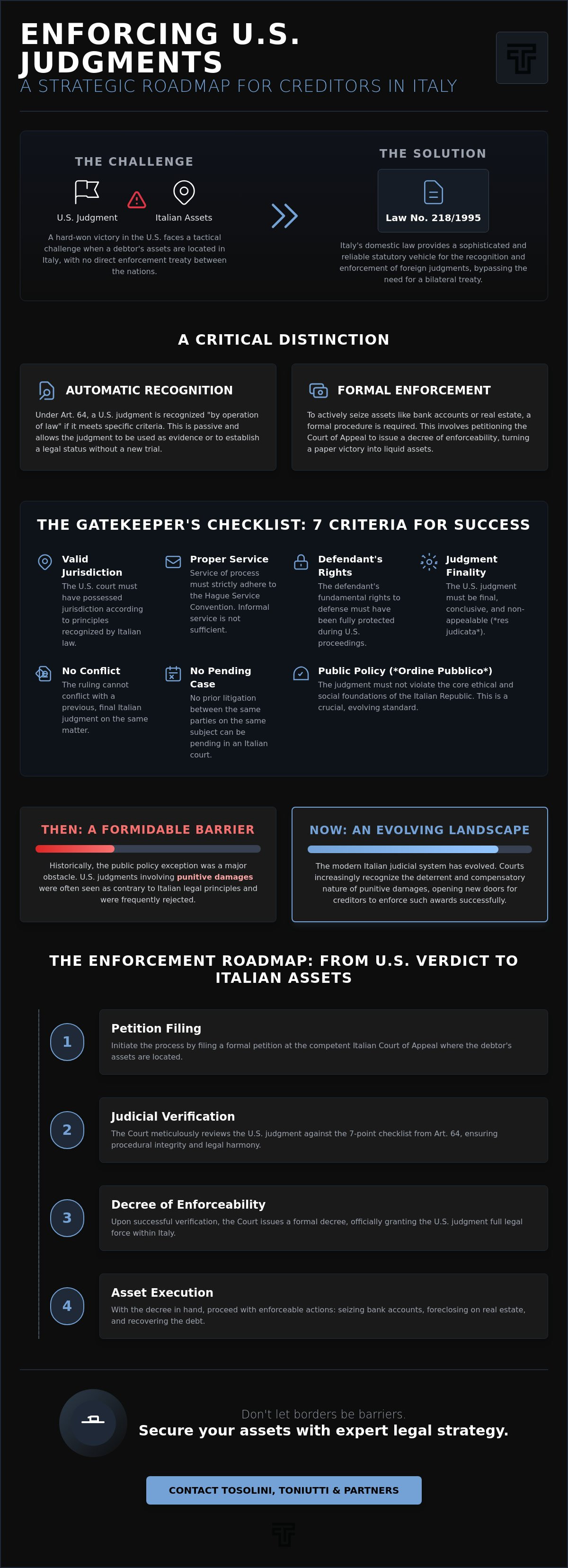
Under Article 64 of Law 218/1995, a foreign judgment is recognized by operation of law if it meets specific criteria. This automatic recognition allows a judgment to be used as evidence or to establish a legal status without a new trial. However, recognition isn't the same as execution. If your goal involves seizing bank accounts or foreclosing on real estate, you must initiate the formal recognition process. This is a specific procedure where the Court of Appeal verifies the judgment's compatibility with Italian law and issues a decree of enforceability. It's the essential bridge between a US paper victory and Italian liquid assets.
Jurisdictional Competence and Comity
Italian judges must confirm that the US court possessed valid jurisdiction according to principles that mirror Italian law. If a US court asserted power over a defendant with no ties to the forum, an Italian court might decline enforcement to protect due process. This evaluation relies heavily on international comity. Comity is the practice of one nation recognizing the legislative, executive, or judicial acts of another to foster international cooperation and legal stability. For those involved in international litigation, understanding this balance is the difference between a successful asset recovery and a costly procedural dead end.
The Statutory Requirements under Law 218/1995
For a US decision to cross the Atlantic and take root in Italian legal soil, it must satisfy the rigorous criteria of Article 64 of Law 218/1995. This isn't merely a bureaucratic checklist. It's a fundamental verification of judicial harmony. When you're enforcing US judgment in Italy, the Italian Court of Appeal acts as a meticulous gatekeeper, ensuring the foreign order respects the structural integrity of the local legal system. The court doesn't reopen the case; it confirms the judgment's legitimacy through a lens of intellectual precision.
The first pillar of this process is the compatibility check. A US judgment can't be recognized if it conflicts with an existing Italian ruling on the same matter or if a trial between the same parties is already pending in Italy. This prevents the double litigation costs that many international creditors fear. Additionally, the judgment must pass the Public Policy filter. This principle ensures that the foreign decision doesn't violate the core ethical or social foundations of the Italian Republic. While this was once a major hurdle, the 2026 legal landscape offers a more predictable path for US creditors.
Service of Process and the Hague Convention
Procedural precision is non-negotiable. Italian courts demand proof that the defendant's rights were fully protected during the US trial. This usually means service of process must have complied with the Hague Service Convention. A common pitfall occurs when a US plaintiff relies on actual knowledge or informal service methods. Even if the defendant knew about the lawsuit, an Italian judge will likely deny enforcement if the formal service requirements weren't met. The Certificate of Service becomes the most valuable document in your portfolio during this phase. If the defendant was declared in default in the US, the scrutiny regarding proper notification increases exponentially.
Finality and Conclusive Judgments
The finality test requires that the judgment is no longer subject to ordinary appeal. In Italy, this refers to a judgment that is final and conclusive. A preliminary injunction or an interlocutory order generally won't qualify for enforcement because they lack the permanence required by Law 218/1995. You'll need exemplified copies of the judgment, authenticated with an international legalization certificate to ensure validity. This documentary rigor transforms a foreign court order into an actionable instrument within the Italian jurisdiction. Achieving this level of procedural alignment requires a deep understanding of both US litigation and Italian execution. If you're concerned about how these requirements apply to your specific case, you can consult with our international litigation team to verify your judgment's eligibility.
Navigating the Public Policy Exception and Punitive Damages
The concept of public policy often looms as a vague specter for US creditors. Historically, it served as an insurmountable wall against any judgment that appeared punitive rather than strictly compensatory. In the 2026 legal environment, this wall has transformed into a sophisticated filter. When you're enforcing US judgment in Italy, public policy is no longer a tool for total rejection. It's a mechanism for ensuring that a foreign award doesn't clash with the fundamental values of the Italian legal order. This shift recognizes that international legal harmony requires flexibility, especially in complex commercial disputes where deterrence is as vital as restitution.
The most significant evolution involves the treatment of punitive damages. For decades, Italian courts viewed these awards as alien to their civil law tradition. This changed with a landmark shift in the perspective of the high court, which was recently refined by the Italian Supreme Court in Judgment No. 31244/2025. The court now accepts that punitive damages aren't inherently contrary to public policy. However, they must pass a rigorous proportionality test. The award must have a clear statutory basis in the US jurisdiction and shouldn't be grossly excessive compared to the actual harm suffered. Italian judges now evaluate the rationality of the award, looking for intellectual consistency between the conduct and the penalty.
The Evolution of Punitive Damages (2017-2025)
The 2025 ruling by the Italian Supreme Court solidified the requirement for predictability. To succeed in enforcing US judgment in Italy when punitive damages are involved, the US court must have operated within defined statutory limits. The Italian judiciary now looks for a balance between the compensatory function of the law and its deterrent nature. If the US award is anchored in a specific legislative framework rather than a jury's arbitrary whim, it's far more likely to be recognized. This intellectual shift moves Italy closer to the global standard of judicial cooperation while maintaining its commitment to legal certainty.
Structuring US Judgments for Italian Success
Success in Italy often begins in the US courtroom. Litigators should strive for special verdicts that clearly separate compensatory amounts from punitive or treble damages. A general verdict that lumps all damages into a single sum is significantly harder to enforce because the Italian Court of Appeal cannot verify the proportionality of the non-compensatory portion. A detailed statement of reasons in the US decision provides the intellectual roadmap the Italian judge needs to confirm that the award respects public policy. If your judgment involves complex damage structures, seeking specialized international litigation advice early in the process can prevent a declaration of unenforceability later.
The Procedural Roadmap: Step-by-Step Enforcement
The transition from a US verdict to Italian liquidity begins with a tactical entry into the Italian courtroom. When you're enforcing US judgment in Italy, the process officially starts with a formal petition filed at the competent Court of Appeal. This isn't a simple administrative filing. It represents the start of the 'Contradictory' phase. During this stage, the debtor is officially notified and granted the right to present a defense. The court's role is focused on verification rather than a new trial. It confirms that the judgment aligns with the standards of Law 218/1995 that we analyzed in previous sections.
The procedural reality of enforcing US judgment in Italy is governed by the issuance of a decree of recognition. Once the Court of Appeal is satisfied that all statutory requirements are met, it grants this decree. You then serve the debtor with the decree and a Precetto, which is a formal notice to comply. This document gives the debtor a final 10-day window to satisfy the judgment voluntarily. If they fail to do so, you gain the power to initiate actual execution. This includes seizing bank accounts, real estate, or third-party credits through a judicial officer who can now access centralized asset registries to identify the debtor's holdings.
Choosing the Correct Venue
Determining the right Foro, or venue, is a vital strategic decision. Jurisdiction is usually tied to where the debtor's assets are located or their primary place of residence. If assets are distributed across different regions, selecting the most efficient Court of Appeal can influence the overall speed of recovery. The Italian Court of Appeal serves as the exclusive judicial body for the recognition and declaration of enforceability of foreign judgments.
Timeline and Costs of Recognition
In the 2026 legal landscape, obtaining a declaration of enforceability for a non-EU judgment typically takes between six and twelve months. Note that a significant Constitutional Court hearing is scheduled for June 9, 2026. This hearing could impact judicial procedures and influence these timelines. Costs are structured around the Contributo Unificato, a court registry fee based on the claim's value. For judgments exceeding €520,000, the fee is fixed at €1,686. Additionally, a legal interest rate of 1.6% per annum applies to judgments as of January 1, 2026. You can Contact Tosolini, Toniutti & Partners for a preliminary assessment of your recovery costs.
If you are ready to move from a US court order to physical asset recovery, you can discuss your enforcement strategy with our team to ensure every procedural detail is handled with precision.
Strategic Support for US-Italy International Litigation
Successful recovery in a cross-border context requires more than just legal knowledge; it demands a vision that spans two distinct judicial cultures. When you're enforcing US judgment in Italy, the primary challenge isn't just the translation of language, but the translation of legal intent. Common law principles from the United States must be meticulously aligned with the rigid civil law structures of Italy. This alignment is only possible through counsel who understand the nuances of both systems. Without this bridge, critical procedural details often get lost, leading to expensive delays or the total rejection of the claim by the Court of Appeal.
Tosolini, Toniutti & Partners operates as a strategic partner throughout the entire lifecycle of a dispute. We believe that the best enforcement strategy begins before the first complaint is even filed in a US court. By conducting comprehensive asset searches in Italy early on, we ensure that your litigation efforts are anchored in reality. There's no value in a hard-won judgment if the debtor has no reachable Italian assets. Our approach integrates high-level legal theory with practical execution, ensuring a seamless flow from the initial verdict to the final seizure of funds or property.
The TT&P Advantage in International Disputes
Our firm provides a holistic ecosystem for cross-border interests, ensuring that every structural element of your case is sound. We apply International Litigation 2026 strategies to navigate the complexities of modern judicial reforms. Beyond the courtroom, our expertise in LLC Incorporation and corporate architecture allows us to assist clients in managing and protecting the assets they recover. This integrated perspective ensures that your Italian interests are handled with the same engineering-grade precision as your US litigation.
Next Steps: From Judgment to Collection
Initiating the process of enforcing US judgment in Italy starts with a deep-dive review of your existing court orders. We analyze the service of process history and the finality of the decision to identify potential hurdles before they reach an Italian judge. Early involvement is the most effective way to avoid the common service errors that often derail recognition. We help you transition from a position of uncertainty to one of tactical advantage. If you're ready to secure your recovery and execute on your US court order, you can Schedule a consultation to begin your strategic assessment.
Securing Your Cross-Border Recovery in 2026
The transition from a domestic victory to the actual recovery of assets in Italy is no longer a path of uncertainty, but one of strategic execution. By mastering the nuances of Law 218/1995 and navigating the evolving landscape of punitive damages, you transform a foreign order into an actionable reality. The 2026 legal environment favors those who prioritize procedural precision and intellectual consistency. When you're enforcing US judgment in Italy, the difference between success and a procedural dead end lies in the details of the original service and the finality of the award.
Success in this arena requires an intellectual bridge between two distinct legal philosophies. Our bilingual legal team is qualified in both jurisdictions, offering specialized expertise in US-Italy cross-border litigation. We bring a proven track record with complex recognition cases, ensuring that even sophisticated awards survive the Italian public policy filter. If you're ready to secure your assets and finalize your recovery, Enforce Your US Judgment in Italy – Contact Our Experts to begin your strategic assessment. Your hard-won victory deserves the precision of professional execution.
Frequently Asked Questions
Is there a treaty between the US and Italy for the enforcement of judgments?
No, there is currently no bilateral treaty between the United States and Italy for the mutual recognition and enforcement of court judgments. Instead, the process relies on Italian Private International Law, specifically Law No. 218 of May 31, 1995. This statute provides the legal framework for recognizing foreign decisions as long as they meet specific procedural and substantive requirements.
How long does it take to recognize a US judgment in Italy?
Obtaining a declaration of enforceability for a non-EU judgment typically takes between six and twelve months in the absence of a dispute. If the debtor raises objections, the timeline can exceed one year. It's important to monitor the impact of the Constitutional Court hearing scheduled for June 9, 2026, as judicial reforms may influence court procedures and overall efficiency.
Can I enforce a US default judgment in Italy?
You can enforce a US default judgment in Italy, but it requires rigorous proof of proper service. The Italian Court of Appeal will verify that the defendant was served in accordance with the Hague Service Convention and that their fundamental rights of defense were not compromised. If the notification process was flawed, the court will likely deny the petition for recognition.
Are punitive damages from a US court enforceable in Italy?
Punitive damages are no longer automatically rejected by Italian courts. Following the landmark 2017 Supreme Court decision and subsequent 2025 refinements, these awards are enforceable if they are proportional and based on clear statutory limits in the US. The award must not be grossly excessive or contrary to the compensatory nature of the Italian civil system.
What documents do I need to enforce a US judgment in Italy?
To initiate the process of enforcing US judgment in Italy, you need exemplified copies of the US court order authenticated with an Apostille. You must also provide certified translations of all documents. A certificate of finality is essential to prove the judgment is no longer subject to ordinary appeal in the United States.
Can I seize an Italian citizen's real estate based on a US court order?
Yes, you can seize real estate owned by an Italian citizen once your US judgment has been recognized by the competent Court of Appeal. After the decree of enforceability is issued and a formal notice to comply is served, a judicial officer can initiate the foreclosure process. This allows creditors to target immovable assets as part of their recovery strategy.
What is the 'Public Policy' exception in Italian law?
The Public Policy exception, or ordine pubblico, is a legal safeguard that prevents the recognition of foreign judgments that violate the fundamental principles of the Italian legal system. It ensures that enforcing US judgment in Italy doesn't conflict with core constitutional values or essential social interests. Modern courts apply this exception narrowly to facilitate international judicial cooperation.
Do I need to hire an Italian lawyer to enforce my US judgment?
Yes, you must retain a qualified Italian lawyer to file the petition for recognition at the Court of Appeal. Legal representation is mandatory for these proceedings. Choosing a firm with expertise in international litigation ensures that the technical requirements of both the US and Italian systems are perfectly synchronized for a successful outcome.


Comments