

Enforcing US Judgment in Italy: The 2026 Strategic Legal Guide

A final US court judgment is not a mere conclusion; it's a dormant legal blueprint that requires precise architectural alignment to activate within the Italian jurisdiction. While many creditors view the Atlantic as an insurmountable barrier to recovery, the reality is that your domestic victory can be seamlessly integrated into the Italian legal system through the right procedural lens. Mastering the art of enforcing US judgment in Italy is about more than just paperwork; it's about navigating a sophisticated landscape where US due process meets the refined requirements of the Italian Court of Appeal.
You likely worry that Italian judges will use the "Public Policy" exception to retry your entire case or that the 2026 judicial reforms have added layers of impenetrable complexity. We understand these anxieties. This guide promises to demystify the Exequatur process, showing you how to bypass a review of the merits and secure finality in cross-border litigation. We'll preview the specific path from Law 218/1995 compliance to the actual seizure of Italian real estate or assets, ensuring your international interests remain protected and your legal strategy remains visionary.
Table of Contents
The Legal Framework for Enforcing US Judgments in Italy (2026)
The Article 64 Requirements: Is Your US Judgment Enforceable?
The Exequatur Process: Domesticating US Orders in Italian Courts
Enforcement in Practice: Real Estate, Probate, and Financial Assets
International Litigation Strategy: Overcoming Challenges and Defense Tactics
The Legal Framework for Enforcing US Judgments in Italy (2026)
Law 218/1995 serves as the definitive gatekeeper for the recognition and enforcement of US judgments within the Italian legal system in 2026. Because no bilateral treaty exists between the United States and Italy for the reciprocal recognition of civil judgments, the process remains governed by this domestic Italian statute. This lack of a treaty-based shortcut means every US court order, whether from a state or federal court, must pass through a specific filter of Italian legal principles to gain traction in the local courts. Precision is mandatory here.
It's essential to grasp the nuance between mere recognition and executive enforcement. Recognition allows an Italian court to accept the legal facts established in a US case, such as the existence of a debt or a change in legal status. However, the enforcement of foreign judgments involves the transfer of executive power, authorizing the seizure of assets or the transfer of property titles. Successful strategies for enforcing US judgment in Italy depend on moving beyond this recognition phase to the executive stage. Without a successful exequatur proceeding, a US judgment remains a valid statement of fact but lacks the teeth required for asset recovery.
The Residual Role of Law 218/1995
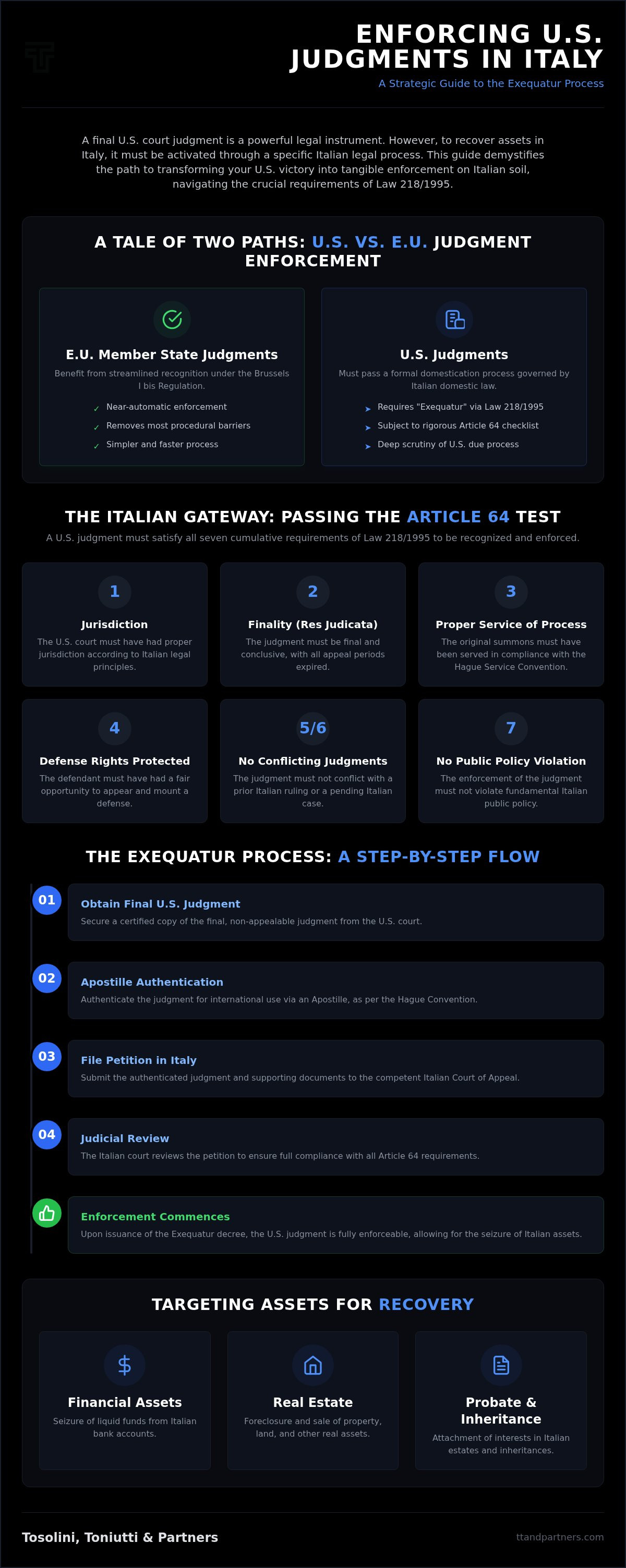
Article 64 of Law 218/1995 lists seven cumulative requirements that a US judgment must satisfy to be domesticated. While the 2026 judicial reforms have accelerated the digital filing process for these petitions, the underlying legal hurdles remain rigorous. Automatic recognition is often reserved for judgments regarding personal status, but for commercial disputes or asset recovery, the Italian Court of Appeal must issue a formal decree. Details matter in this process. This step ensures that the US judgment doesn't conflict with previous Italian rulings and that the original court had proper jurisdiction under Italian standards.
US vs. EU Judgments: Key Procedural Divergence
Navigating the path for enforcing US judgment in Italy requires a different strategy than enforcing an order from an EU member state. Judgments from countries like France or Spain benefit from the Brussels I bis Regulation, which removes most procedural barriers. US orders are treated as non-EU judgments, requiring a deeper dive into the service of process. Italian judges look closely at whether the defendant was served according to the Hague Convention on the Service Abroad of Judicial Documents. If the initial US service was flawed, the entire domestication effort in Italy can fail, regardless of the judgment's merits.
The Article 64 Requirements: Is Your US Judgment Enforceable?
Article 64 of Law 218/1995 serves as the definitive checklist for any creditor seeking to bridge the gap between American litigation and Italian asset recovery. It isn't enough to simply possess a favorable order; the judgment must align with specific Italian procedural standards to survive the scrutiny of the Court of Appeal. These standards ensure that the foreign ruling respects the fundamental architecture of the Italian legal system. Failure to meet even one of these criteria can stall an enforcement action indefinitely.
The first hurdle involves jurisdiction. The US court's authority must be recognized according to Italian rules on foreign judgment recognition. This means that if the dispute had no meaningful connection to the US forum, an Italian judge might refuse domestication. Additionally, the judgment must be final, or res judicata. This requires proof that all appeals in the US system have been exhausted or that the time for filing such appeals has expired. A judgment that is still subject to standard appellate review in its originating legal system won't be considered enforceable in the jurisdiction where recognition is sought.
Due Process and Service of Process
Proper notification is the cornerstone of a successful domestication. Italian courts are famously protective of defense rights, particularly when dealing with default judgments where the defendant didn't appear. To succeed in enforcing US judgment in Italy, you must demonstrate that the summons was served in strict compliance with the Hague Service Convention. If the defendant can prove they weren't given adequate time or a proper opportunity to defend themselves, the Italian court will likely block the enforcement. Documentation of service is often the most scrutinized piece of evidence in the entire file.
The Public Policy Exception in 2026
Italian public policy is the most frequent hurdle for US awards. In 2026, the landscape regarding punitive damages has reached a point of sophisticated balance. Historically, Italian courts rejected US awards that included punitive components, viewing them as contrary to the compensatory nature of Italian civil law. However, recent Supreme Court rulings have signaled a more permissive stance, provided the award isn't disproportionately high compared to actual damages. If your US judgment conflicts with an existing Italian ruling on the same matter, the local judgment will almost always prevail.
Strategic litigation involves anticipating these challenges early. Those managing complex cross-border interests should consult with dual-jurisdiction counsel to audit their US judgment against these 2026 standards before initiating the formal exequatur process. This proactive alignment is what separates successful asset recovery from costly procedural failures.
The Exequatur Process: Domesticating US Orders in Italian Courts
The transition from a US court order to an enforceable Italian title is a structured journey known as the Exequatur. This isn't a secondary trial; it's a sophisticated validation process where the Italian Court of Appeal grants executive power to the foreign ruling. Success in enforcing US judgment in Italy hinges on a sequence of technical milestones that must be navigated with architectural precision. Each step serves to bridge the gap between two distinct legal cultures.
Step 1: Authentication. You must obtain a certified copy of the US judgment, complete with the Apostille. This international certification confirms the document's origin for use in Italy.
Step 2: The Petition. Your legal counsel files a formal petition with the competent Court of Appeal. This filing triggers the formal domestication process.
Step 3: Judicial Review. The court initiates an adversarial phase where the judge verifies the jurisdictional and procedural criteria. The defendant has the opportunity to raise limited objections, primarily focused on procedural flaws.
Step 4: The Decree. Upon satisfaction of all requirements, the court issues a decree granting the executive formula. This is the final executive stamp that transforms the US order into a local writ of execution.
Filing with the Court of Appeal
Determining the correct geographic jurisdiction is the first strategic decision. The petition is typically filed where the debtor is domiciled or where the specific assets are located. Under the 2026 judicial framework, all filings are now processed through mandatory electronic platforms, requiring certified translations by sworn experts. While the 2026 reforms aim for efficiency, current transition friction suggests that first-instance timelines for these proceedings can range between 24 and 42 months. Precision in the initial filing is the best defense against unnecessary delays.
The Summary Nature of the Proceeding
One of the most significant advantages of the Exequatur is its summary nature. The Italian Court of Appeal is legally prohibited from reviewing the merits of the original US case; it can't re-examine the facts or the legal reasoning of the American judge. This limitation prevents the debtor from using the Italian court as a super-appellate body to delay the process of enforcing US judgment in Italy. To protect your interests during this phase, you can seek interim measures, such as a conservative attachment, to freeze the debtor's assets while the domestication is pending. If you're ready to initiate this process, contact our bilingual litigation team to ensure your documentation meets the 2026 standards.
Enforcement in Practice: Real Estate, Probate, and Financial Assets
Once the executive formula is granted, the focus shifts from legal validation to the tangible seizure of assets. This is the stage where enforcing US judgment in Italy moves from the courtroom to the public record, requiring a coordinated effort to secure the debtor's holdings. For immovable property, this necessitates a formal transcription at the local Land Registry. This registration acts as a public lien, effectively preventing the debtor from transferring the property to a third party while the execution is pending. Our real estate closing expertise ensures that these title transfers and liens are handled with the necessary due diligence to avoid future encumbrances or title defects.
Inheritance and Probate Enforcement
Inheritance disputes frequently arise when a US will conflicts with the rigid forced heirship rules found in the Italian Civil Code. A domesticated US probate order provides the legal mechanism to bypass local succession claims, allowing for the distribution of assets according to the decedent's wishes. The execution of these orders involves an Italian Notary who, acting as a public official, updates the property and cadastral records to reflect the new ownership. This coordination is vital for resolving complex estate matters across borders. Strategic international litigation ensures that these probate findings are respected across both jurisdictions, providing long-term finality for beneficiaries and executors alike.
Commercial Debt Collection
For commercial creditors, recovery often targets liquid capital held within the Italian banking system. Through a third-party garnishment, a creditor can freeze funds in the debtor’s bank accounts or intercept payments from the debtor’s own clients, such as rental income or service fees. It's also critical to analyze the debtor’s corporate structure during this phase. The specifics of LLC incorporation can influence the success of asset recovery, especially when navigating the boundaries of corporate liability in cross-border scenarios. This multi-pronged approach ensures that a US judgment is not merely a symbolic victory but a source of actual financial restitution. By targeting diverse asset classes, creditors can maximize their recovery potential in the 2026 judicial landscape.
To convert your legal victory into Italian assets, reach out to our cross-border litigation team for a detailed analysis of your enforcement options and a strategic audit of the debtor's holdings.
International Litigation Strategy: Overcoming Challenges and Defense Tactics
Success in enforcing US judgment in Italy requires a mindset that looks beyond the initial decree toward the inevitable counter-maneuvers of the debtor. Italian legal architecture provides debtors with specific defensive tools, primarily the "Public Policy" exception, which serves as a filter for foreign values that might clash with local constitutional principles. A visionary strategy anticipates these friction points before the petition is even filed. Explore our full guide to international litigation for 2026 to understand how these global dynamics are shifting and how they impact your recovery efforts.
Managing parallel proceedings remains one of the most complex aspects of cross-border disputes. If a debtor initiates a preemptive strike in an Italian court while the US case is still active, it can create a jurisdictional knot that takes years to untangle. This is where the dual-jurisdiction perspective becomes indispensable. We focus on ensuring that the US judgment is insulated from these challenges by strictly adhering to the procedural requirements of the Italian Private International Law Act from the very beginning of the litigation chain.
Challenging the Domestication
Procedural precision in the initial US case is the best defense against Italian appeals. Italian debtors often focus on technicalities, such as the rule regarding conflicting pending litigation, which can stall enforcement if a parallel proceeding is already active in an Italian court. If the US case was initiated after the Italian one, or if the service of process didn't meet the rigorous standards of the Hague Convention, the domestication could be set aside. While the Court of Appeal handles the primary review, final appeals on points of law are directed to the Court of Cassation. This supreme body doesn't retry the facts but ensures the legal framework was applied with absolute accuracy.
Strategic Settlement and Mediation
The threat of a successful exequatur often serves as the most potent leverage in settlement negotiations. In 2026, the Italian justice system emphasizes mandatory mediation for many civil disputes, creating a structured window where parties can resolve conflicts before entering the executive phase of enforcing US judgment in Italy. This process allows for a more flexible, private resolution that avoids the public nature of asset seizure. Strategic litigation isn't always about the final blow of the hammer; it's about creating a position of strength that makes settlement the debtor's only logical choice. Contact our team for a strategic consultation on your enforcement case to evaluate whether a negotiated exit or full execution aligns best with your objectives.
Activating Your Cross-Border Recovery Strategy
Transforming a US court order into a tangible asset in Italy requires more than technical compliance; it demands a visionary alignment of two distinct legal architectures. By navigating the Article 64 requirements and the Exequatur process with precision, you ensure that your domestic victory gains the executive power necessary for real estate seizure or financial recovery. The path from a paper judgment to finality in cross-border litigation is structured, yet it rewards those who anticipate procedural hurdles early in the process.
Mastering the nuances of enforcing US judgment in Italy is a core strength of our practice. With decades of experience in US-Italy cross-border law and a track record of strategic success in the Italian Court of Appeal, we provide the dual-jurisdiction litigation support required to protect your global interests. Don't let your legal victory stall at the border. Secure your international interests-Contact Tosolini, Toniutti & Partners for an enforcement strategy. Your path to asset recovery starts with a sophisticated, bilingual approach to international law.
Frequently Asked Questions
Can I enforce a US default judgment in Italy?
Yes, you can enforce a US default judgment in Italy, provided the service of process was executed correctly. The Italian Court of Appeal will verify if the defendant was properly notified according to the Hague Service Convention. If the defendant was given a fair opportunity to appear but chose not to, the judgment remains valid. However, if notification was flawed, the Italian court will likely block the domestication to protect fundamental defense rights.
How long does the Exequatur process take in 2026?
The Exequatur process in 2026 typically spans between 24 and 42 months for a first-instance decision. While the recent judicial reforms aim to reduce litigation times, the transitional period has introduced some procedural friction. Digitalization of the courts is accelerating the filing phase, but the actual judicial review of Article 64 requirements still depends on the specific workload of the competent Court of Appeal. Strategic planning remains essential for timely asset recovery.
Does Italy recognize US punitive damage awards?
Italy now recognizes US punitive damage awards, provided they aren't considered disproportionate or purely speculative. Historically, Italian courts rejected these awards as contrary to public policy. However, the Supreme Court has shifted its stance, allowing enforcement if the award serves a legitimate deterrent purpose and is grounded in compensatory principles. This evolution is a significant factor when enforcing US judgment in Italy for commercial or tort-related disputes.
Is an Apostille required for my US court judgment?
Yes, an Apostille is a mandatory requirement for any US court judgment intended for use in Italy. Since both nations are signatories to the Hague Apostille Convention, this certification provides the necessary international legalization. Without it, the Italian Court of Appeal cannot verify the authenticity of the documents. You must also provide a certified, sworn translation of the entire judgment into English to satisfy the court's filing requirements in 2026.
Can I seize Italian real estate based on a US divorce decree?
You can seize Italian real estate or transfer title based on a US divorce decree, as long as the order is first domesticated through the Exequatur process. Once the decree is recognized, it must be registered with the Italian Land Registry, or Conservatoria. This process is common in cross-border family law matters where property in Italy was part of the marital estate. It's often the most effective way to resolve international title disputes.
What is the cost of domesticating a US judgment in Italy?
The cost includes court filing fees, known as the Contributo Unificato, along with sworn translation expenses and professional legal fees. In 2026, these court fees are calculated based on the value of the claim being enforced. While we don't provide specific firm pricing here, creditors should also account for the costs of registering the final decree in the public registries. These administrative expenses are separate from the dual-jurisdiction legal counsel required for the proceeding.
Will the Italian court retry the facts of my case?
No, the Italian court won't retry the facts or the merits of your original American case. The judicial review is strictly limited to ensuring the judgment satisfies the procedural and public policy criteria outlined in Article 64 of Law 218/1995. This means the judge won't question the US court's findings on evidence or liability. This limitation is a key advantage when enforcing US judgment in Italy, as it prevents a second full trial.
What happens if the debtor has no assets in Italy?
If the debtor has no assets in Italy, the domesticated judgment serves as a dormant legal title until assets are identified. You can't perform an actual seizure without a target, such as real property, bank accounts, or third-party credits. In these cases, conducting a professional asset search is the logical first step. Once assets are located, the domesticated judgment allows for immediate executive action without further judicial delays in the Italian system.


Comments