

US Commercial Leases for Italian Businesses: 2026 Guide

What if the right premises are only the beginning of a sound US expansion? For an Italian business, a US commercial lease agreement for Italian business operations is also a commitment that can shape costs, flexibility, and how the company enters the market. Before signing, assess not only the space but also which entity will be the tenant and what obligations the agreement creates.
Unfamiliar terminology and negotiation practices can make that decision difficult, particularly when guarantees and exit provisions may affect the business beyond the initial move. This guide explains how to assess a US commercial lease, identify responsibilities the agreement may place on the tenant, and prepare for negotiation and signing.
You’ll also learn which provisions may need state-specific legal review and why premises decisions should be coordinated with entity, business, and immigration planning. The aim is to treat the lease as part of a connected cross-border strategy, not as a standalone document.
Table of Contents
Why an Italian Business Should Assess a US Commercial Lease Before Signing
Entering an unfamiliar lease process can feel uncertain, especially when the document uses terminology and negotiation practices your business hasn’t encountered before. A US commercial lease agreement for Italian business operations deserves careful assessment because its terms can affect more than the choice of premises. They may shape operating flexibility, occupancy plans, and costs throughout the tenancy.
General guidance can help you identify questions to ask, but it isn’t a substitute for advice based on the applicable state law and the specific contract. Lease rights and obligations can depend on both. For background on the range of arrangements and issues that may arise, see this overview of commercial leasing agreements.
What a US commercial lease can require from a tenant
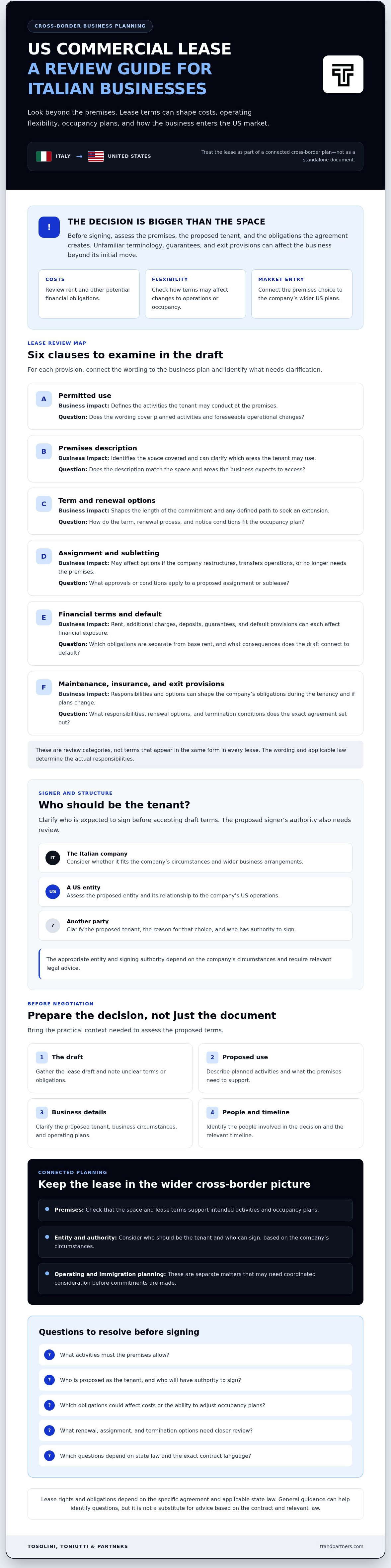
Review the provisions covering rent and other payments, permitted use, maintenance, insurance, renewal, and termination. A permitted-use clause, for example, may affect whether the planned business activity can take place at the premises. Renewal or termination language can shape the company’s options if its plans change. These are review categories, not terms that appear in the same form in every lease. The wording and applicable law determine the actual responsibilities.
Why the tenant’s business structure matters
Before accepting draft terms, clarify who is expected to sign: the Italian company, a US entity, or another party. The choice can affect how the lease fits the company’s wider business arrangements, and the proposed signer’s authority also needs review. The appropriate entity and signing authority depend on the company’s circumstances and require relevant legal advice.
Keep the premises decision connected to other planning. Signing a lease does not, by itself, resolve immigration questions or determine which business entity should operate in the United States. These are separate matters that may need coordinated consideration before the company makes commitments.
Before requesting or accepting lease terms, answer these questions:
What activities must the premises allow?
Who is proposed as the tenant, and who will have authority to sign?
Which obligations could affect the company’s costs or ability to adjust its occupancy plans?
What renewal, assignment, and termination options need closer review?
Which questions depend on the state and the exact contract language?
Clear answers help the business judge whether the proposed space and terms support its operating plans, while flagging issues for state-specific review before signing.
How to Review the Main Terms in a US Commercial Lease
A clause-by-clause review turns a lengthy draft into practical decisions: what the business can do at the premises, what it may need to pay, and how it could adapt if plans change. For an Italian business, assess each provision against its intended operations and the exact wording of the agreement. The points below are issues to investigate, not universal requirements or standard terms.
Clause: Permitted useBusiness impact: Defines the activities the tenant may conduct under the agreement.Question to raise: Does the wording cover the business’s planned activities and foreseeable operational changes?
Clause: Premises descriptionBusiness impact: Identifies the space covered by the lease and can clarify which areas the tenant may use.Question to raise: Does the description match the space and any areas the business expects to access?
Clause: Term and renewal optionsBusiness impact: Shapes how long the tenant is committed and whether there is a defined path to seek an extension.Question to raise: How do the stated term, renewal process, and notice conditions fit the occupancy plan?
Clause: Assignment and sublettingBusiness impact: May affect the company’s options if it restructures, transfers operations, or no longer needs the premises.Question to raise: What approvals or conditions apply to a proposed assignment or sublease?
Clause: Financial terms and defaultBusiness impact: Rent, additional charges, deposits, guarantees, and default provisions can each affect financial exposure.Question to raise: Which amounts or obligations are separate from base rent, and what consequences does the draft connect to a default?
Clause: Maintenance, alterations, access, and insuranceBusiness impact: Allocates responsibilities that may affect daily operations and planned changes to the space.Question to raise: Which responsibilities or approvals could affect repairs, fit-out work, access, or insurance arrangements?
Assess operational, financial, and exit terms together
Read related clauses as a set. A broad permitted-use clause may be less helpful if operational changes still require approval. Consider a renewal option alongside its procedures and timing. Review rent separately from other amounts or obligations rather than treating base rent as the full financial picture.
Consider renewal, assignment, subletting, early termination, and default language together. If the draft includes a guarantee, ask counsel to clarify its scope and whether a business change could affect continuing obligations. The effect of any provision depends on the contract and applicable state law.
A careful review of a US commercial lease agreement for Italian business operations can help surface questions before signing. To discuss how lease considerations may connect with broader US-Italy business matters, you can contact the firm and clarify what support may be relevant to your circumstances.
How to Compare Lease Structures, Signers, and Business Risks
Choosing who signs a lease is not a routine formality. The proposed tenant should fit the company’s operating plans, entity arrangements, and ability to meet the agreement’s obligations. For a US commercial lease agreement for Italian business operations, compare possible signing structures with qualified legal advice rather than assuming one is always preferable.
Who should sign the commercial lease?
Start by confirming whether the proposed tenant is the Italian company, a US entity, or another party. If a US entity is being considered, assess how its role fits the business plan and whether it is ready to enter the agreement. If the Italian company is proposed as tenant, review how that choice aligns with the intended US operations and lease terms.
In either case, check the entity’s formation, capacity, and authority to enter the lease. Confirm that the individual signing has appropriate authorization from the relevant business. Counsel can assess how the lease, entity records, and signing documents should align. These questions are fact-specific, and the analysis depends on the company’s circumstances and applicable law.
A landlord may also request supporting documents or a guaranty. Review what is requested, who would provide it, and what obligations the proposed language could create. A personal guarantee is a contract issue to understand and negotiate, not an automatic result of choosing a particular entity. Don’t assume that using a US entity alone resolves questions about guarantees or separates every business risk.
How do guarantees and immigration plans fit into the decision?
Keep the lease decision and immigration eligibility analytically separate. Signing a lease does not establish visa eligibility, guarantee an immigration outcome, or replace a review of the relevant visa requirements. If the premises form part of a broader business investment plan, however, the lease commitment may be relevant to that planning. The E-2 visa strategic guide may help frame that connection, but it shouldn’t be treated as a prediction of eligibility or outcome.
Before signing, ask counsel to consider the proposed tenant, signing authority, requested guarantees, and supporting documents together. If investment and immigration planning overlap, coordinate the relevant professional reviews while keeping lease obligations distinct from immigration criteria. To discuss how the firm’s cross-border capabilities may relate to your circumstances, use the contact page.
How to Move from Lease Draft to Informed Negotiation
A focused preparation process turns a lease draft into a manageable set of decisions. Before negotiating a US commercial lease agreement for Italian business operations, compare the proposed space and terms with the company’s actual plans, then record what needs clarification or change.
Define the business requirements. Summarize the intended operations, space needs, expected occupancy period, and flexibility the business may need if its plans evolve. Describe how the premises will be used so the draft can be assessed against real operating needs.
Gather the relevant materials. Collect the current lease draft, details about the business and proposed tenant, a description of the intended use, the desired timeline, and any supporting documents already provided. Keep related communications together so proposed terms can be compared with the written agreement.
Identify decision-makers and signing authority. Determine who can approve commercial commitments and who may sign for the proposed tenant. Confirm that decision-makers understand which terms require approval, including any requested guarantees or other supporting commitments.
Create a negotiation and verification list. Record unclear clauses, operational assumptions, and requested changes in one place. Mark questions that may require state-specific legal, tax, zoning, or occupancy verification. The relevant checks depend on the property, intended use, contract, and applicable rules. Don’t assume that the same filing, review, or approval applies in every situation.
Negotiate against the written draft. Share questions and proposed revisions clearly, and track the landlord’s responses. If a point is agreed, confirm how it will appear in the documents rather than relying on an informal summary or a conversation.
Review the final document before signing. Compare the final draft with the negotiated changes and confirm that all referenced exhibits are included. Check the tenant’s name and entity details, signer authority, dates, and notice instructions. Seek qualified legal review of the final wording before signing.
Preparation is most useful when it separates business preferences from issues that need professional verification. For example, the company may prefer flexibility around a future change in operations, while the precise effect of a clause or an occupancy question may require review based on the contract and applicable rules. Keep those categories distinct so negotiations address commercial priorities without treating unresolved legal or regulatory questions as settled.
If you’re preparing a cross-border lease decision, you can discuss your business circumstances with Tosolini, Toniutti & Partners and clarify what support may be relevant.
How Cross-Border Legal Support Can Clarify the Next Step
A commercial lease can sit at the intersection of several decisions: which entity will operate the business, who will sign, how the premises fit the company’s plans, and whether commitments in the United States align with the Italian business. For a US commercial lease agreement for Italian business operations, considering these questions together can help identify what needs attention before the company proceeds.
Tosolini, Toniutti & Partners assists with US-Italy cross-border business matters, LLC incorporation, and real estate closings. These capabilities may be relevant to parts of a company’s planning, but they do not establish that the firm provides dedicated commercial lease review. The firm can clarify whether the specific work requested fits its scope and whether other qualified counsel may be needed for state-specific lease questions.
When should an Italian business seek cross-border review?
Consider asking for guidance when the proposed tenant, owner, or operating business involves more than one jurisdiction. Discussion points may include uncertainty about which entity should be named, who can authorize or sign the lease, a requested guarantee, or documents involving both the Italian company and a US entity. These questions are connected, but their answers depend on the company’s facts and the relevant documents.
Ask which parts of the matter can be addressed within the firm’s cross-border, LLC incorporation, or real estate closing capabilities, and whether a separate state-specific review is appropriate. Clarifying the scope helps avoid assuming that a particular service is available.
What information should a business bring to an initial discussion?
A concise, organized briefing makes it easier to identify the questions that matter most. Prepare:
The current lease draft and any related documents received
The proposed tenant’s details and a short description of the business’s intended operations
A list of unresolved terms, including questions about entity identity, authority, or guarantees
Target dates for the decision and the names or roles of internal decision-makers
Use the conversation to ask what work is within scope, which jurisdiction’s rules may be relevant, what additional documents may be needed, and what the next steps could be. If a question falls outside the firm’s confirmed capabilities, clarify that early rather than treating a general discussion as a substitute for the appropriate review. Don’t assume a lease approval, negotiated savings, or immigration outcome.
For a measured first step, contact the firm to outline your circumstances and ask whether the support you need fits its scope.
Make Your Premises Decision Part of a Clearer US Strategy
A well-considered lease decision starts with more than the space itself. Review how the agreement’s terms affect your operating plans, identify which entity should sign, and flag questions that depend on the contract and applicable state law. A US commercial lease agreement for Italian business operations should be assessed alongside the company’s broader cross-border plans, not treated as an isolated commitment.
Before signing, confirm that the final document reflects negotiated changes and that unresolved questions have received appropriate review. Lease commitments don’t determine immigration eligibility or settle every question about business structure. Keeping these matters distinct while coordinating them can help your company move forward with greater clarity.
Tosolini, Toniutti & Partners provides cross-border US-Italy legal services and assists with LLC incorporation and real estate closings. To discuss your circumstances and clarify what support may be relevant, Discuss your US-Italy business legal questions.
With careful preparation and the right questions addressed, your premises decision can support a more deliberate path into the US market.
Frequently Asked Questions
Can an Italian company sign a commercial lease in the United States?
An Italian company may be able to sign a US commercial lease, but whether it can enter a particular agreement depends on applicable law, the company’s circumstances, and the landlord’s requirements. Confirm that the company is correctly identified as the tenant and that the person signing has authority to act for it. State-specific legal review can clarify questions about capacity, documentation, and the proposed contract.
Should an Italian business sign a US lease through an LLC?
Not necessarily. A US LLC may be one structure to consider, but it isn’t automatically the right tenant for every Italian business. Compare the company’s operating plans, entity arrangements, lease obligations, and any requested guarantees before deciding. Check the proposed tenant’s formation and authority as well. Seek fact-specific legal advice on how the entity and lease documents should align before committing.
What should an Italian business review in a US commercial lease?
Review the permitted use, premises description, term, renewal options, and assignment or subletting provisions. Also examine rent separately from additional charges, deposits, guarantees, maintenance, insurance, alterations, access, termination, and default language. Assess a US commercial lease agreement for Italian business operations against the company’s actual plans, not just a summary of headline terms. The contract wording and applicable state law affect the obligations.
Can a landlord require a personal guarantee from a foreign business owner?
A landlord may request a personal guarantee as part of lease negotiations, but whether it is required depends on the proposed agreement and the parties’ discussions. Don’t assume it follows automatically from foreign ownership or from choosing a particular business entity. Before agreeing, ask who would guarantee the obligations, what the guarantee covers, and whether it could continue after a business change. Have the wording reviewed under applicable law.
Does signing a commercial lease help an Italian owner qualify for an E-2 visa?
Signing a lease alone doesn’t establish E-2 visa eligibility or guarantee an immigration outcome. A lease may form part of a broader investment and business plan, but immigration eligibility must be assessed separately under the applicable criteria and individual facts. Coordinate immigration and business planning where they overlap, without assuming that a premises commitment by itself satisfies visa requirements.
How can an Italian business negotiate a US commercial lease?
Start with the business’s intended use, space needs, occupancy plans, and desired flexibility. Review the draft, record unclear clauses, and list requested revisions before discussing terms with the landlord. Separate base rent from other stated obligations, and examine renewal, assignment, subletting, termination, guarantees, and default provisions together. Track agreed changes in writing, then compare the final draft with those changes before signing.
Should a lawyer review a US commercial lease before signing?
Obtaining qualified legal review before signing is a prudent way to identify contract and state-specific questions. A lawyer can assess the actual wording, clarify provisions that affect the company’s plans, and flag issues involving the tenant entity, signer authority, or guarantees. Confirm the scope of review in advance. General guidance or informal summaries shouldn’t replace advice based on the final agreement and relevant jurisdiction.


Comments