

English-Speaking Italian Attorney: A Strategic Guide to Cross-Border Law in 2026

Updated: Sep 24
In the high-stakes arena of international law, a simple translation is often the shortest path to a costly legal misunderstanding. Engaging a specialized english-speaking italian attorney is no longer just about linguistic clarity; it's about bridging the fundamental divide between Italy's Civil Law tradition and the United States' Common Law system. With the 2025 enactment of Law No. 74/2025, which strictly limited Italian citizenship by descent to a two-generation rule, the margin for error has vanished. You likely feel the friction of receiving conflicting advice from different continents while trying to manage a global portfolio of assets and ambitions.
We understand that your objectives, whether securing a Green Card or finalizing a complex real estate closing in Italy, require more than just clerical assistance. This guide promises to reveal a dual-jurisdiction strategy that treats your legal needs as a cohesive structure rather than isolated tasks. We'll explore the current 36-month processing timelines for citizenship, the intricacies of E-2 visa compliance, and the architectural precision needed for cross-border business expansion in 2026. By the end, you'll have a clear vision of how to align your international legacy with the latest regulatory realities.
Table of Contents
Beyond Translation: What an English-Speaking Italian Attorney Actually Does
The role of an english-speaking italian attorney transcends the mere conversion of words from one language to another. It is an architectural discipline. You aren't just hiring a translator; you're engaging a strategist who understands the structural integrity of two distinct legal frameworks. In 2026, as the European Travel Information and Authorisation System (ETIAS) becomes a standard operational reality, the need for a professional who can anticipate how these shifts impact US-Italy relations is paramount. This specialized counsel ensures that your intent isn't lost in the friction between different bureaucratic philosophies.
The Civil Law vs. Common Law Divide
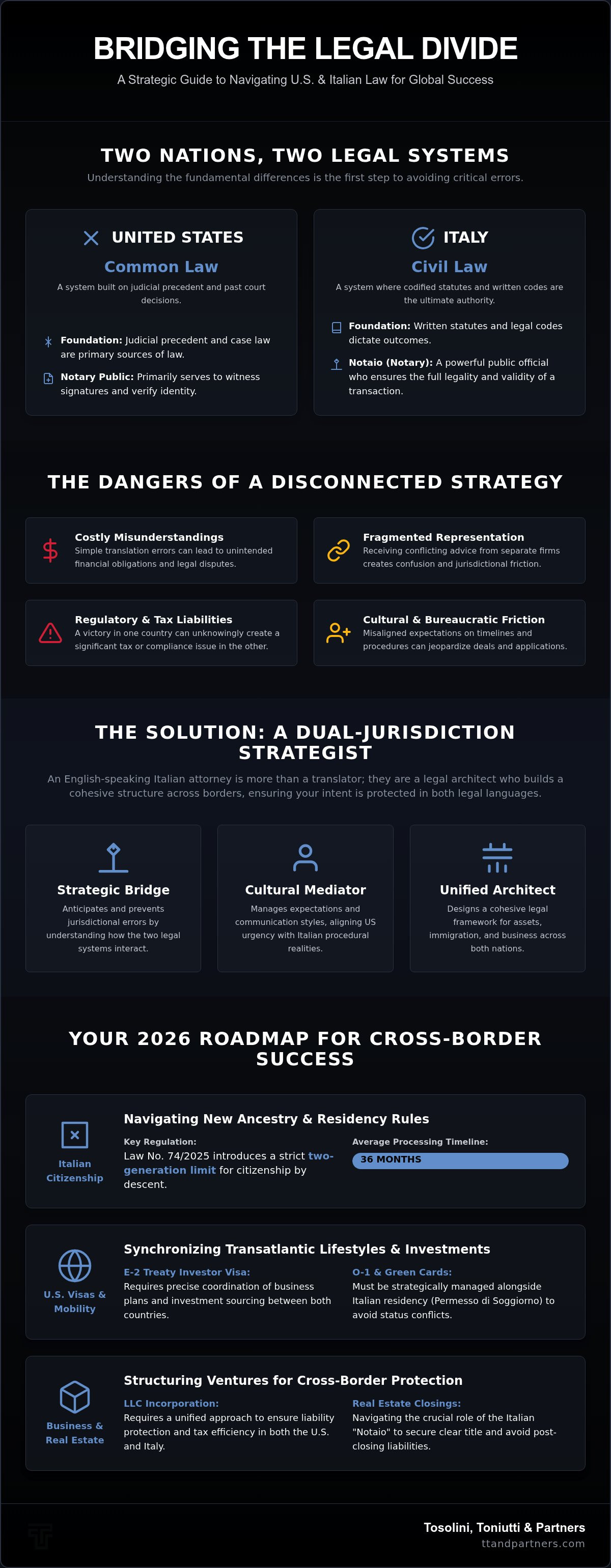
The Italian legal system is built upon a Civil Law foundation, where codified statutes dictate the outcome of every transaction. This stands in stark contrast to the US Common Law tradition, which relies heavily on judicial precedent. This divergence creates significant friction in contract interpretation. For instance, the Italian "Notaio" serves as a public official ensuring the legality of a deed, a role far more powerful and legally consequential than a US Notary Public. Without an english-speaking italian attorney to bridge this gap, a US investor might misunderstand the weight of a signed "compromesso" in a real estate closing, leading to unintended financial obligations. Precedent might guide your expectations in the US, but in Italy, the written code is the ultimate authority.
The Strategic Importance of Cultural Competency
Legal success often hinges on managing the gap of expectations. Business timelines in Italy rarely mirror the rapid-fire pace of the US corporate world. A strategic counsel acts as a cultural mediator, ensuring that your US interests remain protected while adhering to local procedural requirements that might otherwise seem opaque. This involves more than just knowing the law; it requires a deep understanding of how to communicate across varying administrative styles. Whether you're pursuing an E-2 visa or managing international litigation, having a representative who can translate "intent" and "urgency" into the local context is essential. It's about creating harmony between your global vision and the practical realities of Italian bureaucracy. Those ready to align these two worlds often find that a direct consultation is the most effective way to begin building this strategic bridge.
The 2026 landscape demands this dual-jurisdiction awareness. From navigating the 2025 citizenship decree changes to managing the complexities of LLC incorporation for cross-border ventures, the "bilingual" label is insufficient. Real protection comes from an attorney who can think in two legal languages simultaneously, ensuring that a victory in one jurisdiction doesn't create a tax or regulatory liability in the other.
Core Services: Navigating the US-Italy Legal Pillar
Managing legal interests across the Atlantic requires a synchronized approach. An english-speaking italian attorney provides the necessary oversight to ensure that immigration, real estate, and corporate structures don't exist in silos. This integrated strategy is vital when reviewing U.S. Embassy legal assistance guidelines, which often highlight the distinction between local practitioners and those with cross-border expertise. By treating your legal needs as a cohesive architecture, you avoid the friction that typically arises when hiring separate firms in different jurisdictions.
Immigration and Residency Permits
Securing a Permesso di Soggiorno for residency in Italy is often the first step for Americans seeking a lifestyle change or ancestral reconnection. However, for those looking to expand into the American market, the focus shifts toward treaty-based solutions. Strategic planning for the E-2 Visa Guide 2026 is essential for investors who wish to maintain a presence in both countries. We coordinate Green Card applications with Italian residency requirements to ensure that one status doesn't inadvertently jeopardize the other. This holistic view prevents the common pitfalls of residency abandonment or tax residency conflicts.
Cross-Border Real Estate and Corporate Setup
Acquiring property or launching a business requires a precise legal checklist. A real estate closing in Italy involves a different sequence of events than in the US, particularly regarding the role of the Notaio and the preliminary contract. Simultaneously, Italian investors entering the US market benefit from strategic LLC incorporation to shield assets and optimize their operational footprint. Mitigating FIRPTA withholding and navigating international tax exposure are critical components of this business architecture. Without this oversight, a simple property sale can trigger unexpected 15% withholdings in the US or complex reporting duties in Italy.
The 2026 landscape for Italian Citizenship is defined by significant legislative shifts. With the two-generation limit established by Law No. 74/2025, applicants must act with surgical precision. Whether you're pursuing Jure Sanguinis or citizenship by marriage, the statutory processing times of 24 to 36 months require a long-term strategic commitment. Your english-speaking italian attorney ensures that document procurement and translation meet the heightened scrutiny of Italian consulates and courts, preserving your legacy for the next generation.
If you're ready to align your international assets with these evolving standards, reaching out for professional guidance is the logical next step toward a secure cross-border future.
Choosing the Right Counsel: Local Generalist vs. Cross-Border Specialist
Selecting legal representation for transatlantic affairs is a choice between a local practitioner and a global architect. While various directories, including U.S. government legal resources in Italy, provide names of local professionals, they don't always distinguish between a generalist and a specialized english-speaking italian attorney. A local lawyer in Italy may possess deep knowledge of regional statutes but often lacks the vision to see how those decisions ripple through US tax or corporate obligations. This fragmented approach forces you to act as your own project manager. It often results in conflicting advice and structural legal errors.
The Efficiency of Integrated Legal Services
Fragmented representation is a structural risk. When you hire separate firms, document management becomes a chaotic relay race. In contrast, a single-point-of-contact firm centralizes the procurement and translation of vital records. This is essential for the 36-month processing cycles now standard for Italian citizenship applications. Unified billing and project management don't just reduce costs. They eliminate the communication errors that occur when two legal teams don't share a common strategic language. You gain a cohesive narrative for your case rather than a collection of disjointed legal opinions.
The Strategic Advantage in Litigation
The intersection of International Litigation and cross-border enforcement requires a mastery of two different procedural universes. Enforcing an Italian judgment in the United States isn't automatic. It requires a roadmap that accounts for specific recognition acts and jurisdictional nuances. A specialized english-speaking italian attorney manages evidence and discovery across these systems, ensuring that procedural differences don't undermine your case. Selecting the most favorable jurisdiction for a contract dispute can save years of litigation. It's about protecting your interests before the first gavel falls.
Choosing a firm that acts as a definitive bridge ensures that your global assets are handled with precision. The 2026 legal landscape is too complex for a trial-and-error approach. For those navigating these high-stakes complexities, a strategic consultation provides the clarity needed to move forward with confidence. You deserve a legal structure that is as durable as it is elegant.
The 2026 Roadmap for Italian Citizenship and US Visas
The legal environment for transatlantic mobility has undergone a profound transformation. Law No. 74/2025, which came into force on March 27, 2025, established a strict two-generation limit for Italian citizenship claims. This legislative shift means that applicants must now generally prove that their parent or grandparent was an Italian citizen. The era of tracing lineage back to the 19th century without limit has ended. A specialized english-speaking italian attorney is essential to evaluate these claims under the new legal scrutiny and manage the 36-month statutory processing window. ETIAS implementation in 2026 further complicates travel planning, making professional oversight a necessity for those maintaining residency in both nations.
Strategic Planning for Dual Citizenship
Success in 2026 requires a departure from the "do-it-yourself" mindset. Document procurement has become more rigorous; consulates now demand flawless records that align with the latest judicial interpretations. Securing certified translation and language support through Dialog One ensures that vital records and civil documents meet strict consular standards without procedural delay. Beyond the initial application, new citizens must manage the AIRE (Registry of Italians Residing Abroad) registration process to maintain their status and access consular services. It's also vital to consider how dual nationality affects US-based obligations. This includes potential impacts on security clearances and the necessity of compliant tax filings under international treaties. For those pursuing lineage through female ancestors, the "1948 Case" law remains a viable but complex judicial path that requires expert litigation strategy in the Italian courts.
The Future of Business Visas (E-1 and E-2)
Entrepreneurs seeking to enter the US market must align their business architecture with treaty requirements. The O-1 Visa remains the gold standard for those with extraordinary ability in science, arts, or business. For investors, understanding the projected E-2 visa investment amounts is the first step in a multi-year growth plan. Meanwhile, the E-1 Treaty Trader visa requires proving substantial and continuous trade between Italy and the US. Structuring a US entity to meet these treaty standards involves more than just filing paperwork; it requires a vision that satisfies both USCIS and Department of State scrutiny. An english-speaking italian attorney ensures your business structure is compliant with both jurisdictions from day one.
As the regulatory landscape continues to tighten, your residency and business planning must be proactive. If you're ready to secure your status under these new 2026 regulations, contact our firm to begin your strategic roadmap.
Partnering with Tosolini, Toniutti & Partners for Your Cross-Border Success
Tosolini, Toniutti & Partners operates at the intersection of legal mastery and strategic foresight. We don't just provide legal services; we design frameworks that protect your legacy across two continents. As a specialized english-speaking italian attorney firm, our role is to act as the definitive bridge for your operations. We ensure that every detail, from corporate bylaws to immigration petitions, aligns with both US and Italian standards. This commitment to professional excellence allows our clients to navigate the complexities of 2026 with absolute confidence. Our firm represents a community of strategic thinkers who believe in continuous dialogue with our clients and the environments they inhabit.
A Tailored Approach to International Law
High-net-worth individuals and corporations require more than standard legal templates. They need a bespoke architecture that accounts for the nuances of international litigation, real estate closings, and complex tax treaties. Our approach is rooted in aesthetic precision and intellectual depth. We believe that a well-designed legal strategy should be as elegant as it is durable. It's about more than just compliance; it's about creating a sustainable lifestyle and business model across borders. Clients choose us because we anticipate challenges before they arise. This might involve managing a Permesso di Soggiorno alongside a Green Card application or structuring an LLC for a new US venture. For enterprises looking to navigate the complexities of government contracts in Italy, you can visit AppaltiLab to review the digital frameworks required for public procurement. We provide a holistic vision that treats your global presence as a single, unified structure. Every word in our counsel has weight and place, much like the elements of a well-designed structure.
Beginning your journey requires a clear understanding of the current regulatory environment. To prepare for an initial case assessment, gather your vital records, corporate documents, and any existing residency permits. Our collaborative process is built on transparent communication and rigorous standards. We don't just work for you; we work with you to ensure your objectives are met with surgical precision. The 2026 landscape for Italian citizenship and business visas is demanding, but it's entirely manageable with the right partnership. We focus on the quality of results and the intellectual content behind our strategies. This ensures that every step you take is grounded in fact and professional certainty. Whether you're navigating the O-1 visa process or securing a property in the Italian countryside, our team provides the continuity between your professional past and your future goals.
Schedule a strategic consultation with our team to begin your cross-border journey today.
Navigating Your Transatlantic Legacy with Precision
The complexity of the 2026 legal landscape demands more than a local generalist. You need a partner who understands the architectural nuances of both the US and Italian systems. Our firm provides specialized expertise in E-1, E-2, and O-1 visas, alongside a proven track record in Jure Sanguinis citizenship cases. We bridge the gap between Civil Law and Common Law; this ensures your real estate closings and LLC incorporations are handled with professional excellence. By engaging an english-speaking italian attorney, you move beyond the risks of fragmented representation and secure a unified strategy for your global assets.
Whether you're navigating the new two-generation limit for citizenship or structuring a US business, the right counsel ensures your vision is realized without procedural friction. We invite you to build this bridge with us. Secure your cross-border future; contact our expert team today. Your international journey deserves a foundation built on harmony and strategic certainty.
Frequently Asked Questions
Do I need an Italian lawyer if I already have a US attorney for my visa?
Engaging a specialized firm is essential because US attorneys are generally not authorized to practice in Italy. While your US counsel manages the visa application, you need a professional to handle Italian residency permits and local compliance. A coordinated approach ensures that your US immigration status doesn't conflict with Italian tax residency rules. This unified strategy prevents the friction that often arises when two separate legal teams provide contradictory advice on cross-border matters.
What are the benefits of hiring an English-speaking attorney for Italian citizenship?
Engaging an english-speaking italian attorney provides a significant advantage during the citizenship process. It ensures that complex document procurement and the latest 2026 legislative updates, such as the two-generation limit, are interpreted with total precision. You gain a representative who can explain the nuances of Civil Law in terms that make sense within the US Common Law framework. This prevents the loss of legal intent during the translation of vital ancestral records for your application.
Can an Italian attorney help me buy property in Italy without me being there?
Yes, you can acquire property remotely by granting a specific Power of Attorney to your legal counsel. The attorney coordinates with the Italian Notaio and manages the entire real estate closing process on your behalf. This includes reviewing the preliminary contract and ensuring all local land registry requirements are met. It's a secure way to manage international investments without the logistical burden of constant travel, providing peace of mind through professional oversight.
How does an English-speaking lawyer simplify the E-2 visa process for Italians?
The E-2 visa process requires proving a substantial investment in a US enterprise. An attorney simplifies this by structuring your Italian assets and US LLC incorporation to meet strict treaty requirements. They translate your Italian business success into a compelling narrative for US consular officers. This involves coordinating financial documentation and operational plans to ensure your investment is viewed as a real, active enterprise that provides a tangible benefit to the American economy.
What is the difference between an Italian lawyer and a US-Italy cross-border attorney?
A standard Italian lawyer typically focuses on domestic codified statutes without considering international implications. Conversely, a specialized english-speaking italian attorney acts as a strategic bridge. They understand how a real estate closing in Italy might trigger FIRPTA withholdings in the US or how an Italian inheritance affects US tax filings. This dual-jurisdiction awareness is essential for high-stakes clients who require a cohesive legal architecture that protects their interests across both countries simultaneously.
Is it possible to manage an Italian legal dispute from the United States?
Managing an Italian legal dispute from the United States is entirely feasible with specialized representation. Your attorney handles all court appearances and procedural filings in Italy while providing you with strategic updates in English. This approach is vital for international litigation involving contract disputes or inheritance claims. You can protect your Italian interests and enforce judgments without leaving the US, as your counsel manages the evidence and discovery process across both jurisdictions.
How do I verify the credentials of an English-speaking Italian attorney?
You should verify that the attorney is duly admitted to the relevant Bar Associations in both Italy and the United States. Look for a firm with a documented focus on US-Italy immigration and corporate setup. True expertise is demonstrated through a mastery of both Civil Law and Common Law traditions. Review their professional track record with complex cases, such as Jure Sanguinis applications or E-2 visa petitions, to ensure their vision aligns with your specific requirements.
What should I expect to pay for cross-border legal services in 2026?
Professional fees for cross-border legal services are determined by the complexity of the architectural strategy required for your case. Whether you're pursuing an O-1 visa or managing international litigation, costs reflect the depth of expertise needed to bridge two legal systems. You should expect a fee structure that accounts for document procurement, translation, and jurisdictional coordination. Legal representation involves a customized approach that reflects the high-stakes nature of managing a global portfolio across two distinct jurisdictions.


Comments