

EU Citizen US Visa Guide: Strategic Pathways and Requirements for 2026
- Gianni Mendes Toniutti, Esq.

- Apr 15
- 13 min read
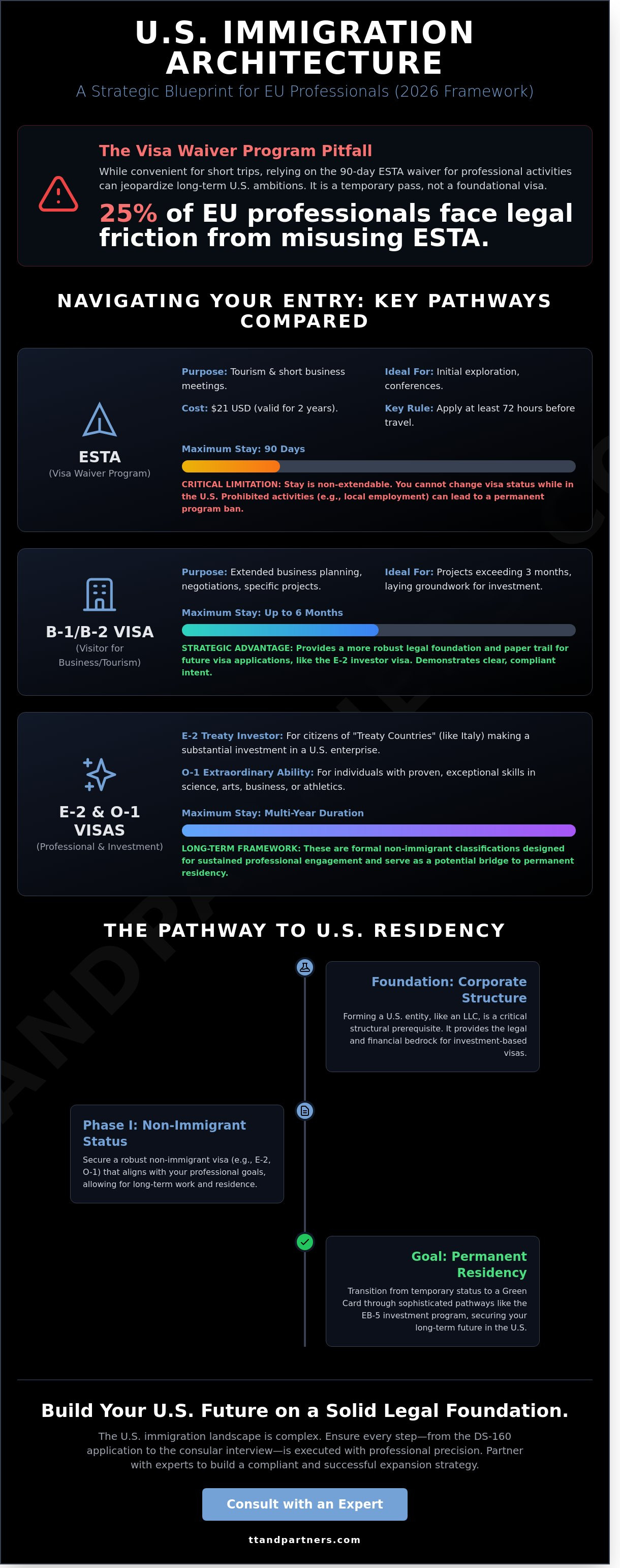
What if the convenience of a ninety-day travel waiver is the primary structural flaw in your long-term expansion strategy? While the Visa Waiver Program offers immediate access, nearly 25 percent of European professionals encounter legal friction when their business activities exceed the narrow definitions of a casual visit. Securing the correct eu citizen us visa requires more than a simple application; it demands a deep understanding of how professional intent aligns with statutory requirements. You likely feel that the transition from a visitor to a professional resident should be a logical progression, yet the complexity of federal regulations often feels like a fragmented landscape rather than a clear path.
This article serves as a comprehensive architectural blueprint for the American immigration process, designed specifically for the 2026 regulatory environment. We'll move beyond the limitations of ESTA to build a robust framework for E-2 investment and O-1 extraordinary ability pathways. By the end of this guide, you'll possess a strategic roadmap that provides the confidence to invest, relocate, and grow within the American market while maintaining absolute compliance with Department of State standards.
Key Takeaways
Define the legal architecture of the US Department of State framework, distinguishing between temporary ESTA waivers and formal visa classifications.
Identify the strategic advantages of "Treaty Country" status when applying for an eu citizen us visa to facilitate professional mobility and business entry.
Understand how the foundation of US company formation and LLC architecture serves as a structural prerequisite for long-term immigration compliance.
Navigate the rigorous application process with precision, ensuring every phase from the DS-160 to the consular interview reflects professional excellence.
Map the trajectory from temporary non-immigrant status to permanent residency through sophisticated pathways like the EB-5 investment program.
Table of Contents The Architecture of US Immigration for EU Citizens Comparison of Non-Immigrant Pathways for EU Professionals Strategic Business Expansion and LLC Architecture The Application Framework: Precision in Execution Bridging the Atlantic: Long-Term Residency and Litigation
The Architecture of US Immigration for EU Citizens
The legal framework governing how an individual enters the United States is as precise and structural as a blueprint. For those holding an Italian passport, the U.S. Department of State classifies them within a specific tier of the international mobility hierarchy. This status isn't merely a convenience; it's a strategic foundation. An eu citizen us visa strategy often begins with the Visa Waiver Program, but long-term professional objectives require a more nuanced understanding of the underlying legal "load-bearing" structures. Success in the American market depends on aligning your entry method with your ultimate career or personal vision, ensuring that the initial steps don't compromise future residency or investment goals.
The distinction between a travel authorization and a formal visa is the difference between a temporary pavilion and a permanent structure. While the former offers speed, the latter provides the stability needed for complex professional endeavors. Understanding this U.S. Visa Policy Overview is essential for any high-net-worth individual or professional looking to leverage their European status. The U.S. system prioritizes security and intent, meaning every entry must be justified by a clear, documented purpose that fits within the established federal categories.
The Visa Waiver Program (VWP) and ESTA Explained
By 2026, the technical requirements for the Electronic System for Travel Authorization (ESTA) will demand even greater digital precision. Applicants must possess a biometric passport and submit their data at least 72 hours before departure, paying a $21 fee that remains valid for two years. However, the ESTA is not a visa. It's a limited authorization for stays of 90 days or less. This 90-day ceiling is absolute. You cannot extend your stay, nor can you adjust your status to a different visa category while on U.S. soil. For an eu citizen us visa applicant, using an ESTA for prohibited activities like full-time study or local employment can lead to a permanent bar from the program. It's designed for tourism and short-term business meetings, not for establishing a professional practice.
Moving Beyond the Waiver: When a Visa Becomes Necessary
Strategic growth often requires more than a 90-day window. If your project timeline exceeds three months, you must transition to a formal B-1 or B-2 visa. These classifications allow for exploratory stays of up to six months and provide a more robust paper trail for those considering future E-2 investor status. Relying too heavily on back-to-back ESTA entries creates "trigger points" for Customs and Border Protection. If an officer suspects you're living in the U.S. without the proper eu citizen us visa, they can revoke your travel eligibility on the spot. Maintaining travel integrity requires a proactive approach to visa selection. If you're planning a complex transition from the EU to the US, reach out to us at https://www.ttandpartners.com/contact to discuss how to structure your professional presence abroad.
Comparison of Non-Immigrant Pathways for EU Professionals
The structural framework of US immigration offers distinct corridors for European talent. Choosing the right path requires a deep understanding of how bilateral agreements shape professional mobility. For those holding an Italian passport, the "Treaty Country" designation acts as a foundation for long-term strategic placement. These pathways aren't merely administrative hurdles; they're essential components of a global career design. The eu citizen us visa landscape is built on a history of reciprocity that dates back to the Treaty of Commerce and Navigation signed between Italy and the US in 1871.
While the ESTA program facilitates short-term entry for many, professionals often require more robust solutions for their operations. For temporary site visits or initial project consultations, the Official Visitor Visa Information provides the baseline requirements for B-1 status. However, for those seeking to lead enterprises or manage complex entities, the eu citizen us visa process shifts toward more specialized, non-immigrant categories like the E and O series.
The E-1 and E-2 Treaty Visas: A European Advantage
Italy's economic ties with the United States facilitate the E-1 Treaty Trader and E-2 Treaty Investor visas. These options allow for a modular approach to residency. The E-2 visa demands a "substantial" investment in a real, operating enterprise. By 2026, practitioners expect the "substantiality" requirement to lean more heavily on the job-creation potential within the local urban fabric rather than just the capital amount. Successful applications typically demonstrate that the business isn't marginal. It must support more than just the investor's family. You can explore the mechanics of trade-based entry in our E-1 Treaty Trader Visa: The 2026 Strategic Guide.
O-1 Visas for Extraordinary Ability
The O-1 visa serves as a high-distinction pathway for EU professionals who have reached the pinnacle of their fields. This isn't a lottery-based system; it's a meritocracy. For architects, scientists, and entrepreneurs, the portfolio must satisfy at least three out of eight specific USCIS criteria. This might include evidence of high remuneration, original contributions of major significance, or memberships in associations that require outstanding achievements. Building this portfolio is akin to drafting a complex blueprint. Every piece of evidence must reinforce the narrative of "extraordinary ability." Detailed technical requirements are available in the O-1 Visa: The Complete 2026 Guide.
Maintaining "dual intent" remains a critical consideration for the modern professional. While E and O visas are non-immigrant in nature, they allow individuals to sustain their practice while building the evidence needed for a transition to permanent residency. This evolution requires a visionary approach to one's legal status. If you're ready to design your professional future in the US, reach out to our team for a strategic consultation on your mobility options.
Strategic Business Expansion and LLC Architecture
Establishing a commercial presence in the United States requires a foundation as precise as a structural blueprint. For an Italian national, the corporate entity acts as more than a vehicle for profit; it serves as the essential framework for a successful eu citizen us visa application. The choice of legal structure dictates the trajectory of both tax liability and immigration eligibility. Most investors find that a carefully designed Limited Liability Company (LLC) or C-Corporation provides the necessary "substantiality" required by US Citizenship and Immigration Services (USCIS). Choosing the right jurisdiction is the first critical decision. Delaware remains the primary choice for 65% of Fortune 500 companies due to its advanced Chancery Court, while Wyoming attracts smaller firms seeking lower annual fees and enhanced privacy. Effective governance avoids the pitfalls of "piercing the corporate veil," a risk that 15% of small international subsidiaries face when they fail to maintain strict separation between personal and corporate assets.
Incorporating for Immigration Success
The LLC is the preferred instrument for many Italian investors because of its "pass-through" taxation and operational flexibility. To satisfy the E-2 Treaty Investor requirements, the US entity must maintain at least 50% ownership by Italian nationals. This ownership structure must be documented through clear capitalization tables and operating agreements. Entrepreneurs should view this process as a form of business architecture where every clause supports the overall stability of the venture. For a deeper analysis of these structures, consult our LLC Incorporation: A Strategic Guide to US Business Architecture. This guide explores how to align your 2026 growth objectives with current regulatory standards.
Employment and Sponsorship Frameworks
Once the corporate shell is active, it must function as a legitimate employer to facilitate talent mobility. The L-1 intra-company transfer visa allows an Italian firm to move executives or managers to a US office, provided the employee worked for the foreign parent company for at least one continuous year within the preceding three years. Compliance is non-negotiable. Under the Corporate Transparency Act of 2024, US entities must report beneficial ownership information to FinCEN, adding a layer of transparency to international operations. Proper payroll integration is also vital. Firms must manage FICA taxes and I-9 employment eligibility verification to maintain their standing as a sponsor. These mechanics ensure that the eu citizen us visa process remains robust, allowing professionals to focus on innovation rather than administrative friction. For personalized guidance on structuring your US headquarters, you can reach out through our contact page.
The Application Framework: Precision in Execution
Securing an eu citizen us visa involves a multi-phased execution strategy that mirrors the rigor of an architectural master plan. The process begins with the DS-160, a digital foundation that requires absolute consistency across all entries. This document isn't just a form; it's the primary blueprint the consular officer reviews before you even enter the embassy. At consular posts across the European Union, the interview serves as the final structural inspection. You must articulate your professional credentials and investment goals with technical accuracy, ensuring your narrative aligns perfectly with the submitted evidence.
Documenting the source of funds is the most critical load-bearing element of the application. Consular officers now demand an exhaustive paper trail that tracks capital from its origin to the US escrow account. According to 2023 Department of State data, E-2 visa issuances for EU nationals remained robust, yet the complexity of financial audits has increased. Projections for 2026 indicate that administrative processing will become more digitized, potentially shortening initial review periods while increasing the depth of background verification. Strategic planning must account for these 2026 timelines to avoid delays in business deployment.
Consular Processing vs. Change of Status
EU citizens typically find greater long-term stability through consular processing in their home country. While a Change of Status within the US offers a temporary solution, it doesn't provide a travel signature, often trapping the applicant domestically. Many consular posts across the EU offer specialized E-visa units that understand the European corporate context. By 2026, experts anticipate a 10% shift toward consular processing as applicants seek the flexibility of international travel. This path ensures your visa remains valid for multiple entries, supporting a global professional lifestyle.
Common Obstacles and Strategic Mitigations
The "intent to immigrate" remains a frequent point of friction for non-immigrant visa categories. You must demonstrate strong ties to your home country through property ownership, family connections, or ongoing business interests. If the government issues a Request for Evidence (RFE), the response must be surgical. A robust RFE rebuttal uses concrete data to fill any perceived gaps in the investment's "marginality" or "substantiality." Legal counsel acts as the lead architect here, harmonizing your personal objectives with the strict requirements of US immigration law.
Success in this process requires a partner who understands the complexity of international transitions. Contact Tosolini, Toniutti & Partners to refine your application strategy.
Bridging the Atlantic: Long-Term Residency and Litigation
The transition from a temporary eu citizen us visa to permanent residency requires more than administrative filing; it demands a comprehensive architectural plan for one's legal standing. While initial entry often relies on non-immigrant categories like the E-2 or O-1, these are temporary structures. To build a lasting presence, investors and professionals must look toward the Green Card. The EB-5 immigrant investor pathway remains the most robust foundation for high-net-worth Italian citizens. Under the EB-5 Reform and Integrity Act of 2022, the minimum investment stands at $800,000 for Targeted Employment Areas and $1,050,000 for other projects. This pathway doesn't just grant residency; it provides a direct route to US citizenship after five years of holding a Green Card.
Strategic planning ensures that the transition between statuses occurs without a "gap." A status gap can freeze an individual's ability to work or travel, creating unnecessary friction in a cross-border life. We view these legal transitions as structural phases in a larger project. Every move is calculated to maintain the integrity of the client's international profile, ensuring that the benefits of Italian citizenship harmonize with US residency requirements.
The Path to Permanent Residency
Timing determines the success of a residency application. For those currently holding an eu citizen us visa, concurrent filing of the I-526E and I-485 forms allows for immediate adjustment of status if the applicant is already in the US. This tactical move provides work and travel authorization while the green card is pending. For a detailed breakdown of the fiscal requirements, see our guide on How Much Is a Green Card? The 2026 Cost and Strategy Guide. It's also vital to consider the US-Italy Double Taxation Treaty of 1999. US residency triggers worldwide tax obligations, so we align our legal strategy with tax efficiency to prevent the erosion of global assets.
Protecting the Vision: Cross-Border Legal Support
Maintaining interests across two continents inevitably leads to complex legal intersections. Whether it's a real estate dispute in Milan or a contract disagreement in New York, the jurisdictional challenges are significant. We apply the same precision to litigation that we do to architectural design, ensuring that every defense is structurally sound. Navigating these waters requires familiarity with the Hague Convention of 1965 regarding the service of documents and the nuances of international arbitration. For those facing these complexities, our International Litigation 2026: Strategic Guide offers a deeper look into protecting your transatlantic interests.
Tosolini, Toniutti & Partners functions as a strategic bridge. We don't just solve isolated legal problems; we design the entire framework for your US-Italy journey. From the first visa application to the finalization of a permanent residency status, we ensure every detail serves the broader vision of your life and business. If you're ready to solidify your transatlantic presence, we invite you to contact Tosolini, Toniutti & Partners for a strategic consultation. Let's build your future on a foundation of professional excellence and vision.
Architecting Your Transatlantic Future
Navigating the complexities of a 2026 expansion requires the same structural integrity as a landmark building. Securing an eu citizen us visa depends on aligning your professional credentials with specific regulatory frameworks like the E-1 or O-1 categories. Data from the 2023 U.S. State Department Report indicates that E-category visas remain a primary vehicle for European investment, provided the business architecture meets strict reciprocity standards. Success isn't found in generic filings. It's found in the meticulous design of your corporate entity and the litigation-ready preparation of your evidence. Every document serves as a load-bearing element in your application framework.
TT and Partners brings decades of expertise in US-Italy immigration law to every case. We provide a specialized focus on E-1, E-2, and O-1 visa architecture, offering comprehensive support for business expansion and litigation. Our approach treats legal strategy as a holistic design process where functionality meets long-term sustainability. Secure your US-Italy cross-border legal strategy with TT and Partners. Your vision deserves a foundation that's as ambitious as the goals you've set for the American market. We're ready to build that bridge with you.
Frequently Asked Questions
Do EU citizens need a visa to visit the United States for 90 days or less?
EU citizens don't need a traditional visa for stays under 90 days; they utilize the Electronic System for Travel Authorization (ESTA). This program currently encompasses 41 participating countries and facilitates rapid entry for tourism or business purposes. It's a precise digital framework that replaces the standard eu citizen us visa for short-term visits. You'll need to complete the online application at least 72 hours before your flight to ensure valid entry.
Can an EU citizen work in the US on an ESTA?
You can't legally work in the United States while visiting under the Visa Waiver Program. This authorization limits your activities to leisure, attending conferences, or conducting brief business meetings. Engaging in any form of paid employment violates Section 212 of the Immigration and Nationality Act. Such breaches carry heavy penalties, including a 10-year ban from entering the country, which destroys any future professional mobility in the US market.
What is the most common US visa for EU entrepreneurs?
The E-2 Treaty Investor visa is the primary choice for EU entrepreneurs looking to build a business in America. This classification allows individuals from treaty countries to reside in the US based on a substantial capital investment. In fiscal year 2023, the Department of State issued thousands of these visas to European innovators. It provides a stable foundation for long-term commercial growth and allows for multiple renewals if the business remains viable.
How long does it take for an EU citizen to get a US visa in 2026?
Obtaining an eu citizen us visa in 2026 will likely take between 120 and 180 days for most professional categories. While the Department of State continues to modernize its digital infrastructure, administrative review times remain a critical factor in the planning schedule. You should consult the specific wait time data for the consulate in your jurisdiction, such as Rome or Paris. This proactive approach ensures your relocation timeline aligns with the current operational capacity.
Can I change my status from an ESTA to a work visa while in the US?
You cannot adjust your status from an ESTA to a work visa while remaining in the United States. The Visa Waiver Program's structure requires participants to depart within 90 days without exception. To secure a work permit, you'll need to return to your home country and attend an interview at a US embassy. This protocol ensures the integrity of the visa system's regulatory framework and prevents the circumvention of standard immigration channels.
Which EU countries have E-2 visa treaties with the United States?
Most EU nations, including Italy, Germany, and France, maintain E-2 treaty agreements with the United States. Currently, 25 out of 27 member states participate in this program, which allows for reciprocal investment and residency. Italy’s treaty has been in place since 1871, providing a historic foundation for modern entrepreneurs. Only Cyprus and Greece are currently excluded from this specific list, though Greek citizens may soon gain access through new diplomatic accords signed in 2024.
What happens if my US visa application is denied as an EU citizen?
If your application is denied, the consular officer will provide a written explanation citing the legal grounds for refusal, such as Section 214(b). A rejection permanently revokes your ability to use the ESTA system for future travel. You'll need to submit a new application with additional evidence to overcome the previous grounds for denial. This process requires a meticulous reconstruction of your application to prove your eligibility and intent to comply with US law.
Is it possible for an EU citizen to get a Green Card through investment?
EU citizens can obtain a Green Card through the EB-5 Immigrant Investor Program by funding a qualifying commercial enterprise. Under the 2022 Reform and Integrity Act, the minimum investment is $800,000 in Targeted Employment Areas. This path leads to permanent residency if the project creates 10 permanent jobs for American workers. It's a complex but rewarding structural path to US citizenship that requires significant financial transparency and long-term commitment to the US economy.


Comments