

Finding Italian Vital Records for Citizenship: The 2026 Strategic Guide
- Gianni Mendes Toniutti, Esq.

- Jun 30
- 12 min read
Your claim to an Italian legacy is no longer a matter of distant family stories; it's a rigorous legal exercise in establishing an unbroken chain of evidence. With the enactment of recent legislative changes in 2025, the window for citizenship by descent has narrowed to those with a parent or grandparent born in Italy, making the task of finding Italian vital records for citizenship a critical and time-sensitive mission. You likely understand the gravity of this search, yet feel paralyzed by the prospect of communicating with local municipalities or the fear that a minor spelling variation on a century-old birth record will lead to an immediate rejection.
We've designed this strategic guide to transform that uncertainty into a structured roadmap for document retrieval. You'll master the nuances of the civil registry, gaining the clarity needed to distinguish between a simple certificate and the legally essential summary extract. By the end of this analysis, you'll possess the technical confidence to build a portfolio that satisfies high consular standards and stands up to the scrutiny of the new centralized office in Rome.
Table of Contents
The Foundation of the Right of Blood: Why Vital Records Matter in 2026
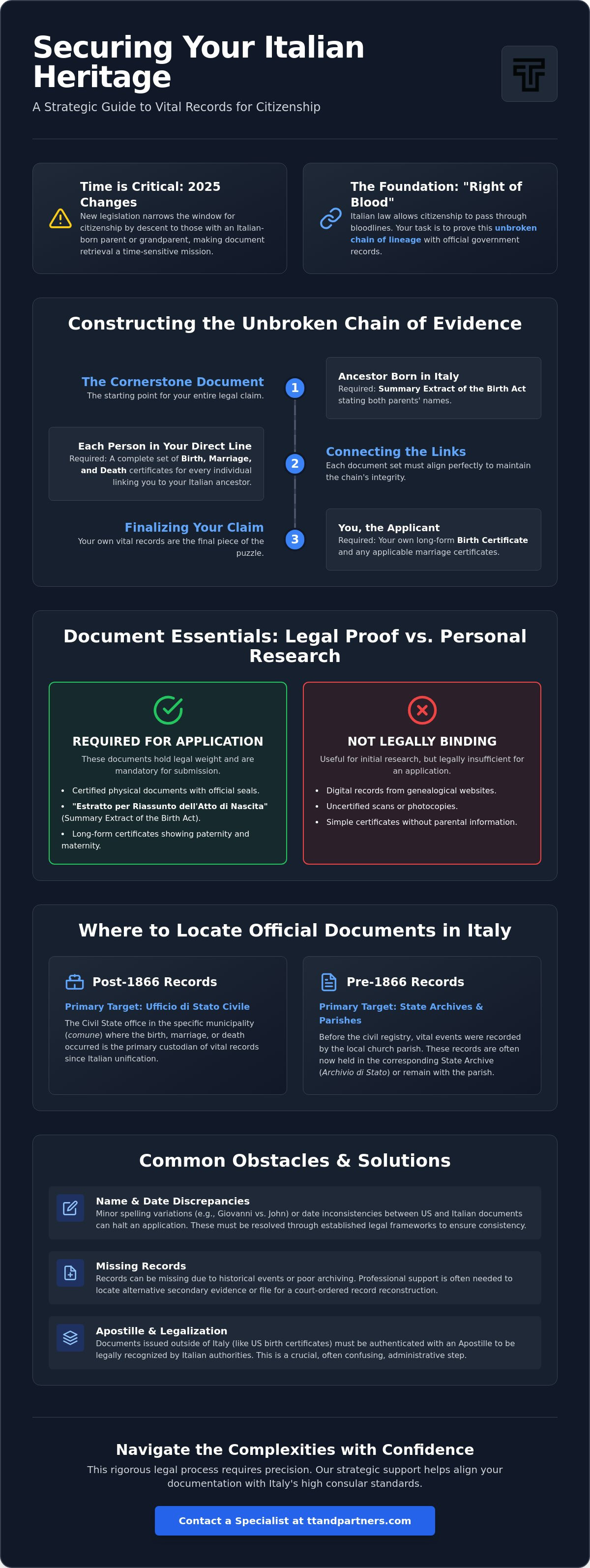
The pursuit of citizenship is an architectural project of legal evidence. At its core, the process relies on Civil Status Acts, which serve as the definitive proof of your lineage. Finding Italian vital records for citizenship isn't merely about tracing a family tree; it's about constructing an airtight legal argument. Under Italian nationality law, the principle of the right of blood allows citizenship to pass through bloodlines, provided the unbroken chain remains intact. This means you must prove that your ancestor never renounced their citizenship before the birth of the next person in your line. Every document acts as a structural pillar in this evidentiary bridge.
Digital records found on genealogical platforms offer a starting point, but they hold no legal weight in a consulate. These platforms provide scans for personal interest, whereas an official application requires certified physical documents issued by the government. The distinction is critical. One is a historical curiosity; the other is a legal instrument. Without the physical seal of the issuing municipality, your digital findings are simply stories rather than proof.
The Legal Weight of a Birth Certificate
The birth certificate of your last ancestor born in Italy is the foundation of your entire application. Consulates demand specific long-form versions that clearly state the names of both parents, referred to as paternity and maternity. Without these details, the legal link between generations remains unverified. The Summary Extract of the Birth Act is the gold standard for citizenship applications because it includes all necessary marginal notations regarding marriage or naturalization. It's the only document that provides a holistic view of your ancestor's legal status in the eyes of the state.
The Document Chain: Birth, Marriage, and Death
Constructing a successful portfolio requires more than just a single birth record. You must present a complete sequence of birth, marriage, and death certificates for every individual in your direct line. Death records are particularly vital; they often serve as secondary evidence to confirm that an ancestor hadn't naturalized before a specific date. A common pitfall occurs when an ancestor married in the United States while their birth record remains in their home country. Discrepancies in dates or name spellings between these two jurisdictions can stall an application for years. Precision in finding Italian vital records for citizenship ensures that these documents speak to each other with legal consistency. If you encounter complexities with missing records or conflicting data, reaching out for professional guidance at ttandpartners.com/contact can help clarify the path forward.
Navigating the Civil Registry: Where to Locate Documents
Locating the exact geographical origin of your ancestor is the first step toward finding Italian vital records for citizenship. In Italy, the municipality serves as the primary custodian of these legal instruments. Since the national unification in 1866, the Civil State office has recorded every birth, marriage, and death within its specific borders. It's essential to distinguish this office from the Residency Registry. While the Residency Registry tracks where people live, the Civil State office documents the legal events of their lives. For a citizenship portfolio, the Civil State office is your primary target.
If your ancestor was born before the civil registry was established in 1866, the search shifts to the State Archive or local ecclesiastical records. During this era, Registering vital records was often a function of the parish rather than the state. Identifying the correct municipality can be complex; many towns merged or changed names over the last century. A thorough review of historical maps and administrative decrees is often required to pinpoint which modern office holds the archives of a now-defunct village. If the search becomes overly technical, you can consult with a specialist to verify the current jurisdiction of your ancestral records.
The Structure of Municipal Archives
Records in small towns are physically organized by year and volume. This manual system means that retrieval is a human process, not an automated one. In southern regions, researchers occasionally face lost records due to historical fires, seismic events, or the ravages of war. When these civil records are missing, parish records become the secondary legal evidence. These documents must be authenticated by the local Diocese to meet the rigorous standards of the consulate.
Modern Digital Portals: National Digital Registry and Beyond
In 2026, the National Digital Registry has centralized much of the administrative data. However, accessibility remains a significant hurdle for those outside the European Union. Most digital portals require a specific Digital Identity, which is difficult for non-residents to obtain. Even when digital records exist, consulates still demand physical, certified copies with wet-ink signatures or specific digital stamps. The reality of finding Italian vital records for citizenship in 2026 is a hybrid one: while data is increasingly centralized, the legal requirement for a tangible extract remains the standard for success.
Overcoming Obstacles: Name Discrepancies and Missing Records
The transition from an Italian village to an American city often resulted in the administrative evolution of family names. Finding Italian vital records for citizenship frequently reveals that an ancestor’s original identity was quite different from the one used on their US naturalization or death records. While consulates expect minor anglicization, such as "Giovanni" becoming "John," fundamental changes to surnames or birth dates can create a legal impasse. This is where the concept of "One and the Same" (Ogyam) becomes a vital tool. It acts as a formal recognition of identity continuity across different jurisdictions; however, if the discrepancy is too vast, an administrative correction is rarely sufficient.
When a search in a specific municipality yields no results, you must request a "Certificato di Risultato Negativo." This document isn't a failure but a formal statement from the Comune that they've searched their archives without success. If you lack a specific birth date or village, you must pivot to secondary records like ship manifests or US census data to narrow the geographical focus. These obstacles require a methodical approach to ensure the "unbroken chain" of citizenship remains verifiable in the eyes of the Italian state.
Correcting the Record: Legal Amendments
Reconciling your family’s history often requires amending US vital records to align with the Italian original. This process might involve "Declaratory Judgments," which are court orders that legally establish an individual’s true identity. Consistency across the entire document chain is the primary focus of Consular officers. By securing these amendments early, you prevent the risk of a rejection based on identity confusion. If you find yourself struggling to align these disparate records, you can seek professional legal review to determine which discrepancies require judicial intervention.
The "Non-Existence" Certificate
If a record is truly missing due to historical loss, the "Certificato di Non-Esistenza" becomes a critical piece of evidence. In these instances, you must supplement your file with secondary Italian proof, such as the "Liste di Leva" (military service records). These military archives often contain the birth details and parentage needed to bridge the gap left by a destroyed birth act. These missing records often trigger the need for a 1948 Case strategy, particularly when the lineage involves a female ancestor whose records were not properly maintained or who was affected by previous discriminatory laws. Finding Italian vital records for citizenship in these complex scenarios requires looking beyond the standard municipal registry to the broader state archives.
The Formal Request Process: From Request to Apostille
Executing a formal request to a municipality is a refined administrative art. It requires more than a simple inquiry; it demands a structured petition drafted in the appropriate technical language, citing specific legislative codes that mandate the issuance of these documents. Finding Italian vital records for citizenship involves overcoming logistical hurdles that digital platforms cannot solve. You must account for international postage, the procurement of specific revenue stamps, and the inclusion of international reply coupons to ensure the return of your documents. Many applicants don't account for these tactile details, only to find their requests ignored or returned due to insufficient postage.
Communicating with the Civil Registry
In 2026, the standard for professional communication with a local registry is the certified email system. This digital infrastructure provides legal certainty of delivery, which is indispensable when dealing with administrative delays. Without this specific type of account, your message from a standard provider might be filtered into junk folders or simply disregarded. When faced with administrative silence, where a municipality remains unresponsive for months, a physical visit to the archive is often the only resolution. Having a representative on the ground in Italy can bypass these delays by engaging directly with the officials in charge of the historical records.
Legalization and Translation Requirements
The legal validation of your document portfolio follows an asymmetric logic. While the records you retrieve from Italy do not require a legalization certificate for use at an Italian Consulate, every record from the United States in your chain must be legalized under the Hague Convention. This ensures the documents are recognized as authentic by the foreign government. Once legalized, these acts require certified translations that meet the compliance standards set by the Ministry of Foreign Affairs.
As of 2026, while European vital records generally do not expire for citizenship purposes, many local jurisdictions and specific consulates enforce a six month validity window for non-European records. Managing this timeline is essential to prevent a costly restart of your application process, particularly given the higher filing fees introduced in 2025. If the logistical complexity of coordinating between international municipalities and domestic state offices feels overwhelming, you can contact our legal team to manage the entire retrieval and legalization process on your behalf. This ensures your portfolio is technically perfect before it reaches the centralized processing office in Rome.
Strategic Legal Support: How Professionals Facilitate Your Journey
Finding Italian vital records for citizenship is a foundational step; however, the transition from archival research to formal legal representation is where a successful outcome is secured. For many, the process moves beyond mere document collection into the sophisticated sphere of Italian Citizenship law. This requires a deep understanding of how diverse jurisdictions interact over decades of family history. Tosolini, Toniutti & Partners serves as a strategic bridge, ensuring that the evidence gathered from a remote Italian village aligns perfectly with amended records from a US state archive. We don't just find documents. We curate a legal portfolio that maintains its integrity under the scrutiny of the centralized processing office in Rome.
Our firm acts as the guardian of your application's legal standing. We provide a level of oversight that genealogical services cannot offer, particularly when family lineages involve complex naturalization timelines or historical name changes. By positioning your file as a defensible legal argument rather than a simple collection of papers, we minimize the risk of administrative delays or outright rejections.
Beyond Retrieval: Building a Defensible File
A lawyer’s review of your naturalization records is a critical checkpoint before you submit your file to a consulate. It's common for ancestors to have naturalized under names or dates that differ from their original birth acts. These discrepancies can break the chain of citizenship if they aren't addressed through formal legal channels. Our team coordinates between US and Italian jurisdictions to resolve these complex lineage breaks, ensuring that every document in your chain is legally consistent. You can learn more about our Immigration Law services to see how we manage these technicalities for our clients.
Navigating the 1948 Case
Lineages involving female ancestors born before 1948 present a unique legal challenge that requires a judicial solution. These cases cannot be processed through a consulate; instead, they require International Litigation within the Italian court system. Finding Italian vital records for citizenship in these instances is only the beginning of a judicial journey. You'll need a power of attorney and expert legal filings to argue your case before an Italian judge. Our firm specializes in these high-stakes proceedings, acting as your advocate in the regional courts. We recommend that you schedule a consultation to evaluate the specific nuances of your lineage and determine the most effective path forward.
Securing Your Legacy in a Centralized Era
The evolution of Italian citizenship law in 2026 demands a shift from amateur genealogy to professional legal strategy. Securing your future as a dual citizen depends on the technical accuracy of your document chain; specifically, the transition from finding Italian vital records for citizenship to presenting a legally sound portfolio to the centralized authorities in Rome. You've seen how name discrepancies and jurisdictional gaps can stall even the most earnest applications. Success now requires a bridge between the administrative archives of Italy and the judicial systems of the United States.
Our firm provides the dual jurisdiction expertise necessary to navigate these complexities. With deep roots in New York and Italy, we specialize in resolving the intricate lineage breaks found in 1948 cases and standard jure sanguinis applications. We don't just facilitate document retrieval; we protect the legal integrity of your family's history. Secure your Italian heritage—contact our cross-border legal experts today. Your journey toward a European future is a significant undertaking, and we're here to ensure your evidentiary path is clear and authoritative.
Frequently Asked Questions
Can I find Italian birth records online for free?
Official records are rarely available for free online in a format accepted by authorities. While platforms like Antenati offer digital scans for genealogical research, these lack the necessary certifications for legal use. Finding Italian vital records for citizenship requires a formal request to the municipality's Civil State office to obtain a certified paper copy with a wet-ink signature or a specific digital seal. These official documents are the only ones recognized by consulates.
What is the difference between a Certificato and an Estratto?
A Certificato is a basic document confirming a life event, but an Estratto per Riassunto is a detailed extract containing critical marginal notations. These notations record subsequent events like marriages or naturalization, which are essential for proving the continuity of a bloodline. Consulates almost always require the Estratto version because it provides a comprehensive legal history of the individual rather than just a simple confirmation of birth or marriage.
How do I find out which Comune my ancestor was born in?
Consulting secondary records in the country of migration is the most effective strategy. Ship manifests, naturalization petitions, and military draft cards often list the specific town of origin rather than just the country. If these sources are inconclusive, you should examine church marriage records or historical census data in the US. These documents frequently provide the geographical precision needed to target the correct municipal archive in Italy.
Do I need an Apostille for records issued in Italy?
Italian records issued by a municipality for use at an Italian Consulate don't require an Apostille. This international legalization is specifically for foreign documents, such as those issued in the United States, to be recognized as authentic by the Italian government. Your Italian birth, marriage, and death extracts are legally valid within the consular system exactly as they're issued by the local Registrar of Civil Status.
How long does it take to get a vital record from Italy in 2026?
Processing times currently range from a few weeks to several months depending on the municipality's administrative capacity. Smaller towns with manual archives often face longer delays than those integrated into the national digital registry. In 2026, backlogs remain a reality in many regions. It's prudent to account for a retrieval window of 60 to 90 days when finding Italian vital records for citizenship to avoid delays in your application.
What if my ancestor’s birth record was destroyed in a war?
You must obtain a formal Certificato di Non-Esistenza from the municipality to document the loss of the original act. Once this certificate is secured, you can substitute the birth record with secondary evidence such as military service records or authenticated baptismal records. These alternatives must be validated by the appropriate authorities to ensure they carry the weight necessary to bridge the gap in your document chain.
Can I apply for Italian citizenship if I only have a baptismal record?
A baptismal record is acceptable if the birth occurred before the civil registry was established in that region, typically before 1866. In these instances, the parish record serves as the primary legal proof of birth. You must ensure the document is authenticated by the local Diocese. This step is vital to meet the administrative standards required by the consulate or the Italian judicial system in 1948 cases.
Does the Italian Consulate return the original vital records I submit?
The Italian Consulate doesn't return any original documents once they're submitted as part of a citizenship application. These records become part of a permanent file and are eventually sent to the town of origin in Italy for official registration. You should order multiple certified copies if you want to keep a set for your family archives. Once you hand them over to the consular officer, they're gone for good.


Comments