

FIRPTA Guide for Foreign Sellers in U.S. Real Estate

The amount withheld at closing may look like your tax bill, but it isn’t necessarily what you ultimately owe. FIRPTA withholding for foreign sellers is a collection process tied to a property transfer. Whether it applies can depend on the seller’s tax status, the property, its intended use, and the sale terms. Reviewing those details early helps clarify how much may be held back and what needs attention before closing.
It’s reasonable to want clear answers before signing. The buyer generally handles required withholding, while the amount withheld is typically a prepayment rather than the seller’s final tax liability. Understanding that distinction helps set expectations and avoid surprises in the closing proceeds.
This guide explains when withholding may apply, how it differs from the final tax calculation, and what to prepare in advance. It also covers forms, withholding certificates, timing, and transaction details worth reviewing early. Legal support for a cross-border real estate closing can help organize the documents and responsibilities, while tax-specific questions remain part of the tax analysis.
Table of Contents
FIRPTA Withholding at U.S. Property Closings
A U.S. property sale may involve withholding from the proceeds before the seller receives the balance. For a foreign seller, the key question is whether the transfer falls within FIRPTA, not simply whether the seller lives outside the United States. Clarifying who owns the property and what the withheld funds represent helps separate closing logistics from the later calculation of tax owed.
FIRPTA is a federal tax withholding regime that may require withholding when a foreign person disposes of a U.S. real property interest. The buyer may act as the withholding agent, while closing professionals coordinate transaction documents and funds. The IRS receives the required reporting and payment. The seller’s circumstances and the transaction details inform how the rules apply. For background on the law’s purpose and history, see this overview of FIRPTA.
The parties have different roles. The seller is the person or entity transferring the property interest. The buyer may have withholding and reporting responsibilities under applicable rules. Closing professionals help coordinate documents and funds, but their involvement does not determine the seller’s tax status or final liability. The IRS administers the federal reporting and payment process.
Who may be treated as a foreign seller under FIRPTA?
Classification depends on applicable U.S. tax rules, not simply citizenship, residence, or mailing address. An individual and an entity may be analyzed differently, and ownership through an entity can add relevant facts. Review who legally owns the property, the owner’s residency history, and the entity’s structure. Don’t assume the answer from a passport or address alone. The specific ownership and transaction facts matter.
What does FIRPTA withholding mean for sale proceeds?
Withholding is collected in connection with the transfer and remitted under applicable rules. It can reduce the proceeds the seller receives at closing, but that reduction is not automatically the seller’s final U.S. income-tax bill. Withholding and the eventual tax calculation are separate steps.
The seller’s final liability depends on the tax situation and details of the sale. The amount withheld is addressed through the relevant tax reporting process and may be taken into account when determining what is ultimately due. Don’t treat the closing statement as a final tax assessment. Reviewing the expected withholding and the documents recording it before closing clarifies the immediate effect on proceeds and supports later tax follow-up. This distinction is central to understanding FIRPTA withholding for foreign sellers.
How FIRPTA Withholding Works: Buyer Responsibilities, Forms, and Timing
Start FIRPTA planning before the closing statement is finalized. The buyer may be the withholding agent responsible for determining, reporting, and paying required withholding, even though the seller’s status and transaction details shape the analysis. The IRS’s FIRPTA withholding guidance explains the federal framework. Follow current instructions for the transaction rather than relying on a form or estimate from an earlier sale.
At closing, the seller provides relevant ownership and tax information, the buyer or withholding agent handles required withholding and reporting, and closing professionals coordinate transaction documents and funds. The IRS receives the required forms and payment.
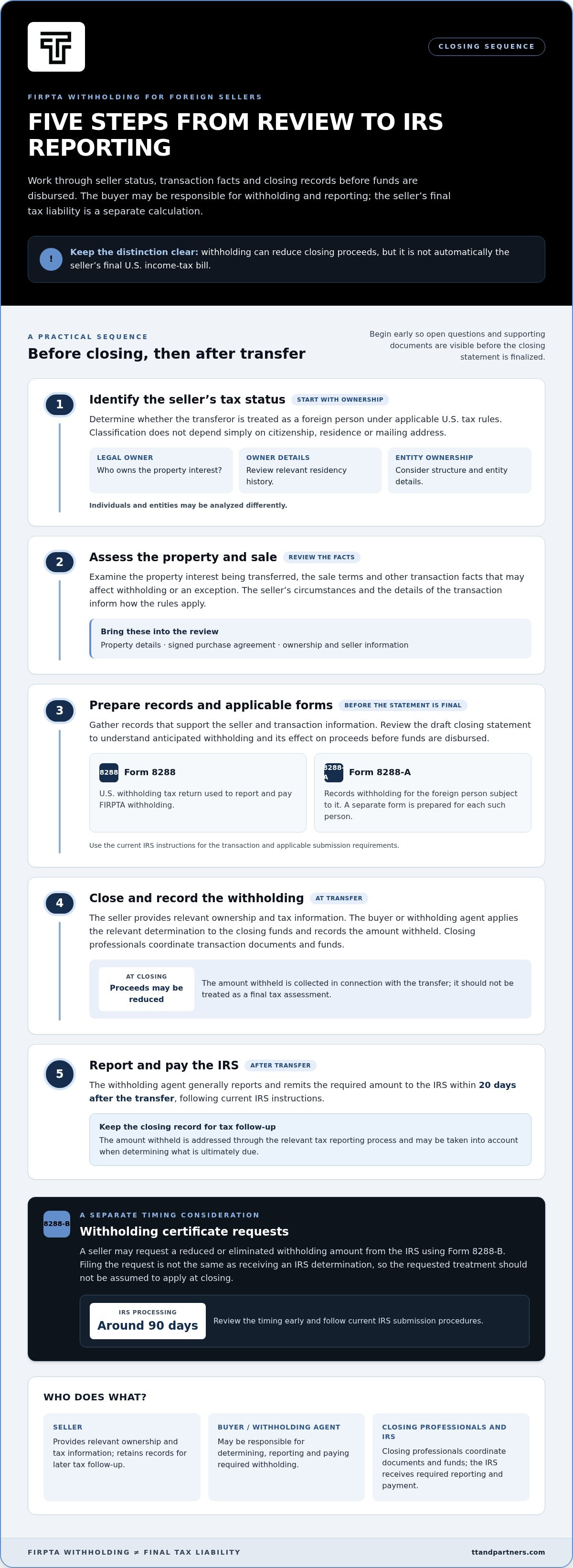
A practical sequence for FIRPTA withholding for foreign sellers is:
1. Identify seller status. Determine whether the transferor is treated as a foreign person under applicable tax rules, including any relevant ownership and entity details.
2. Assess the transaction. Review the property interest, sale terms, and other facts that may affect withholding or an exception.
3. Prepare documents. Gather records supporting the seller and transaction information, then identify the applicable IRS forms.
4. Close and withhold. Apply the relevant determination to the closing funds and record the amount withheld.
5. Report and pay. The withholding agent generally reports and remits the amount to the IRS within 20 days after the transfer.
Which transaction details should the parties assemble before closing?
Start with the seller’s identity and tax classification, ownership structure, property details, and signed purchase agreement. Review the draft closing statement to see the anticipated withholding and how it affects the proceeds before funds are disbursed. The required supporting records depend on the transaction and current IRS instructions. Early legal coordination helps organize the closing file and identify unresolved questions.
Form 8288 is the U.S. withholding tax return used to report and pay FIRPTA withholding. Form 8288-A records withholding for the foreign person subject to it. A separate Form 8288-A is prepared for each foreign person subject to withholding. The withholding agent submits the applicable forms under current IRS instructions.
When can a withholding certificate affect the closing?
A seller may request a withholding certificate from the IRS using Form 8288-B to seek a reduced or eliminated withholding amount. Filing a request is not the same as receiving an IRS determination, so the parties shouldn’t assume the requested treatment will apply at closing. IRS processing generally takes around 90 days, making early review important. Follow current IRS submission procedures and timing. A certificate request doesn’t guarantee approval or a particular outcome.
Legal closing support can help align transaction documents and closing logistics while keeping tax analysis distinct. Early communication helps clarify responsibilities before the transfer date.
FIRPTA Withholding vs. a 1031 Exchange: Separate Questions, Different Rules
A planned like-kind exchange can raise a practical question for a foreign seller: will FIRPTA withholding still affect the closing? The two concepts address different legal and tax questions. FIRPTA withholding is a collection procedure connected to a property transfer. A 1031 exchange may defer recognition of gain when the transaction meets applicable requirements. Neither conclusion automatically determines the other.
Does a 1031 exchange automatically remove FIRPTA withholding?
No. Don’t assume withholding disappears simply because an exchange is planned. Exchange eligibility and FIRPTA withholding procedures require separate analysis. Any claimed exception or deferral of withholding must be checked against current law and IRS guidance. The transaction’s structure and sequence matter. Calling a sale an exchange does not, by itself, establish that withholding can be omitted.
A request for a different withholding amount is also separate from establishing exchange eligibility. The IRS explains the purpose and current instructions for Form 8288-B for FIRPTA withholding certificates. A request is not an approval and does not settle whether a proposed exchange qualifies.
What should foreign investors clarify before relying on an exchange?
Review the transferor’s identity and ownership, the property type and use, the proposed replacement property, transaction timing, and the full exchange structure. Don’t generalize about the treatment of U.S. real property and foreign real property. The relevant rules depend on the specific assets and facts. Coordinate legal closing review with tax analysis before finalizing closing instructions, so the intended exchange treatment and any withholding steps are considered together without being conflated.
For foreign sellers, FIRPTA withholding and 1031 treatment are related transaction considerations, but one does not answer the other. Early cross-border closing coordination helps organize documents and clarify closing responsibilities while keeping tax analysis separate.
What Foreign Sellers Can Do Before and After a FIRPTA Closing
A well-organized closing file makes it easier to understand what was withheld and support the seller’s later tax reporting. Treat pre-closing review, closing coordination, document retention, and post-closing follow-up as connected stages. FIRPTA withholding for foreign sellers affects the transaction proceeds, but the closing record alone doesn’t establish the seller’s final tax liability.
Before signing closing documents
Review the seller’s tax classification and ownership records alongside the sale agreement and other transaction documents. Compare the proposed withholding calculation with the closing statement, and raise discrepancies before funds are distributed. Make sure the closing records show where withholding appears and which documents record the amount and its reporting. The precise tax calculation depends on the circumstances and belongs in qualified tax analysis.
Coordinate the closing and retain the record
Keep communication among the seller, buyer, and closing professionals focused on the documents and transaction steps that need to align. Confirm that the closing file accurately reflects the parties, property, proceeds, and any amount withheld. After closing, retain the final closing statement, sale agreement, withholding statements, and copies of relevant tax forms or correspondence. These records can help the seller and tax adviser reconcile the transaction later.
For a foreign individual, the applicable U.S. return may include Form 1040-NR. The correct filing depends on the taxpayer and transaction. The return determines the seller’s tax liability under applicable rules, taking account of relevant income, gain, and withholding. The final calculation may differ from the amount held back at closing. If withholding exceeds the liability, the seller may be able to seek a refund through the applicable filing process, subject to eligibility and required documentation. A refund isn’t automatic, and the outcome depends on the facts and filing.
After closing: follow through on tax reporting
Share the closing records with the tax professional handling the seller’s U.S. reporting, and clarify what information is needed to prepare the appropriate return. A U.S. taxpayer identification number may be necessary to claim a refund of excess withholding. Keep copies of the filed return and supporting documents, and track any follow-up correspondence. Current IRS procedures and the seller’s circumstances determine the applicable steps. The closing agent’s records don’t replace the seller’s own reporting obligations.
For help coordinating transaction documents and closing logistics, Tosolini, Toniutti & Partners supports cross-border real estate closings. Legal coordination can help organize the transaction, while tax analysis remains a distinct part of the post-closing process.
Coordinate a Cross-Border Real Estate Closing with FIRPTA in View
A cross-border property sale brings together legal documents, closing arrangements, and tax questions within the same transaction timeline. Early coordination helps identify who is handling each step, what information is still needed, and which questions require separate professional analysis. It won’t determine the tax outcome, but it can clarify responsibilities and open issues before closing instructions are finalized.
How can cross-border transaction coordination reduce closing uncertainty?
Map the transaction’s key dates, decision-makers, required documents, and unresolved legal questions. In a U.S.-Italy transaction, the cross-border context may add coordination needs, but it doesn’t establish a particular tax or treaty result. Reviewing ownership information, sale documents, closing records, and communication among the parties early can surface inconsistencies while there is still time to address them.
FIRPTA withholding for foreign sellers should be considered alongside the wider closing plan, not instead of it. Legal closing support can help organize documents and coordinate transaction steps. Tax analysis, including the seller’s classification, withholding treatment, and eventual liability, is a distinct function that may require advice from a qualified tax professional. Clear roles keep these related workstreams connected without blurring their purposes.
Tosolini, Toniutti & Partners supports cross-border legal matters and assists with U.S. real estate closings. The firm’s legal coordination can help identify transaction questions and bring the relevant documents and participants into a coherent process. It does not replace tax-specific analysis or guarantee a particular withholding result.
When should a seller seek guidance on a FIRPTA-related closing?
Seek review early if the seller’s tax classification or entity ownership is unclear, if an exchange is planned, or if the proposed withholding calculation raises questions. These issues can affect the documents and instructions being assembled for closing. Raising them before signing and disbursement gives the transaction team time to identify what needs clarification and who should address it.
For U.S.-Italy transactions, coordination may also involve aligning legal documents and closing logistics across the parties. Establish the timeline, clarify responsibilities, and keep the transaction record organized. Any tax-specific conclusion should be handled through appropriate tax advice.
For help coordinating the legal and transaction aspects of a cross-border sale, discuss your real estate closing with Tosolini, Toniutti & Partners.
Prepare Your Closing with Clarity
FIRPTA withholding for foreign sellers is a closing-stage collection process, not automatically the final tax bill. The buyer may have withholding and reporting responsibilities, while the seller’s ultimate tax position depends on the applicable facts and filing. A planned 1031 exchange is a separate question, so don’t assume it removes withholding without transaction-specific review.
Before closing, clarify the seller’s classification, review ownership and sale documents, and understand how withholding will appear in the closing records. Keep those records for post-closing tax follow-up. Early coordination can also help align transaction documents, closing logistics, and the responsibilities of the professionals involved, while keeping legal closing support distinct from tax analysis.
Tosolini, Toniutti & Partners facilitates real estate closings in the United States and Italy and provides legal support for cross-border matters involving both countries. If you’re preparing for a sale and want to coordinate its legal and closing steps, discuss your cross-border real estate closing with the firm. With a clear process and the right questions addressed early, you can approach closing with greater confidence.
Frequently Asked Questions
Does FIRPTA withholding apply to every foreign seller of U.S. real estate?
No. FIRPTA withholding may apply when a foreign person disposes of a U.S. real property interest, but exceptions and reduced withholding may depend on the transaction. For example, certain personal residence sales can qualify for different treatment depending on sale price and the buyer’s intended use. Seller classification, ownership, property use, and transaction details matter. Don’t assume withholding applies or does not apply based on citizenship or address alone.
Is FIRPTA withholding the same as the seller’s final tax bill?
No. FIRPTA withholding is generally collected during the transaction as a prepayment, not a final calculation of the seller’s U.S. tax liability. The seller’s tax return reports the transaction and determines the amount ultimately due under applicable rules. The final result may differ from the amount withheld. Depending on the facts and filing, excess withholding may be recoverable, but a refund isn’t automatic.
Who is responsible for FIRPTA withholding at a property closing?
The buyer generally has responsibility for withholding and may act as the withholding agent under FIRPTA. The seller provides relevant ownership and tax information, while closing professionals coordinate transaction documents and funds. The IRS receives the required reporting and payment. Because the buyer’s responsibilities can have financial consequences, address the withholding analysis and documentation before closing rather than assuming another participant will resolve them.
Can a foreign seller obtain a FIRPTA withholding certificate?
Yes. A foreign seller may apply to the IRS for a withholding certificate using Form 8288-B to request reduced or eliminated withholding. An application is not an approval, and submitting it doesn’t establish that the requested treatment will apply at closing. The IRS generally takes around 90 days to process applications, so review current procedures and timing early and account for the transaction’s specific circumstances.
Can a 1031 exchange eliminate FIRPTA withholding?
Not automatically. A 1031 exchange concerns potential deferral of gain recognition, while FIRPTA withholding is a collection process associated with a transfer. An exchange may affect withholding if it’s structured to meet applicable requirements, but don’t assume planning an exchange removes the withholding obligation. Ownership, property use, transaction structure, timing, and current law all need separate review before closing instructions are finalized.
What forms are used to report FIRPTA withholding?
Form 8288 is used to report and pay FIRPTA withholding to the IRS, and Form 8288-A records the withholding for the foreign person subject to it. A separate Form 8288-A is prepared for each foreign person subject to withholding. Form 8288-B serves a different purpose: a seller may use it to apply for a withholding certificate. The withholding agent should follow current IRS instructions for applicable forms and submission procedures.
Can a foreign seller recover excess FIRPTA withholding?
Possibly. The seller’s U.S. tax return reports the sale and calculates tax liability under applicable rules, taking withholding into account. If the amount withheld exceeds the tax due, the seller may be able to claim a refund through the applicable filing procedure, subject to eligibility and required documentation. A U.S. taxpayer identification number may be needed to obtain a refund. Neither a refund nor its amount is guaranteed.


Comments