

Legal Considerations for US Joint Ventures with Italian Firms

The right joint venture structure can still fail if the partners haven’t agreed on who decides, who bears risk, and how either side can leave. The legal considerations for US joint ventures with Italian firms therefore begin before the first investment: the choice between forming a new entity and using a contractual collaboration must fit the venture’s ownership, operations, and long-term aims.
It’s reasonable to focus first on the commercial opportunity. But differences in governance expectations, cross-border tax treatment, regulatory review, and personnel plans can reshape the arrangement if they’re addressed only after negotiations are advanced. Clear documentation turns commercial intent into workable decision-making and helps each partner understand its rights and responsibilities.
This article offers a practical framework for comparing structures and identifying issues to resolve before signing or investing. It covers control, deadlock, liability, funding, and exit provisions, then considers how tax, regulatory, immigration, and dispute planning connect across both countries. The goal is a coordinated legal plan in which ownership, day-to-day operations, and dispute resolution support the same business strategy.
Table of Contents
What a US-Italy Joint Venture Means, and What It Does Not Decide
Choose the US Joint Venture Structure Around Control, Contributions, and Liability
Resolve Governance, Deadlock, and Exit Before the US-Italy Venture Begins
Map Cross-Border Compliance, Tax, Intellectual Property, and Immigration Issues
Turn the Joint Venture Plan into Negotiated Documents and Coordinated Counsel
What a US-Italy Joint Venture Means, and What It Does Not Decide
A joint venture describes a commercial collaboration, not a single legal form. The parties may pursue a shared business objective through a jointly owned entity or a contract that sets out how they will work together. As a high-level overview, Joint venture can provide useful background, but the label itself does not establish the partners’ rights and responsibilities.
A joint venture is a business arrangement in which parties collaborate toward a shared objective, while its legal structure and terms depend on the work they plan to do. That distinction is central to the legal considerations for US joint ventures with Italian firms: define the commercial plan first, then select and document an arrangement that supports it.
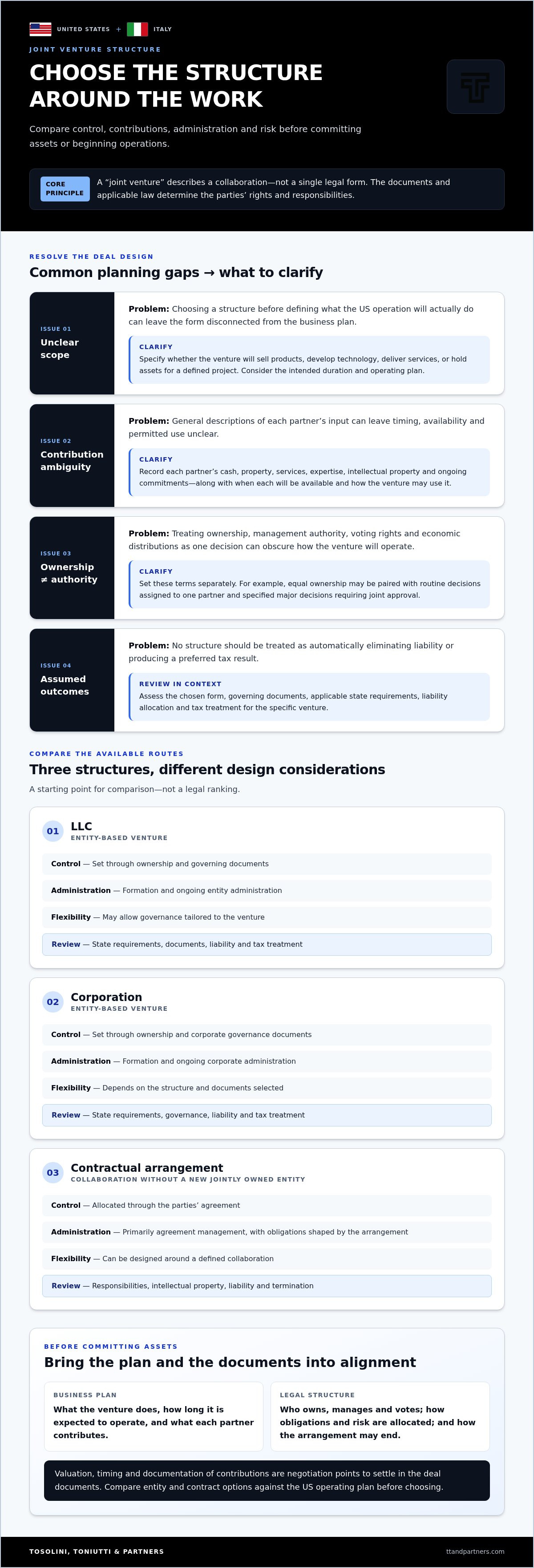
Start with what the US operation will actually do. Will it sell products, develop technology, deliver services, or hold assets for a defined project? The answers affect how the parties assess their contributions, authority, risk allocation, and expected duration. Contributions may include capital, personnel, assets, intellectual property, or commercial relationships. Record what each partner will contribute, when it will be available, and how the venture may use it, rather than relying on a general description of the deal.
When an entity-based venture may fit the commercial plan
A jointly owned entity may fit when the partners expect continuing operations, shared ownership, or assets dedicated to the venture. It creates a distinct structure for the agreed business, but the appropriate entity, formation state, and governing documents depend on the project’s objectives and operating plan. An LLC is one possible US entity; assess its suitability against the intended ownership and governance instead of assuming it is the right choice. Tosolini, Toniutti & Partners provides LLC incorporation support that connects formation choices with the venture’s planned operations.
When a contractual collaboration may be worth comparing
A contractual arrangement may be worth evaluating for a limited project, a defined commercial relationship, or cooperation that does not require shared ownership of a new entity. It lets the parties shape responsibilities around the work, but that flexibility is useful only when the agreement clearly addresses performance, contributions, intellectual property, and how the relationship can end.
Neither route is universally preferable. Calling a contract a “joint venture” does not, by itself, establish what rights the parties have or how their relationship will be treated. The documents and applicable law matter. Compare both approaches against the US operating plan, contributions, and intended duration before committing assets or beginning operations.
Choose the US Joint Venture Structure Around Control, Contributions, and Liability
Structure should follow the operating plan, not a generic ranking of entity types. Decide what the venture will do, how each side will contribute, and which decisions require shared approval. The legal definition of a joint venture offers a US-law reference point, but specific rights and obligations depend on the chosen structure, governing documents, and applicable law.
Record each party’s proposed cash, property, services, expertise, intellectual property, and ongoing commitments. Then distinguish the ownership split from management authority, voting rights, and economic distributions. These do not have to be identical. For example, partners may negotiate equal ownership while assigning certain routine operating decisions to one party and requiring joint approval for specified major decisions. Valuation, timing, and documentation of each contribution are negotiation points to settle in the deal documents.
Compare structures against the venture’s needs
An LLC, a corporation, and a contractual arrangement can support different operating models. A continuing business with shared assets may need a different governance framework from a defined collaboration with a limited duration. The comparison below is a starting point, not a legal ranking.
Review liability and tax in context
Do not treat any structure as automatically eliminating liability or producing a preferred tax result. Outcomes can depend on the chosen form, the documents, the parties’ activities, and applicable US and Italian law. Review the proposed arrangement against the venture’s specific facts, including how obligations are allocated and how contributions or distributions may be treated.
For legal considerations for US joint ventures with Italian firms, entity planning should connect ownership and governance to the actual US operation. Coordinated cross-border legal planning can translate the parties’ commercial agreement into consistent formation and operating documents, while keeping tax analysis specific to the proposed structure and activities.
Resolve Governance, Deadlock, and Exit Before the US-Italy Venture Begins
Shared ownership doesn’t automatically create shared understanding. If authority is vague, routine choices about spending, hiring, or changing the business plan can become points of friction. Clear governance provisions make operating decisions more predictable by defining who can act, which matters require approval, and what happens when partners disagree.
Set decision rights and management responsibilities
Separate day-to-day authority from decisions that call for both partners’ consent. For example, one manager might handle activity within an approved budget, while the agreement reserves major departures from the business plan for joint approval. The documents can also address appointment rights, access to financial and operational information, reporting frequency, and how approval requests are presented and recorded.
Funding deserves the same precision. State what each party has agreed to contribute, when contributions are due, and how the partners will address a change in funding needs. These are negotiated commercial terms, not assumptions about universal legal requirements. Check the final governance provisions against the entity’s governing documents and applicable law.
Decision scope: Identify which actions management may take independently and which require partner approval.
Information flow: Specify reporting expectations and access to the records needed to monitor the venture.
Business plan and funding: Set out how the parties approve material changes and address additional financial commitments.
Governance should also reflect the venture’s cross-border context. The U.S. Department of State’s Investment Climate Statements: Italy provides background on Italy’s investment climate. Use country-level information as context, while assessing the venture’s specific operations and legal requirements separately.
Plan for deadlock, change, and a possible exit
Even carefully designed decision rights can leave the partners divided on a reserved matter. The agreement can establish an escalation path, such as referral to senior representatives, followed by negotiation or mediation. The parties may also consider buyout, sale, or termination mechanisms. These are planning options, not guarantees that every dispute will be resolved or that an exit will proceed on a particular timetable.
Define the details before disagreement arises: whether ownership interests can be transferred, what restrictions apply, how a buyout price would be determined, and whether a change of control affects the arrangement. Valuation methods and triggering events require project-specific drafting. Because a US-Italy dispute may raise questions about governing law, forum, and enforcement, coordinate dispute provisions with the venture documents. Tosolini, Toniutti & Partners provides international litigation support for disputes involving US and Italian jurisdictions.
For the legal considerations for US joint ventures with Italian firms, governance, deadlock, and exit provisions should work as one system. Together, they translate commercial expectations into decision paths for ordinary operations and moments of change.
Map Cross-Border Compliance, Tax, Intellectual Property, and Immigration Issues
Due diligence should connect the venture’s ownership and authority to what it will actually do in the United States. A cross-border plan can involve company formation, existing assets, contracts, personnel, and activity in a regulated sector. Assess tax, data, intellectual property, and foreign investment review against the facts. These are not automatic consequences of having an Italian partner.
A focused diligence review can organize the questions:
Ownership and authority: Identify the parties and confirm who can act for them in negotiating and implementing the venture.
Assets and contracts: Review the property, technology, licenses, and existing agreements the venture may use. Determine whether rights need to be transferred or obtained.
Workforce and operations: Map who will perform the work, where they will work, and what US activities are planned.
Regulatory and data issues: Assess whether the sector, transaction, information handled, or ownership structure raises review or compliance questions.
Foreign investment screening, including possible CFIUS review in the United States, depends on transaction-specific facts. The same is true of sector-specific review. Identify potential triggers early and assess current requirements against the proposed ownership, assets, activities, and timing. Do not assume every US-Italy venture follows the same process.
Coordinate US and Italian tax and regulatory review
Map expected income flows, ownership, payments between related parties, and the operating plan across both countries. This gives the tax analysis concrete facts to address under current US and Italian rules. The US-Italy income tax treaty may be relevant, but its application and any resulting position require current specialist review. Avoid relying on a general description of the treaty or entity type to predict the venture’s tax outcome.
Protect intellectual property and assess immigration separately
Document which partner owns existing intellectual property, what the venture may use, whether any license is exclusive, and who owns or may use new work developed through the collaboration. Address confidentiality, permitted use, access, and what happens to those rights when the relationship changes or ends. Assess data practices in light of the information the venture will handle and its operations.
Personnel planning is a separate workstream. Determine whether US or Italian staff may need an appropriate immigration pathway for their proposed roles. Forming a company or investing in it does not itself grant US immigration status. An investor’s plans may make E-2 visa analysis relevant, but eligibility depends on the individual circumstances and applicable requirements. Tosolini, Toniutti & Partners assists with E-1, E-2, and O-1 visas, Green Cards, and Italian immigration matters.
These legal considerations for US joint ventures with Italian firms are best assessed as connected workstreams, with business structure, compliance, tax, intellectual property, and personnel plans aligned before operations begin.
Turn the Joint Venture Plan into Negotiated Documents and Coordinated Counsel
A sound commercial understanding needs a clear path into signed documents and day-to-day practice. For a US-Italy venture, coordination matters: the business plan, entity documents, operational agreements, and cross-border advice should describe the same arrangement rather than create competing expectations.
Prepare a focused term sheet and diligence plan
Begin with a concise record of the proposed deal. Capture its purpose and scope, each party’s contributions, ownership expectations, governance, funding approach, and intended duration. Identify unresolved terms so the partners can negotiate them before definitive drafting, rather than leaving assumptions to emerge during formation or operations.
Build diligence around the parties and the work the venture will perform. Information requests may cover ownership and authority, assets and intellectual property, relevant contracts, personnel, and intended US activities. The aim is to understand what each party can contribute and what the proposed operating model requires, while identifying issues for legal, tax, and regulatory analysis.
Coordinate formation, agreements, and ongoing decisions
Once the commercial terms and diligence findings align, map the document set. Depending on the selected structure and project, this may include formation documents, a venture or operating agreement, operational contracts, and intellectual property arrangements. Each document should reflect the negotiated contributions, decision rights, allocation of risk, and exit terms. A template is not a substitute for reconciling the documents with the parties’ actual plan.
A practical sequence can keep the work organized:
Define objectives: Describe the venture’s purpose, scope, and expected operations.
Set the commercial framework: Record proposed contributions, ownership, governance, funding, and duration.
Complete diligence: Review the parties, assets, contracts, personnel, and planned activities, then identify matters requiring specialist analysis.
Negotiate and document: Resolve open terms and align formation documents with venture, operational, and intellectual property agreements.
Form and review: Establish the agreed structure, maintain relevant records, review performance, and revisit governance as the business develops.
US and Italian legal, tax, and business advisers should work from a shared understanding of the proposed operation. Coordinated input helps keep commercial intentions, entity formation, cross-border analysis, and documentation aligned, while recognizing that one set of documents may not answer every question in both jurisdictions. The legal considerations for US joint ventures with Italian firms are ultimately practical: document the venture to match how the partners intend to own, operate, and adapt it.
Build Your US-Italy Venture on a Clear Legal Foundation
A strong joint venture plan connects commercial goals to a structure that supports the partners’ intended ownership, contributions, and operations. Clear agreements should define decision-making, funding, risk allocation, and exit options so expectations are documented before the venture begins.
The legal considerations for US joint ventures with Italian firms extend beyond formation. Tax, regulatory, intellectual property, workforce, and immigration questions each call for analysis based on the venture’s specific facts. Coordinating advice across both countries can help keep the business plan, governing documents, and dispute strategy aligned.
Tosolini, Toniutti & Partners supports US-Italy cross-border business operations, including LLC incorporation, and provides international litigation support for disputes involving both jurisdictions. The firm also assists with US and Italian immigration matters relevant to individuals and businesses involved in cross-border operations.
Discuss your US-Italy business venture with Tosolini, Toniutti & Partners to plan the legal steps around your business objectives.
Frequently Asked Questions
What is the best structure for a US joint venture with an Italian firm?
There is no universally best structure. The choice should fit the venture’s purpose, control needs, contributions, liability considerations, and expected duration. An LLC or corporation may suit ongoing shared operations, while a contractual collaboration may fit a defined project without a jointly owned entity. The legal considerations for US joint ventures with Italian firms include how ownership, management authority, and economic rights will work together under the selected structure and its governing documents.
Do US joint venture partners need to form a new company?
No. Partners may pursue their shared objective through a newly formed entity or a contract that defines their collaboration. A separate company may provide a dedicated structure for continuing operations or shared assets, while an agreement may suit a limited commercial project. Compare administration, control, responsibilities, and liability implications for the proposed arrangement, then document the choice to reflect the actual relationship.
What should a US-Italy joint venture agreement include?
A joint venture agreement should reflect the partners’ negotiated business plan. Address the venture’s purpose, scope, contributions, ownership, management authority, voting and approval rights, funding, reporting, intellectual property, and allocation of risks. Include a process for handling disagreements, transfers, and exit, as well as terms for changing or ending the arrangement. Coordinate the agreement with entity formation documents and operational contracts so the documents do not conflict.
How can joint venture partners prevent a deadlock?
Partners can reduce deadlock risk by defining which decisions managers may make and which require joint approval, then agreeing on a path for unresolved issues. The documents might provide for escalation to senior representatives, followed by negotiation or mediation, and address possible buyout, sale, or termination options. These mechanisms can guide a response, but no clause guarantees agreement. The process should fit the venture’s governance and be drafted for its circumstances.
Does an Italian partner need a US visa to participate in a joint venture?
Participation or investment alone does not establish that a particular visa is required or confer US immigration status. The relevant analysis depends on the person’s proposed role and activities, including whether they will travel to or work in the United States. Assess immigration planning separately from company formation. For an investor, an E-2 visa may be relevant in some circumstances, but eligibility and requirements depend on the individual case.
Can a US joint venture with an Italian firm be subject to foreign investment review?
Yes. A transaction may be subject to foreign investment or sector-specific review, depending on its facts, including ownership, the business involved, assets, and proposed activities. CFIUS review may be relevant to certain US transactions involving foreign investment. Do not assume that every joint venture triggers review or that none does. Assess current federal and state requirements against the proposed deal before signing or closing.
How are disputes between US and Italian joint venture partners handled?
The agreement can set out how disputes are addressed, including escalation, negotiation, mediation, and the forum or process for resolving unresolved claims. The partners should consider governing law, where proceedings may take place, and how a decision could be recognized or enforced across borders. These choices depend on the transaction and applicable law. Coordinated planning matters because dispute provisions should align with the venture documents and operations.


Comments