

The Jure Sanguinis Italian Citizenship Process: A 2026 Guide

A jure sanguinis claim is only as strong as the evidence connecting each generation. If you’re asking what it takes to claim Italian citizenship through descent, start with the family line, not a stack of forms. The jure sanguinis Italian citizenship process begins with assessing whether your lineage meets the rules in force and whether the records support it.
That first review matters even more under the 2025 reform, which generally limits new claims to applicants with an Italian parent or grandparent. Eligibility depends on the facts of your family history, and legal questions around the changes continue to develop. A name variation, missing record, or unclear naturalization history can also affect how the line is documented.
This 2026 guide explains how to assess eligibility before investing in record collection, assemble a coherent evidence chain across generations, and consider the appropriate filing route from the United States. It also outlines the procedural stages and the points where discrepancies or gaps may need careful attention. Use it as a starting point for evaluating your case and planning next steps.
Table of Contents
What Is the Jure Sanguinis Italian Citizenship Process, and Who May Qualify?
Build the Jure Sanguinis Evidence Chain Before Preparing an Application
Compare the Main Jure Sanguinis Filing Routes Before Choosing One
Follow the Jure Sanguinis Application Process from Preparation to Submission
Plan Your Next Steps with a Clear Jure Sanguinis Legal Strategy
What Is the Jure Sanguinis Italian Citizenship Process, and Who May Qualify?
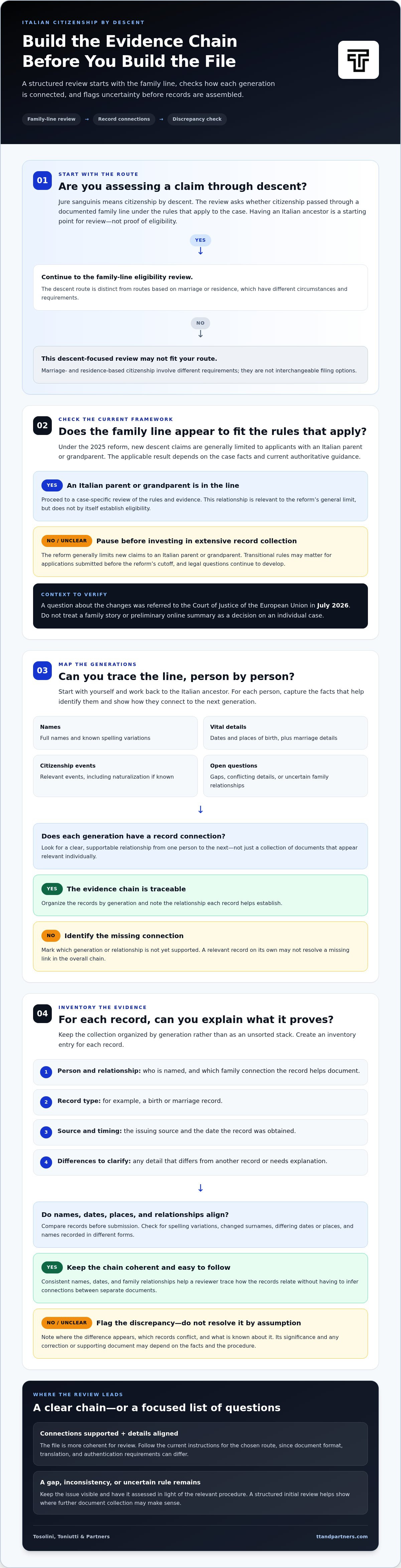
Jure sanguinis means citizenship by descent. The process examines whether Italian citizenship passed through a documented family line to the applicant under the rules that apply to the case. Having an Italian ancestor is a starting point for review, not proof of eligibility.
Recognition through descent differs from routes based on marriage or residence, which depend on different circumstances and requirements. This guide focuses on people tracing a family connection to Italy. The central question is whether the relevant citizenship line continued through each generation. The overview of Italian nationality law provides background on the principle, but it is not a substitute for current official guidance or a case-specific legal review.
Eligibility rules have changed. Under the 2025 reform, new descent claims are generally limited to applicants with an Italian parent or grandparent. The legal framework remains subject to challenge, including a question referred to the Court of Justice of the European Union in July 2026. Transitional rules may also matter for applications submitted before the reform’s cutoff. A family story or preliminary online summary cannot establish the result. Assess the applicable rules against current authoritative guidance and the facts of the individual case.
How does citizenship by descent differ from other Italian citizenship routes?
Descent-based recognition examines a family line and whether citizenship passed through it. Marriage- and residence-based routes concern different personal circumstances and have distinct requirements. They are not interchangeable filing options. For a descent claim, the focus is the evidence and legal analysis needed to assess ancestry and transmission through the family line.
What should an initial family-line review establish?
Begin with a generation-by-generation map, from yourself back to the Italian ancestor. For each person, record:
Full names and known spelling variations
Dates and places of birth, and marriage details
Relevant citizenship events, including naturalization if known
Gaps, conflicting details, or uncertain family relationships
This map helps identify which records you may need and where closer review is warranted. For example, do not resolve a name difference across records by assumption. Flag it for legal analysis alongside the rest of the line. A structured initial review can show whether further document collection makes sense before you invest time in building the full case.
Build the Jure Sanguinis Evidence Chain Before Preparing an Application
A family-line application is assessed through the records that connect one generation to the next. The goal is not simply to collect documents, but to show a clear, supportable relationship across the line. Birth, marriage, and other relevant vital records may establish identity and family relationships, while citizenship records may clarify events that affect the legal analysis. The records required depend on the applicant’s facts and the applicable procedure.
Which records help document a family line?
Organize the material by generation, from the applicant back to the Italian ancestor, rather than keeping it as an unsorted collection. Create an inventory for each record that notes:
The person named and the relationship that record helps document
The record type, such as a birth or marriage record
The issuing source and the date the record was obtained
Any detail that differs from other records or needs clarification
This structure makes gaps easier to spot. For example, if one record links a parent to a grandparent, the next should help establish the link to the preceding generation. A record that looks relevant on its own may not resolve a missing connection in the overall chain. Your chosen route can affect document format, translation, and authentication requirements, so follow the current instructions for that process. The consulate’s official application process is a useful reference for its stated procedures, but requirements may vary by filing route.
Consistent names, dates, and family relationships across birth, marriage, and citizenship records make the evidence chain easier to follow and the application easier to assess. A coherent file lets the reviewer trace how the records relate, instead of having to infer the connection between separate documents.
How should applicants address mismatched names or dates?
Compare records before submission. Look for spelling variations, changed surnames, differing dates or places, and names recorded in different forms. A variation may have a straightforward explanation, but do not ignore it or assume it is immaterial. Note where it appears, which records differ, and what is known about the discrepancy. Then have its significance assessed in light of the relevant procedure.
Do not assume that a particular correction or supporting document will be accepted across all routes. Requirements can depend on the authority handling the application and the facts involved. A structured legal review can help organize the records, identify unresolved inconsistencies, and clarify the next steps in the jure sanguinis Italian citizenship process. Tosolini, Toniutti & Partners provides Italian citizenship legal guidance to help applicants review their family-line evidence.
Compare the Main Jure Sanguinis Filing Routes Before Choosing One
The route is not simply a matter of preference. It depends on the applicant’s circumstances, the legal basis of the claim, and the procedures that apply to the case. Consular and in-Italy applications are administrative pathways; a court pathway involves judicial review. None is automatically the fastest or most suitable for every family line.
What distinguishes consular and in-Italy applications?
Both are administrative settings, but different authorities handle them, and their submission instructions and document expectations may differ. The appropriate process depends on the applicant’s situation, not on a general assumption that one setting is preferable. Before preparing a file for either route, review the current instructions from the relevant authority, including requirements for records, translations, authentication, and submission format.
When might a court pathway require separate legal analysis?
A judicial route may be relevant when the legal circumstances of a claim call for a court’s consideration. It is not a general alternative for every descent application, and having an Italian ancestor alone does not determine whether a court route applies. Review the legal basis and evidence together.
A 1948 case is a distinct type of judicial claim concerning historical limits on transmission through Italian women before 1948. It is not a solution for all applicants, and its specific analysis belongs in a dedicated guide. Other claims may raise different questions, so route selection requires attention to the individual facts and current law.
For the jure sanguinis Italian citizenship process, compare the routes only after clarifying the family line and identifying any legal complications. Route comparison is a planning tool, not a guarantee of access or outcome. Review current procedures for the relevant authority and obtain legal analysis when the basis of the claim is uncertain.
Follow the Jure Sanguinis Application Process from Preparation to Submission
A disciplined sequence helps turn family research into a file that can be reviewed and submitted under the procedure that applies to your case. The jure sanguinis Italian citizenship process is not complete when the records are collected. Each document must support a relevant family connection, and preparation must match the selected route’s current instructions.
In brief: assess the family line, identify the appropriate route, assemble and check the records, resolve or flag gaps, then submit according to the current instructions for that route.
Assess the family line. Map the generations and organize known facts about relationships and citizenship events. Identify issues that may affect the legal basis of the claim.
Identify the route. Consider the applicant’s circumstances and the legal analysis of the claim before preparing documents for a consular, in-Italy, or court process.
Assemble records. Gather the documents relevant to the family line and arrange them so the relationship each one supports is clear.
Review the file. Check for missing evidence, inconsistent details, and route-specific requirements before submission. A legal review can help identify evidentiary gaps or unresolved issues while there is still time to address them.
Submit and track. Follow the applicable authority’s instructions, retain copies of the materials submitted, and keep a record of official correspondence.
What happens during application preparation?
Preparation means matching each piece of evidence to its purpose. For every record, note the person it names and the relationship it is intended to establish. Then compare names, dates, and other details across the file. Identify a missing link between generations or an unexplained discrepancy before compiling the application, rather than leaving the reviewer to infer the connection.
Translation, authentication, document format, and submission instructions can depend on the chosen route and current rules. Use the relevant authority’s current guidance rather than assuming that requirements for one procedure apply to another. If the legal significance of a gap or inconsistency is unclear, a case-specific review can help determine what needs attention before filing.
What should applicants expect after submission?
After filing, the responsible authority may review the materials and request information or further action under the applicable procedure. Keep copies of the application and supporting records, save submission confirmations, and monitor official correspondence so you can respond appropriately. Appointment availability and review procedures can change, so do not treat a general estimate as a promise of when a decision will arrive.
Tosolini, Toniutti & Partners provides Italian citizenship legal guidance to help applicants review family-line evidence and plan application steps.
Plan Your Next Steps with a Clear Jure Sanguinis Legal Strategy
Use the work so far to create a practical starting file: outline the family line, gather records already available, note uncertainties, and identify questions about eligibility or route selection. This preparation will not determine the outcome, but it can make a legal review more focused and clarify what still needs investigation under the rules that apply to your case.
What information should applicants prepare for an initial legal review?
A concise, generation-by-generation summary is more useful than a collection of documents without context. Organize what you know, and distinguish confirmed details from family recollections or unresolved questions.
Family outline: Names, known spelling variations, dates and places of birth, marriages, and relationships connecting each generation.
Citizenship history: Known citizenship events involving the Italian ancestor and descendants, including naturalization information where available.
Available records: Birth, marriage, and other relevant vital or citizenship records, grouped by the person and generation they relate to.
Open issues: Missing records, inconsistent names or dates, previous applications, and any official correspondence or decisions relevant to the claim.
Keep copies of correspondence and note the context of any earlier filing, including the authority involved and the documents submitted, if known. This helps a reviewer understand the procedural history alongside the evidence.
How can legal guidance support a complex cross-border process?
Italian citizenship matters involving a family line across the United States and Italy can require coordinated review of both the evidence and the relevant procedure. Legal guidance can assess how the records support the claimed relationships, identify gaps or inconsistencies for further analysis, and consider route-specific questions before an application is prepared. The appropriate next steps depend on the individual facts and current requirements; no review can guarantee recognition or a particular decision.
The jure sanguinis Italian citizenship process is best approached as a sequence of informed decisions: clarify the family line, understand the legal basis, organize the evidence, and plan the next procedural step. A focused discussion can help bring those elements together without assuming that ancestry alone establishes eligibility. To discuss your citizenship matter, prepare the family outline and records you have already located.
For legal guidance on Italian citizenship and related matters connecting the United States and Italy, explore Tosolini, Toniutti & Partners.
Move Forward with a Clear Plan
The jure sanguinis Italian citizenship process begins with a careful review of the family line, not an assumption based on ancestry alone. A generation-by-generation record can show where evidence is strong, where details conflict, and what questions need legal analysis. Consider the filing route in light of the claim and the requirements currently in force.
Preparing an organized family outline, available vital records, and relevant prior correspondence gives that review a practical foundation. Tosolini, Toniutti & Partners provides Italian citizenship services and focuses on legal matters connecting the United States and Italy. Legal guidance can help bring eligibility, evidence, and procedural considerations into a coherent plan, without guaranteeing a particular outcome.
Take the next step with a focused review of your circumstances. Explore Italian citizenship legal support and move forward with a clearer plan.
Frequently Asked Questions
What is the jure sanguinis Italian citizenship process?
The jure sanguinis Italian citizenship process reviews whether Italian citizenship passed through a family line to an applicant under the rules that apply to the case. The applicant documents each generational link and relevant citizenship events, then follows the appropriate filing procedure. An Italian ancestor alone does not establish eligibility. Consider the evidence and legal circumstances together before choosing a route or submitting an application.
Who may qualify for Italian citizenship by descent?
Under the 2025 reform, new claims are generally limited to applicants with an Italian parent or grandparent. Whether an individual may qualify depends on the family line, citizenship history, any applicable transitional rules, and the law governing the specific claim. Applications submitted by the stated March 27, 2025 cutoff may be treated under earlier rules. Because eligibility can turn on detailed facts, review the full line against current authoritative guidance.
What documents are needed for an Italian citizenship by descent application?
Applicants commonly begin by organizing birth and marriage records for each generation, along with other vital records and documents that may clarify citizenship history. The required evidence depends on the applicant’s family line and filing route. Make an inventory showing each record’s source, date, and the person named, then compare names and dates across documents. Follow the current translation, authentication, format, and submission requirements for the authority handling the application.
Can I apply for Italian citizenship by descent from the United States?
Yes, applicants based in the United States can pursue a descent claim, subject to eligibility and the applicable procedure. The suitable route and submission instructions depend on the claim and the applicant’s circumstances. Before preparing a final file, identify the authority and route involved, then review its current requirements for records, translations, authentication, and submission. A legal review can help assess the family-line evidence and procedural questions involving the United States and Italy.
How long does the jure sanguinis process take?
Processing time varies, and no general estimate guarantees when an individual case will be completed. As of 2026, the maximum processing period for applications has been extended to 36 months, but that figure is not a prediction of the full time needed, including preparation or access to a filing route. Document gaps, route-specific steps, and requests for further information may affect a case. Review current official guidance for the process that applies.
Can name or date discrepancies affect an Italian citizenship application?
Yes. Different spellings, changed surnames, or inconsistent dates can make it harder to establish that records refer to the same people and relationships. A discrepancy does not by itself determine the result, but it should be documented and assessed rather than ignored. Compare records before filing, note exactly where details differ, and seek guidance on how to address the issue under the procedure for your case. Do not assume one correction method applies everywhere.
Do 2026 rules affect applications based on Italian ancestry?
Yes. The 2025 reform changed the eligibility framework for new descent claims, generally limiting them to applicants with an Italian parent or grandparent, while transitional provisions may affect earlier submissions. Legal challenges also continue: in July 2026, the Italian Constitutional Court referred a question about the reform to the Court of Justice of the European Union. The law may evolve, so assess your facts using current official guidance and case-specific legal review.


Comments