

Italian Citizenship by Descent Attorney: How Legal Guidance Can Help

What if the key to an Italian citizenship claim isn’t simply finding an Italian ancestor, but understanding how the records for each generation fit the rules that apply today? An Italian citizenship by descent attorney can assess that connection before you commit to an application path, particularly when family history is incomplete or documents don’t align.
It’s understandable to feel uncertain when eligibility depends on details across generations, records are difficult to obtain, or the right authority isn’t clear. Legal guidance can organize those details into a case-specific assessment, identify questions that need resolution, and consider relevant US-Italy issues without promising a particular outcome.
This article explains what an attorney may evaluate before a claim proceeds, how administrative and judicial pathways differ, and which family-history details and records to gather. A clearer picture of your lineage and available documents can help you understand what your case requires and prepare for the next steps.
Table of Contents
What an Italian Citizenship by Descent Attorney Actually Does
An Italian citizenship by descent attorney evaluates how your family history and available evidence relate to the legal rules that apply to your claim. The attorney’s role is to provide legal analysis, plan the case, and guide you through procedural questions, not to promise that citizenship will be recognized. An ancestor’s Italian background may be a starting point, but ancestry alone doesn’t establish eligibility. The facts across the family line and the applicable rules must be considered together.
In practical terms, an attorney assesses the claim, identifies legal questions, and helps plan procedural steps. The relevant government authority makes the decision. A careful review can bring issues to light before an application proceeds, but it cannot replace the authority’s review or guarantee an outcome.
How legal review differs from gathering family records
Legal analysis starts with the proposed line of descent. An attorney considers the relationships and events described in your family history, then assesses what those facts may mean under the applicable rules. An overview of Italian nationality law can provide general background, but an individual claim still needs a case-specific assessment.
Gathering records is related work, but it is distinct from legal analysis. Locating documents, requesting copies, arranging translations, and obtaining certifications are practical steps. Interpreting what those records mean for a claim is a separate task. A document might establish a relationship or date, while a name difference or missing record could raise a question for closer review.
An attorney can help define what the evidence needs to establish and identify gaps or inconsistencies for follow-up. This makes record gathering more purposeful: rather than collecting papers without a clear objective, you can understand which facts each document is intended to support. The relevant documents and procedures depend on the claim and the authority handling it.
Why US-Italy context matters to a descent claim
A family line may include events and records from both the United States and Italy. Documents can come from different jurisdictions, and the process may involve procedural considerations on either side. Identifying those connections early helps frame questions such as where records originated and how they relate to the legal claim.
Tosolini, Toniutti & Partners handles Italian citizenship matters within its US-Italy cross-border legal practice. The firm can review family facts, identify legal issues, and organize practical next steps alongside relevant US-side considerations. Use the firm’s citizenship matter contact page to begin a discussion with a clear account of your family line and the records you have.
How an Attorney Assesses Eligibility, Family History, and Case Route
An eligibility review turns family history into a set of legal questions. Start by tracing each relationship, checking what available records establish, and considering which procedures may fit the individual circumstances. A particular date or family detail should not be treated as a universal test without assessing the rules that apply to the claim.
A family tree can show who is related to whom, but it cannot establish legal eligibility without supporting records and analysis under the rules that apply to the individual claim. An Italian citizenship by descent attorney can organize that review and identify uncertainties, rather than relying on assumptions based on ancestry alone.
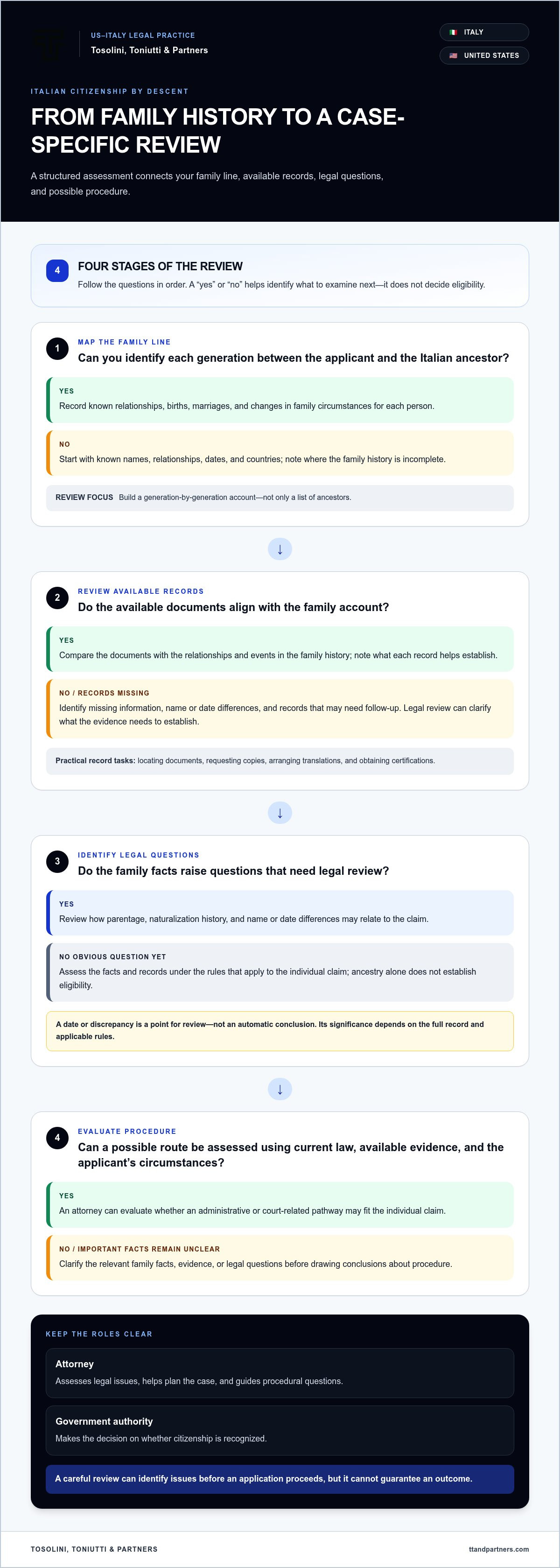
A structured assessment may proceed through four stages:
1. Map the family line. Identify each generation between the applicant and the Italian ancestor. Note known relationships, births, marriages, and changes in family circumstances.
2. Review available records. Compare documents with the family account. Note missing information, differences in names or dates, and questions that may need further documentation.
3. Identify legal questions. Consider how parentage, naturalization history, and other relevant facts may affect the claim. A date or discrepancy is a point for review, not an automatic conclusion.
4. Evaluate procedure. Assess possible administrative or court-related pathways in light of current law, available evidence, and the applicant’s circumstances.
Which family-history facts can affect legal analysis?
Start with a generation-by-generation account, not just a list of ancestors. For each person, record the known name, relationship, birth and marriage details, and any naturalization information available. These facts help clarify what the records need to establish and where the family history is incomplete.
For example, a naturalization record may raise a question about timing, while inconsistent spellings across documents may need context. Neither fact alone determines the outcome. Its legal significance depends on the full record and the rules applicable to the claim.
How attorneys evaluate possible filing pathways
Administrative and court-related procedures are distinct possibilities. The appropriate route depends on current law and the individual facts. An attorney can assess which issues affect that choice and whether a particular route is relevant. General descriptions cannot substitute for reviewing the evidence and current procedural requirements.
Thresholds, exceptions, and filing rules can change, so check them against authoritative information before an application proceeds. Claims involving a female ancestor and a child born before 1948 raise particular legal questions, which require case-specific review.
For a case-specific discussion of family facts and potential procedural questions, use the firm’s Italian citizenship contact page. A focused review can clarify what is known, what needs attention, and which next steps may be appropriate, without promising recognition.
Attorney-Guided Claim or DIY Filing: What Changes in Practice?
Handling a claim yourself may be reasonable if you’re comfortable organizing records and your family history is straightforward. Legal representation doesn’t guarantee recognition. It changes who helps interpret the facts, identify potential issues, and plan procedural steps. The choice is best understood as a question of complexity and risk management, not as a measure of how serious or deserving a claim is.
You can also divide responsibilities. Applicants may gather family documents themselves while seeking legal analysis on specific questions. The right division of work depends on the case and the support being provided.
When self-management may involve more legal judgment
Unclear relationships between generations, records with different names or dates, naturalization details that need interpretation, or uncertainty about the applicable procedure can make a case more demanding. These factors are reasons to assess the claim, not proof that it will fail. Their significance depends on the documented facts and the rules in force when the case proceeds.
What professional representation can add
An Italian citizenship by descent attorney can help build a coherent case plan: identify the legal questions, connect each available record to the fact it may support, and separate established information from unresolved issues. This structure makes it easier to see what further information may be useful before taking procedural steps. It does not control a government decision or guarantee recognition.
If you prefer to manage practical tasks yourself, focused legal analysis may still help when a specific question affects your next move. Representation also does not have to mean that counsel performs every administrative task. Clear role-setting helps keep the process suited to the needs of the claim.
Tosolini, Toniutti & Partners handles Italian citizenship matters within a US-Italy cross-border legal practice. A case-specific discussion can help clarify which tasks you can manage and where legal analysis may help. Use the firm’s citizenship matter contact page to discuss those questions in the context of your family records and circumstances.
What to Prepare Before Discussing an Italian Descent Claim
You don’t need a complete archive to begin a useful legal discussion. A clear account of what you know, which records you have, and where information is uncertain gives an Italian citizenship by descent attorney a practical starting point for understanding your family line and identifying questions for review.
Gather what is available and note what you’re still trying to establish. Don’t fill gaps with guesses or alter a record to make details appear consistent. A discrepancy is useful information when documented and assessed in context.
Build a clear family-line overview
Write down each generation between the Italian ancestor and the applicant, including the relationship between each person. Add known names, birth and marriage dates, and the country where each relevant event was recorded. If a detail is uncertain, mark it as unknown rather than estimating it.
List full names and any known spelling or name variations.
Record family relationships and known birth, marriage, and death details.
Note any available naturalization information, including the person and record involved.
Mark amended records, conflicting dates, and gaps in the family history for review.
This overview doesn’t need to be a formal family tree. Its purpose is to make the known sequence clear and show where additional information may be needed.
Organize records without assuming every document is sufficient
Group available documents by person and event. Birth, marriage, death, and naturalization records may help explain the family history, but don’t assume every item is required or that a document alone answers a legal question. Requirements depend on the case and the relevant authority, so verify current instructions before filing.
Keep originals separate from copies, extracts, and family notes. If you have several versions of a record, label each with its source and any known context. If spellings differ, for example, note exactly how each document records the name instead of trying to resolve the discrepancy yourself.
Assess documents in context, not by simply counting them. Their relevance depends on what each record shows, how it relates to the family line, and the requirements that apply to the particular claim.
A concise preparation file can include your family-line overview, an inventory of available documents, and a short list of unanswered questions. This keeps the first discussion focused, even if some records are still missing.
To discuss your family history and available records with Tosolini, Toniutti & Partners, contact the firm about your Italian citizenship claim.
How Tosolini, Toniutti & Partners Supports US-Italy Citizenship Matters
An Italian citizenship claim based on family history can involve records and legal procedures connected to both the United States and Italy. Tosolini, Toniutti & Partners provides Italian citizenship services as part of its US-Italy cross-border legal practice. The firm considers those connected issues through a case-specific review rather than treating every claim as a standard checklist.
The first step is to understand the family facts shown by the available records. From there, the legal questions can be identified and next steps organized around the individual claim. A record discrepancy, an uncertain point in the family line, or a question about procedure may shape what needs further review. The significance of each issue depends on the evidence and current requirements.
A cross-border perspective for applicants in the United States
Records created in the United States may form part of a family history that also involves Italian records or procedures. A cross-border perspective helps place those materials in relation to one another and consider relevant US-side issues alongside the Italian citizenship matter. Not every claim involves the same records or steps; the details depend on the documented family history and applicable process.
For applicants in the United States, organizing the known family line and noting where records originated can help frame an initial legal discussion. Tosolini, Toniutti & Partners reviews those facts within its cross-border practice and identifies questions that merit attention before next steps are set.
Practical next steps for a case-specific discussion
Start with a concise family-line overview, an inventory of records already available, and notes about missing or inconsistent details. You don’t need to resolve every uncertainty before discussing the matter. Identifying what is known and what remains unclear can focus the conversation on issues that may affect the claim.
Next steps depend on the individual facts and the requirements that apply at the time. A discussion can clarify which legal questions need analysis, what information may be relevant, and how to approach the procedure. This brings structure to a complex family history without assuming that any particular outcome is assured.
If you’re ready to discuss your circumstances, contact Tosolini, Toniutti & Partners about your citizenship matter and share the family information and records you have available.
Take the Next Step With a Clearer Perspective
A family story can span generations, countries, and records created in different circumstances. The next step is not to resolve every uncertainty alone, but to bring the known facts into a focused legal discussion. An Italian citizenship by descent attorney can help frame the questions that matter to your claim and clarify what further review may be appropriate.
Before proceeding, consider what you want to understand: how a particular record relates to your family line, which legal questions remain open, or what procedural considerations may apply. A thoughtful discussion can turn those questions into a considered path forward, with the facts and current requirements guiding each decision.
Discuss your Italian citizenship matter with Tosolini, Toniutti & Partners and take a measured first step toward understanding your options. Your family history deserves a careful, case-specific assessment.
Frequently Asked Questions
Can I claim Italian citizenship through a grandparent?
Possibly, but having an Italian grandparent alone doesn’t establish eligibility. The legal review depends on the full family line, the relevant records, and the rules that apply to your particular claim. Details about parentage or a family member’s citizenship history, for example, may raise questions that a family tree alone cannot answer. A case-specific assessment can help clarify what those facts mean before you choose a filing route.
Do I need an attorney to apply for Italian citizenship by descent?
Whether legal representation is appropriate depends on your circumstances and the procedure that applies. Some applicants may be comfortable organizing records and managing practical steps themselves. Others may want legal analysis when the family line, evidence, or route raises questions. An Italian citizenship by descent attorney can connect the facts to relevant legal issues, but representation does not determine how a government authority will decide the application.
What documents are usually relevant to an Italian citizenship by descent claim?
Records that may help explain the family line include birth, marriage, and death documents, along with naturalization records where relevant. Which documents matter depends on the claim and the authority reviewing it. As you organize materials, note who issued each record, whom it concerns, and which event it records. This context can help distinguish documents that support a family connection from items that provide background only.
How long does an Italian citizenship by descent application take?
There isn’t one reliable timeframe for every claim. The route, appointment access where applicable, the authority’s procedures, and any need for further record or legal review can all affect the process. Separate preparation time from the period after filing, since they are different stages. Before making plans around a particular date, check current information for the procedure and authority relevant to your case.
Can I apply if my family records contain different names or dates?
A difference in a name or date doesn’t automatically determine whether a claim can proceed, but it should be documented and reviewed. Keep each version of the record, note where it came from, and write down any family explanation without changing the document or presenting a guess as fact. A spelling difference across records, for example, may need to be considered alongside the relationships and other details those records show.
Can an Italian citizenship by descent attorney guarantee approval?
No attorney can guarantee that a government authority will recognize a claim. Legal guidance can help assess the documented facts, identify issues that may need attention, and clarify procedural considerations. The authority responsible for reviewing the matter makes its own decision under the applicable rules. A careful assessment supports informed next steps, but it is legal guidance, not a promise of a particular result.
Can I pursue Italian citizenship by descent if I live anywhere in the United States?
You can discuss a potential claim from anywhere in the United States with Tosolini, Toniutti & Partners, which serves clients nationally in US-Italy legal matters. Your location alone doesn’t establish eligibility or determine the procedure. The relevant route and authority depend on the facts of your claim and current requirements. A discussion can help clarify which details about your residence and family history matter to the next steps.


Comments