

FIRPTA Withholding for Italian Property Sellers: The 2026 Strategic Guide
- Gianni Mendes Toniutti, Esq.

- Jun 1
- 13 min read
What if the 15% of your gross sales price currently earmarked for the IRS wasn't an inevitable loss, but a liquidity hurdle you could strategically clear before the ink even dries on your contract? For many, the sudden realization that a significant portion of their equity will be held in escrow feels like an unbridgeable gap in their financial planning. It's understandable to feel a sense of unease when the complexities of FIRPTA withholding for Italian property sellers collide with your existing obligations to the Agenzia delle Entrate. Managing these cross-border tax layers requires more than just awareness; it demands a visionary approach to capital stewardship.
You're about to discover how to master these intricate U.S. real estate tax requirements to protect your liquidity during a sale. This 2026 guide provides a clear roadmap for utilizing Form 8288-B to reduce or eliminate the standard withholding amount legally. We'll examine the specific residential exemptions and the precise steps needed to ensure your real estate closing proceeds without the burden of unnecessary escrow, maintaining the harmony between your international investments and your long-term financial goals.
Key Takeaways
Recognize the distinction between the mandatory 15% collection mechanism and your actual U.S. tax liability to better manage capital expectations at the time of sale.
Master the strategic application for a Withholding Certificate via Form 8288-B to significantly reduce the impact of FIRPTA withholding for Italian property sellers.
Leverage the US-Italy Tax Treaty to ensure seamless cross-border synergy and effectively utilize the Foreign Tax Credit on your Italian tax returns.
Navigate the technical nuances of depreciation recapture and capital gains rates to accurately forecast your net liquidity after the transaction.
Align your sale with integrated legal counsel to ensure a compliant real estate closing that bridges the gap between American escrow and Italian fiscal reporting.
Table of Contents
Understanding FIRPTA: Why the IRS Withholds 15% from Italian Sellers
The Financial Impact: Calculating Your Real US Tax Liability
Cross-Border Tax Synergy: The US-Italy Double Taxation Agreement
Strategic Mitigation: Obtaining a FIRPTA Withholding Certificate (Form 8288-B)
Navigating the US-Italy Real Estate Closing Process with TT&P
Understanding FIRPTA: Why the IRS Withholds 15% from Italian Sellers
The Foreign Investment in Real Property Tax Act (FIRPTA) serves as a defensive fiscal mechanism rather than a definitive capital gains tax. For Italian residents divesting from the U.S. market, this distinction is paramount. The 15% deduction isn't the final amount you owe; it's a security deposit held by the IRS to ensure that non-resident sellers fulfill their tax obligations before transferring proceeds abroad. This creates a unique challenge regarding FIRPTA withholding for Italian property sellers, as the burden of compliance shifts from the seller to the buyer in a way that can disrupt the natural flow of a transaction.
Under U.S. tax law, a "foreign person" includes non-resident alien individuals and foreign corporations. Whether you're selling as a private individual from Milan or through an Italian corporate structure like an S.r.l. or S.p.A., the IRS views the transaction through the same lens of mandatory withholding. While an S.r.l. is a separate legal entity in Italy, for FIRPTA purposes, it's still a foreign entity unless it has made specific elections to be treated otherwise. This distinction matters because the documentation required to prove "non-foreign" status is stringent and must be handled with professional precision to avoid deal-breaking delays.
The Role of the Withholding Agent
U.S. title companies and buyers often approach these transactions with extreme caution. The law designates the buyer as the "withholding agent," making them personally liable for the tax if it isn't collected and remitted correctly. This liability explains why buyers are rarely willing to waive withholding without official IRS documentation. Understanding FIRPTA and its enforcement helps sellers realize why buyers won't simply take their word for it. If the buyer fails to withhold, the IRS can collect the tax directly from them, plus interest and penalties. Funds must be remitted to the IRS within 20 days of the closing, leaving a very narrow window for administrative errors. This pressure often makes the buyer's legal team or the title company incredibly rigid during negotiations.
Gross Realized Amount vs. Net Gain
The most jarring aspect of this regulation is that the 15% is calculated based on the gross realized amount, which is essentially the total sales price. It doesn't account for your original purchase price, renovation costs, or the remaining mortgage balance. If you're selling a property for $800,000, the IRS expects $120,000 at closing, even if your actual profit is only $50,000. This often triggers a liquidity crisis for sellers who haven't planned for such a significant escrow, especially when high mortgages are involved.
For smaller transactions, there's a narrow path for relief. If the sale price is $300,000 or less and the buyer intends to use the property as a primary residence, a 0% rate may apply. However, most premium investments sold by Italian nationals exceed this threshold, making a proactive strategy essential. If you're preparing for a real estate closing, assessing these variables early is the only way to protect your cash flow and ensure the deal remains viable for both parties.
The Financial Impact: Calculating Your Real US Tax Liability
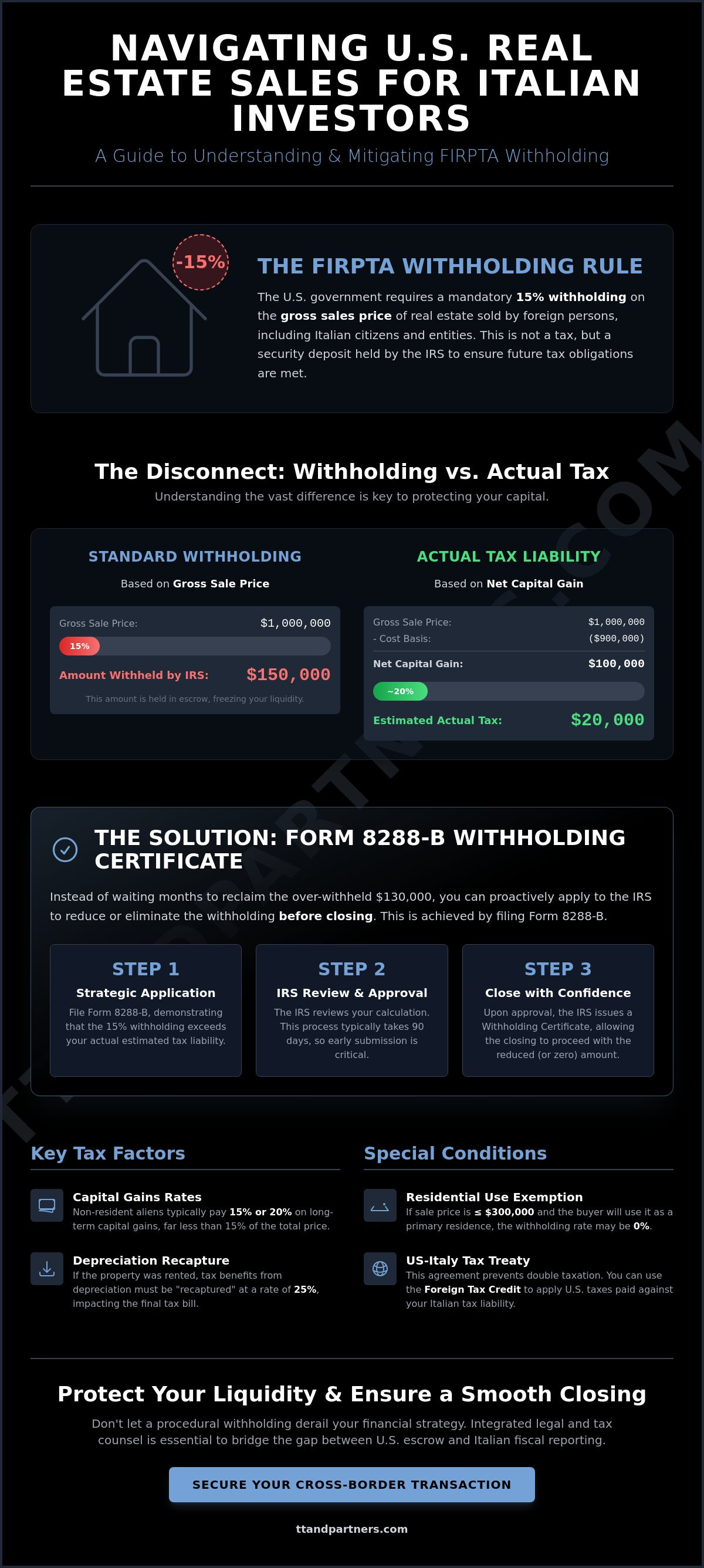
The financial reality of FIRPTA withholding for Italian property sellers often feels disproportionate because the 15% is a flat grab against the total price. Your actual tax liability is calculated quite differently. Non-resident aliens generally pay 15% or 20% on long-term capital gains, but this is applied to the net profit after deducting the cost basis and expenses. The discrepancy between 15% of the gross sale and 20% of the net gain can be massive. For a property sold at $1,000,000 with a $900,000 basis, the withholding is $150,000, even though the actual tax on the $100,000 gain might only be $20,000.
Depreciation recapture adds another layer of complexity for those who held the property as an investment. The IRS requires you to pay back the tax benefits you claimed during ownership, typically at a rate of 25%. This often catches Italian investors off guard; it inflates the final bill beyond simple capital gains. According to the IRS guidelines on FIRPTA, these nuances must be settled on a final tax return. However, waiting for a refund via Form 1040-NR is a slow process. Since you can't file until the tax year ends, it often takes 12 to 18 months to see that liquidity return to your accounts.
The $300,000 and $1,000,000 Thresholds
Specific exceptions exist based on price and buyer usage. If the sales price is $300,000 or less and the buyer intends to use the property as a primary residence, the withholding rate drops to 0%. For properties between $300,001 and $1,000,000, the rate is reduced to 10% if the same residency intent is met. These aren't automatic. The buyer must sign an affidavit under penalty of perjury. Their failure to actually reside there could create future legal friction, so buyers remain cautious.
Corporate vs. Individual Tax Implications
Selling through a corporate structure requires a different lens. If you utilized LLC incorporation for your U.S. holdings, the tax treatment depends on whether the entity is disregarded or treated as a corporation. Italian corporate sellers might also face a branch profits tax, which aims to equalize the tax treatment between U.S. subsidiaries and foreign branches. The amount realized in these transactions includes the sum of all cash received, the fair market value of other property received, and the amount of any liabilities the buyer assumes. Carefully consulting with a specialist before the sale helps you model these outcomes accurately.
Cross-Border Tax Synergy: The US-Italy Double Taxation Agreement
The interaction between U.S. domestic law and the 1999 US-Italy Tax Treaty is where the most sophisticated financial planning occurs. Article 13 of the treaty explicitly confirms that gains derived by a resident of Italy from the alienation of real property situated in the United States may be taxed in the U.S. While this gives the IRS primary taxing rights, FIRPTA acts as the enforcement arm for this authority. It's a common misconception that the treaty exempts you from withholding; in reality, it simply provides the framework for the eventual Foreign Tax Credit (Credito d’imposta) you'll claim on your Italian Redditi PF. Coordinating FIRPTA withholding for Italian property sellers with the Italian "Plus-valenza" requires a granular understanding of how these two systems overlap.
Italy taxes its residents on their worldwide income, meaning your U.S. gain must be reported in Italy. To prevent double taxation, the Italian tax authorities allow a credit for the actual U.S. tax paid. It's vital to remember that the 15% withholding is merely a deposit. You can't usually claim a credit in Italy for the full 15% if your actual U.S. tax liability is lower. Misalignment here often leads to temporary double taxation until the IRS processes your refund and provides the final tax certification. Additionally, the year of the sale marks the final reporting period for the IVIE (Imposta sul Valore degli Immobili all’Estero), which is calculated pro-rata until the closing date.
Reporting the Sale in Italy: Quadro RW
The transition from holding an asset to realizing a gain involves moving from asset monitoring to active tax reporting. Your Quadro RW filing, which previously tracked the property for IVIE purposes, must now reflect the disposal of the asset. One often overlooked nuance is the currency exchange rate. The U.S. calculates gains in dollars based on historical cost; however, Italy requires the gain to be calculated in euros using the exchange rates applicable at the time of purchase and sale. If the dollar strengthened significantly during your ownership, you might face a larger Italian tax bill even if the U.S. gain is modest. Precise documentation, aligned with IRS FIRPTA Withholding Rules, is the only way to satisfy the Agenzia delle Entrate that your credit is legitimate.
Legal Disputes in Cross-Border Real Estate
Transactional friction often arises when a buyer or their title company becomes overly aggressive with withholding to protect themselves from IRS penalties. In some cases, disputes over the escrowed funds can delay a closing or lead to unfavorable terms. When these disagreements escalate, having access to international litigation expertise becomes a vital asset. Legal counsel ensures that "good title" is delivered without allowing the buyer to use FIRPTA withholding for Italian property sellers as a leverage point to withhold more than is legally required. Protecting your interests requires a proactive stance that balances technical tax compliance with robust legal advocacy. If you find yourself in a contested closing, you should contact a professional to secure your equity.
Strategic Mitigation: Obtaining a FIRPTA Withholding Certificate (Form 8288-B)
The 15% withholding requirement isn't an immovable obstacle; it's a fiscal starting point that can be refined through technical precision. The Withholding Certificate, obtained via Form 8288-B, serves as the primary instrument for liquidity protection. By shifting the focus from the gross sales price to your "Maximum Tax Liability," you can legally reduce or even eliminate the amount held at closing. This strategic pivot ensures that your capital remains under your stewardship rather than sitting in an IRS account for over a year. FIRPTA withholding for Italian property sellers becomes manageable when you demonstrate that the actual tax owed on the net gain is a fraction of the standard 15% mandate.
Timing remains the most critical element of this strategy. You must file the 8288-B application on or before the date of the transfer. If the application is submitted even one day late, the buyer is legally compelled to remit the full 15% to the IRS within 20 days of the closing. Missing this window effectively closes the door on early liquidity recovery. Managing the buyer's expectations is equally vital; a well-structured "Escrow Agreement" allows the transaction to proceed while the application is pending, providing the buyer with the legal security they require while protecting your cash flow.
The Form 8288-B Application Process
Success in this process depends on the depth and accuracy of your financial records. You must provide a comprehensive history of the property's adjusted basis, which includes the original purchase price and all documented capital improvements. These figures are essential to justify a lower withholding amount to the IRS. Additionally, every seller must possess an Individual Taxpayer Identification Number (ITIN). If you don't already have one, the ITIN application must be carefully coordinated and submitted simultaneously with your 8288-B to prevent administrative bottlenecks that could jeopardize the closing timeline.
Closing with a Pending Application
A pending application doesn't have to stall your transaction. Under U.S. law, if the 8288-B is filed by the closing date, the buyer can legally hold the withheld funds in a qualified escrow account instead of remitting them to the IRS. The buyer must still file Forms 8288 and 8288-A but leaves the payment amount blank while the certificate is under review. The IRS typically processes these certificates within 90 days. Once the IRS issues the certificate, the escrow agent releases the certified tax amount to the IRS and the remaining balance directly to the seller. To ensure your real estate closing follows this sophisticated path, it's essential to work with counsel who can bridge the gap between U.S. tax requirements and Italian fiscal interests.
Navigating the US-Italy Real Estate Closing Process with TT&P
The final stages of a cross-border transaction demand a synthesis of engineering like precision and strategic foresight. Managing FIRPTA withholding for Italian property sellers isn't a task for a generalist; it requires a deep understanding of how American escrow requirements interact with Italian fiscal law. TT&P acts as the vital conduit between U.S. closing agents, who are often focused solely on domestic compliance, and the Italian seller’s broader financial ecosystem. By integrating legal counsel with international tax strategy, we ensure that every document signed at the closing table serves your long-term liquidity goals and remains in harmony with your global tax position.
Proactive planning should ideally begin 60 days before the property is even listed. This timeline allows for the meticulous preparation of ITIN applications and the gathering of historical cost data necessary for a successful 8288-B filing. Waiting until a contract is signed often leaves too little time to navigate the IRS’s administrative requirements, potentially forcing a 15% liquidity loss that could've been avoided. Our approach ensures that the US-Italy Tax Treaty isn't just a theoretical benefit but a practical tool used to maximize your net proceeds. We bridge the gap between the U.S. title company's risk aversion and your need for immediate capital access.
Comprehensive Real Estate Support
Our engagement extends beyond the technicalities of tax forms. We review U.S. purchase agreements to insert protections specific to the needs of Italian residents, ensuring that the terms of the real estate closing reflect the cross-border nature of the deal. This includes coordinating directly with your Italian commercialista to ensure that the sale is correctly reflected in your Quadro RW reporting. For those looking toward their next chapter, we often assist in reallocating property proceeds into E-2 Visa investment funds, turning a successful exit into a new strategic entry into the U.S. market.
Securing Your Financial Future
The advantage of a single firm handling both U.S. real estate law and international tax strategy provides a level of security that fragmented advice cannot match. This holistic perspective protects you against future IRS audits by ensuring that the record-keeping during the sale is beyond reproach. We provide the intellectual framework needed to navigate FIRPTA withholding for Italian property sellers with confidence, allowing you to focus on the next phase of your investment journey. To secure your equity and ensure full compliance on both sides of the Atlantic, reach out to our team for a tailored FIRPTA analysis today.
Securing Your Capital Through Strategic Foresight
The complexities of a cross-border sale shouldn't compromise your financial liquidity. As we've explored, the 15% IRS mandate is a provisional measure that yields to technical precision and proactive planning. By aligning your transaction with the specific provisions of the US-Italy Tax Treaty and utilizing the Withholding Certificate process, you transform a potential cash flow hurdle into a controlled administrative step. Mastering FIRPTA withholding for Italian property sellers is fundamentally about reclaiming control over your equity before the closing date arrives.
Success in these matters depends on the synergy between American legal standards and Italian tax obligations. Our bilingual legal team brings decades of experience in US-Italy real estate law and a proven track record with complex Form 8288-B applications. We don't just facilitate a transaction; we protect the intellectual and financial value of your international portfolio. To ensure your next sale is defined by harmony and compliance, Schedule a Strategic FIRPTA Consultation with Our Cross-Border Experts today. Your path to a seamless, treaty-protected closing starts with a single strategic decision.
Frequently Asked Questions
Can I avoid FIRPTA withholding if I am selling my US property at a loss?
Selling at a loss doesn't automatically exempt you from the 15% withholding because the IRS calculates the amount based on the gross sales price rather than your profit. However, you can apply for a Withholding Certificate by demonstrating that your actual tax liability is zero. This proactive step prevents the IRS from holding your capital for over a year. It's the most effective way to manage FIRPTA withholding for Italian property sellers when profit margins are non-existent.
How long does it take for the IRS to process a FIRPTA Withholding Certificate?
The IRS typically processes Form 8288-B applications within 90 days of receipt. During this period, the withheld funds are held in a secure escrow account rather than being remitted to the IRS, provided the application was filed on or before the closing date. This window requires careful coordination between the buyer and seller. Having a bilingual legal team ensures that all documentation meets the specific requirements to avoid administrative delays or rejections.
Is the 15% FIRPTA withholding a final tax for Italian residents?
The 15% withholding is not a final tax; it's a security deposit to ensure the seller files a U.S. tax return. Your actual tax liability depends on the net gain, depreciation recapture, and applicable treaty rates. You must file Form 1040-NR after the tax year ends to calculate the precise amount. Any excess funds held by the IRS are then refunded, though this process can often take 12 to 18 months to complete.
How does the US-Italy Double Taxation Agreement affect FIRPTA?
The US-Italy Double Taxation Agreement doesn't eliminate the FIRPTA withholding requirement, but it prevents you from being taxed twice on the same gain. Under Article 13, the U.S. retains primary taxing rights on real property located within its borders. You then claim a foreign tax credit on your Italian Redditi PF return for the actual tax paid to the IRS. This synergy ensures your global tax burden remains balanced and compliant with both jurisdictions.
What happens if the buyer refuses to file Form 8288-B on my behalf?
The seller is responsible for filing Form 8288-B, but the buyer's cooperation is essential for the escrow agreement and the signing of specific IRS forms. If a buyer is hesitant, your legal counsel can draft specific clauses in the purchase agreement to protect your right to a withholding reduction. Since the buyer faces personal liability for uncollected taxes, they often require professional assurance that the certification process is being handled with absolute technical precision.
Do I need a US Social Security Number to sell my property and comply with FIRPTA?
You don't need a Social Security Number, but you must obtain an Individual Taxpayer Identification Number (ITIN) to comply with FIRPTA. This unique number allows the IRS to track your tax obligations and process your Withholding Certificate or refund. It's best to initiate the ITIN application alongside your property listing. This early start prevents the lack of a tax ID from stalling your FIRPTA withholding for Italian property sellers strategy at the closing table.
Can I use an Italian LLC to avoid FIRPTA withholding requirements?
Using an Italian LLC, such as an S.r.l. or S.p.A., doesn't bypass FIRPTA requirements because these entities are classified as foreign persons under U.S. tax law. The IRS focuses on the residency of the entity owning the property. While corporate structures offer other strategic benefits, they are still subject to the 15% withholding on the gross sales price. Proper planning remains the only way to mitigate the immediate impact on your corporate liquidity.
What is the residential occupancy exception for FIRPTA?
The residential occupancy exception allows for a reduced or zero withholding rate if the buyer intends to use the property as a primary residence. If the sales price is $300,000 or less, the rate is 0%. For properties between $300,001 and $1,000,000, the rate drops to 10%. The buyer must sign an affidavit confirming their intent to reside in the home for at least 50% of the time during the first two years following the sale.


Comments