

Italian Ancestry for Citizenship: 2026 Legal Guide

What if the most significant asset you own isn't a piece of property, but a forgotten lineage waiting to be reclaimed? For many, the journey of proving Italian ancestry for citizenship feels like a search for a ghost, haunted by incomplete family records and the silent gaps left by ancestors who crossed the Atlantic decades ago. You understand the profound value of this heritage, yet the technical reality of tracking down naturalization dates or securing centuries-old certificates can quickly turn inspiration into frustration.
It's true that the administrative hurdles and lengthy consulate wait times are daunting obstacles on the road to a second passport. This guide offers a refined roadmap to manage these complexities, ensuring you master the precise legal requirements and document strategies needed to bridge the gap between your family's past and your future. We'll explore the essential records required for a successful application and demonstrate how professional legal support can transform a fragmented history into a definitive case for your dual citizenship.
Table of Contents
The Doctrine of Jure Sanguinis: Understanding Your Right to Italian Citizenship
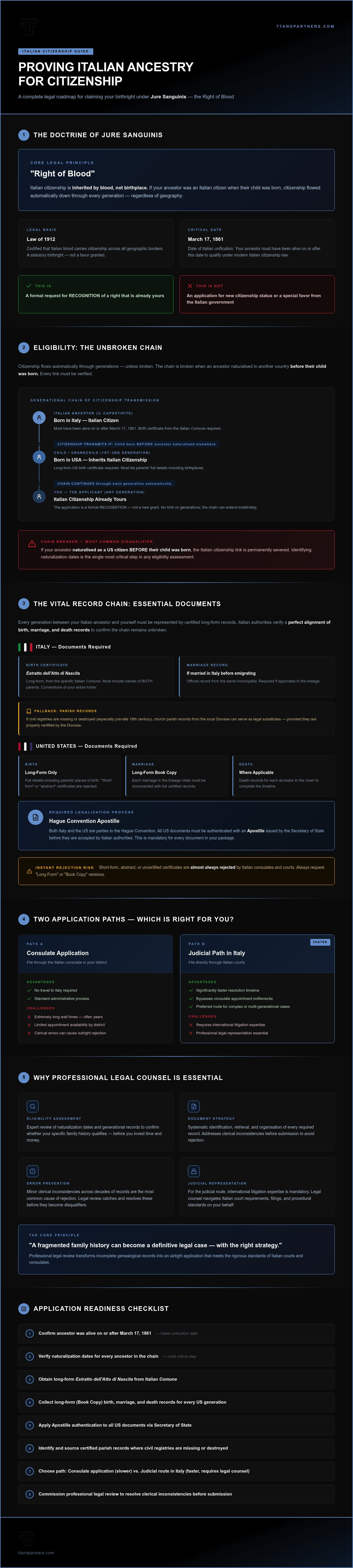
Italian citizenship rests on the principle of Jure Sanguinis, or the "right of blood." Unlike nations that grant citizenship based on the location of one's birth, Italy recognizes citizenship as an inherent trait passed from parent to child through the generations. This means that if your ancestor was an Italian citizen at the time of their child's birth, and that child never formally renounced the right, the citizenship flowed naturally down to you. It's a legal inheritance that exists regardless of whether you've ever stepped foot on Italian soil.
The process of proving Italian ancestry for citizenship is not an application for a new status. Instead, it's a formal request for the recognition of a right that's already yours. The Italian government requires a meticulous paper trail because they must verify that the chain remained legally intact at every generational transition. They aren't granting you a favor; they're certifying a biological and legal reality that has been part of your identity since birth.
The Legal Foundation of the Unbroken Chain
The transmission of this right is silent and automatic. Your parents or grandparents didn't need to file specific paperwork or "apply" for you to inherit this status. It exists as a latent legal reality within your lineage, waiting to be activated. Jure Sanguinis is a statutory birthright under the Law of 1912. This specific law codified the idea that Italian blood carries the weight of citizenship across geographic borders. To secure your recognition, you must demonstrate that no ancestor in your direct line ever voluntarily severed this connection before the next generation was born.
Who Qualifies? The Basic Eligibility Framework
The journey begins with your "Lira," the Italian-born ancestor who first emigrated from the peninsula. For a claim to be valid, this ancestor must have been alive on or after March 17, 1861, which marks the date of Italy's formal unification. If an ancestor passed away before this date, they were technically a citizen of a precursor state, such as the Kingdom of the Two Sicilies, rather than the modern Italian Republic. This temporal boundary is the first filter in any eligibility assessment.
Eligibility also hinges on the timing of naturalization. If your ancestor became a citizen of another country before their child was born, the chain was broken. Identifying these specific dates is the most critical step in determining if you qualify for recognition. Minor clerical errors or missing naturalization records are the most common disqualifiers, which is why a strategic legal review is essential to ensure your family's history meets the rigorous standards of the Italian courts and consulates.
The Vital Record Chain: Essential Documents for Proving Your Lineage
Proving Italian ancestry for citizenship isn't just a genealogical hobby; it's a rigorous legal reconstruction that requires an airtight paper trail. Every generation between your Italian-born ancestor and yourself must be represented by a series of long-form, certified vital records. These documents don't just provide names; they establish a seamless timeline that proves the citizenship was never interrupted. Italian authorities look for a perfect alignment of birth, marriage, and death records to confirm that the chain of Jure Sanguinis remains unbroken.
Document Requirements for the Italian Ancestor
The cornerstone of your folder is the Estratto dell’Atto di Nascita, a long-form birth certificate obtained from the specific Italian Comune where your ancestor was born. This document must include the names of both parents to be valid for citizenship purposes. If your ancestor married in Italy before emigrating, you'll also need the official marriage record from the same municipality. In cases where civil registries are missing or destroyed, particularly for births before the late 19th century, parish records from the local church can often serve as legal substitutes, provided they're properly certified by the Diocese.
The US Document Trail: Consistency and Legalization
In the United States, "Short Form" or "Abstract" certificates are almost always rejected by Italian consulates and courts. You must secure "Long Form" or "Book Copy" versions that contain the full details of the event, including the parents' places of birth. Once collected, these documents must undergo a process called legalization. Since Italy and the US are both parties to the Hague Convention, this is achieved through an Apostille. This certificate, issued by the Secretary of State, verifies the signature of the local official who issued the record, making it legally recognizable in Italy.
Discrepancies in names or dates are common in old records, often caused by phonetic spellings or clerical errors during the immigration process. These inconsistencies can lead to immediate denials if they aren't corrected through legal amendments or court orders. Professional oversight is often necessary to determine if a minor misspelling requires a formal correction or if it's within the acceptable margin of error for the Italian authorities. If you're encountering complex errors in your family records, it's wise to consult with a legal expert who understands the specific requirements of the Italian court system. Finally, every non-Italian document must be translated by a certified professional to ensure the legal terminology is accurately preserved in the target language.
The Naturalization Hurdle: Proving the Unbroken Link
The naturalization status of your Italian-born ancestor represents the most critical pivot point in the legal reconstruction of your lineage. While vital records confirm biological connections, naturalization records determine the legal continuity of citizenship. If your ancestor became a US citizen before the next person in your line was born, the chain was severed. This is why the specific date of naturalization is the ultimate factor in proving Italian ancestry for citizenship. It's a binary legal reality; either the citizenship was transmitted at birth, or it was lost before it could be passed down.
The "Minor Issue" remains a complex point of contention in Italian law. Historically, if an Italian father naturalized while his children were still minors, the Italian government argued that the children lost their Italian citizenship along with him. However, recent court rulings have challenged this interpretation. When no record of naturalization exists, you must provide certified "No Record" letters from both the United States Citizenship and Immigration Services (USCIS) and the National Archives (NARA) to prove your ancestor remained Italian until their death, which is a vital step in proving Italian ancestry for citizenship.
Identifying the Naturalization Date
A common point of confusion involves the multi-stage immigration process. The Declaration of Intention, or "first papers," did not strip an immigrant of their Italian status. Even the Petition for Naturalization was merely a formal request. The legal break only occurred on the date of the Oath of Allegiance. You can locate these definitive dates in federal archives or local county courts, depending on where your ancestor resided. Finding the specific certificate number and date is essential for a successful filing, as this marks the exact moment the Italian government considers the bond broken.
The 1948 Case: Overcoming Gender Discrimination
Before January 1, 1948, Italian women could not pass citizenship to their children. This discriminatory law meant that if your lineage involves a female ancestor whose child was born before this date, your path to citizenship through a consulate is typically blocked. The Italian Constitution of 1948 corrected this inequality, but it didn't apply retroactively to births before that year. To resolve this, you must pursue a judicial case in the Italian courts to have your rights recognized. For a more exhaustive look at this legal strategy, you can read about Reclaiming Italian Citizenship: The 1948 Case Law. These cases bypass consulate backlogs and are decided by judges who uphold the constitutional principle of gender equality.
Strategic Preparation: Organizing Your Application for Recognition
Gathering the necessary paperwork is a significant milestone, but the method of submission often dictates the success and speed of your recognition. When proving Italian ancestry for citizenship, you face a strategic choice between administrative and judicial routes. Each path requires a different level of preparation and carries distinct timelines that can impact your ultimate goal of securing a passport. The transition from a genealogical project to a legal reality hinges on how you present your folder to the authorities.
Consulate vs. Judicial Paths
Most applicants instinctively turn to the Italian Consulate serving their place of residence. This involves navigating the "Prenot@Mi" booking system, which is notorious for its lack of available appointments and multi-year backlogs. For those facing wait times that exceed the legal limit of 730 days, a judicial application in Italy may be a more efficient alternative. This "against the queue" lawsuit allows you to bypass the consulate entirely and have your case heard in an Italian court. A coordinated US-Italy legal strategy ensures that your documentation meets the high evidentiary standards required by Italian judges, who often provide a faster resolution than the overwhelmed consular network.
The Final Folder Review
Before any submission, a rigorous audit of your document folder is mandatory. Italian authorities have a zero-tolerance policy for inconsistencies. You must verify that names, birth dates, and places of origin are identical across every certificate in the chain. If your great-grandfather's name was anglicized from "Giovanni" to "John" on a US marriage record, you may need to seek a court order for a record amendment to maintain the legal link. This is a common hurdle when proving Italian ancestry for citizenship, as even minor phonetic shifts can raise doubts about the identity of the person in the chain.
Precision in translation is equally vital. Every non-Italian document must be rendered into Italian by experts who understand the nuances of legal terminology. A minor error in a translated birth record can lead to a formal rejection, forcing you to restart the process. To ensure your application is beyond reproach, it's highly recommended to engage an Italian Citizenship Lawyer: What to Look For for a comprehensive professional folder audit.
Once your citizenship is recognized, the final administrative step is registration with the Registry of Italians Residing Abroad, known as AIRE. This registration is a prerequisite for your passport application and ensures you're officially recognized as a citizen by the Italian Ministry of Foreign Affairs. This completes the transition from a descendant to a fully recognized citizen of the Italian Republic, granting you the freedom to live, work, and travel across the European Union.
Beyond Genealogy: Why Professional Legal Counsel is Essential
Proving Italian ancestry for citizenship is often mistaken for a simple genealogical pursuit. In reality, it's a rigorous legal reconstruction of a bloodline that must satisfy the exacting standards of both American record-keeping and Italian administrative law. While a family tree provides the narrative, only a legally sound document folder provides the proof. The margin for error is razor-thin; a single misspelled name on a manifest or a mismatched date on a birth certificate can lead to a formal rejection that halts years of effort.
Professional legal counsel acts as a critical safeguard against these technical failures. A law firm with dual-jurisdiction expertise doesn't just collect records; it interprets them through the lens of current Italian court rulings. This is especially vital when proving Italian ancestry for citizenship in complex scenarios, such as 1948 cases or appealing a consulate's decision. These disputes require a level of advocacy that goes far beyond what a standard document service can provide.
Navigating Cross-Border Legal Complexity
Effective communication with Italian Comuni and courts is the foundation of a successful application. Legal counsel manages these interactions with the precision required to enforce your rights. They bridge the gap between the chaotic nature of historical records and the structured demands of the Italian legal system. By proactively addressing discrepancies before they reach a judge or consular officer, you ensure your case is presented with the highest degree of authority. For deeper context on how these cross-border disputes are managed, our guide on International Litigation 2026 offers strategic insights.
Long-Term Strategic Benefits
Securing your recognition opens doors that extend well beyond a second passport. As a dual citizen, you gain full EU residency rights, allowing you to live, work, and invest across all member states without the need for complex visas. This status creates unique business opportunities and provides a stable foundation for your family's global future. Integrating Italian Citizenship into your broader business or immigration strategy is a visionary move that preserves your heritage while expanding your professional horizons. Professional guidance turns a family dream into a legal reality.
Securing Your Italian Legacy
The journey of reclaiming your heritage is a transition from personal history to a recognized legal status. Success in proving Italian ancestry for citizenship depends on the meticulous alignment of historical records with the rigorous demands of Italian law. By identifying critical naturalization dates and organizing a seamless document chain, you transform a fragmented family narrative into a definitive legal right. It's a process that requires both patience and a sophisticated understanding of cross-border regulations.
While administrative hurdles are significant, they aren't insurmountable. Strategic legal action, especially in complex 1948 cases or litigation against consulate backlogs, provides a clear path forward for those seeking the global benefits of an EU passport. Our firm brings decades of US-Italy cross-border legal expertise to bridge the gap between US records and Italian requirements; we offer comprehensive support from the initial search to the final passport application. The future of your dual citizenship starts with a precise, authoritative strategy.
Consult with our Italian Citizenship Attorneys today to begin the process of certifying your lineage. Your Italian heritage is a lifelong asset, and with the right professional guidance, your path to citizenship is finally within reach.
Frequently Asked Questions
How far back can I go to prove my Italian ancestry for citizenship?
The legal limit for claiming citizenship is tied to the birth of the Italian nation on March 17, 1861. Your Italian-born ancestor must have been alive on or after this date to be considered a citizen of the modern state. If they emigrated or passed away before unification, they were citizens of precursor states, which prevents the transmission of modern Italian rights. This serves as the chronological foundation for anyone proving Italian ancestry for citizenship.
What happens if my Italian ancestor naturalized before my parent was born?
If your ancestor naturalized in the United States before the birth of the next person in your direct line, the legal chain of citizenship was broken. In this scenario, the ancestor had formally renounced their Italian status before they could pass it to their child. Identifying the exact date of the Oath of Allegiance is vital, as it determines whether the child was born to an Italian citizen or a foreign national.
Do I need to speak Italian to apply for citizenship by descent?
No, there is currently no language proficiency requirement for those applying through Jure Sanguinis. While other paths, such as citizenship by marriage, require a certified B1 level of Italian, the right of blood is based solely on your lineage. You don't need to pass a test or demonstrate fluency to have your existing rights recognized. However, all your supporting US documents must be translated into Italian by certified professionals.
Can I apply for Italian citizenship if my ancestor was a woman?
Yes, you can apply through a female ancestor, but the date of her child's birth determines the procedure. If the child was born on or after January 1, 1948, you can apply through a consulate. If the birth occurred before this date, the case falls under the 1948 Rule due to historical gender discrimination. These specific cases cannot be handled by consulates and must be pursued through the Italian judicial system instead.
How long does the process of proving Italian ancestry typically take?
The timeline for proving Italian ancestry for citizenship depends heavily on the chosen application path and current administrative backlogs. Consular appointments in the United States often involve wait times exceeding two years just for the initial interview. Once you submit your folder, the consulate has up to 730 days to process the recognition. Judicial applications in Italy or cases based on residency can sometimes offer a more predictable schedule.
What is the "minor issue" and how does it affect my citizenship claim?
The minor issue refers to a legal theory where an Italian parent's naturalization automatically caused their minor children to lose Italian citizenship. This occurs if the child was under the age of 21, or 18, depending on the year, when the parent became a US citizen. While some consulates use this as a reason for denial, recent rulings from Italian courts have provided more favorable interpretations for applicants. Legal expertise is essential for navigating these disputes.
Can I apply in Italy instead of through a US consulate?
Yes, you have two primary ways to apply directly in Italy. The first involves establishing legal residency in an Italian municipality, which allows you to file your paperwork with the local town hall. The second is the judicial route, often used to bypass the extreme wait times at US consulates. This against the queue litigation is handled by Italian courts and doesn't require you to move to Italy during the legal proceedings.
What is an Apostille and why is it required for my US documents?
An Apostille is an international certification that authenticates the seals and signatures on public documents. Since Italy and the US are members of the Hague Convention, this specialized stamp allows Italian authorities to accept your US birth, marriage, and death records as legitimate. Without an Apostille issued by the Secretary of State, your American records have no legal standing in Italy. This step is a non-negotiable requirement for your final application folder.


Comments