

Green Card for Italian Citizens: 2026 Strategic Residency Guide
- Gianni Mendes Toniutti, Esq.

- Jul 15
- 12 min read
Securing a Green Card for Italian citizens is far more than a bureaucratic milestone; it's a deliberate act of architectural precision that must harmonize your professional ambitions with the preservation of your Italian legacy. For many, the prospect of permanent residency brings a sense of profound uncertainty, especially when weighing the benefits of a US lifestyle against the complexities of global taxation on European assets. You've likely realized that a simple visa transition, such as moving from an E-2 treaty status, requires a strategic vision that accounts for both legal compliance and long-term asset protection.
We promise to provide a clear, legally sound roadmap that navigates the latest 2026 USCIS regulations, including the implications of the May 2026 policy memorandum on adjustment of status. This guide examines the most efficient pathways through investment, employment, and family-based petitions, ensuring your family's relocation is as seamless as it is secure. We'll preview the essential steps for transitioning your business and protecting your wealth across borders, giving you the confidence to build a future in the United States without compromising your heritage or your financial stability.
Table of Contents
Navigating the Path to US Permanent Residency for Italians
For many Italian professionals and families, the United States represents a landscape of unmatched opportunity and architectural ambition. While the initial journey often begins with a temporary "visto," the transition to a U.S. Permanent Resident Card marks a profound shift in both legal status and personal identity. This document, commonly known as a Green Card, serves as the definitive legal gateway to living and working permanently in the U.S. without the recurring anxiety of visa renewals. It's the moment where a temporary stay evolves into a lasting legacy, allowing you to plant roots while maintaining the cultural and legal ties to your homeland.
Securing a Green Card for Italian citizens is a process that demands intellectual rigor and strategic foresight. Most Italian nationals don't jump directly into permanent residency. Instead, they often utilize non-immigrant visas as a tactical entry point. This phased approach allows for the establishment of businesses or careers under the protection of historic bilateral agreements. However, the emotional and professional shift from a guest status to "residenza permanente" is significant. It moves the focus from short-term compliance to long-term wealth preservation and family stability.
The Strategic Advantage of the US-Italy Treaty
The relationship between Italy and the United States is anchored by the 1948 Treaty of Friendship, Commerce and Navigation. This historic agreement provides a unique framework that facilitates the movement of Italian entrepreneurs and specialists. While visas like the E-1 or E-2 are strictly non-immigrant, meaning they don't lead directly to residency, they provide the essential "waiting room" where a residency strategy can be built. Understanding the "dual intent" doctrine is vital here. It allows certain visa holders to maintain their current status while actively pursuing permanent residency, provided the legal architecture is constructed correctly from the outset.
Green Card vs. Citizenship: What Italians Need to Know
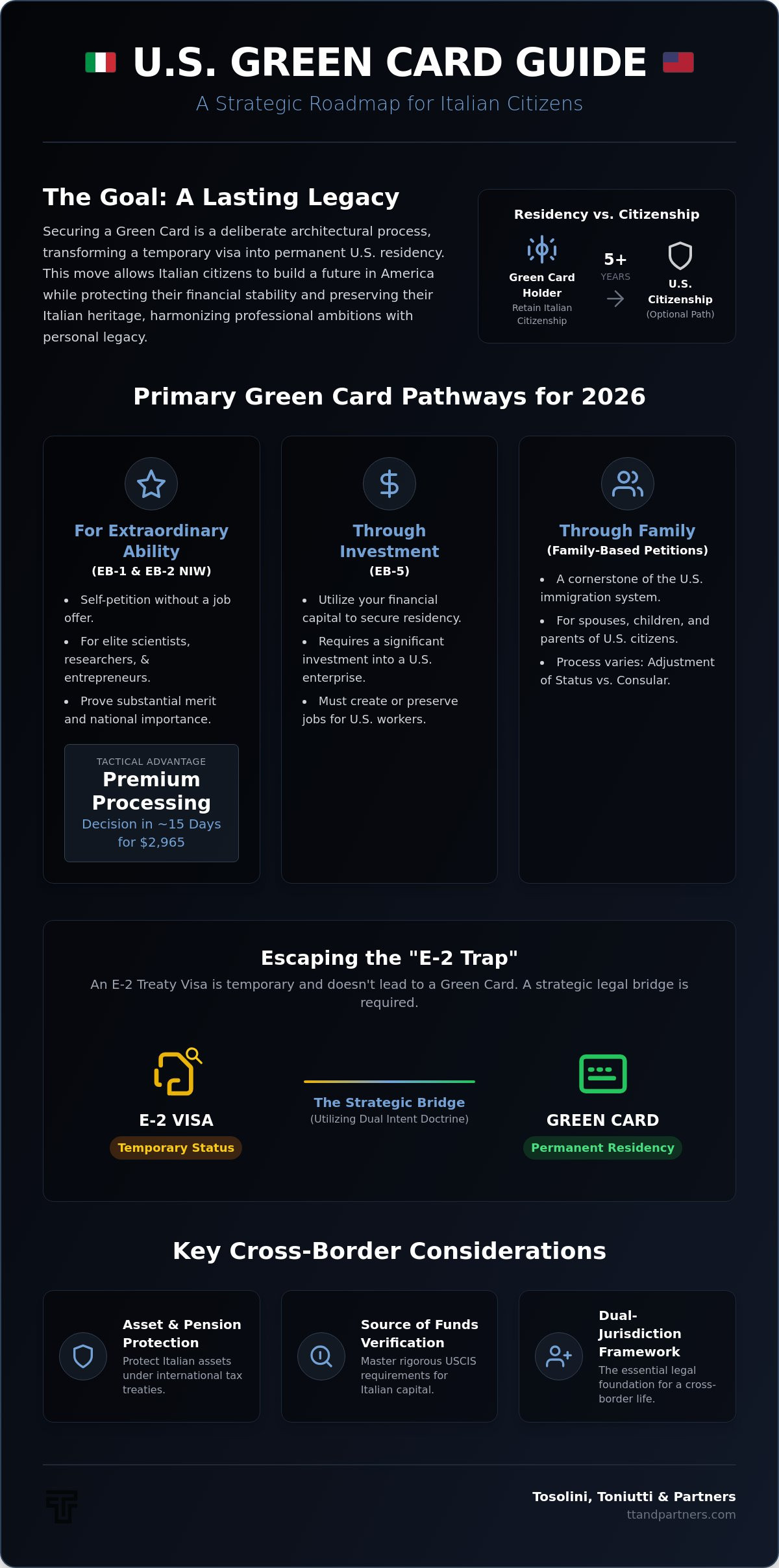
A common concern among our clients is whether obtaining a Green Card requires surrendering an Italian passport. It doesn't. Permanent residency allows you to retain your Italian citizenship while granting you nearly all the rights of a US citizen, including social security benefits, employment flexibility across any industry, and the freedom to travel. Once you've held residency for five years, the path to naturalization opens. This timeline offers a structured progression, giving you ample space to harmonize your global assets before deciding on full citizenship. If you're ready to design your residency strategy, you can reach out to our team at Tosolini, Toniutti & Partners for a professional consultation.
Primary Green Card Pathways for Italian Nationals in 2026
Choosing the right immigration strategy requires a deep understanding of the official Green Card eligibility categories and how they align with your professional or personal profile. For many, the journey involves selecting between employment-based merit, investment capital, or family reunification. Each path offers a distinct legal architecture. While some Italian applicants rely on corporate sponsorship, others utilize their own intellectual or financial capital to secure a Green Card for Italian citizens without needing a traditional employer.
EB-1 and EB-2 NIW: For Italians with Extraordinary Ability
Professional mobility often hinges on the EB-1A and EB-2 National Interest Waiver (NIW) categories. These are particularly attractive because they allow Italian scientists, researchers, and high-level entrepreneurs to self-petition. You don't need a specific job offer if you can demonstrate that your work has substantial merit and national importance. In the 2026 landscape, the use of premium processing for Form I-140 has become a standard tactical move. With a filing fee of $2,965, this service provides a decision within 15 days, offering a significant advantage in a system where standard processing times remain fluid. This pathway rewards those who have built a distinguished career in Italy and wish to export that expertise to the American market.
Family Reunification: Spouses and Relatives
Family-based sponsorship remains a cornerstone of the US immigration system. For an Italian spouse of a US citizen, the decision between Adjustment of Status and Consular Processing has become more nuanced following the May 2026 USCIS policy memorandum. This update instructs officers to view adjustment of status as an extraordinary form of relief, which may nudge more applicants toward processing their visas through the US Consulate in Naples. Whether pursuing the K-1 fiancé pathway or the CR-1 marriage visa, proving a "bona fide" relationship is essential. This involves meticulous documentation of shared lives, assets, and intentions to prevent any administrative delays.
Beyond professional and family ties, other avenues exist for those with specific circumstances:
EB-5 Immigrant Investor Program: This requires a minimum investment of $1,050,000, or $800,000 if the project is located in a Targeted Employment Area (TEA). It's a direct route to residency for those with the necessary capital.
EB-3 Category: Aimed at skilled workers and professionals who have a permanent job offer from a US employer.
Diversity Visa Lottery: While statistically challenging, it remains an option. For the DV-2026 cycle, 267 Italian entrants were selected from over 20 million global entries.
If you're evaluating which pathway aligns with your long-term objectives, discussing your case with a legal strategist can clarify the most efficient route for your specific situation.
The Bridge Strategy: Transitioning from E-2 Visa to Green Card
Many Italian entrepreneurs enter the United States on an E-2 treaty investor visa, drawn by its flexibility and the historic bilateral ties between Rome and Washington. However, this often leads to what professionals call the "E-2 Trap." While renewable indefinitely, the E-2 is a non-immigrant visa that never matures into permanent residency on its own. For those seeking a Green Card for Italian citizens, the E-2 should be viewed as a temporary foundation, not the final structure. It's a treadmill that requires constant movement just to stay in place. Without a deliberate bridge strategy designed early in the process, you remain vulnerable to business fluctuations or shifts in treaty regulations.
Transitioning requires a sophisticated shift in your corporate and legal architecture. While an LLC incorporation is often the default choice for initial E-2 investments due to tax simplicity, a C-Corp structure might offer more robust advantages when moving toward an EB-1C or EB-5 pathway. Early planning is essential to manage the legal concept of "immigrant intent." Since the E-2 visa doesn't technically support dual intent, filing for residency while traveling frequently can lead to complications at the border. You must build your bridge before you attempt to cross it.
Comparing E-2 to EB-5 and EB-1C
The choice of bridge depends on your capital and corporate history. For Italian company expansions, the EB-1C pathway for multinational managers is often the most elegant solution. If you've managed a business in Italy for at least one of the last three years, you can transition your US subsidiary into a permanent residency sponsor. Alternatively, the "Direct EB-5" option allows E-2 owners to credit their initial investment toward the higher EB-5 thresholds if they meet job creation requirements.
E-2 Treaty Investor: Substantial investment required; no fixed job count; no direct path to residency.
EB-5 Investor: $1,050,000 minimum ($800,000 in TEA); 10 permanent jobs required; direct path to Green Card.
EB-1C Multinational Manager: Requires Italian parent company; no fixed investment amount; direct path to residency.
Managing the Transition Period
Once you file Form I-485 to adjust your status, your E-2 remains your primary safety net. You must maintain this status meticulously until the residency is approved. Travel becomes a strategic decision during this phase. You'll need "Advance Parole" (Form I-131, which carries a $630 fee in 2026) to leave the US without abandoning your application. For Italian business owners who frequently cross the Atlantic to manage assets in Milan or Rome, this document is the oxygen of your relocation strategy. Ensuring your travel dates don't conflict with USCIS appointments is a matter of logistical precision. If you're ready to design your bridge, consult with our team to ensure your transition is seamless and secure.
Cross-Border Hurdles: Tax, Real Estate, and Source of Funds
Transitioning to a new life in the United States requires more than just legal eligibility; it demands a comprehensive audit of your financial architecture. When seeking a Green Card for Italian citizens, the most rigorous challenge often lies in the "Source of Funds" requirement. USCIS mandates a transparent, documented trail for every Euro used in investment-based applications. Whether your capital originates from a family inheritance in Tuscany or the sale of a corporate entity in Milan, you must provide an unbroken chain of custody that satisfies stringent anti-money laundering standards. This process often involves tracing funds back several years to ensure every transaction is beyond reproach.
Navigating the US-Italy Tax Treaty is equally vital to protect your legacy. Without strategic planning, you risk double taxation on Italian property or pensions. Italian residents are familiar with the IVIE (Imposta sul Valore degli Immobili situati all'Estero), but once you become a US tax resident, your reporting obligations shift significantly. You'll need to harmonize your Italian real estate holdings with US requirements while ensuring that your Italian legal documents, such as an "Atto Notarile," are professionally translated and certified to meet federal expectations. This ensures that your assets are recognized and protected under both jurisdictions.
Tax Residency and the "Worldwide Income" Rule
The moment you receive your residency, you're classified as a US tax resident. This means the IRS taxes your worldwide income, regardless of where it's earned. For high-net-worth Italians, pre-immigration tax planning isn't optional; it's a necessity. This global reporting requirement extends to all forms of wealth, and firms like Tax Partners emphasize that even unexpected international gains, such as lottery winnings from Canadian sources, must be carefully integrated into your overall tax strategy. You must account for FBAR and FATCA reporting for your Italian bank accounts. For the 2026 tax year, the Foreign Earned Income Exclusion is set at $132,900, which offers some relief, but it doesn't cover all global assets. You should also be aware of the "8-year rule," where relinquishing your status after eight of the last fifteen tax years could trigger a significant exit tax on your global holdings.
Documenting Italian Assets for US Immigration
Properly documenting the sale of property or business dividends in Italy requires a deep understanding of both legal systems. The "Atto Notarile" serves as a foundational piece of evidence in this process. When verifying funds, you must demonstrate the initial acquisition of the asset, even if it occurred decades ago. This often involves digging into historical records and tax returns to prove that the original capital was earned legally. If your relocation involves complex cross-border assets and you need to ensure your financial transition is handled with precision, contact our legal team to design a strategy that protects your wealth while satisfying USCIS requirements.
Professional Support for Your US-Italy Relocation
Relocating across the Atlantic is a sophisticated act of creation that requires more than just a passing knowledge of immigration forms. It demands a legal partner who understands the intellectual and cultural nuances of both the Italian and American systems. Choosing a boutique firm with specialized expertise in cross-border transitions is essential for Italians who value precision and long-term stability. At Tosolini, Toniutti & Partners, we serve as the architectural bridge between your current life in Italy and your future residency in the United States. Our approach isn't about high-volume processing; it's about designing a bespoke strategy that respects your professional heritage while securing your place in the American market.
As you look toward 2026, the complexity of US immigration law continues to evolve. Navigating the path to a Green Card for Italian citizens requires a firm that can manage the intricate interplay between business goals, family needs, and international tax obligations. We provide the professional scaffolding necessary to ensure your transition is not only successful but also harmonious with your existing global commitments. By integrating legal foresight with a deep appreciation for the Italian-American experience, we help you avoid the common pitfalls that often derail unguided relocation efforts.
Tailored Legal Architecture for Italian Clients
Our firm handles the complex cross-border litigation and business setup that many general practice firms overlook. We offer a "white glove" service that addresses the specific needs of high-net-worth individuals and entrepreneurs. This includes everything from initial visa selection to the strategic management of your corporate presence. If you're ready to move beyond temporary status and want to explore a comprehensive residency plan, you can Contact Tosolini, Toniutti & Partners for a strategic consultation that addresses your unique legal profile.
Beyond the Visa: Building Your Life in the US
A successful transition involves more than just obtaining a Green Card for Italian citizens; it's about establishing a secure foundation for your family and your business. Our comprehensive services extend to supporting real estate closings and professional LLC incorporation. We ensure that your property acquisitions and business entities are structured correctly from day one, protecting your assets and maintaining your legal health in a foreign jurisdiction. Securing your future in the United States requires a partner who speaks your language, both literally and legally. We invite you to begin your 2026 residency evaluation with a team that values the quality of your results as much as you do.
As you settle into your new community, it is also wise to identify local legal resources for personal matters; for example, those relocating to Florida can rely on Fenderson Law Firm for dedicated assistance with personal injury and liability concerns.
Designing Your American Legacy in 2026
Securing a Green Card for Italian citizens is a transformative achievement that demands a sophisticated legal architecture. The transition from temporary status to permanent residency isn't a simple administrative task; it's a strategic evolution of your personal and professional presence in the United States. Whether you're bridging from an E-2 treaty visa or leveraging extraordinary talent through an EB-1 petition, success hinges on your ability to harmonize Italian asset protection with American regulatory requirements. Our decades of experience in US-Italy cross-border law provide the bilingual support and technical precision necessary for these high-stakes transitions.
The 2026 immigration landscape rewards those who plan with foresight and intellectual rigor. By addressing source-of-funds verification and tax residency early, you ensure your family's future remains secure across both jurisdictions. We invite you to schedule a strategic consultation for your US Green Card to begin building your roadmap with confidence. Your American legacy is a structure worth building with the finest legal tools available, and we're here to help you lay the first stone.
Frequently Asked Questions
Can an Italian citizen apply for a Green Card through the Diversity Lottery?
Yes, Italian citizens are fully eligible for the Diversity Visa Program. For the DV-2026 cycle, 267 Italian entrants were selected from a pool of over 20 million global entries. While the statistical probability is low, it remains a viable option for those who meet the minimum education or work experience requirements. Winners must complete their interviews and receive their visas by September 30, 2026.
How much does it cost for a Green Card application for an Italian citizen in 2026?
Total government fees depend on your pathway and filing location. For those already in the US, the Form I-485 fee is $1,440. Consular processing involves a $325 visa fee and a $235 USCIS immigrant fee. If your strategy requires premium processing for an employment petition, the fee is $2,965 as of March 1, 2026. Medical examinations and biometric services add approximately $200 to $500 in additional costs.
Is it possible to move from an E-2 Visa to a Green Card?
Yes, you can transition by utilizing specific legal bridges such as the EB-1C for multinational managers or the EB-2 National Interest Waiver. Because the E-2 is a non-immigrant visa, it doesn't lead to residency automatically. You must file a separate immigrant petition that proves eligibility under a permanent category. This shift requires careful timing to maintain valid status while your adjustment of status application is pending.
Do I lose my Italian citizenship if I get a US Green Card?
No, obtaining a Green Card for Italian citizens does not affect your Italian nationality. Italy has recognized dual citizenship since 1992, allowing you to retain your Italian passport while holding permanent residency in the US. You can continue to renew your Italian documents and exercise your rights as a citizen of the European Union while building a permanent life and career in the United States.
How long does the Green Card process take for Italians?
Timelines vary based on the specific visa category and current USCIS backlogs. As of July 2026, I-130 petitions for immediate relatives of US citizens generally take 10 to 18 months. Employment-based categories often move faster if you utilize premium processing for the initial petition. However, family preference categories for adult children or siblings can involve wait times that extend for several years due to annual visa caps.
What are the tax implications for an Italian citizen holding a US Green Card?
Becoming a permanent resident triggers US tax residency on your worldwide income. You'll need to report all global assets, including Italian bank accounts and real estate, under FBAR and FATCA regulations. The US-Italy Tax Treaty helps prevent double taxation, but you must still file annual returns in the US. If you hold residency for at least 8 of the last 15 years, you may also face exit tax obligations.
Can I include my family in my Green Card application?
Yes, your spouse and unmarried children under age 21 are typically included as derivative beneficiaries in employment and investment-based applications. They'll receive their residency status at the same time you do, allowing the entire family to relocate together. For family-based sponsorship, the rules differ depending on whether the petitioner is a US citizen or a permanent resident, which affects the priority dates and overall waiting periods.
Do I need a lawyer to apply for a Green Card, or can I do it myself?
While you aren't legally required to hire an attorney, the complexity of cross-border law makes professional guidance vital. Documenting the legal source of funds from Italy and navigating the interaction between US and Italian tax systems requires technical precision. A specialized firm ensures that your application satisfies rigorous USCIS standards while protecting your assets and ensuring your long-term business architecture remains sound throughout the relocation process.


Comments