

Guide to Choosing an Italian Citizenship Lawyer
- Gianni Mendes Toniutti, Esq.

- Jul 28
- 11 min read
Your path to an Italian passport isn't just a bureaucratic checklist; it's a strategic architectural project that bridges two distinct legal worlds. You likely understand that securing dual status involves more than just submitting paperwork. It requires harmonizing US immigration needs with Italian civil law, often while managing business interests or real estate across borders. Partnering with a specialized Italian citizenship lawyer Miami who understands this dual-jurisdiction complexity is the difference between a seamless transition and years of administrative stagnation. With the March 2025 legal reforms tightening descent requirements, the margin for error has effectively disappeared.
We recognize that you seek more than just a service; you're looking for legal certainty in a landscape of conflicting advice regarding taxation and residency. This guide provides a strategic framework to help you master the complexities of US-Italy immigration and citizenship. You'll learn how to choose expert representation that handles everything from 1948 court cases to O-1 visas and international litigation with technical precision. We'll explore the essential criteria for selecting a partner who can align your personal heritage with your professional and investment goals across the Atlantic.
Table of Contents
The Strategic Role of an Italian Citizenship Lawyer in 2026
The pursuit of dual status is an exercise in structural integrity where the legal foundations must be laid with absolute precision. In 2026, the role of an Italian citizenship lawyer Miami has evolved from a mere facilitator of paperwork into a high-stakes legal strategist. This transformation is driven by the increasing complexity of Italian nationality law, particularly following the restrictive measures introduced by Decree-Law No. 36 in March 2025. A cross-border attorney serves as a strategic architect for international mobility, designing legal frameworks that withstand the friction of dual-jurisdiction compliance.
Securing citizenship through Jure Sanguinis or the "1948 Rule" demands more than genealogical proof. It requires specialized court litigation experience to navigate the Italian judicial system, where cases are now distributed across regional courts rather than centralized in Rome. For those in Florida, an Italian citizenship lawyer Miami acts as a vital bridge, ensuring that vital records from US jurisdictions meet the exacting standards of Italian civil law while simultaneously addressing the intersection of US immigration status and Italian residency requirements.
Navigating the US-Italy Legal Corridor
Successful citizenship acquisition relies on understanding the delicate interplay between the US Department of State and Italian Consulates. We operate at the intersection of Common Law and Civil Law, two systems that often speak different legal languages. Consular appointments in major US hubs remain scarce, forcing many to seek judicial alternatives. This shift requires a legal partner who can maneuver through the Italian regional courts with the same dexterity they apply to US administrative law. A minor clerical error in a Florida birth certificate or an improperly executed Apostille can trigger a cascade of delays. When these systems clash, the result is often a bureaucratic stalemate. Errors in one country don't just delay a passport; they can jeopardize your tax status or residency rights in the other.
The Evolution of Citizenship Laws in 2026
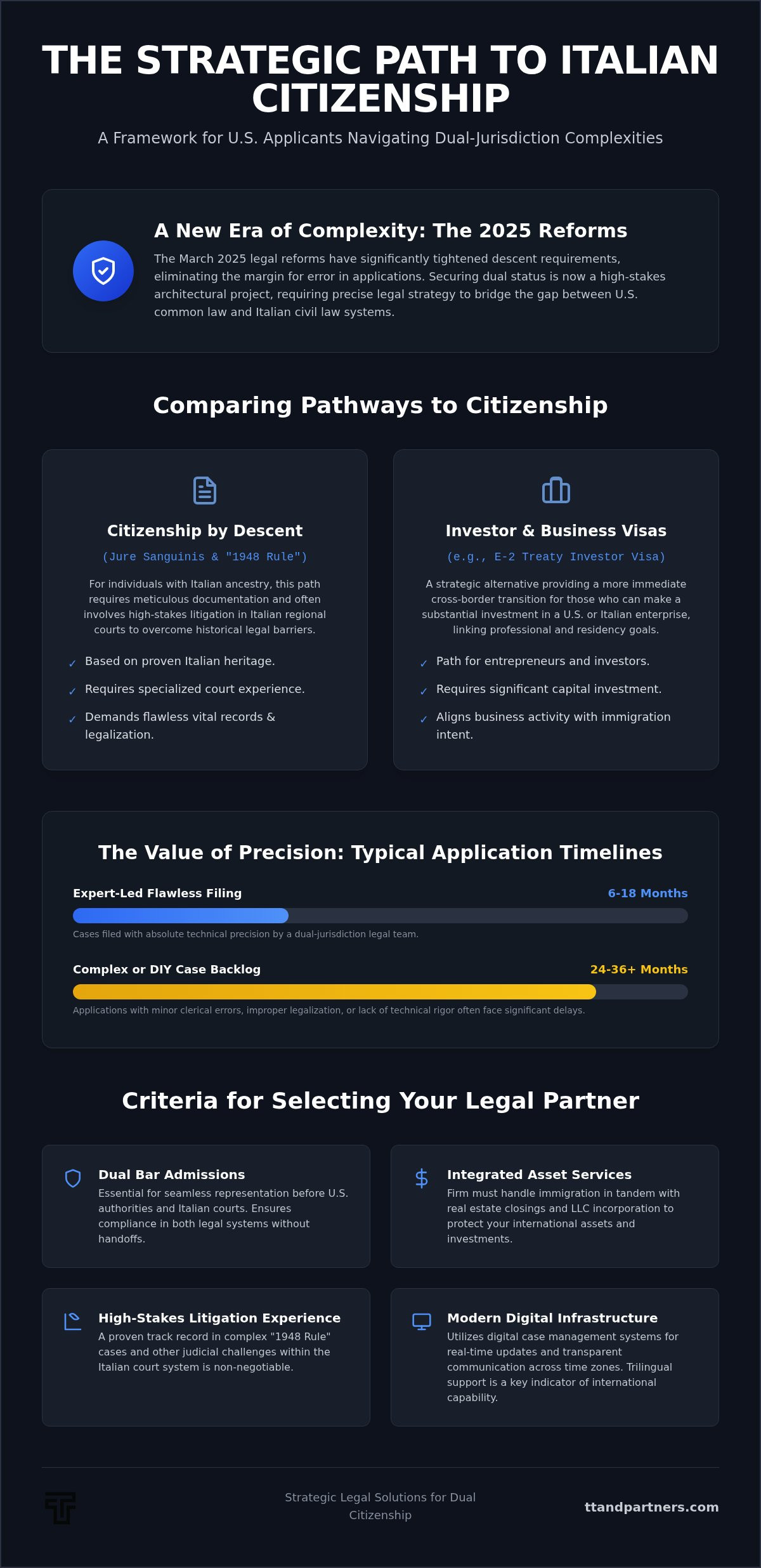
The landscape has shifted significantly with the full digitalization of the Italian court system. While this has streamlined some processes, it has also heightened the transparency requirements for dual nationals. As of 2026, the Italian government utilizes advanced cross-referencing to verify residency and tax compliance. The March 2025 reforms prioritize closer, more immediate ties to Italy, making the documentation phase more rigorous than in previous decades. "DIY" applications frequently fail because they lack the technical rigor required to meet these evolving administrative standards. For instance, 1948 cases now typically see processing times of 6 to 18 months, but only if the initial filing is flawless. Without professional oversight, applicants risk falling into the 24 to 36 month backlog typical of complex naturalization cases.
Criteria for Selecting an Italian Immigration Attorney
Selecting legal counsel for a cross-border transition is an exercise in structural alignment. A practitioner's credentials must reflect the dual nature of your journey. Presence in both the United States and Italy isn't a luxury; it's a non-negotiable asset. An Italian citizenship lawyer Miami must possess bar admissions in both jurisdictions to provide a unified legal defense. This ensures they can represent your interests before the Italian Consulate General in New York or regional courts in Italy while maintaining a sophisticated practice in Florida. Trilingual support and digital case management systems are the modern standards that allow for real-time updates across time zones.
High-stakes transitions often involve more than just bloodline claims. If you're an investor, your attorney must demonstrate a proven track record in securing the E-2 Visa. Beyond the visa itself, the firm should manage ancillary needs like LLC incorporation and real estate closings. This holistic perspective ensures that your business architecture and personal status are built on the same resilient foundation. When your legal partner understands the full scope of your international footprint, they can anticipate hurdles before they manifest as delays.
Technical Expertise vs. Administrative Support
You need a litigator, not just a document preparer. This distinction is critical for 1948 cases, which are judicial challenges to gender discrimination in past laws. These cases require an advocate who can argue complex points of constitutional law in Italian courts. Additionally, evaluate the firm's experience with the Permesso di Soggiorno. Mastery of residency permits and the Visto per Residenza Elettiva is essential for those seeking a lifestyle shift without immediate work intent. A specialized Italian citizenship lawyer Miami will bridge these technical gaps with ease.
Evaluating Cross-Border Business Experience
Success in the global market hinges on the ability to handle E-1 Treaty Trader Visas alongside citizenship matters. A major red flag is a firm that ignores the tax treaty implications between the US and Italy. Comprehensive support means your corporate structure and real estate portfolio are protected in both legal systems. If you're ready to secure your international future, consulting with a strategic legal partner can provide the technical precision your case deserves.
Comparing Pathways: Citizenship by Descent vs. Investor Visas
Choosing between heritage-based citizenship and investment-led residency is a decision that shapes your family's global architecture for generations. While heritage remains a powerful motivator, the administrative hurdles of 2026 require a more nuanced approach to international status. Since the March 2025 legal reforms, Jure Sanguinis (bloodline) applications have become significantly more restrictive, generally limiting new claims to those with a parent or grandparent who held Italian citizenship. This shift makes the initial diagnostic phase critical. An Italian citizenship lawyer Miami acts as a strategic filter, determining if your lineage remains viable under the new generational limits or if an investor pathway offers a more certain trajectory for your goals.
For many, the standard consular route isn't the only option. High-achieving individuals often find that the O-1 Visa for Entrepreneurs provides a faster entry into the US market than waiting for a citizenship appointment. Conversely, Italian citizens can leverage their status to access the E-2 Investor Visa, a treaty-based category that allows for substantial business expansion in the United States. As Forbes on Italian Citizenship for Americans highlights, the growing interest in these dual-status strategies reflects a desire for both cultural connection and practical mobility. Your choice depends on whether you value the permanence of a passport or the immediate utility of a business visa.
The 1948 Case: A Specialized Litigation Pathway
The "1948 Rule" remains a vital judicial avenue for descendants of Italian women who had children before January 1, 1948. These cases are unique because they cannot be handled at a consulate; they require a formal challenge to historical gender discrimination within the Italian civil court system. In 2026, these judicial claims are processed in regional courts, with expected timelines ranging from 6 to 18 months from the date of filing. Success rates remain high for well-documented cases, but they demand the precision of an Italian citizenship lawyer Miami who is comfortable navigating foreign litigation. This pathway bypasses the multi-year wait times at major consulates, offering a structured, court-monitored timeline.
Investor Strategies: E-2 and O-1 Synergies
Italian citizenship facilitates specific US treaty visas that aren't available to all nationalities. The E-2 visa requires a "substantial investment" in a US enterprise, and for Italians, this remains a premier method for establishing residency through commerce. The synergy between these categories allows for a sophisticated transition from non-immigrant status to a Green Card. This strategic layering ensures that your legal status evolves alongside your business success, providing a seamless bridge between the European and American markets.
The Advantage of Integrated Business and Real Estate Services
A successful cross-border transition is rarely limited to a single passport or visa. It involves the meticulous coordination of assets, business entities, and residential foundations. When acquiring property in Italy or establishing a commercial presence in Florida, real estate closings must be handled with a clear immigration intent. An Italian citizenship lawyer Miami ensures that these transactions aren't isolated events but strategic components of your broader legal architecture. This holistic approach prevents the common pitfall where a property purchase fails to meet the specific requirements for a residency permit or a business visa.
Protecting these international interests requires a firm capable of international litigation. Disputes involving cross-border assets or inheritance require a deep understanding of both US and Italian civil codes. Simultaneously, for those pursuing investor-class visas, LLC formation serves as a prerequisite. It's the structural vehicle that carries your investment into the US market. Managing the Permesso di Soggiorno for property owners in Italy further bridges the gap between ownership and the right to inhabit the space you've built.
Cross-Border Corporate Architecture
Structuring US entities for Italian parent companies requires a delicate balance of governance standards. It's not enough to simply register a company; the architecture must support international tax compliance and operational fluidity. Securing an EIN and establishing robust banking relationships for non-resident investors are foundational steps that often prove difficult without specialized guidance. These elements ensure your corporate presence is respected by both the IRS and Italian authorities, providing the legal certainty necessary for long-term growth.
Real Estate as an Immigration Anchor
Securing Your Status: The Legal Engagement Process
The engagement begins with a diagnostic mapping of your current legal standing against your long-term vision. This isn't a mere intake form; it's a strategic architectural review. An Italian citizenship lawyer Miami will evaluate the convergence of your ancestry and business objectives to determine the most resilient path forward. Whether your goal is the acquisition of an Italian passport or the establishment of a US presence through an E-1 or E-2 visa, the initial phase focuses on identifying potential structural weaknesses in your documentation or corporate setup before they become administrative hurdles.
The technical execution of your case involves document procurement and legalization across two continents. This includes obtaining Apostilles for US vital records and ensuring Italian certificates meet the specific requirements of the relevant municipality or court. Choosing between the consulate and judicial routes is a tactical decision based on current wait times and the strength of your legal claim. In 2026, the digitalization of Italian records has accelerated some aspects, yet the administrative burden of proof remains high. An Italian citizenship lawyer Miami ensures your filing strategy is optimized for the specific regional court or consulate handling your case.
Onboarding and Strategic Planning
Preparing for your first consultation requires gathering existing vital records and a clear summary of your cross-border business interests. During this phase, we establish realistic timelines for major milestones, such as document retrieval or court filings in Italy. Understanding the investment in professional counsel is essential. Fee structures reflect the complexity of a dual-jurisdiction practice that handles everything from genealogy to international litigation. We move beyond administrative support to offer a roadmap that accounts for the 6 to 18 month timelines typical of judicial cases and the multi-year horizons of consular applications.
The Path Forward
Securing your Italian passport or US Green Card is the start of a new chapter, not its conclusion. Post-immigration support is vital for maintaining your status through the renewal of residency permits like the Permesso di Soggiorno. We also provide guidance on tax residency implications and corporate maintenance for your LLC or Italian entity. This holistic approach ensures that your international mobility remains a sustainable asset. If you're ready to define your future across borders, contact Tosolini, Toniutti & Partners to begin your cross-border journey with technical precision and strategic foresight.
Building Your Transatlantic Legacy
Navigating the US-Italy legal corridor requires more than administrative diligence; it demands a strategic architecture that aligns your heritage with your professional and investment goals. By understanding the nuances of judicial citizenship claims and the technical requirements of investor visas, you transform a complex bureaucratic process into a seamless transition. A specialized Italian citizenship lawyer Miami acts as the essential bridge, ensuring that your corporate entities, real estate holdings, and personal status are integrated into a single, resilient framework.
With decades of experience in US-Italy immigration, we offer a specialized mastery of E-2 and O-1 visa categories alongside comprehensive support for corporate and real estate transactions. This holistic approach provides the legal certainty necessary to protect your assets and secure your family's future across borders. We're committed to the precision and integrity of your international journey.
Your path toward dual status is a profound step toward global mobility, and we're here to ensure every detail of that foundation is built to last.
Frequently Asked Questions
How long does it take to get Italian citizenship by descent in 2026?
Timelines depend on the application route you choose. For judicial claims processed through regional courts, expect a timeframe of 6 to 18 months from the date of filing. Consular applications in major US cities often face longer backlogs, sometimes extending between 2 and 4 years. Gathering your vital records and securing Apostilles typically adds another 3 to 6 months to the initial preparation phase.
Do I need to live in Italy to claim Italian dual citizenship?
You don't need to reside in Italy if you're applying through Jure Sanguinis or a 1948 judicial case. These claims can be managed from abroad through the appropriate consulate or a legal representative in the Italian courts. Conversely, citizenship through naturalization requires a minimum of 10 years of legal residency for non-EU citizens, alongside proof of tax compliance and social integration.
Can an Italian citizenship lawyer help with a US E-2 investor visa?
An Italian citizenship lawyer Miami is uniquely positioned to bridge these two legal systems. Because Italy maintains a commerce treaty with the United States, obtaining Italian citizenship can serve as a prerequisite for the E-2 visa. This allows you to establish a US business with a substantial investment, providing a strategic pathway for Italian nationals to reside and work in the American market.
What is a 1948 case and why does it require an Italian lawyer?
A 1948 case is a judicial challenge for descendants of Italian women who had children before January 1, 1948. Prior to this date, Italian law didn't permit women to pass citizenship to their offspring. Because this involves overturning historical gender discrimination, these cases can't be handled by consulates. They require a litigator to present the claim before a regional civil court in Italy to recognize your bloodline rights.
What are the benefits of having an Italian passport for a US citizen?
An Italian passport offers unrestricted access to live, work, and study across all 27 European Union member states. It simplifies the process of purchasing real estate in Italy and provides access to high-quality healthcare and education systems. For many, it's a tool for generational mobility, allowing your children to move between the US and Europe with complete legal flexibility and certainty.
How much does an Italian citizenship lawyer cost for a judicial claim?
Professional fees for an Italian citizenship lawyer Miami vary based on the number of applicants and the complexity of the genealogical research. Beyond legal representation, you must account for mandatory government expenses. As of January 1, 2025, the application fee for Italian citizenship is €600 per adult. Judicial cases also involve court filing fees and costs for certified translations and Apostilles for every vital record.
Can I buy property in Italy to get a residency permit?
Purchasing property is a foundational step for the Elective Residency Visa, but it doesn't automatically grant citizenship. This permit is designed for individuals who can prove sufficient passive income to live in Italy without local employment. Property ownership serves as a strong indicator of your intent to reside, helping you secure the Permesso di Soggiorno while you work toward long-term residency or naturalization.
What is the difference between Jure Sanguinis and Naturalization?
Jure Sanguinis is citizenship by bloodline, based on the principle that citizenship is passed from parent to child regardless of birthplace. Under the March 2025 reforms, this is generally limited to those with a parent or grandparent who was an Italian citizen. Naturalization is a residency-based path that requires passing a B1 level Italian language test and paying a €250 mandatory contribution fee during the application process.


Comments