

Legal Steps for US Market Entry for Italian Business: The 2026 Strategic Roadmap
- Gianni Mendes Toniutti, Esq.

- May 31
- 13 min read
What if the success of your American expansion depends less on your product's quality and more on the invisible architecture of your corporate and immigration strategy? You likely understand that moving from Italy's civil law tradition to the intricate 50-state regulatory patchwork of the United States presents a unique intellectual challenge. Mastering the legal steps for US market entry for Italian business is not a matter of simple registration. It's a synchronized effort between structural compliance and treaty rights.
We'll guide you through a comprehensive legal framework designed for the 2026 landscape, where the US remains the premier global investment destination. You'll learn how to harmonize LLC incorporation with specific visa timelines, ensuring your leadership team arrives with the authority to scale. This roadmap previews the essential sequence of actions, from managing the updated $400 Delaware annual tax to securing E-1 or E-2 visas, creating a compliant and resilient foundation for your transatlantic vision.
Key Takeaways
Determine whether an LLC or C-Corp offers the superior structural harmony for your Italian parent company’s tax and operational goals.
Master the essential legal steps for US market entry for Italian business by synchronizing your corporate formation with E-1 and E-2 treaty visa requirements.
Navigate the administrative landscape of 2026, including the acquisition of an EIN and the evolving requirements for securing US business banking for non-residents.
Protect your transatlantic investment by understanding the nuances of "at-will" employment and establishing robust intellectual property safeguards.
Follow a phased, two-quarter roadmap that moves from strategic pre-entry planning to a fully operational and compliant US entity.
Table of Contents
Strategic Architecture: Choosing the Optimal US Legal Structure
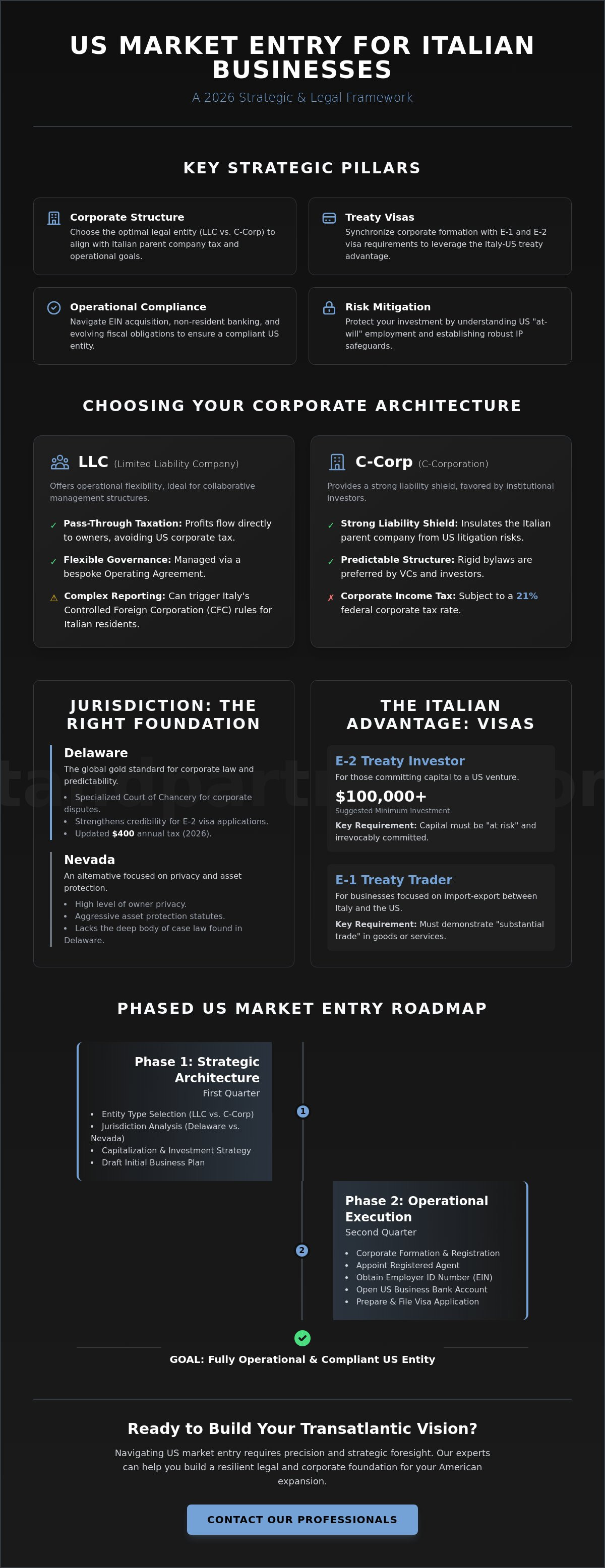
The foundation of any successful expansion lies in its structural integrity. Choosing between a Limited Liability Company (LLC) and a C-Corporation represents the first of many critical legal steps for US market entry for Italian business. This decision isn't merely administrative; it's a strategic choice that dictates your fiscal footprint and operational flexibility for years to come. While some advisors suggest an LLC for its perceived simplicity, the reality for an Italian entity is far more nuanced and requires a visionary approach to corporate design.
LLC vs. C-Corp for Italian Investors
An LLC typically functions as a pass-through entity, where profits flow directly to the owners. For an Italian resident, this might seem attractive, but it often triggers complex reporting requirements under Italy's Controlled Foreign Corporation rules. Conversely, a C-Corporation faces the 21% federal corporate income tax rate but offers a familiar shield against personal liability. It acts as a distinct legal person, which is often preferable when the Italian parent company seeks to insulate itself from US litigation risks. Governance also differs significantly. An LLC relies on a bespoke Operating Agreement, allowing for a level of creative freedom in management that mirrors the collaborative spirit of Italian entrepreneurship. C-Corporations follow rigid bylaws, providing the structural predictability favored by institutional investors and venture capital firms.
The Strategic Importance of State Selection
Jurisdiction is the environment in which your business breathes. Delaware remains the global gold standard due to its Court of Chancery, where specialized judges resolve corporate disputes with unmatched technical precision. This predictability is vital for those pursuing an E-2 Treaty Investor Visa, as a stable corporate home strengthens the overall credibility of the investment. While the annual tax for a Delaware LLC increased to $400 in 2026, the state’s legal maturity continues to justify the operational cost. Nevada offers an alternative focused on privacy and aggressive asset protection, though it lacks the deep body of case law found in Delaware.
Maintaining state-level compliance requires more than just a filing fee. You must appoint a Registered Agent to serve as your official point of contact with the Secretary of State. This role is essential for receiving service of process and ensuring that your entity remains in good standing. If you're ready to design your corporate structure with precision, you can contact our professionals to begin your expansion. Each choice you make now serves as a pillar for your future American legacy.
The Italian Advantage: Leveraging Treaty-Based Visas (E-1 & E-2)
Italian entrepreneurs possess a unique historical advantage that simplifies the legal steps for US market entry for Italian business. The 1871 Treaty of Commerce and Navigation between Italy and the United States remains a cornerstone of modern expansion. It allows for specialized visa categories that bypass the restrictive quotas and lottery systems common in other immigration paths. This treaty provides a direct bridge for founders and executives to establish a physical presence alongside their corporate entities.
Qualifying for the E-2 Investor Visa
The E-2 Treaty Investor Visa is the premier choice for those ready to commit capital to the American market. While the law doesn't set a rigid minimum investment, 2026 market trends indicate that successful applications often involve $100,000 or more. This capital must be "at risk," meaning it's committed to the business and subject to partial or total loss if the venture fails. You must prove the funds are irrevocably committed before the visa is granted. This requirement often necessitates a synchronized approach where you select from various U.S. legal business structures and fund the business bank account simultaneously. For a deeper dive into these requirements, consult our E-2 Visa Guide 2026: The Strategic Framework for Treaty Investors.
The E-1 Visa for Import-Export Operations
If your expansion focuses on moving goods or services rather than capital investment, the E-1 Treaty Trader Visa offers a strategic alternative. This category rewards existing commercial relationships. To qualify, your entity must demonstrate "substantial trade," which is measured by the volume of transactions rather than a specific dollar amount. Crucially, at least 51% of your international trade must occur between the US and Italy. This path is ideal for Italian manufacturers and service providers who already have a growing American client base. You can explore the technicalities of trade volume in our E-1 Treaty Trader Visa: The 2026 Strategic Guide for International Business.
Beyond treaty visas, the O-1 category serves entrepreneurs with "extraordinary ability" in their field. This is a merit-based path that doesn't require an investment or trade history, focusing instead on your professional accolades and industry impact. As of June 2026, the application fee for E-1 and E-2 visas is $315, with an additional $308 reciprocity fee for Italian nationals. If you're evaluating which treaty path aligns with your vision, you might consider reaching out to discuss your specific investment goals. Each visa choice serves as a distinct tool in your 2026 expansion toolkit.
Operational Compliance: EIN, Banking, and Fiscal Obligations
Establishing a corporate structure and securing a visa are only the initial stages of a successful expansion. The subsequent legal steps for US market entry for Italian business involve the administrative plumbing that allows your entity to breathe. This phase requires a transition from high-level strategy to the granular precision of federal and state compliance. Without a functional tax identity and a robust banking relationship, your US operation remains a shell, unable to execute contracts or manage payroll for your American team.
The journey toward operational readiness begins with obtaining an Employer Identification Number (EIN) from the Internal Revenue Service. While there's no federal fee for this application, the process for foreign-owned entities requires specific documentation to verify the identity of the responsible party. This number serves as your entity's social security equivalent, essential for everything from filing the 21% federal corporate income tax return to complying with the Corporate Transparency Act (CTA). The CTA is a non-negotiable reporting requirement in 2026, demanding that most businesses disclose their beneficial owners to the federal government to ensure transparency and combat financial irregularities.
Banking Realities for Italian Entities
Opening a commercial bank account has become the most significant hurdle for non-resident entrepreneurs. Major US financial institutions have intensified their "Know Your Customer" protocols, often requiring a physical US presence or a domestic director to finalize the process. You'll need a comprehensive documentation package, including your filed Articles of Incorporation and your EIN confirmation letter. Digital banking alternatives provide a faster entry point for initial expenses, yet they often lack the sophisticated credit facilities and international wire capabilities that a growing Italian firm needs. Traditional commercial banks remain the gold standard for long-term stability, provided you can navigate their strict residency and identification reviews.
Tax Treaties and Withholding
The US-Italy Tax Treaty is a vital instrument for maintaining fiscal harmony between your transatlantic operations. By properly leveraging this treaty, you can avoid the double taxation of profits and optimize your global tax footprint. Central to this is the W-8BEN-E form, which confirms your Italian parent company's status and eligibility for treaty benefits. The 2026 tax treaty updates focus on maintaining reduced withholding rates for dividends and interest, ensuring that profit repatriation remains a viable strategy for Italian investors. If these fiscal complexities feel daunting, you can reach out to our strategic advisors to ensure your financial architecture is built on a compliant foundation. Understanding the shift from a national VAT system to a 50-state sales tax patchwork is essential for protecting your margins from the start.
Mitigating Risk: Employment Law and Cross-Border Litigation
Protecting your American expansion requires a shift from the protective embrace of Italian labor law to the pragmatic, often startling reality of "at-will" employment. While the US system offers greater flexibility in workforce management, it introduces unique vulnerabilities that must be addressed during the legal steps for US market entry for Italian business. You aren't just hiring staff; you're entering a high-stakes regulatory environment where state-level mandates can diverge sharply from federal standards. Strategic foresight in drafting employment agreements and intellectual property safeguards is the only way to insulate your Italian headquarters from domestic liabilities.
Employment Law Compliance
In 2026, the complexity of multi-state operations is exemplified by new mandates like the Delaware Paid Family and Medical Leave program. Effective January 1, 2026, employers with 10 or more employees must navigate a 0.80% payroll tax to fund these benefits, which can be split between the employer and the staff. This state-level precision contrasts with the federal minimum wage of $7.25, while Delaware's rate has reached $15.00. Beyond wages, the US Department of Labor's increased scrutiny on worker classification means you must precisely define who is an employee versus an independent contractor. Failing this distinction can lead to significant back-tax obligations and legal penalties that threaten your subsidiary's liquidity.
Navigating Cross-Border Disputes
A common oversight in international expansion is the failure to plan for the eventual friction between an Italian headquarters and its US subsidiary or partners. Drafting enforceable cross-border contracts requires more than just a signature; you must choose a forum that offers predictability and intellectual rigor. Arbitration clauses are often the most elegant solution for international distribution agreements. They provide a neutral ground for resolving conflicts without the public exposure or unpredictable jury trials of a standard courtroom. Our International Litigation 2026: A Strategic Guide to US-Italy Legal Disputes explores how to bridge these two legal worlds effectively.
Securing your intellectual property is equally vital, as US protections operate on a "first-to-file" basis. Early registration of trademarks and patents is a primary defense against domestic infringement. If a dispute does arise, enforcing an Italian judgment in a US court requires a sophisticated understanding of international comity and specific state statutes. Executing these legal steps for US market entry for Italian business requires a proactive stance on risk. To safeguard your transatlantic interests with professional precision, you should contact our international litigation team to review your foundational agreements before they are finalized.
The 2026 Roadmap: Executing Your US Market Entry
Executing the legal steps for US market entry for Italian business is a chronological discipline. It requires a six month horizon where each phase builds upon the previous one's compliance. In 2026, the US remains the most attractive destination for the 14th consecutive year, but success is reserved for those who synchronize their corporate architecture with their immigration timeline. You shouldn't view these requirements as isolated hurdles. Instead, treat them as interconnected layers of a single, visionary structure.
Phase 1: Pre-Entry Planning and Visa Strategy (Months 1-3). This initial quarter is dedicated to intellectual groundwork. Before any capital moves across the Atlantic, you must verify your eligibility under the US-Italy Treaty of Commerce. This period involves documenting the source of your investment funds and selecting the leadership team that will spearhead the American operation. It's the time to decide if an E-1, E-2, or O-1 path aligns best with your commercial goals.
Phase 2: Entity Incorporation and Structural Setup (Months 3-4). Once the strategy is set, you move to the physical creation of your US personhood. This involves filing your Articles of Incorporation or Organization in your chosen jurisdiction, such as Delaware or Nevada. You'll draft the Operating Agreements or Bylaws that will govern your subsidiary's relationship with the Italian parent company.
Phase 3: Operational Activation (Months 4-6). With your entity formed, you must breathe life into it. This phase includes obtaining your EIN, navigating the "Know Your Customer" protocols of US commercial banks, and securing a physical office space. These actions demonstrate to the US government that your business is "real and operating," a critical standard for treaty visa approval.
Phase 4: Launch and Ongoing Regulatory Maintenance (Month 6+). Expansion doesn't end at the ribbon-cutting. You must manage the ongoing fiscal obligations, such as the $400 Delaware annual LLC tax or the 21% federal corporate rate, while ensuring your employment practices remain compliant with local state laws.
Step-by-Step Launch Checklist
Confirm treaty eligibility before initiating any irrevocable capital transfers.
Coordinate state-level incorporation filings with federal tax registration to ensure a seamless identity.
Secure all necessary local permits and specialized industry licenses required for your specific sector.
Establish a US-based payroll system that accounts for state-specific mandates like the Delaware PFML tax.
Why a Specialized Bridge Firm is Essential
Bridging the gap between the Italian Civil Law tradition and the American Common Law system requires a legal team that speaks both languages fluently. You don't just need a lawyer; you need a strategic partner who understands the cultural and legal nuances of the Italian diaspora. A specialized firm reduces the risk of receiving a Request for Evidence (RFE), which can stall your expansion by months. By providing customized support that respects your past values while applying modern technological solutions, we ensure your entry is both elegant and compliant. Ready to begin your expansion? Contact Tosolini, Toniutti & Partners for a strategic consultation.
Building Your Transatlantic Legacy
Navigating the American market requires more than just ambition; it demands a meticulously designed legal architecture. You've seen how the choice of corporate structure and the strategic use of treaty-based visas form the dual pillars of a successful expansion. By synchronizing these elements with the operational realities of 2026, you ensure that your Italian heritage finds a resilient and compliant home in the United States. Mastering the legal steps for US market entry for Italian business is a journey best taken with partners who understand the nuances of both legal worlds.
Our bilingual legal team bridges New York and Italy, offering decades of experience in US-Italy immigration and specialized expertise in E-1, E-2, and O-1 visas. We provide the intellectual precision needed to transform your vision into a functioning US entity. Whether you're navigating complex tax treaties or securing key personnel, we're here to guide your transition. Schedule your US-Italy cross-border legal consultation to begin your journey. Your American legacy starts with a single, well-planned step.
Frequently Asked Questions
Do I need a US partner to start a business in the United States?
No, you don't need a US partner or citizen to incorporate your business. 100% foreign ownership is entirely permissible for both LLCs and C-Corporations. This flexibility allows Italian entrepreneurs to maintain full control over their strategic vision while navigating the legal steps for US market entry for Italian business. You can manage the entity from Italy, though having a US-based Registered Agent is a mandatory requirement for state compliance and receiving legal notices.
How much money do I need to invest for an E-2 visa in 2026?
There's no statutory minimum investment amount for an E-2 visa, but the capital must be substantial relative to the business type. In 2026, successful applications often feature investments of $100,000 or more to demonstrate the venture's viability and potential for growth. Italian citizens should also budget for the $315 application fee and the $308 reciprocity fee. The investment must be irrevocably committed and "at risk," meaning it's already being used for the business before the visa is granted.
Can I open a US business bank account from Italy without traveling?
Opening a bank account without a physical presence in the US has become increasingly complex due to stringent "Know Your Customer" protocols. Most traditional commercial banks require at least one member or director to appear in person to verify their identity. While some digital platforms offer remote setup, they often lack the sophisticated credit and wire features needed for a growing international firm. Having a US-based director can sometimes facilitate this process, but a physical visit is still the most reliable path for traditional banking.
What is the difference between an LLC and a C-Corp for an Italian company?
The primary difference lies in taxation and governance structure. An LLC is a pass-through entity where profits flow to the owners, while a C-Corp is taxed as a separate legal person at a flat 21% federal rate. For an Italian parent company, a C-Corp often provides a cleaner liability shield and more predictable tax treatment under the US-Italy treaty. LLCs offer more flexibility in their Operating Agreements, whereas C-Corps must follow rigid corporate bylaws and formal shareholder meetings.
How long does the legal process for US market entry typically take?
You should expect the entire sequence to take between four and six months. This timeline accounts for the initial strategic planning, entity incorporation, and the acquisition of a federal EIN. Visa processing at the US Consulate in Italy adds several months to the roadmap, depending on current appointment availability. Coordinating these legal steps for US market entry for Italian business early ensures that your leadership team arrives precisely when the operation is ready to activate and scale.
Are Italian companies subject to double taxation when operating in the US?
No, the US-Italy Tax Treaty is specifically designed to protect businesses from being taxed twice on the same income. By properly utilizing W-8BEN-E forms and confirming your tax residency, you can access reduced withholding rates on dividends and interest. This fiscal harmony is essential for efficient profit repatriation and global financial planning. It's vital to maintain precise records to satisfy both IRS and Italian tax authorities during your transatlantic expansion.
What is the Corporate Transparency Act and does it apply to my US entity?
The Corporate Transparency Act is a federal mandate requiring most businesses to report their beneficial owners to the Financial Crimes Enforcement Network. It absolutely applies to your US entity, whether you've formed an LLC or a C-Corp. You must disclose individuals who exercise substantial control or own at least 25% of the company. Failure to comply with these reporting requirements can lead to significant civil and criminal penalties, so it's a critical maintenance task for your new American subsidiary.
Can I move my Italian employees to the US through an E-1 or E-2 visa?
Yes, you can transfer key Italian personnel to the US if they share the same nationality as the treaty-qualified business owners. These employees must serve in an executive, managerial, or highly specialized capacity to qualify for an E-1 or E-2 visa. This allows you to maintain your corporate culture and technical standards while scaling your American operation. The business must prove that these individuals possess skills that are essential to the success of the US venture.


Comments