

How to Obtain Dual Citizenship in Italy: The 2026 Strategic Guide
- Gianni Mendes Toniutti, Esq.

- Apr 14
- 12 min read
What if your family history isn't just a collection of faded memories but the structural blueprint for a life without borders? For many, the dream of reconnecting with their heritage feels buried under layers of administrative dust and the shifting legislative updates of 2024 and 2025. Learning how to obtain dual citizenship in italy is a process that mirrors the restoration of a historic landmark; it requires a deep respect for the original context and a rigorous commitment to modern legal standards.
You likely feel the weight of bureaucratic overwhelm and the frustration of conflicting information regarding recent court rulings. It's a complex landscape where every document serves as a vital pillar in your legal foundation. This 2026 strategic guide promises to clear the path, offering a precise roadmap to master the legal framework and procedural steps necessary for your EU passport. We'll examine the specific record-tracing techniques and cross-border legalities that turn a fragmented history into a secure future of European residency.
Key Takeaways
Navigate the shifting 2026 legislative landscape by understanding the specific eligibility criteria for both bloodline and marriage-based citizenship paths.
Discover how to obtain dual citizenship in italy through an architectural approach to document assembly that prioritizes precision and legal consistency.
Identify the most efficient procedural roadmap by comparing consulate filing, judicial action, and the accelerated residency path within Italy.
Align your global mobility with strategic insights into EU healthcare rights, labor access, and the management of cross-border tax obligations.
Table of Contents Understanding the Foundations: Methods of Obtaining Italian Dual Citizenship Navigating the 2026 Legislative Landscape and Eligibility Criteria The Document Assembly Phase: Precision and Legalization Filing Your Application: A Step-by-Step Procedural Roadmap Strategic Integration: Post-Citizenship Logistics and Global Rights
Understanding the Foundations: Methods of Obtaining Italian Dual Citizenship
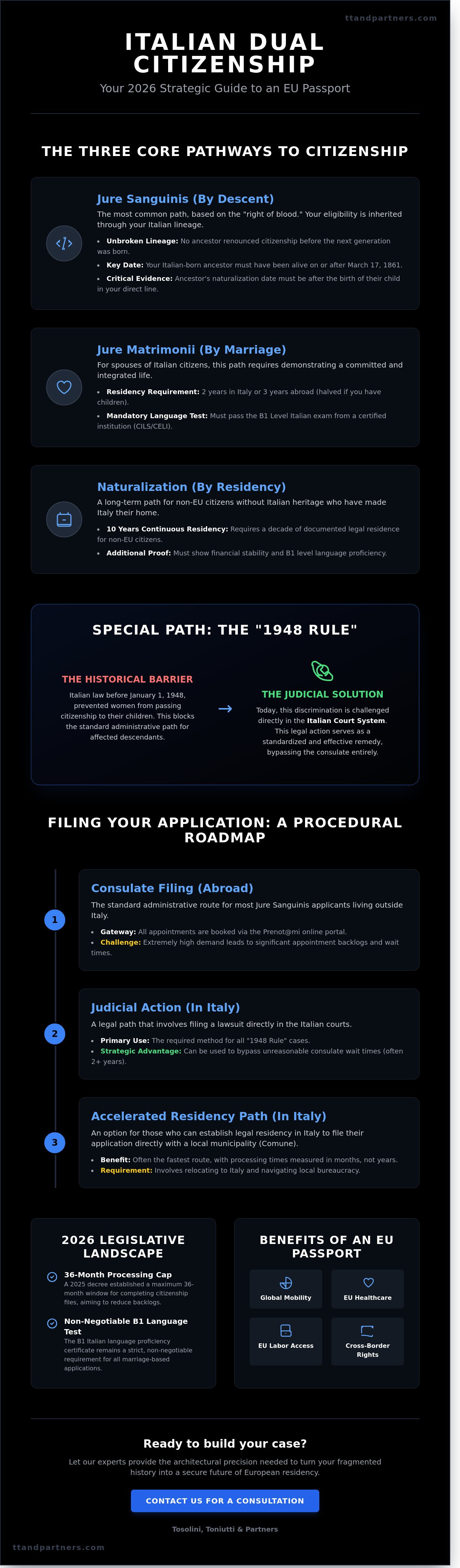
The architecture of Italian nationality is built upon a historical commitment to heritage and bloodline. Unlike countries that prioritize the place of birth, Italy's legal framework operates primarily through the principle of Jure Sanguinis, or the right of blood. This perspective treats citizenship as an inherent trait passed from parent to child, regardless of where that child enters the world. Understanding Italian Nationality Law Explained is essential for anyone tracing their lineage back to the unification of Italy in 1861, as it defines the structural requirements for reclaiming this identity.
While descent is the most common path, other avenues exist for those seeking to integrate into the Italian social fabric. Citizenship through marriage, known as Jure Matrimonii, requires a deep commitment to the state. As of 2026, residency requirements for spouses remain firm; you must reside in Italy for two years after marriage or wait three years if living abroad. These timelines are halved if the couple has children. For those without Italian blood or a spouse, naturalization serves as a long-term pathway. This typically requires ten years of continuous, documented residency for non-EU citizens, alongside proof of financial stability and language proficiency at a B1 level or higher.
Before you commit to the logistics of how to obtain dual citizenship in italy, verifying the "unbroken line" of your ancestry is the most critical preliminary step. This means proving that no ancestor in your direct chain formally renounced their Italian citizenship before the next generation was born. If a gap exists in this historical continuity, the administrative path is effectively closed, necessitating a more complex legal strategy.
Citizenship by Descent (Jure Sanguinis)
The search begins with identifying the last Italian ancestor who was alive on or after March 17, 1861. Law No. 91, enacted on February 5, 1992, was a pivotal moment in this process; it formally recognized dual nationality and allowed Italians to acquire second citizenships without losing their original status. The structural pivot of your case relies on your ancestor's naturalization date. If they became a citizen of another country before the birth of their child, the link was severed under the laws of that era. Precise dates from census records or naturalization certificates are the foundation of a successful application.
The 1948 Rule: Descendants of Italian Women
Historical Italian law contained a gender-based bias that prevented women from passing citizenship to children born before January 1, 1948. While the 1947 Constitution established equality, it didn't retroactively apply to administrative processes at consulates. Today, descendants in these female lines must seek redress through the Italian court system rather than a standard consulate appointment. The 1948 Case serves as a judicial remedy for those blocked by traditional administrative paths. This process requires a specialized legal approach to challenge the old discriminatory statutes effectively. Understanding how to obtain dual citizenship in italy through the courts is now a standard procedure for thousands of applicants globally.
Navigating the 2026 Legislative Landscape and Eligibility Criteria
The 2025 Council of Ministers decree redefined the administrative architecture of citizenship recognition, creating a ripple effect that shapes the 2026 processing environment. This legislative shift established a maximum 36-month window for the completion of citizenship files, a response to the growing backlog in major metropolitan hubs. For those exploring how to obtain dual citizenship in italy via marriage, the B1 language proficiency requirement remains a non-negotiable structural element. Since the implementation of Law 132/2018, applicants must provide a certificate from a CLIQ-certified institution, such as CILS or CELI, proving they can manage complex social and professional interactions in Italian.
The Prenot@mi portal functions as the primary digital gateway for all consulate services, yet it remains a significant bottleneck due to high demand. Success requires a strategic approach to timing and digital precision. When Applying for Italian Citizenship from Abroad, particularly through the New York jurisdiction, applicants must account for the 180-day expiration rule on certain vital records. Immediate rejections often stem from minor clerical discrepancies or the "minor" issue, where an ancestor naturalized while the next in line was still a minor, potentially severing the chain of transmission according to current Ministry interpretations.
Recent Regulatory Changes
Legislative updates in late 2025 have centralized the verification process within the Ministry of the Interior to ensure consistency across various jurisdictions. Many Italian municipalities, including major centers like Milan and Florence, have transitioned to mandatory digital document submission. This shift requires high-resolution, certified scans that meet specific archival standards. For individuals with ancestors from former Italian territories, such as those affected by the 1920 Treaty of Rapallo, the eligibility window is narrow and requires precise historical documentation to prove the ancestor did not renounce Italian status during the border shifts.
Determining Your Specific Eligibility Framework
The 1912 Citizenship Law (Law 555) serves as the foundational blueprint for those researching how to obtain dual citizenship in italy through descent. To verify the integrity of your lineage, use this specific checklist:
Confirm the ancestor was alive and an Italian citizen after the unification on March 17, 1861.
Identify the exact date of foreign naturalization via NARA or USCIS records.
Verify if the next in line was born before the ancestor renounced Italian citizenship.
Complex cases involving multi-generational gaps or 1948 Rule exceptions require the same level of scrutiny one would apply to a structural restoration. Professional insight ensures that the historical context aligns with modern legal interpretations. For a detailed analysis of your specific lineage, you may consult with our strategic partners to ensure every document serves its purpose in your application.
The Document Assembly Phase: Precision and Legalization
Building a petition for dual citizenship mirrors the complexity of an architectural blueprint. You aren't just collecting papers; you're constructing a legal bridge across generations. Understanding how to obtain dual citizenship in italy relies on the structural integrity of your evidence, where every birth, marriage, and death certificate serves as a load-bearing pillar. Accuracy is the baseline, but consistency across a century of records is what ensures the foundation doesn't crumble during the consulate's review.
The 1906 Basic Naturalization Act serves as a primary reference point for your search. You'll need to secure "No Appeal" and naturalization records from USCIS or NARA to prove your ancestor didn't renounce their Italian heritage before the next generation's birth. If an ancestor never naturalized, a "Certificate of Non-Existence" becomes the cornerstone of your file. These documents must be vetted for discrepancies. A 1912 arrival record spelling "Giuseppe" as "Joseph" can stall a petition for months. You'll need to address these variations through legal amendments or "One and the Same" affidavits to maintain the narrative flow of your lineage.
The Legalization Process: Apostilles and Translations
International document recognition requires the 1961 Hague Convention Apostille. This seal validates the signature of the issuing official for use in Italy. It's a non-negotiable layer of authentication. Every American document must also be paired with a high-fidelity translation. Italy requires "sworn" translations, often performed by professionals registered with Italian courts, to ensure the technical terminology remains intact. It's vital to remember that while birth records don't expire, certain background checks or marriage certificates may have a validity window of only six months.
Sourcing Records from Italy
Securing the Estratto di Nascita from the Italian Comune is a critical step for anyone learning how to obtain dual citizenship in italy through jure sanguinis. This isn't a digital transaction; it often involves formal correspondence with municipal archives in cities like Caltanissetta or Lucca. You'll also need the Certificato di Stato Libero to verify marital status for specific application tracks. Local representation is often necessary to manage the 60-day to 90-day delays typical of smaller municipal offices. For those requiring sophisticated oversight of this complex assembly, professional guidance via our contact page ensures every structural detail meets the highest legal standards.
Filing Your Application: A Step-by-Step Procedural Roadmap
The path to Italian citizenship requires the same structural integrity as a well-planned architectural project. You must choose a venue that aligns with your timeline and lifestyle. Most applicants utilize the Italian consulate serving their permanent residence, yet this path often involves significant administrative delays. If you seek a faster trajectory, moving to Italy to establish residency allows you to apply at a local comune. This "Apply in Italy" route typically concludes within 90 to 180 days, provided your documentation is flawless. A third option involves judicial action through the Italian court system, which is essential for "1948 cases" or when consulate wait times exceed legal limits.
Step 1: Securing the Appointment
In 2026, navigating the Prenot@mi booking system remains the most challenging hurdle. Appointments are often booked out for 24 months in high-demand jurisdictions like New York, Buenos Aires, or London. You should attempt to log in during peak release windows, typically midnight Rome time, to secure a slot. Having a complete file ready before you book is vital; consulates in 2026 have become less lenient with "missing" documents. If your local consulate cannot provide an appointment within 730 days, you may have grounds to file a "denial of justice" claim in the Italian courts to bypass the queue.
Step 2: The Submission and Review
During the interview, the consular officer meticulously examines the "unbroken line" of descent to confirm no ancestor renounced their Italian citizenship before the next generation was born. Precision is the priority here. The officer may issue a Request for Information (RFI) for minor discrepancies in names or dates. For those with complex business interests or high-stakes assets, an international litigation perspective can protect your rights during disputes or administrative denials. This ensures your application adheres to the highest legal standards and resists arbitrary rejection.
Step 3: Recognition and Registration
Once the review is successful, you receive a formal notification of citizenship recognition. This isn't the final step. You must be registered in the AIRE (Anagrafe degli Italiani Residenti all'Estero), which is the registry for citizens living abroad. This registration is the prerequisite for requesting your first Italian passport. Holding this document grants you full EU mobility, allowing you to live, work, and study across 27 member states without a visa. This status transforms your legal identity, providing a permanent connection to the Italian social and economic fabric.
Understanding how to obtain dual citizenship in italy involves managing complex timelines and bureaucratic expectations. If you require expert guidance to navigate these legal structures, contact our strategic advisors to discuss your application roadmap.
Strategic Integration: Post-Citizenship Logistics and Global Rights
Securing an Italian passport is the final step in a legal journey, but it functions as the foundational stone for a new global architecture. Understanding how to obtain dual citizenship in italy requires a vision that extends beyond the initial application toward the practicalities of EU integration. As a dual citizen, you possess the right to live, work, and study in any of the 27 European Union member states. This mobility allows for a fluid lifestyle where your professional and personal interests can shift across borders without the friction of visa applications or residency permits.
Your new status brings technical advantages in healthcare and social services. When residing in Italy, you gain access to the Servizio Sanitario Nazionale, consistently ranked among the world's top healthcare systems by the World Health Organization. However, global rights come with specific administrative responsibilities. US citizens must continue to adhere to the 1999 US-Italy Tax Treaty to prevent double taxation. You'll still file Form 1040 and report foreign assets through FBAR if your accounts exceed $10,000 at any point during the year. Professional Italian citizenship experts provide the necessary oversight to ensure your fiscal and legal standing remains pristine in both jurisdictions.
Cross-Border Asset Management
Italian citizenship transforms the landscape of real estate acquisition. You bypass the "condition of reciprocity" checks often required for foreign investors, simplifying the purchase of historical or urban properties. Citizens can often access the Prima Casa tax benefits, which reduce the registration tax from 9% to 2% for primary residences. This status also streamlines residency paths for non-EU family members through the Carta di Soggiorno. If you're looking to expand your commercial footprint, you should consult with our team to align your citizenship with your LLC incorporation or broader business goals. This ensures your corporate structure and personal status work in harmony.
Maintaining Your Legacy
The jure sanguinis principle ensures that your citizenship is a transgenerational asset. Once your status is recognized, your children under 18 receive citizenship automatically. For this legacy to remain functional, you must maintain your records in the AIRE (Anagrafe degli Italiani Residenti all'Estero) system. This registry is the vital link between you and the Italian government while living abroad. You're required to update your file after major life events like marriages, births, or changes in address. Italian citizenship is a permanent legal status that requires ongoing administrative diligence. By treating your citizenship with the same precision as a high-value architectural project, you ensure its durability for future generations. This long-term perspective is essential for anyone mastering how to obtain dual citizenship in italy in 2026.
Architecting Your Italian Legacy for 2026
Reclaiming your heritage is a structural endeavor that bridges historical context with modern global rights. Navigating the 2026 legislative landscape requires a meticulous approach to document legalization and a deep understanding of the 1948 judicial precedents that shape eligibility today. Precision in the assembly phase ensures your application withstands the scrutiny of Italian consulates and courts. It's clear that mastering how to obtain dual citizenship in italy is the first step toward a timeless legacy that offers functional benefits across the European Union. Our firm provides 20 years of US-Italy cross-border legal expertise, focusing specifically on complex Jure Sanguinis and 1948 cases. We offer comprehensive support through every phase, from the initial archival document search to the final issuance of your passport. This journey transforms a genealogical connection into a concrete reality for your family. Secure your Italian legacy; contact our cross-border legal experts today. Your future in Italy is a vision ready to be realized.
Frequently Asked Questions
How long does it take to get Italian dual citizenship in 2026?
It takes approximately 18 to 36 months to complete the process of how to obtain dual citizenship in Italy through a consulate. Court cases in Italy, specifically 1948 cases, often conclude within 12 to 24 months due to the 2022 decentralization of cases to regional courts. Processing times at major hubs like the New York consulate remain backlogged, with wait times for appointments extending 2 years into the future.
Do I need to speak Italian to qualify for citizenship by descent?
You don't need to speak Italian to qualify for citizenship by descent, also known as jure sanguinis. Unlike citizenship by marriage or residency, which requires a B1 level certification under the 2018 Salvini Decree, descent applications have no language requirement. This allows applicants to focus on the structural integrity of their genealogical records rather than linguistic proficiency. It's a pathway based purely on your family's historical lineage.
Can I lose my US citizenship if I obtain an Italian passport?
You won't lose your US citizenship by obtaining an Italian passport. The US Department of State policy, updated in 1990, allows citizens to acquire foreign nationality without jeopardizing their status. Italy has also permitted dual nationality since Law No. 91 of 1992. You'll carry two passports and navigate international borders with the flexibility of a global citizen. This dual status offers a strategic advantage for international travel and residency.
What is the "1948 Case" and does it apply to my family line?
A 1948 Case refers to a legal challenge against the rule that Italian women could only pass citizenship to children born after January 1, 1948. If your female ancestor gave birth before this date, you must file a claim in the Italian court system. Since the June 2022 reform, these cases are heard in the regional court where your ancestor was born. This judicial route restores rights previously denied by gender discrimination.
How much does the entire Italian dual citizenship process cost?
The cost includes a 300 Euro administrative fee for adult applicants paid directly to the Italian consulate. Total expenses vary based on document procurement, apostilles, and professional translations required for how to obtain dual citizenship in Italy. While government fees are fixed, the investment in a comprehensive application ensures the longevity of your claim. Expect to pay for certified copies from state archives and various vital records offices during the gathering phase.
Can my spouse get Italian citizenship if I qualify by descent?
Your spouse can apply for Italian citizenship by marriage after you've been a citizen for 3 years, or 1.5 years if you have children under 18. The spouse must pass a B1 level Italian language exam as mandated by the 2018 security decree. This timeline is halved if the couple resides in Italy, emphasizing the importance of family unity in the legal framework. Marriage applications are processed through the Ministero dell'Interno portal.
What happens if I cannot find my ancestor’s naturalization records?
You must obtain a No Record Certification from USCIS and a certified negative search from the National Archives if records are missing. These documents prove your ancestor never renounced their Italian nationality before their child was born. Census records from 1920 or 1930 can provide supporting evidence of their status. This meticulous verification process ensures the chain of citizenship remains unbroken and legally sound despite gaps in historical archives.
Do I have to pay taxes in Italy if I become a dual citizen?
You're only liable for Italian income taxes if you reside in Italy for more than 183 days in a calendar year. Italy taxes residents on worldwide income, but non-residents only pay on income sourced within Italy, such as rental property. The US-Italy Tax Treaty of 1999 prevents double taxation for most individuals. Becoming a citizen provides a strategic European foothold without creating immediate fiscal obligations unless you choose to relocate permanently.


Comments