

How to Retire in Italy from the USA: The 2026 Strategic Legal Guide
- Gianni Mendes Toniutti, Esq.

- Jun 15
- 12 min read
Updated: Jul 2
With 15,465 American retirees currently receiving Social Security benefits in Italy, the dream of a Mediterranean sunset is increasingly becoming a calculated reality. Yet, the journey often begins with a fundamental question regarding how to retire in Italy from USA without compromising one's financial security or legal standing. It's understandable that you might feel a quiet anxiety when faced with the opaque bureaucratic expectations of Italian consulates or the complex implications of international tax treaties on your pension.
You've worked for decades to curate a life of quality, and your transition abroad should reflect that same level of intentionality. This guide provides the professional cross-border precision necessary to navigate the legal architecture of Italian residency. We'll outline a clear roadmap that harmonizes your US-based wealth with Italian requirements, ensuring your move is defined by strategic clarity rather than administrative friction. From the latest 2026 Elective Residence Visa income thresholds to the nuances of the 7% flat tax regime in southern municipalities, we'll examine the structural elements required for a successful and protected transition to your new home.
Table of Contents
The Legal Architecture of Italian Residency: The Elective Residence Visa
Strategic Financial Requirements: Proving Substantial Passive Income
The Citizenship Advantage: Jure Sanguinis as a Retirement Strategy
Post-Arrival Compliance: Permesso di Soggiorno and the 7% Tax Regime
Securing Your Italian Home: Real Estate Closing and Litigation Support
The Legal Architecture of Italian Residency: The Elective Residence Visa
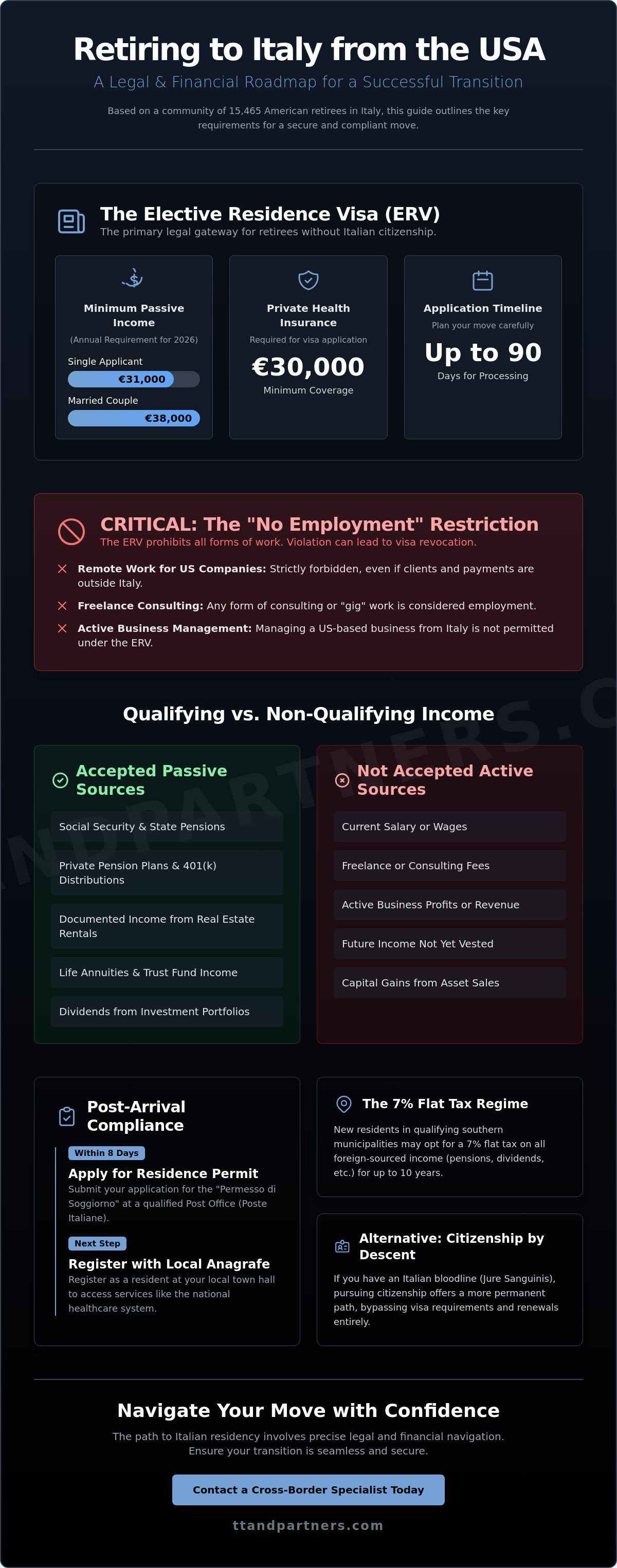
The foundation of any successful transition rests upon selecting the correct legal instrument. For most, the Elective Residence Visa serves as the primary gateway. It is designed specifically for those who possess the financial autonomy to live in Italy without engaging in any form of employment. When considering how to retire in Italy from USA, it's vital to recognize that this visa isn't a mere formality. It is a rigorous assessment of your long-term commitment and financial stability. For 2026, applicants must meet specific minimum passive income thresholds, including €31,000 per year for a single applicant and €38,000 per year for a married couple. You must also secure private health insurance with a minimum of €30,000 in coverage.
Italian consulates in the United States operate with a degree of discretion that can feel opaque to the uninitiated. Some consulates prioritize the total volume of your liquid assets, while others focus strictly on the consistency of your monthly pension distributions. Each jurisdiction interprets documentation requirements with subtle variations, making professional precision a necessity. For those planning a 2026 move, administrative processing windows can extend up to 90 days. This requires a meticulously timed application strategy that aligns with your intended departure date and property acquisition timeline.
The ERV vs. the 90-Day Schengen Rule
Many prospective residents mistakenly believe they can test the waters using a standard tourist entry. However, the Schengen Area visa policy limits US citizens to 90 days within any 180-day period. This timeframe is insufficient for establishing the deep roots required for a permanent life. Without an Elective Residence Visa, you cannot register at the local registry office, access the national healthcare system, or sign long-term utility contracts. Relying on tourist status creates a legal ceiling that prevents true integration. Once you cross the threshold of applying for residency, you move from a temporary visitor to a permanent resident, a transition that demands full compliance with national law.
The Legal Implications of the "No Employment" Restriction
The most significant hurdle for modern retirees is the "no work" clause. National authorities define employment broadly. This includes remote work for US-based companies, freelance consulting, or even active management of an American business from your Italian home. Engaging in these activities on an Elective Residence Visa creates a precarious legal situation. If authorities discover unauthorized professional activity, the risk of visa revocation is high. The government expects your presence to be supported entirely by passive streams such as Social Security, which saw a 2.8% increase in January 2026, or established investment portfolios. If your retirement plans include active income, you must explore alternative strategies. Options like an E-2 or O-1 visa might be more appropriate if passive income is not your sole resource. Understanding these boundaries early prevents the stress of future legal challenges. You can contact our team to discuss which residency path aligns with your specific financial profile.
Strategic Financial Requirements: Proving Substantial Passive Income
The financial vetting process for an Elective Residence Visa is an exercise in structural stability. While the official Italian Elective Residence Visa requirements stipulate basic income minimums, these figures represent the absolute legal baseline. In practice, successful applicants often present higher figures to demonstrate a robust economic margin. When planning how to retire in Italy from USA, you must differentiate between liquid wealth and recurring passive revenue. Consulate officers prioritize income that is guaranteed, perpetual, and independent of your physical presence or professional effort.
Qualifying sources include state pensions, Social Security benefits, life annuities, and documented income from real estate rentals. Conversely, your current salary or future freelance projections are strictly discounted. The logic is simple: the government seeks residents who contribute to the local economy through consumption without competing for domestic employment opportunities. Documenting this wealth requires surgical precision. Bank statements must show a clear history of deposits; investment portfolios must be presented with a focus on yield rather than just total valuation.
The Role of US Social Security and Pensions
To present 401(k) or IRA distributions effectively, you should demonstrate a structured withdrawal plan that mimics a steady salary. Simply showing a large balance is rarely sufficient; the consulate requires evidence of periodicity. Every financial document from the US must undergo professional translation and receive an apostille to be legally recognized by national authorities. This ensures that your financial narrative remains coherent and indisputable during the review process. Verifying your specific distributions against the 2026 cost-of-living adjustments provides the consulate with a clear, forward-looking view of your financial health.
Housing Requirements and Legal Residency
The "Suitable Accommodation" mandate is the second pillar of your application. You must prove you have a place to live before the visa is even granted. This requires either a registered deed of ownership or a long-term residential lease that complies with national standards. A common pitfall is relying on short-term vacation rentals or hotel reservations; these temporary solutions lead to immediate rejection because they don't establish a habitual abode. A valid lease must be for a minimum of twelve months and registered with the Revenue Agency. Understanding these nuances is the first step in learning how to retire in Italy from USA with total legal confidence. If you're unsure if your documentation meets these rigorous standards, you can reach out for a professional review of your residency strategy.
The Citizenship Advantage: Jure Sanguinis as a Retirement Strategy
While the Elective Residence Visa is the most common route, many Americans discover a more profound legal gateway through their heritage. If you're exploring how to retire in Italy from USA, identifying a potential Italian bloodline via Jure Sanguinis can transform your transition from a temporary residency into a permanent homecoming. An Italian passport isn't just a travel document; it's a sophisticated retirement tool. It grants you the unconditional right to live, work, and access healthcare across the entire European Union. Unlike the ERV, which requires periodic renewals and strictly prohibits any form of employment, citizenship offers total autonomy. This path allows you to bypass the passive income requirements entirely, providing a level of security that residency alone cannot match.
Determining Eligibility for Italian Citizenship by Descent
Italy follows the principle of Jure Sanguinis, meaning citizenship is transmitted through the bloodline rather than the place of birth. The primary requirement is an "unbroken line" where no ancestor in the chain renounced their Italian citizenship before the birth of the next person in line. Often, the critical factor is the date of your ancestor's US naturalization. If your Italian born great grandfather naturalized after your grandfather was born, the line remains intact. Many retirees are eligible for Italian citizenship without realizing it until they perform a deep genealogical audit. Beyond your own move, this path provides immense value for long term estate planning. It secures a dual citizenship legacy for your descendants, allowing them to benefit from European education and labor markets.
The Judicial Path to Citizenship
The administrative route through US based consulates currently faces significant backlogs, with appointment wait times often stretching into several years. This is where the judicial path becomes a strategic advantage for those who cannot wait. For those impacted by the 1948 Rule, a historical legal hurdle where a female ancestor could not pass citizenship to children born before January 1, 1948, the only recourse is through the Italian court system. These cases are now routinely won based on gender equality principles. Even for standard cases, "Against the Queue" lawsuits are used to bypass consulate delays. Partnering with a specialized Italian immigration lawyer is essential for litigating these claims. The judicial process is often more predictable than consulate appointments, providing a structured timeline for recognition. This legal avenue ensures your retirement plans aren't held hostage by administrative bottlenecks.
Post-Arrival Compliance: Permesso di Soggiorno and the 7% Tax Regime
Your first year functions as a legal probationary period. Maintaining your status requires more than just physical presence. It demands a continuous paper trail that mirrors the financial stability presented during your visa application. If you fail to demonstrate that you still meet the passive income thresholds during your first renewal, your right to stay could be revoked. This phase is where many realize that learning how to retire in Italy from USA is an ongoing commitment to compliance, not a one-time hurdle.
Navigating the Residency Permit Workflow
The step from an entry visa to a physical residency permit involves a fingerprinting appointment at the Police Headquarters. Here, officials verify your original documents and biometric data. Once issued, your residency permit becomes your most valuable asset. It allows you to register with the National Health Service, granting you access to the medical system. This integration is essential for long-term security, especially since Medicare doesn't provide coverage abroad. Renewals typically occur every one to two years, requiring updated proof of your passive income and private health insurance.
The 7% Flat Tax for Foreign Retirees in 2026
Strategic tax planning is often the deciding factor for those choosing their final destination. The 7% flat tax regime has been expanded in 2026 to include municipalities with populations of up to 30,000 residents. To qualify, you must move to a town in one of the southern regions, such as Sicily, Calabria, Sardinia, or Puglia, and you must not have been a tax resident for the previous five years. This incentive applies to all foreign-source income, including Social Security and private pensions, for a generous 10-year window. It’s a powerful tool for protecting your wealth while enjoying a high quality of life. If you're ready to secure your financial future, you should consult with our legal team to verify your eligibility for these specific fiscal benefits.
Securing Your Italian Home: Real Estate Closing and Litigation Support
Acquiring property is the final architectural element in your transition. In the Italian legal system, the journey from a viewing to a deed involves specific contractual stages that differ significantly from American practices. The Proposta d’Acquisto serves as the initial formal offer. Once the seller accepts this document, it becomes a legally binding contract. This is typically followed by the Preliminare di Vendita, or compromise, where a significant deposit is paid. If you back out after this point, you forfeit that deposit; if the seller defaults, they're often required to pay you double the original amount. This structural rigidity underscores why professional oversight is mandatory from the first signature.
A common misconception involves the role of the Notaio. While the Notary is a central figure in every transaction, they're a neutral public official representing the Italian state. Their primary duty is to ensure the integrity of the public record and the payment of taxes. They don't perform the exhaustive due diligence required to uncover hidden debt, private liens, or zoning irregularities. For a secure real estate closing, you need independent legal counsel to protect your specific interests and verify every facet of the title and structural history.
The Legal Due Diligence of Italian Property
Verifying Conformità Catastale and Urbanistica ensures the home's physical state matches the official municipal records. Illegal additions or internal modifications are frequent in historic Italian structures and can lead to severe fines or a complete block on future sales. Unlike the US escrow model, funds are often handled through the Notary's dedicated escrow account. You'll need to have an Italian bank account and a Codice Fiscale (tax ID) ready well in advance to facilitate these transfers. This proactive preparation ensures your residency strategy remains on schedule.
Protecting Your Assets with Cross-Border Litigation
Cross-border disputes require a specific set of skills to resolve. Whether it's a conflict with a developer over construction delays or navigating Italy's forced heirship laws, which mandate that 50% to 75% of an estate must go to specific family members, you must be prepared. Professional international litigation expertise protects your investment from these unique European legal complexities. Aligning your Italian property acquisition with your US estate plan is the final step in learning how to retire in Italy from USA with total peace of mind. Ensuring these two legal worlds communicate effectively is the only way to safeguard your legacy and your Mediterranean lifestyle.
Architecting Your Strategic Transition to Italy
Your move to the Mediterranean is a journey defined by both visionary inspiration and technical precision. Success requires harmonizing the strict passive income requirements of the Elective Residence Visa with the long-term fiscal advantages of the 7% tax regime. Whether you seek residency through heritage or strategic investment, every document and contract must meet the highest standards of Italian legal compliance to ensure your wealth and lifestyle remain secure. Understanding how to retire in Italy from USA is the first step toward a life of Mediterranean harmony and intellectual fulfillment.
Our bi-lingual legal team, based in the US, brings decades of experience in cross-border law to your specific case. We specialize in the intricate intersections of immigration and real estate litigation, providing the professional confidence necessary to navigate complex international transactions. We believe that a successful relocation is built on a foundation of transparency and expert foresight. Take the next step in securing your Italian legacy with expert guidance. We invite you to Schedule a Strategic Consultation with our US-Italy Legal Experts. Your future in Italy is within reach, and we're dedicated to ensuring every legal detail is perfectly placed.
Frequently Asked Questions
Can a US citizen stay in Italy for more than 90 days without a visa?
No, US citizens cannot legally exceed the 90-day limit within any 180-day period without a specific long-stay visa. While the Schengen Area allows for short-term tourism, establishing a permanent life requires a formal residency vehicle like the Elective Residence Visa. Attempting to overstay tourist status can result in deportation and a multi-year ban from the entire European Union, jeopardizing any future residency applications.
How much passive income do I need to retire in Italy in 2026?
For 2026, the official minimum passive income is €31,000 per year for individuals and €38,000 for married couples. It's important to remember that these figures are a baseline. Consulates often exercise discretion and prefer to see a higher financial margin to ensure you won't become a burden on the Italian state. This income must be strictly passive, derived from sources like pensions, Social Security, or rental dividends.
Is US Social Security taxed in Italy under the 7% regime?
Yes, US Social Security benefits qualify for the 7% flat tax regime if you establish residency in a southern municipality with fewer than 30,000 residents. This incentive is designed to revitalize smaller communities in regions like Sicily and Puglia. This favorable rate applies to all foreign-source income for a period of ten years, providing a significant strategic advantage for those planning how to retire in Italy from USA with substantial assets.
Can I work remotely for my US company while living in Italy on an Elective Residence Visa?
Legally, you cannot engage in any work activities, including remote employment for an American company, while holding an Elective Residence Visa. The ERV is strictly for non-working residents who support themselves through existing wealth. If your retirement plan involves active income, you should consider alternative paths such as an E-2 or O-1 visa, as unauthorized work can lead to the immediate revocation of your residency permit.
What happens if my Elective Residence Visa is rejected?
If your application is rejected, you have the right to file a formal appeal through the Regional Administrative Court (TAR) within 60 days of the decision. Rejections usually occur due to insufficient documentation regarding passive income or the lack of a suitable long-term lease. Identifying the specific legal deficiency is the first step in a successful appeal. Professional legal counsel is essential to litigate these administrative disputes effectively.
How long does it take to get Italian citizenship by descent for a retiree?
The timeline varies significantly based on the chosen path. Administrative applications at US consulates often face backlogs of several years. However, the judicial path through the Italian court system typically takes between 12 and 24 months for recognition. This judicial route is often a more predictable and efficient strategy for retirees who wish to bypass the standard visa process and gain immediate EU residency rights through their bloodline.
Do I need an Italian lawyer to buy property in Italy?
While only a Notary is legally required to finalize a deed, hiring an independent lawyer is vital for protecting your investment. The Notary is a neutral state official who doesn't perform the deep due diligence needed to uncover hidden liens or structural irregularities. An independent legal advocate ensures that the "Preliminare" contract is sound and that your property acquisition aligns perfectly with your broader residency and tax strategies.
What is the difference between a visa and a Permesso di Soggiorno?
A visa is an entry document issued by an Italian consulate in the US that allows you to cross the border for a specific purpose. The Permesso di Soggiorno is the actual residence permit you apply for within eight days of arriving in Italy. While the visa gets you through the door, the Permesso is the document that grants you the legal right to live in the country and access national healthcare.


Comments