


Incorporating an LLC in USA as a Non-Resident: The 2026 Strategic Guide
- Gianni Mendes Toniutti, Esq.

- Mar 23
- 14 min read
What if the most resilient foundation for your global enterprise isn't located within your own borders, but rather in the deliberate structure of a Delaware or Wyoming filing? For visionaries planning for 2026, incorporating an LLC in USA as a non-resident acts as a sophisticated architectural choice rather than a mere administrative task. You've likely felt the frustration of attempting to secure a US bank account from 5,000 miles away or feared that a technical oversight could lead to 30% withholding penalties. These concerns are valid in a complex regulatory environment that often lacks clarity.
We understand that a business entity should be as well-designed as a flagship building, balancing functionality with future growth. This guide offers a comprehensive legal framework to establish a compliant US presence that guarantees access to essential payment gateways and creates a viable path for an E-2 investor visa. We'll detail the exact steps to align your international ambitions with US fiscal standards, ensuring your corporate structure remains timeless and effective.
Key Takeaways
Master the foundational legal framework and global benefits of US entity ownership to establish a credible presence in the international market.
Identify the most advantageous jurisdiction for your specific goals, ranging from Delaware’s legal stability to Wyoming’s privacy-focused environment.
Learn the precise protocol for incorporating an LLC in USA as a non-resident while maintaining remote compliance through professional registered agents.
Navigate complex IRS reporting standards and pass-through taxation mechanisms to ensure your foreign-owned entity remains fully compliant.
Leverage your corporate structure as a strategic investment vehicle to meet the rigorous requirements for E-1 and E-2 US investor visas.
Table of Contents Understanding the US LLC Framework for Foreign Nationals A Step-by-Step Protocol for Remote Incorporation in 2026 Navigating International Tax Obligations and Reporting Standards Leveraging Your LLC for US Investor Visas (E-2 and E-1) Strategic Implementation: Why Professional Legal Oversight Matters
Understanding the US LLC Framework for Foreign Nationals
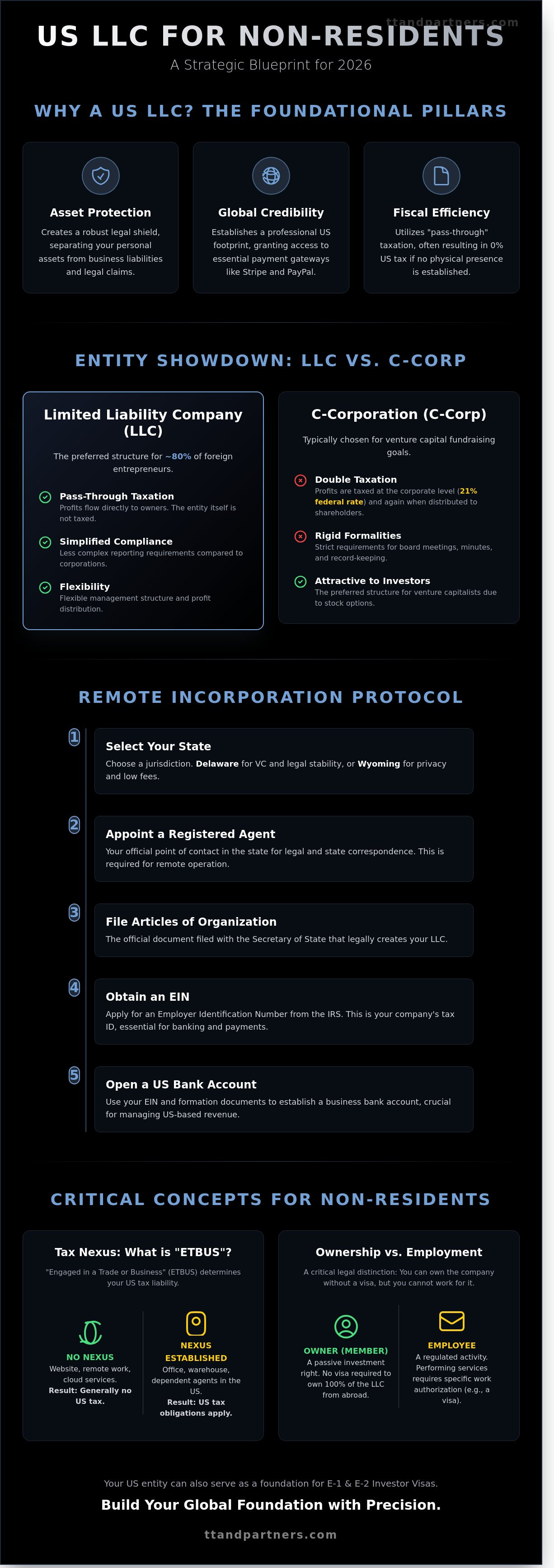
The US legal system treats business entities as distinct legal personas, separate from the individuals who founded them. This architecture relies on state statutes rather than federal mandates, allowing for a decentralized approach to corporate formation. For an international investor, incorporating an LLC in USA as a non-resident provides a robust shield between personal assets and business liabilities. Understanding the US LLC Framework is the essential first step toward global expansion. Wyoming became the pioneer in this field when it authorized the first LLC statute in 1977; today, all 50 states offer these protections, though each operates under its own specific regulatory code.
The primary appeal of this structure lies in three pillars: asset protection, global credibility, and fiscal transparency. Unlike a C-Corp, which faces a 21% federal corporate tax rate under the 2017 Tax Cuts and Jobs Act, an LLC usually functions as a pass-through entity. This means the profits flow directly to the owners without being taxed at the entity level. For non-residents, this often results in zero US tax liability if the business has no physical presence or employees within the country. It's a clean, efficient model that mirrors the precision of a well-planned architectural blueprint.
Legal definitions distinguish between Resident and Non-Resident Aliens based on the Substantial Presence Test. If you spend fewer than 31 days in the US during the current year, the IRS typically classifies you as a non-resident. This distinction governs how your income is reported and taxed. Choosing an LLC over a C-Corp avoids the double taxation inherent in corporate dividends; it's the preferred vehicle for approximately 80% of individual foreign entrepreneurs entering the US market for the first time.
The Concept of 'Nexus' and US Business Presence
The IRS uses the term 'Engaged in a Trade or Business' (ETBUS) to determine taxability. A digital presence, such as a website or a cloud-based service, doesn't automatically create a US tax nexus. Physical presence requires an office, a warehouse, or a dependent agent on the ground. Establishing a US footprint through an LLC allows you to access US payment processors like Stripe or PayPal, which require a domestic Tax ID (EIN). This professional footprint is vital for 95% of businesses looking to build trust with American consumers.
Common Misconceptions About Foreign Ownership
Many founders believe a visa is necessary for incorporating an LLC in USA as a non-resident. This isn't true. You can own 100% of a US company from your home country without ever stepping foot on American soil. However, ownership doesn't grant you the right to work. Under 8 CFR § 274a.12, you need specific work authorization to perform services for your company. You're a member, which is the legal term for an owner, not an employee. It's a crucial distinction that prevents legal complications with US Citizenship and Immigration Services. Ownership is a passive investment right; employment is a regulated activity.
A Step-by-Step Protocol for Remote Incorporation in 2026
Building a corporate structure from abroad demands the same precision as a master-planned development. The process of incorporating an LLC in USA as a non-resident begins with selecting a legal home that aligns with your long-term vision. This foundation is laid through a sequence of technical filings that establish your entity's presence within the American legal fabric. It's a remote operation that requires a Registered Agent to act as your physical anchor. This agent receives service of process and official state correspondence, ensuring you remain in good standing while operating from any global coordinate.
The structural integrity of your business depends on the Articles of Organization. Filed with the Secretary of State, this document officially births the LLC. For multi-member structures, the Operating Agreement serves as the internal blueprint. It defines ownership percentages, voting rights, and capital contribution requirements. Even if not mandated by every state, it's a vital tool for preventing future friction. Clear documentation is the hallmark of a professional enterprise. For those seeking a strategic partnership in business architecture, clarity remains the greatest asset.
State Selection: Strategic Considerations
Delaware serves as the premier choice for founders eyeing venture capital. Since January 2026, over 66% of Fortune 500 companies have maintained their legal seat here due to the Court of Chancery's specialized focus on corporate law. It provides a level of legal predictability that other jurisdictions cannot match. If your roadmap includes seeking US investment, Delaware is the logical starting point.
Wyoming presents a more minimalist, cost-effective alternative for small businesses and independent consultants. It offers a $102 initial filing fee and zero state income tax. Privacy is a core feature here; Wyoming doesn't list member names on public records. This creates a discreet environment for entrepreneurs who value confidentiality and low maintenance overhead. It's a functional choice for lean operations.
Nevada remains the fortress of asset protection. While filing fees have risen to $425 for the initial articles and business license, the state's charging order protection is unparalleled. It's designed for high-risk ventures where shielding personal assets from business liabilities is the primary objective. The higher cost reflects the robust nature of its legal safeguards.
The EIN Acquisition Process
The Employer Identification Number (EIN) functions as the social security number for your business. Success in incorporating an LLC in USA as a non-resident hinges on this tax identity. You'll use IRS Form SS-4 to apply. Since you lack a Social Security Number (SSN), you must leave the SSN field blank and designate yourself as a foreign responsible party. This tells the IRS that the entity is foreign-owned but US-based.
IRS processing times for non-residents in 2026 typically range between 30 and 45 business days when submitted via fax. It's a period that requires patience and administrative accuracy. Mistakes on Form SS-4 can lead to rejections, delaying your access to the US financial system. Compliance extends beyond the initial filing; Navigating International Tax Obligations requires understanding Form 5472 for foreign-owned entities to avoid heavy penalties.
Without an EIN, your LLC is a shell. It's the essential key to opening a US business bank account and signing up for payment processors like Stripe or PayPal. It bridges the gap between a legal registration and a functional business. Once the IRS issues your CP575 or 147C letter, your entity is ready to participate in the global market.
Navigating International Tax Obligations and Reporting Standards
The structural integrity of a US business depends on its fiscal foundation. For a non-resident, the most common framework is the Single-Member LLC (SMLLC). The US tax system treats this entity as "disregarded" for federal purposes, meaning the business itself doesn't pay income tax. Instead, the financial results flow directly to the owner. This pass-through mechanism prevents the entity-level taxation typical of corporations, but it doesn't exempt the owner from rigorous reporting duties. When incorporating an LLC in USA as a non-resident, the fiscal architecture requires a deep understanding of these transparency cycles.
The Internal Revenue Service demands specific disclosures from foreign-owned US entities to monitor cross-border transactions. Owners must file Form 5472 and a pro-forma Form 1120 annually. These documents aren't for paying tax but for reporting "reportable transactions" between the LLC and its foreign owner. The IRS guidelines on LLCs confirm that ownership is unrestricted for foreign nationals, yet this freedom comes with strict oversight. Missing these deadlines isn't a minor clerical error; it's a structural failure that triggers immediate financial repercussions.
Italy-based entrepreneurs benefit from the US-Italy Tax Treaty, which has been in force since 1999. This agreement dictates how income is treated to ensure capital flows efficiently between the two nations. For instance, dividend withholding rates can be reduced to 15% or even 5% under specific ownership conditions. The treaty also clarifies how "Effectively Connected Income" (ECI) is handled. If your US LLC doesn't have a physical office or employees in the States, your income might not be subject to US federal tax, though it remains reportable in your home jurisdiction.
Transparency standards reached a new peak with the Corporate Transparency Act (CTA), which became effective on January 1, 2024. Most LLCs must now file a Beneficial Ownership Information (BOI) report with the Financial Crimes Enforcement Network (FinCEN). This filing identifies the individuals who ultimately own or control the company. Navigating the complexities of incorporating an LLC in USA as a non-resident requires a meticulous approach to these evolving digital registries to maintain your entity's standing.
Avoiding Double Taxation
The concept of Permanent Establishment (PE) is the pivot point for international tax. If your US LLC operates without a fixed place of business in the US, the tax treaty often grants the right of taxation exclusively to your home country. Strategic use of foreign tax credits allows you to deduct taxes paid in one country from the liability in another. This prevents the erosion of capital that occurs when two governments claim the same revenue stream. Precision in defining your PE status is non-negotiable for long-term profitability.
Compliance Risks and Penalties
The cost of negligence is high. The IRS increased the penalty for failing to file Form 5472 to $25,000 per violation, effective from the 2017 tax year. Beyond fines, maintaining "clean" accounting is vital; commingling personal and business funds can lead to "piercing the corporate veil," which destroys your liability protection. By January 1, 2026, the Corporate Transparency Act will have effectively dismantled the traditional veil of anonymity for existing small business structures through its mandatory beneficial ownership registry. Professional record-keeping isn't just a preference; it's a survival strategy.
Leveraging Your LLC for US Investor Visas (E-2 and E-1)
Setting up a US entity is rarely just about liability protection; it's often the architectural blueprint for a professional life in the States. For many entrepreneurs,
incorporating an LLC in USA as a non-resident
serves as the primary engine for securing an E-2 Treaty Investor visa. This specific visa category allows individuals from treaty countries to reside and work in the US based on a business investment. The LLC acts as the legal vessel that holds the capital, signs the contracts, and employs the staff necessary to satisfy federal requirements.
The US Citizenship and Immigration Services (USCIS) evaluates applications based on two critical pillars: substantiality and non-marginality. While the law avoids naming a minimum dollar amount, an investment under $100,000 often faces rigorous scrutiny. Your LLC must prove it can generate more than just a meager living for you and your family. It needs to impact the local economy. By the third year of operation, a successful E-2 entity typically employs at least 2 to 3 US workers to demonstrate it isn't a marginal enterprise.
Capital at Risk: Funds must be irrevocably committed to the business before the application.
Operational Control: The investor must develop and direct the operations.
Job Creation: The venture must have the capacity to hire US citizens or residents.
To maintain E-2 eligibility, treaty nationals must own at least 50% of the LLC. This structural control ensures the business remains a vehicle for the treaty country's economic interests. A 5-year business plan is the project's structural core. It's a binding roadmap that details hiring schedules, market analysis, and financial projections. Consular officers rely on this document to verify the venture's long-term viability.
The E-2 Visa Path for Italian Entrepreneurs
Italian citizens applying through the US Consulate in Rome or Naples must demonstrate that their capital is fully committed. When incorporating an LLC in USA as a non-resident, your capital expenditures, such as signing a 3-year commercial lease or purchasing $45,000 in specialized equipment, count directly toward your investment total. You'll transition from a passive founder to an active manager, overseeing daily operations and strategic growth within the American market.
E-1 Treaty Trader Opportunities
The E-1 visa focuses on trade rather than a massive upfront investment. Your LLC facilitates "substantial trade" where over 50% of the international trade volume occurs specifically between the US and Italy. This requires meticulous documentation of invoices, bills of lading, and service contracts. If your LLC moves $200,000 worth of Italian design services or physical goods annually, you likely meet the threshold for this status.
For a personalized visa strategy that aligns with your specific business goals, contact our cross-border legal team to begin your expansion.
Success in US immigration requires a blend of legal precision and strategic foresight. If you're ready to build your American presence,
for long-term growth and compliance.
Strategic Implementation: Why Professional Legal Oversight Matters
Establishing a presence in the United States requires more than a digital signature on a web portal. It's a structural undertaking that demands the same precision as a blueprint for a skyscraper. Many entrepreneurs fall into the trap of using automated filing services that treat incorporating an LLC in USA as a non-resident as a simple clerical task. These platforms often overlook the 2024 Corporate Transparency Act requirements; a failure that can result in civil penalties of 591 dollars per day. A professional legal perspective ensures the foundation of your business isn't built on shifting sand.
Operating Agreements serve as the internal skeleton of your entity. For international clients, a standard template is insufficient. It must account for cross-border complexities like the 1984 US-Italy Tax Treaty or specific dividend repatriation rules. If your agreement doesn't define how 30 percent withholding taxes are handled or how disputes are resolved across time zones, you're inviting structural failure. We design these documents to reflect the nuances of your home country's civil code while maintaining full compliance with Delaware or Wyoming statutes.
Compliance isn't a one-time event but a continuous state of alignment. Since January 1, 2024, the Financial Crimes Enforcement Network (FinCEN) requires detailed Beneficial Ownership Information. Beyond this, foreign-owned LLCs must file Form 5472 and Form 1120. Missing these deadlines isn't just a minor oversight; the minimum penalty for failing to file Form 5472 is now 25,000 dollars. Professional oversight integrates these filings into your broader corporate strategy, ensuring that your US expansion supports, rather than complicates, your long-term estate planning and residency goals.
The Value of a Multi-Jurisdictional Law Firm
A firm that understands both US common law and Italian civil law acts as a bridge between two distinct legal philosophies. We ensure your American entity doesn't create unintended tax liabilities in Rome or Milan. By coordinating with tax professionals in both regions, we protect your global assets. Our physical presence provides a "Registered Office" that offers the professional prestige your brand deserves, far beyond the anonymity of a PO Box.
Next Steps for Your US Expansion
Your journey toward incorporating an LLC in USA as a non-resident should begin with a feasibility study. This analysis determines if your current business model translates to the 50 different regulatory environments across the States. Success requires securing a legitimate physical US address and a robust banking relationship with an institution like JP Morgan or Mercury. To begin your US incorporation with architectural precision, schedule a consultation with our New York office. We'll help you build a structure that's not only functional but also built to last for decades.
Conduct a 30-day feasibility study on your specific industry sector.
Identify the optimal state for your specific tax profile (e.g., Delaware vs. Florida).
Establish a secure physical nexus for legal and banking correspondence.
Draft a customized Operating Agreement that satisfies both IRS and home-country regulators.
Architecting Your Global Presence in the 2026 US Market
Establishing a footprint in the American market requires more than just administrative filing; it demands a structural vision that balances 2026 reporting standards with long-term immigration goals. Digital efficiency now defines the remote incorporation process. Success hinges on aligning your corporate entity with the specific requirements of E-2 or E-1 investor visas to ensure your physical presence matches your commercial ambitions. Incorporating an LLC in USA as a non-resident shouldn't be a solitary endeavor without professional oversight.
At Tosolini, Toniutti & Partners, we apply the same precision to corporate law that we bring to international design. Our team operates from three strategic hubs in New York, Miami, and Milan, providing 25 years of specialized US-Italy cross-border expertise. We don't just fill out forms. We design the legal framework that supports your growth. Our partners bridge the gap between European heritage and American opportunity with surgical accuracy.
Your vision for a sustainable American enterprise starts with a foundation built on professional excellence and clear strategic foresight. We're ready to build that future together.
Frequently Asked Questions
Do I need a US visa to incorporate an LLC as a non-resident?
You don't need a US visa or a physical presence to form a legal entity. The process of establishing a business structure is strictly administrative and handled through state agencies. Thousands of international founders manage their entities remotely every year. While you can own and direct the company from abroad, you'll still need a valid visa if you plan to perform work while physically located on US soil.
What is the best US state for a non-resident to form an LLC?
Wyoming and Delaware represent the most efficient context for international structures. Wyoming is favored for its $62 annual fee and robust privacy protections that keep member names off public records. Delaware serves those seeking venture capital or future public offerings. Incorporating an LLC in USA as a non-resident in these jurisdictions ensures a functional foundation for global operations without the burden of high state income taxes.
Can I open a US business bank account without visiting the United States?
You can open a business bank account remotely using modern fintech platforms like Mercury or Relay. These institutions allow founders to complete the entire application online by providing a passport and company formation documents. Traditional banks like JP Morgan Chase or Bank of America usually require a physical visit to a branch. Digital solutions offer the necessary innovation to manage global capital flows without international travel.
How do I get an EIN if I do not have a Social Security Number?
You'll obtain an Employer Identification Number by filing Form SS-4 with the IRS via fax or mail. Since you lack a Social Security Number, you must leave section 7b blank and indicate "Foreign" where applicable. Processing times for 2024 typically range from 4 to 8 weeks. This number is the essential identifier for your business, functioning as the key to tax compliance and banking access.
Will I be double-taxed on my US LLC income in my home country?
Double taxation is usually avoided because an LLC is a pass-through entity for tax purposes. Profits flow directly to the owners, who then pay taxes based on their personal residency and local laws. The US maintains tax treaties with over 60 countries to prevent overlapping claims. If your business has no US employees or physical office, it's possible you'll owe 0% in US federal income tax.
What are the ongoing annual requirements for a US LLC owned by a foreigner?
You're required to file an Annual Report and maintain a Registered Agent to ensure the entity's functional longevity. In Wyoming, this report carries a $62 fee due by the first day of your anniversary month. Federal compliance involves filing Form 5472 and Form 1120 by April 15th to report foreign ownership. Failure to meet these 2024 IRS standards results in a minimum penalty of $25,000 per year.
Can my US LLC sponsor me for a Green Card or work visa?
An LLC can sponsor a visa, but the process involves complex legal hurdles and significant capital requirements. The E-2 Investor Visa is the most common path, requiring a substantial investment often exceeding $100,000 in the business. It's a temporary solution that doesn't lead directly to a Green Card. You'll need a detailed business plan showing the company's ability to support employees and contribute to the US economy.
How much does it cost to maintain a US LLC annually for a non-resident?
Annual maintenance costs for incorporating an LLC in USA as a non-resident typically range from $350 to $800. This budget covers the $62 Wyoming annual report fee, a $150 Registered Agent service, and roughly $300 for professional tax filing assistance. Prices vary based on the complexity of your operations. Investing in these recurring costs ensures your business maintains its legal standing and protects your personal assets from corporate liabilities.
Disclaimer
The information provided in this website is offered purely for informational purposes. It is not intended to create or promote an attorney-client relationship, and does not constitute and should not be relied upon as legal advice. We intend to make every attempt to keep this information current. We do not promise or guarantee, however, that the information is correct, complete or up-to-date, and readers should not act based upon this information without seeking professional counsel from a licensed attorney. Transmission of information from this newsletter is not intended to create, and its receipt does not constitute, an attorney-client relationship with Tosolini, Toniutti & Partners or any of its individual attorneys or personnel.


Comments