

Italian Business Lawyer in Miami: Strategic Cross-Border Legal Guidance for 2026

The most significant hurdle to your transatlantic expansion isn't the physical distance across the ocean, but the invisible legal friction that occurs when two distinct jurisdictions collide. Many investors assume that a domestic firm can handle the nuances of a foreign portfolio, yet the reality is that local expertise often fails to account for the complexities of international treaty law. When seeking an Italian business lawyer in Miami, you aren't just looking for a representative; you're seeking a strategic bridge capable of translating your vision into a compliant, high-performing US entity.
We understand that the dual burden of managing assets across two continents while navigating intricate US visa requirements feels overwhelming. This article provides a comprehensive framework for 2026 to secure your transatlantic investments and ensure a seamless entry into the American market. We'll examine the technical pathways to successful E-2 or E-1 visa issuance, the precision required for LLC incorporation, and the sophisticated protective measures needed for cross-border real estate and litigation.
Table of Contents
Bridging Jurisdictions: The Strategic Role of an Italian Business Lawyer
Corporate Architecture: Synchronizing LLC Incorporation with Treaty Visas
Cross-Border Asset Management: Real Estate and Compliance Frameworks
Resolving Transatlantic Disputes: Litigation and Arbitration Strategies
The Dual-Presence Advantage: Why National Expertise Outperforms Local Counsel
Bridging Jurisdictions: The Strategic Role of an Italian Business Lawyer
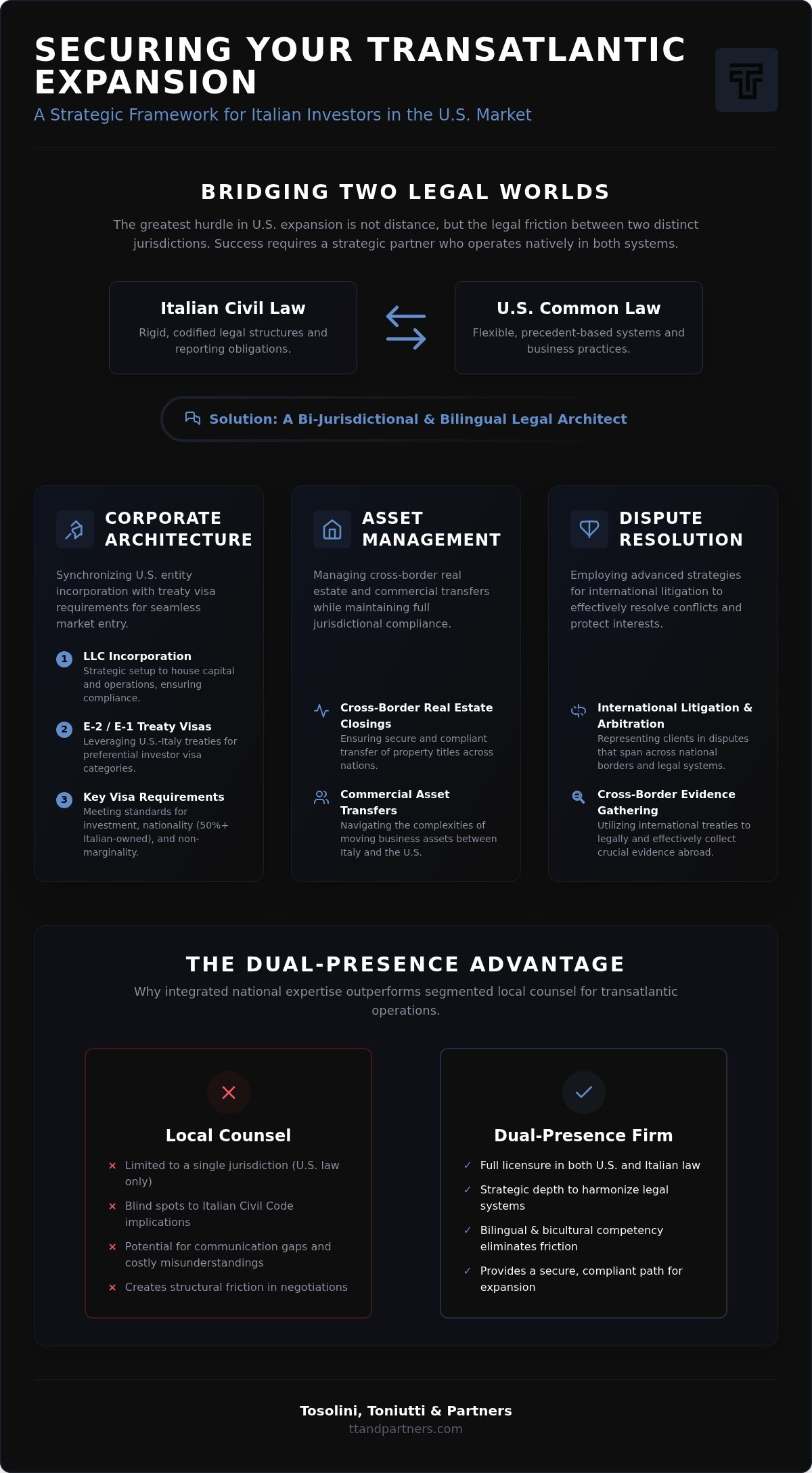
Expanding a business across the Atlantic requires a professional who understands that the legal landscape is more than just a set of rules; it's an extension of a nation's history and philosophy. An Italian business lawyer in Miami serves as a bilingual and bi-jurisdictional architect. They're licensed to operate within both the US common law system and the Italian civil law system. This dual qualification is mandatory for ensuring that a contract drafted in the United States doesn't inadvertently violate Italian corporate governance or tax reporting requirements. Domestic counsel might understand American statutes perfectly, but they're often blind to the Italian Civil Code implications of a cross-border merger or asset transfer. This expertise is vital for maintaining compliance with reporting obligations that apply to Italian residents holding foreign assets.
A legal bridge is a strategic business asset that harmonizes the rigid structures of Italian civil law with the flexible, precedent-based common law of the United States.
The Value of Cultural and Linguistic Competency
Italian business etiquette often emphasizes long-term relationships and subtle hierarchies that standard US legal frameworks don't always reflect. A trilingual attorney ensures that the strategic intent of a Milanese parent company is perfectly preserved when communicating with its American subsidiary. This goes beyond simple translation. It involves interpreting the weight of specific legal terms to prevent friction and ensure that both parties are operating on a shared intellectual foundation. Negotiating a lease or a partnership agreement requires an understanding of good faith as it's practiced in Italy versus the more literal interpretations found in US courts. By reducing communication gaps, businesses avoid the costly misunderstandings that frequently derail transatlantic partnerships.
Navigating the US-Italy Treaty of Commerce
The foundation of modern Italy-U.S. diplomatic relations rests on historical agreements like the 1871 Treaty and the 1948 Treaty of Friendship, Commerce and Navigation. These documents aren't just relics; they provide the legal basis for preferential treatment given to Italian investors today. A specialized Italian business lawyer in Miami leverages these treaties to secure advantages in trade and investment that aren't available to other nations. By utilizing these frameworks, businesses can access specific visa categories and trade protections that significantly lower the barrier to entry for the American market. This strategic use of treaty law transforms a standard business expansion into a protected international investment, allowing for a more predictable and secure deployment of capital across the US.
Corporate Architecture: Synchronizing LLC Incorporation with Treaty Visas
The structural design of a US entity is the most critical factor in determining the success of a treaty visa application. Investors often view the creation of a company as an administrative formality, yet for an Italian national, the choice between an LLC and a C-Corp carries profound immigration consequences. While an LLC offers tax flexibility, the ownership must be meticulously documented to prove that at least 50% of the entity is owned by Italian citizens. This alignment ensures that the corporate shell satisfies the nationality requirements inherent in the treaty agreements discussed earlier. Strategic LLC incorporation serves as the essential legal vehicle that houses the qualifying capital and operational assets for a successful E-2 investment.
Adjudicators in Rome scrutinize whether an investment is substantial and whether the business is marginal. A marginal business is one that lacks the capacity to generate more than enough income to provide a minimal living for the investor and their family. To counter this, your corporate architecture must be supported by a robust five-year business plan that projects growth and job creation for US workers. An Italian business lawyer in Miami ensures that your initial capital contribution, which often starts around a recommended minimum of $75,000, is irrevocably committed to the enterprise before the visa interview occurs.
E-2 and E-1 Treaty Visa Opportunities for Italians
Italian citizens benefit from a 60-month reciprocity agreement for the E-2 Visa, allowing for long-term operational stability in the United States. While the E-2 focuses on investment, the E-1 Treaty Trader visa is designed for entities engaged in substantial trade between the US and Italy. Understanding the nuances of E-1 Treaty Trader Visas is vital for export-heavy businesses that may not require the same level of capital expenditure as a traditional brick-and-mortar investment. Both pathways require a deep understanding of foreign investment frameworks in Italy to ensure that the capital's origin is transparent and legally sourced.
Strategic Entity Formation for Foreign Nationals
Selecting the correct jurisdiction is the first step in building a resilient US presence. Choosing a state with a favorable tax climate and straightforward filing requirements is paramount for non-resident owners. The operating agreement must be drafted with transatlantic governance in mind, addressing how a non-resident owner will manage the entity from abroad. Securing an Employer Identification Number (EIN) and opening a US commercial bank account are the final hurdles to operational readiness. If you're ready to align your corporate structure with your immigration goals, you can reach out to our team for a detailed jurisdictional analysis.
Cross-Border Asset Management: Real Estate and Compliance Frameworks
Italian investors entering the Florida market often expect a legal process similar to the Italian system, where a notary acts as a neutral public official. In the United States, the legal burden shifts to the parties involved, making an attorney-led real estate closing mandatory for protecting foreign capital. An Italian business lawyer in Miami provides the necessary oversight to verify title integrity and ensure that commercial acquisitions for business operations align with broader corporate goals. Without this proactive representation, investors risk falling into common pitfalls such as restrictive zoning ordinances or undisclosed environmental liabilities that differ significantly from European standards.
Securing a physical location is often the final step in satisfying the "real and active" requirement of a treaty visa. Whether you're acquiring a warehouse in Doral or a storefront in Coral Gables, the contract must be structured to allow for the contingencies of your immigration timeline. Engaging a legal partner who understands both the local market and your international status ensures that your investment remains secure while you wait for consular processing in Rome. An attorney-led closing is the only way for a foreign investor to guarantee that their interests are prioritized over the speed of the transaction.
Navigating FIRPTA and Cross-Border Tax Compliance
Managing the Foreign Investment in Real Property Tax Act (FIRPTA) is a critical component of any exit strategy. The standard withholding rate is 15% of the gross sales price, which the buyer, acting as the withholding agent, must remit to the IRS. There are specific exceptions based on the property's use and value. For example, the rate is reduced to 10% for sales between $300,000 and $1,000,000 if the buyer intends to use the property as a personal residence. If the sale is under $300,000 and meets the residency requirement, the withholding may be 0%. Because this is a prepayment of tax rather than a final liability, we often recommend applying for a withholding certificate (IRS Form 8288-B) at the time of listing. This proactive approach is essential because IRS processing times typically range from 90 to 120 days.
Italian Citizenship and Property Rights
Holding Italian citizenship significantly alters the landscape of property inheritance and ownership rights within Italy. For those managing transatlantic family offices, a dual-passport strategy offers more than just travel convenience; it provides a framework for integrating estate planning across two continents. We ensure that your US real estate holdings are structured to coexist harmoniously with your Italian assets, preventing jurisdictional conflicts during succession. If you're managing complex assets across borders, you can contact our team to discuss a tailored compliance framework.
Resolving Transatlantic Disputes: Litigation and Arbitration Strategies
Business conflicts across borders aren't just legal battles; they're tests of jurisdictional endurance. When a dispute arises between a Miami-based subsidiary and a Milanese parent, the complexity scales exponentially. Engaging an Italian business lawyer in Miami ensures that your litigation strategy accounts for the procedural differences between US and Italian courts. The primary challenge often begins with the service of process and the collection of evidence. Gathering depositions or documents in Italy for use in a Florida court requires strict adherence to international treaties like the Hague Evidence Convention. Failure to follow these protocols can lead to the exclusion of vital evidence, potentially jeopardizing the entire case.
Strategic international litigation involves more than just courtroom advocacy. It requires a deep understanding of how to bridge the gap between discovery-heavy US litigation and the more document-centric Italian approach. The enforcement of foreign judgments remains a critical legal hurdle for businesses that win cases abroad but struggle to collect assets in the United States.
Enforcing Italian Judgments in the United States
Domesticating an Italian court order in the US is not an automatic process. It requires filing a recognition action under state laws, such as the Uniform Foreign-Country Money Judgments Recognition Act. A seasoned Italian business lawyer in Miami anticipates the common defenses used to block enforcement. These often include claims of insufficient notice or the argument that the original judgment violates American public policy. Proactive drafting of dispute resolution clauses in your initial contracts can mitigate these risks by clearly defining the chosen forum and governing law from the outset. This foresight prevents a victory in an Italian court from becoming a hollow win that cannot be liquidated in the US.
Strategic International Arbitration
Arbitration is frequently the preferred route for US-Italy business conflicts because it offers a level of neutrality and confidentiality that public courts cannot provide. By choosing venues like the International Chamber of Commerce (ICC), parties can select arbitrators who possess specific expertise in cross-border trade. This method often streamlines the timeline and reduces the costs associated with multi-jurisdictional legal battles. Having counsel who is multi-qualified allows for a more cohesive representation throughout the arbitration process, ensuring that Italian corporate values are defended within an international framework. If you're facing a complex jurisdictional dispute, you should consult with our international litigation team to evaluate your options.
The Dual-Presence Advantage: Why National Expertise Outperforms Local Counsel
Many entrepreneurs begin their search for an Italian business lawyer in Miami thinking only of the immediate Florida market. However, a transatlantic enterprise requires a legal partner whose vision extends far beyond city limits. A firm with a national and international presence offers a distinct advantage over strictly local counsel. By maintaining physical offices in Milan, Naples, New York, Miami, and Orlando, a unified team can operate across time zones and jurisdictions simultaneously. This structural continuity prevents the information silos that typically occur when a business is forced to manage separate firms in different countries. It reduces administrative overlap and ensures that every corporate decision in the US is made with full awareness of the Italian legal context.
Tosolini, Toniutti & Partners represents a unique 'bridge' in the international legal market, offering the intellectual depth of a global firm with the personalized touch of a specialized boutique.
Integrating Immigration, Corporate, and Personal Law
Successful expansion is rarely just about the business; it's about the people behind the venture. Our approach provides holistic support for the entrepreneur, the business, and the family. For innovators with a proven track record, there's a powerful synergy between securing an O-1 visa for extraordinary ability and launching a high-growth US startup. We don't just facilitate the initial entry. We manage the long-term transition from treaty visas to permanent residency, ensuring that your path toward a Green Card is integrated into your corporate structure from day one. This foresight protects your status and your investment as the business matures.
A Strategic Partner for the Long Term
We believe in moving beyond transactional services to become a long-term strategic advisor for our clients. A legal partner must understand the Italian economic landscape as intimately as the US market to provide truly effective counsel. This dual perspective allows us to anticipate challenges in cross-border reporting or corporate governance before they become obstacles. Whether you're navigating the complexities of a new market or protecting established assets, our team provides the stability and precision required for sustained success. If you're ready to build a resilient transatlantic presence, contact Tosolini, Toniutti & Partners to discuss your cross-border strategy.
Securing Your Transatlantic Legacy in 2026 and Beyond
Navigating the intersection of US and Italian law requires more than just legal knowledge; it demands a strategic vision that bridges two distinct business cultures. By synchronizing your corporate architecture with treaty visa requirements and implementing robust compliance frameworks for real estate, you create a foundation for sustainable growth. The complexity of international litigation and asset management shouldn't be a deterrent to your expansion. Instead, these challenges are best managed through a dual-presence model that eliminates information silos and provides clear, actionable guidance.
Since 2005, Tosolini, Toniutti & Partners has provided trilingual legal support for those seeking an Italian business lawyer in Miami with a national and international reach. As a proud member of the Italian American Chamber of Commerce, we leverage our physical presence in New York, Miami, Milan, and Naples to protect your interests across both continents. Your vision for a transatlantic business deserves a partner who understands the nuances of your heritage as well as the demands of the American market. Schedule a consultation with our US-Italy legal experts to refine your cross-border strategy. We look forward to building your future together.
Frequently Asked Questions
Do I need a lawyer licensed in both Italy and the US for my business expansion?
Yes, engaging a multi-qualified attorney is essential for bridging the gap between the Italian Civil Code and American common law. This dual expertise prevents the creation of unintended tax or reporting liabilities when operating a US subsidiary from abroad. By maintaining a unified legal strategy, you ensure that every corporate action satisfies the regulatory standards of both nations, reducing the risk of jurisdictional conflicts that often arise with local-only representation.
What is the most effective visa for an Italian entrepreneur starting a US business?
For 2026, the E-2 Treaty Investor visa remains the premier choice for Italian nationals due to the five-year reciprocity agreement. It provides a stable framework for entrepreneurs to manage their US operations while maintaining their primary business ties in Italy. Other options include the E-1 visa for trade-heavy entities or the O-1 visa for those with extraordinary professional achievements, depending on the specific corporate architecture of your venture.
Can an Italian business lawyer help with real estate closings in the United States?
Yes, a specialized attorney manages the entire real estate closing process to protect foreign capital from common market pitfalls. Unlike the Italian system where a notary acts as the primary neutral official, US transactions require an attorney to perform title searches and ensure contract contingencies protect the buyer. An Italian business lawyer in Miami provides the necessary oversight to ensure that a commercial acquisition satisfies the specific physical investment requirements for a treaty visa.
What are the common legal challenges for Italians doing business in America?
The most frequent hurdles involve navigating US tax withholding regulations and the procedural nuances of international evidence gathering. Many investors also face challenges adapting Italian business etiquette to the rigid reporting standards of the US legal system. By engaging an Italian business lawyer in Miami, you gain a partner who can translate these complex regulatory demands into a cohesive strategy that protects both your business assets and your personal immigration status.
How do I enforce a contract dispute between an Italian parent company and its US subsidiary?
Resolving such conflicts involves domesticating a foreign judgment or pursuing international arbitration. The process of recognizing an Italian court order in the US requires strict adherence to state laws regarding foreign-country money judgments. To avoid the high costs of multi-jurisdictional litigation, we often recommend incorporating specific arbitration clauses in your initial contracts, which allows for a more predictable and confidential resolution process that respects the international nature of your partnership.
What is FIRPTA and how does it affect Italian citizens selling US property?
The Foreign Investment in Real Property Tax Act requires a 15% withholding on the gross sales price when a foreign person sells US property. This serves as a prepayment of tax, and sellers can often apply for a withholding certificate to reduce this amount if their actual tax liability is lower. Because the processing time for such certificates can range from 90 to 120 days, proactive planning is essential to avoid liquidity issues during a closing.
Is it better to incorporate my US business in Delaware, Florida, or another state?
The optimal state for incorporation depends on your specific business model and tax strategy. Some jurisdictions offer zero state-level personal income tax and a straightforward filing process, while others are preferred for their sophisticated court systems that specialize in complex corporate litigation. We evaluate your operational needs on a national scale to determine which jurisdiction provides the most resilient foundation for your specific transatlantic investment and long-term growth objectives.
Can an Italian business lawyer also assist with Italian citizenship by descent?
Yes, a firm with dual-jurisdiction expertise can manage applications for citizenship by descent as part of a holistic family office strategy. Securing a dual passport facilitates transatlantic wealth management and simplifies the process of obtaining an Italian residency permit for family members. This integrated approach ensures that your personal status and your business holdings are perfectly aligned, protecting your family's legacy and your international mobility across both continents.


Comments