

Italian Citizenship 1948 Rule: A Strategic Guide to Maternal Line Claims in 2026

Updated: Aug 23
What if the historical gender bias that once severed your family's connection to Italy is now your most reliable strategic advantage for securing dual nationality? For many, the dream of reclaiming their heritage through the italian citizenship 1948 rule feels increasingly vital as Law 74/2025 imposes strict two-generation limits on standard administrative applications. You likely share the frustration of facing overbooked consulates and the fear that an outdated law might permanently erase your birthright. It is a complex landscape where the architecture of the past often conflicts with the aspirations of the future.
This guide provides a clear roadmap to navigating this judicial pathway, which bypasses recent legislative restrictions and offers a precise solution for maternal line claims. By understanding the judicial process, you can transform a historical injustice into a successful legal outcome. We will explore the nuances of the 2022 decentralization of cases, the implications of the July 2026 Supreme Court ruling on the minor issue, and the strategic importance of engaging a US-Italy cross-border law firm. Discover how to move beyond the limitations of the consulate system and secure your legacy through the Italian judicial structure.
Table of Contents
Understanding the 1948 Rule: Why Your Maternal Line Was Previously Denied
The historical framework of Italian nationality law was built upon a rigid patriarchal interpretation of jure sanguinis, or the right of blood. Law no. 555, enacted in 1912, codified a system where citizenship was almost exclusively a paternal inheritance. Under this structure, Italian women were legally marginalized; they didn't have the power to transmit their heritage to their children. This legal reality remained unchallenged for decades, creating a deep-seated gender imbalance in how Italian identity was preserved across borders.
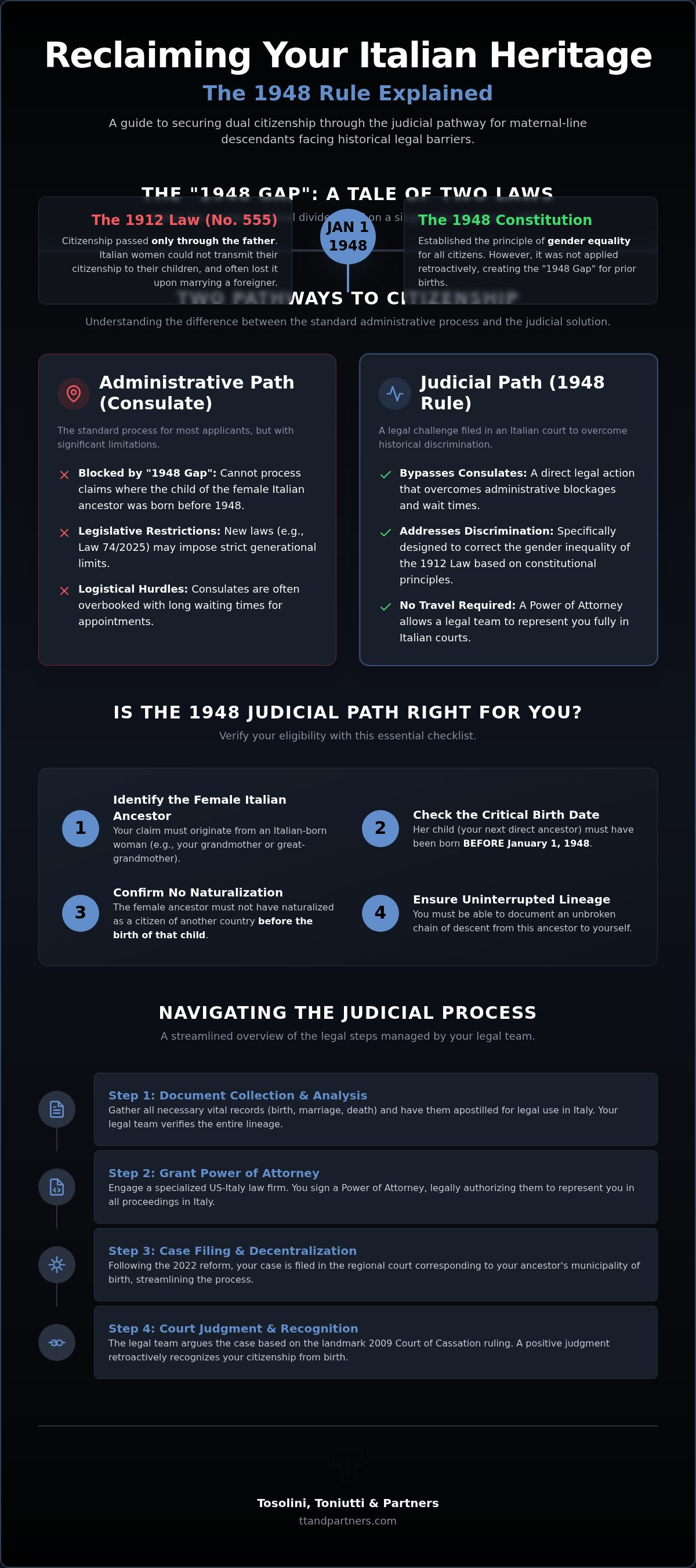
The 1948 Italian Constitution introduced a visionary shift toward gender equality, declaring all citizens equal before the law. However, a significant legal friction persisted. Because the Constitution wasn't applied retroactively to births occurring before its effective date of January 1, 1948, a generation of descendants found themselves excluded. This exclusion created what experts call the "1948 Gap." Even today, Italian Consulates are bound by administrative protocols that prevent them from acknowledging maternal lineage for these specific cases. They lack the judicial authority to override the non-retroactive nature of the 1948 shift, leaving the italian citizenship 1948 rule as the only viable path for those seeking to restore their family's legal continuity.
The 1912 Law vs. The 1948 Constitution
The 1912 law prioritized the unity of the family under a single head: the father. If an Italian woman married a foreign national, she often lost her citizenship, and her children were denied Italian status from birth. The 1948 Constitution fundamentally contradicted this by establishing that gender shouldn't dictate one's rights. This tension created a discriminatory environment where a child's right to their heritage depended entirely on the parent's gender. Resolving this discrepancy requires a sophisticated understanding of how modern constitutional principles interact with historical statutes through the italian citizenship 1948 rule.
Identifying Your 1948 Case Path
Determining eligibility for a judicial claim requires precise genealogical mapping and an analysis of specific dates. You must first identify the birth date of the first child in the lineage born to an Italian woman. If that birth occurred before January 1, 1948, the case falls outside the jurisdiction of the consulate and into the hands of the Italian courts.
Verify that the Italian mother hadn't naturalized in another country before the child's birth.
Confirm the presence of an uninterrupted chain of descent from the Italian ancestor.
Ensure all vital records are consistent and properly apostilled for judicial review.
Because this process involves challenging an administrative rejection, it necessitates a judicial filing in Italy. For those ready to begin this evaluation, professional guidance is essential to ensure every document aligns with court expectations. You can reach out for a specialized review of your lineage at
.
The Legal Evolution: From Discriminatory Laws to the 2009 Precedent
The transition from administrative rejection to judicial recognition represents a profound evolution in Italian jurisprudence. While the 1948 Constitution established the ideal of equality, it took decades for the legal system to provide a practical remedy for those born to Italian mothers before that year. The legislative branch remained largely silent on the matter, leaving the burden of correction to the judiciary. This silence created a legal vacuum that was finally filled by a transformative shift in the interpretation of constitutional rights. It was no longer a question of if the law was discriminatory, but how the courts would architect a solution for the descendants of those excluded women.
The Power of the 2009 Court of Cassation Ruling
The landmark 2009 Ruling by the Italian Court of Cassation fundamentally altered the landscape for the italian citizenship 1948 rule. The court argued that the 1912 law's failure to allow women to pass citizenship was a clear violation of the constitutional principle of gender equality. By declaring this discrimination unconstitutional, the court enabled descendants to claim their rights from birth, effectively retroactively applying the 1948 Constitution's values. This precedent transformed what was once a discretionary hope into a recognized legal right for thousands of eligible applicants in the United States. While the Italian Consulate in New York and other diplomatic missions must strictly adhere to administrative statutes, the judicial system operates on a higher constitutional plane, providing a remedy that consulates cannot offer.
Stability of the Judicial Path in 2026
Entering 2026, the judicial route stands as one of the most stable pillars of Italian immigration law. Unlike administrative processes that are subject to shifting governmental regulations or the "two-generation limit" introduced in 2025, judicial claims are anchored in permanent constitutional protections. Over the last decade, the success rate for these cases has remained remarkably consistent. Judges across Italy’s 26 regional courts now view these proceedings as standard practice. This legal maturity provides applicants with a high degree of predictability and confidence. The constitutional right to equality remains the foundation of every case, ensuring that your heritage is protected by the highest legal standards. For those navigating these historical complexities, a consultation with a cross-border legal expert can clarify how these precedents apply to your specific family history.
Eligibility and Document Requirements for a 1948 Case
Successful litigation under the italian citizenship 1948 rule demands a meticulous approach to evidence. Unlike administrative paths, a judicial claim is an active legal challenge that requires a structural foundation of proof. Every document serves as a component of your narrative, demonstrating that your Italian heritage remained legally intact despite historical gender barriers. The court's scrutiny is precise; therefore, your dossier must be beyond reproach, reflecting a clear and uninterrupted line of descent from your Italian ancestor to yourself.
The US Naturalization Trap
The pivot point of any claim is the naturalization date of your Italian ancestor. If they became a US citizen before the birth of the next person in your line, the legal chain was broken. However, recent legal developments have clarified complex scenarios that once hindered applicants. On July 26, 2026, the Italian Supreme Court ruled that a child who held dual citizenship from birth did not lose their Italian status simply because their parent naturalized later. This landmark decision, reinforced by Ministry of Interior Circular 65050 on August 10, 2026, provides a significant strategic advantage for cases previously complicated by the "minor issue." To establish these timelines, you must secure certified records from USCIS or the National Archives. If no records exist, a "Certificate of Non-Existence" is required to prove your ancestor maintained their Italian status throughout their life.
Vital Records and the Chain of Descent
Marriage Records: These documents prove the legal union and the consistent transfer of the family name through the generations.
Death Certificates: These are essential to close the legal identity of each ancestor and confirm the continuity of the line.
Birth Certificates: Every descendant in the chain must provide a long-form birth certificate to link them to the previous generation.
Once gathered, every non-Italian document must be authenticated with an Apostille. Professional translations into Italian are also mandatory, as the judicial process operates strictly in the national language. This rigorous preparation ensures that your application under the
italian citizenship 1948 rule
is presented with the professional precision the Italian judiciary expects.
Navigating the Judicial Process in Italian Courts
Transitioning from the preparation of a document dossier to the actual courtroom requires a shift in strategic perspective. The italian citizenship 1948 rule is enacted through a formal litigation process where the Italian state, represented by the Ministry of the Interior, acts as the defendant. This isn't an administrative interview; it's a structural sequence of legal milestones designed to correct a historical constitutional error. One of the most significant advantages of this route is that it doesn't require your physical presence in Italy. By signing a Procura, or Power of Attorney, you grant your legal team the authority to represent your interests before the judge, bridging the geographical gap between your home in the United States and the Italian courthouse.
The Shift to Regional District Courts
A pivotal reform effective June 22, 2022, fundamentally changed the geography of these cases. Previously, all 1948 claims were filed exclusively in the Court of Rome, leading to significant bottlenecks. Today, jurisdiction is determined by the municipality of your ancestor's birth. Your case will be heard in one of Italy's 26 regional district courts. This decentralization has created a more varied landscape in 2026. While some efficient courts might reach a final decision in as little as 5 months, others can take over 2 years depending on their specific workload. Navigating these regional nuances requires a legal partner who understands the local judicial patterns of each specific district.
The Courtroom Procedure and Final Recognition
The process begins with the filing of a formal summons against the Italian government. Once the case is assigned to a judge, an initial hearing is scheduled. In many instances, the judge reviews the evidence without requiring oral arguments if the documentation is sufficiently robust. After the judge issues a favorable ruling, a mandatory 60-day window begins. During this period, the Ministry of the Interior has the right to appeal the decision, though appeals are rare when the lineage is clearly documented.
Judgment Finalization: Once the 60-day period expires without an appeal, the ruling becomes final and "res judicata."
Transcription: The court order is sent to the ancestor's original municipality to be transcribed into the local civil registries.
AIRE Registration: The final step involves registering with the Registry of Italians Residing Abroad, which allows you to apply for your Italian passport.
Understanding these procedural layers is essential for managing expectations regarding the 2026 timeline. If you're ready to initiate this judicial sequence, you can
to begin architecting your claim.
Strategic Legal Support: How Tosolini, Toniutti & Partners Secures Your Heritage
The journey toward reclaiming your heritage through the italian citizenship 1948 rule is a sophisticated legal undertaking that requires more than just genealogical research. It demands a structural bridge between two distinct legal cultures. Tosolini, Toniutti & Partners operates at this intersection, offering a dual-presence perspective that simplifies the complexities of international law. By maintaining a professional presence in both the United States and Italy, our firm ensures that the transition from US document collection to Italian court representation is seamless and strategically sound. We provide the intellectual and tactical anchor your case requires, ensuring that every detail aligns with the high standards of the Italian judiciary.
Why Cross-Border Expertise Matters
A judicial claim is a formal act of litigation. Managing such a case requires a deep understanding of international litigation, where the nuances of Italian civil procedure must align with the specificities of US vital records. This holistic approach is vital for clients who view their Italian citizenship as part of a broader global lifestyle. Many of our clients who pursue the italian citizenship 1948 rule also seek to expand their professional footprint through LLC incorporation or other strategic business ventures. Our ability to handle these interconnected legal needs ensures that your personal heritage and professional goals are managed with equal precision. We offer a level of continuity that single-jurisdiction firms cannot match, protecting your interests across borders.
Starting Your Application Process
The first step toward securing your heritage is a thorough assessment of your maternal lineage. We encourage you to gather your family's vital data, focusing on birth dates and naturalization timelines, to build a preliminary family tree. This data serves as the blueprint for our legal strategy. A professional consultation allows us to identify potential obstacles early, such as inconsistencies in record names or complex naturalization scenarios, before they reach the Italian judge. Avoiding these common pitfalls through early legal intervention is the most efficient way to protect your claim. Every word in your dossier has weight. Every document is a part of a larger structure. When you're ready to transform your family history into a recognized legal reality, we invite you to schedule your consultation with Tosolini, Toniutti & Partners. Our team will provide the clarity and expertise needed to navigate the Italian judicial system with confidence.
Securing Your Italian Legacy in a Changing Legal Landscape
Reclaiming your family history through the italian citizenship 1948 rule is more than a legal procedure; it's an act of restoration. As administrative pathways face new restrictions and consulate wait times extend into years, the judicial route offers a stable and predictable alternative. You've seen how the 2009 precedent and the 2022 court decentralization have refined this process, making it a sophisticated tool for those whose maternal lineage was once unfairly restricted.
Navigating this cross-border journey requires a partner who understands the structural nuances of both US and Italian legal systems. Tosolini, Toniutti & Partners provides specialized cross-border legal expertise and decades of experience in Italian immigration law to ensure your claim is handled with professional precision. We offer comprehensive support for US-based applicants, managing every detail from initial document verification to final court representation. It's time to transform your family's past into a recognized future. Begin your Italian citizenship assessment today and take the first step toward your dual nationality.
Frequently Asked Questions
What is the 1948 Rule in Italian citizenship?
The 1948 Rule is a judicial remedy used to correct historical gender discrimination within Italian nationality law. Before January 1, 1948, Italian women couldn't pass citizenship to their children. This rule allows descendants of these women to claim their rights through a court case. It effectively bridges the gap between the patriarchal 1912 statutes and the egalitarian 1948 Constitution, ensuring that maternal lineage is recognized with the same legal weight as paternal descent.
Can I apply for a 1948 case through an Italian consulate?
You cannot apply for a 1948 case through a consulate because diplomatic missions lack the authority to apply constitutional principles retroactively. Consulates must strictly follow administrative laws, which still view these maternal lines as ineligible for standard processing. To overcome this restriction, you must file a lawsuit in the Italian civil court system. This judicial path is the only way to bypass the administrative rejection that consulates are legally required to issue in these specific scenarios.
Do I need to live in Italy to win a 1948 court case?
Physical residency in Italy isn't required to pursue or win a case under the italian citizenship 1948 rule. The entire process is handled by your legal representatives through a formal Power of Attorney. This document allows your attorneys to file the summons, attend hearings, and manage all communications with the judge on your behalf. You can remain in the United States while the judicial system in Italy processes your claim and restores your heritage.
How long does a 1948 Italian citizenship case take in 2026?
In 2026, the timeline for a 1948 case varies significantly depending on the specific regional court's workload. While some efficient districts may issue a final decision within 5 months, other busier courts can take over 2 years. This variation is a result of the 2022 decentralization reform. Factors such as the judge's schedule and the Ministry of Interior's response time also influence the duration. We monitor these regional patterns to provide realistic expectations for every applicant.
What happens if my Italian ancestor naturalized before the child was born?
If your Italian ancestor naturalized in another country before their child was born, they generally lost their Italian citizenship and the ability to pass it on. However, the July 2026 Supreme Court ruling has provided new clarity for dual citizenship scenarios. If the child was a dual citizen from birth, the parent's later naturalization might not have severed the line. Each case requires a precise analysis of naturalization dates and the specific laws in effect at the time of birth.
Can multiple family members join the same 1948 court case?
Multiple family members from the same lineage can and often should join a single 1948 judicial case. This collaborative approach is highly efficient as it allows the group to share the burden of document collection and legal representation. All applicants must descend from the same Italian ancestor who was affected by the pre-1948 gender discrimination. Joining a case ensures that the entire family's heritage is recognized simultaneously through a single, cohesive judicial ruling.
Is the 1948 judicial process successful in most cases?
The 1948 judicial process has a very high success rate when the lineage is clearly documented and the legal arguments are sound. Since the 2009 landmark precedent, Italian courts have consistently ruled in favor of applicants seeking to correct historical gender bias. Success depends on the structural integrity of your dossier and the precision of your legal representation. While outcomes are never guaranteed in litigation, the constitutional foundation of these cases remains exceptionally stable and well-recognized in 2026.
What is the difference between Jure Sanguinis and a 1948 case?
The primary difference lies in the method of recognition rather than the underlying right of blood. Standard Jure Sanguinis is an administrative process handled by consulates for paternal lines or maternal lines where the child was born after 1948. A 1948 case is a judicial action required specifically for maternal lines where the child was born before 1948. Both seek to establish citizenship by descent, but the italian citizenship 1948 rule requires a judge to override historical discrimination.


Comments