

Italian Citizenship Application Timeline: A Strategic 2026 Guide

The traditional path to your Italian heritage has been fundamentally redesigned, and the strategy you would have used just two years ago is now obsolete. With the implementation of Law 74/25, the landscape of the Italian citizenship application timeline has shifted from a test of endurance to a high-stakes legal maneuver. You're likely facing the frustration of consular wait times that stretch beyond three years or the anxiety of the new two-generation limit on ancestral claims. It's a complex environment where a single administrative oversight can result in a rejection under the Article 3-bis criteria.
This guide offers the architectural precision required to navigate these 2026 regulations with absolute confidence. We'll demystify the current processing speeds of regional courts and compare the administrative residency path against the judicial route to determine which offers you the fastest resolution. By the end of this analysis, you'll have a clear, expert-backed roadmap to secure your place within the Italian state while ensuring your application aligns with the most recent judicial precedents.
Table of Contents
The Three Primary Paths to Italian Citizenship in 2026
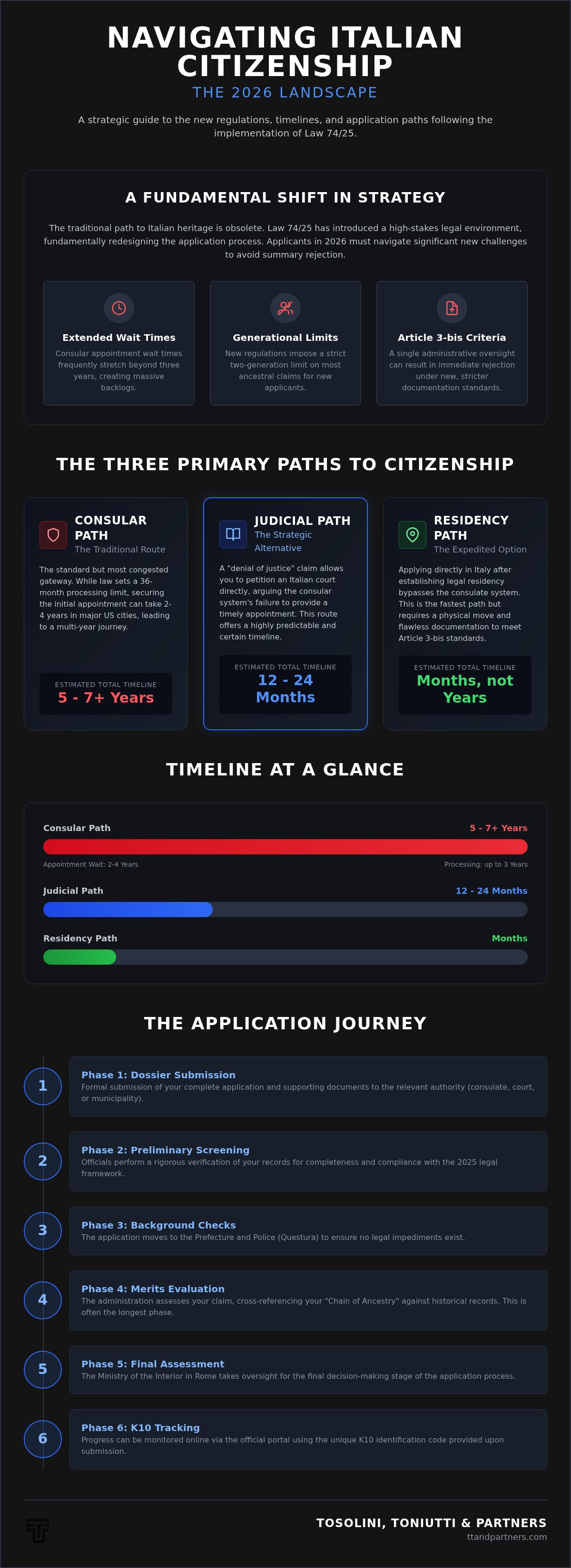
The current legal framework for acquiring citizenship has entered a period of significant restriction. With the implementation of Law 74/25, the era of unlimited ancestral claims has effectively ended for new applicants. For those beginning their journey in 2026, the path is now primarily limited to the children or grandchildren of the last Italian-born ancestor. This shift has fundamentally redefined the Italian citizenship application timeline, as the pool of eligible applicants narrows while the complexity of the required documentation increases under the new Article 3-bis standards. Choosing the correct path is no longer just about convenience; it's about navigating a system that now prioritizes a direct and verifiable link to the Italian state.
The Consular Path: Managing Multi-Year Expectations
Consulates in the US remain the standard gateway for most applicants, but they're currently the most congested. While Italian nationality law sets a 36-month limit for processing once an application is accepted, this doesn't include the years spent waiting for an appointment. In major cities, these wait times often span two to four years. The March 27, 2025, cutoff for previous regulations created a massive backlog of files that consulates are still processing in 2026. Applicants should expect a multi-year journey if they choose this administrative route without a specific acceleration strategy, as appointments remain difficult to secure despite digital portal updates.
The Judicial Path: Bypassing Consular Backlogs
If you can't secure a consular appointment within a reasonable timeframe, the Italian court system offers a sophisticated alternative through a "denial of justice" claim. This allows you to petition a regional court directly, arguing that the administrative system's failure to provide an appointment violates your rights as a citizen. This path, along with 1948 maternal line cases, typically concludes within 12 to 24 months. Since the decentralization of these cases to regional courts, timelines vary by jurisdiction, but the process remains significantly more predictable than the consular route. It's a strategic choice for those who value timeline certainty and wish to avoid the years of administrative limbo common in the US-based consulate system.
Applying directly within Italy involves establishing legal residency in a municipality to bypass the consulate system entirely. This route can drastically compress the Italian citizenship application timeline, often concluding in months rather than years. However, it requires a physical move and a genuine intent to reside in Italy. The 2025 legal updates require strict adherence to Article 3-bis, making professional oversight essential to avoid residency-based rejections. For those who can commit to the residency requirement, this remains the most expedited path to a passport, provided the "Chain of Ancestry" verification is flawless before arrival.
The 7 Mandatory Phases of the Italian Citizenship Application
The journey through the Italian citizenship application timeline is defined by seven distinct phases, each requiring meticulous attention to detail and legal precision. Phase 1 begins with the formal submission of your dossier, which must adhere to the standards outlined by the Italian Consulate General in New York or the relevant regional authority. Phase 2 involves a rigorous preliminary screening where officials verify the completeness of your records under the 2025 legal framework. Any discrepancy at this stage can stall the process for months, as the administration is now more stringent regarding document integrity.
Phase 3 moves the application to the Prefecture and Police (Questura), where background checks ensure no legal impediments exist. Phase 4 is the critical evaluation phase. Here, the administration assesses the merits of your claim, cross-referencing your lineage against historical records. This internal review is often the most extended stretch of the timeline, as it involves coordination between multiple government departments to verify the "Chain of Ancestry" without gaps.
The Evaluation and Decision-Making Stage
Once the local investigation concludes, the Ministry of the Interior takes oversight of the final assessment. You can track this progress through the official portal using a unique K10 identification code provided upon submission. The status updates indicate when your file has moved from "under evaluation" to the "decision notification" phase. This notification is the formal acknowledgment that your right to citizenship is recognized, marking the end of the investigative portion of the Italian citizenship application timeline.
The Final Hurdles: Oath and Registration
Recognition is not the final step. For marriage or residency applicants, you must complete the Oath of Allegiance within a strict six-month window from the date of notification. Failing to meet this deadline invalidates the entire process. Afterward, the municipality registers your records in the Vital Records (Stato Civile). If you're living abroad, you'll then need to register with the Registry of Italians Residing Abroad (AIRE). This registration is the prerequisite for your final passport issuance. If you're concerned about the technicalities of these final phases, consulting with a legal professional can ensure your file remains on track.
Comparing Timelines: Consulates, Courts, and Municipalities
The divergence in the Italian citizenship application timeline across different jurisdictions has never been more pronounced than in 2026. While the administrative path through a consulate remains the most common route, it's frequently the least efficient; some applicants face a reality of up to 10 years when factoring in appointment backlogs and the 36-month statutory processing window. This creates a "Standard Track" that often feels like an endless wait. In contrast, the judicial and residency paths offer a "Fast Track" alternative for those who require a more predictable horizon. Your choice between these tracks depends on your ability to relocate or your eligibility to claim a "denial of justice" based on current consular delays.
Why Applying in Italy is a High-Speed Strategy
Relocating to Italy to apply directly at a municipality is the most expedited strategy available, often concluding within 3 to 9 months. This path requires you to establish legal residency, which involves obtaining a Permesso di Soggiorno (residency permit) specifically for citizenship seekers. Once you've registered at the local Comune, officials have a strict 45-day window to conduct a residency verification check. After this verification, the municipality validates your ancestral ties and processes the claim locally. It's a high-intensity path that trades the convenience of staying home for a significantly compressed schedule, provided your documentation is flawless before arrival.
Judicial Timelines in the Post-2022 Decentralization Era
Since the 2022 reforms moved citizenship cases from the centralized courts in Rome to regional courts, the Italian citizenship application timeline for judicial claims has stabilized. In 2026, most regional courts reach a final decree within 12 to 24 months from the initial filing. This decentralization was designed to prevent bottlenecks, though wait times vary depending on the specific region's caseload. While the majority of these cases are decided at the first instance, you should be aware that a challenge from the state could move the case to the Corte d’Appello. An appeal is rare, but it can extend the timeline by another 12 to 18 months, making expert legal preparation essential to secure a favorable and final initial ruling.
Strategic Variables: What Accelerates or Delays Your Application
The momentum of your Italian citizenship application timeline is often decided long before a single form is submitted to an official. While judicial and administrative windows are defined by law, the pre-filing phase remains the most volatile variable. In 2026, the introduction of Article 3-bis checks has added a sophisticated layer of scrutiny to every file. Officials now perform deeper investigations into the "Chain of Ancestry" to ensure no generational breaks occurred. This rigorous verification can extend the initial screening phase by several months, especially if the lineage involves multiple jurisdictions with varying record-keeping standards.
Administrative errors are the most common source of avoidable delays. A "Request for Evidence" (RFE) triggered by a minor name discrepancy or a missing certification can pause your application for half a year or more. Common triggers in 2026 include misaligned dates on birth certificates and naturalization records that haven't been properly amended. Ensuring your dossier is "trial-ready" before submission is the only way to maintain the integrity of your schedule. If you're navigating these technical requirements, contact our legal team to perform a pre-submission audit of your entire ancestry chain.
The Document Collection Bottleneck
Retrieving documents from US authorities is a significant logistical hurdle. USCIS "No Record" certificates, essential for proving an ancestor never naturalized, currently involve extensive wait times that can stall a project for six months. Similarly, state-level vital records offices exhibit vast differences in processing speeds. While some states offer expedited digital services, others remain manual and slow. Professional genealogical searches often save months of trial and error by identifying the correct archives immediately, bypassing the common pitfalls of searching in the wrong county or state repositories.
Translation and Legalization Timelines
Every US document must undergo a specific transformation before it's recognized in Italy. This involves obtaining a Traduzione Giurata (Sworn Translation) performed by a translator registered with an Italian court. The timeline for these translations depends on the volume of the dossier, but it typically adds three to five weeks to your preparation. The Apostille process, which involves state-level certification of US documents for international use, maintains an average four-week turnaround in 2026. Choosing court-based legalization over consular legalization is often faster for those pursuing the judicial path, as it avoids the administrative backlogs inherent in the consulate system.
Securing Your Legacy: Professional Legal Support for Cross-Border Applications
The 2026 legal landscape has transformed the pursuit of heritage into a high-precision legal operation. Attempting a DIY approach under the current Law 74/2025 is significantly riskier than in previous years, as the administration now utilizes Article 3-bis to conduct exhaustive audits of every lineage. A single technical error in your documentation doesn't just cause a delay; it can lead to a permanent rejection. A specialized US-Italy cross-border legal team provides the intellectual oversight necessary to navigate this "new normal," ensuring your Italian citizenship application timeline remains a predictable path rather than a series of administrative setbacks.
Professional litigation support is particularly vital when managing "denial of justice" claims. When consular wait times exceed reasonable limits, your legal counsel acts as the bridge to the Italian regional courts, transforming a passive wait into an active judicial petition. This strategic intervention is often the only way to bypass the multi-year backlogs currently affecting major US consulates. By managing expectations through data-driven insights and local court expertise, a dedicated firm ensures your legacy is secured with the efficiency that modern international life demands.
Navigating Law 74/2025 with Expert Counsel
Before you commit resources to document retrieval, we verify your Article 3-bis compliance through a rigorous eligibility audit. This proactive screening identifies potential generational breaks or naturalization conflicts that could trigger an immediate denial. In the decentralized era of 2026, having representation within the specific Italian regional court handling your case is non-negotiable. Our team ensures your file meets the local judge's standards, providing a level of precision that a solo applicant simply cannot replicate. You can contact ttandpartners for a citizenship assessment to begin this verification process.
Beyond Citizenship: A Holistic Legal Framework
Securing an Italian passport is often just the first step in a broader global strategy. For many of our clients, dual citizenship serves as a foundation for expanded commercial interests. We assist in integrating your new status with LLC incorporation to facilitate cross-border trade and optimize your US-Italy business architecture. If you have family members who don't qualify for citizenship, we provide strategic planning regarding the cost of a Green Card to ensure your entire household can transition smoothly. This holistic approach ensures your Italian citizenship isn't just a static document but a dynamic asset that aligns with your long-term professional and personal goals.
Mastering Your Italian Heritage Strategy
The landscape of 2026 demands more than just patience; it requires a calculated legal strategy. Whether you choose an expedited residency path or a predictable judicial route, your success depends on a flawlessly constructed dossier that anticipates the rigors of Article 3-bis scrutiny. We've explored how the Italian citizenship application timeline is no longer a passive wait but a process that can be actively managed through precise document retrieval and expert litigation support. By aligning your ancestry records with the latest 2025 legal framework, you transform a complex administrative challenge into a streamlined transition toward dual nationality.
Tosolini, Toniutti & Partners brings specialized US-Italy cross-border legal expertise to every case. With decades of experience in Italian immigration and litigation, our team provides the comprehensive support needed for full Law 74/2025 compliance. We invite you to schedule a consultation with our Italian citizenship experts to ensure your application meets the highest standards of modern legal architecture. Your journey toward dual citizenship is a bridge between your family's history and your global future. With the right professional partners, that future is closer than you think.
Frequently Asked Questions
How long is the current wait for an Italian citizenship appointment at US consulates?
The current wait for an initial appointment at US-based Italian consulates typically ranges from two to four years. This duration is separate from the statutory processing time that begins once your application is formally accepted. Because of the massive backlog created by the 2025 legal reforms, many applicants find that securing an appointment slot is the most significant hurdle in the entire Italian citizenship application timeline.
Can I speed up my Italian citizenship application by moving to Italy?
Relocating to Italy is the fastest administrative method, often concluding within three to nine months for eligible applicants. By establishing legal residency and obtaining a Permesso di Soggiorno, you bypass the years-long consular waitlists. This path requires a physical move and a genuine intent to reside in a municipality, where local officials verify your ancestral ties and residency status within a strict 45-day verification window.
What is the timeline for a 1948 case in the Italian regional courts?
A 1948 case pursued through the Italian regional courts generally reaches a final decree within 12 to 24 months from the date of filing. Since the 2022 decentralization of these cases, hearing dates have become more predictable across various regions. This judicial path is specifically designed for maternal line claims where the child was born before 1948, offering a structured alternative to the administrative backlogs found in the consulate system.
How did the 2025 law changes affect the citizenship application timeline?
Law 74/2025 fundamentally altered the Italian citizenship application timeline by introducing a two-generation limit on descent claims for new applicants. It also implemented Article 3-bis, which mandates more rigorous audits of every lineage and naturalization record. While the legal maximum processing time remains 36 months, the increased scrutiny during the initial screening phase often extends the overall duration of the preparation and investigation stages compared to previous years.
How long does it take to get an Italian passport after citizenship is recognized?
After your citizenship is recognized, the final passport issuance typically takes several weeks to a few months, depending on your place of residence. If you live abroad, you must first register with the Registry of Italians Residing Abroad (AIRE). Once your registration is confirmed by the municipality in Italy, you can schedule a passport appointment at your local consulate, which remains the final administrative step in the recognition process.
What happens if the Italian government exceeds the 36-month processing limit?
The legal maximum processing time for citizenship by descent applications is currently 36 months. If the administration exceeds this statutory window without a decision, you may have grounds for a judicial appeal in Italy. This "denial of justice" claim allows a judge to oversee the file and issue a ruling, effectively bypassing the administrative delay and ensuring your right to citizenship is legally recognized by the court system.
How much time should I budget for document collection and translation?
You should budget approximately six to twelve months for the comprehensive collection, translation, and legalization of your records. Obtaining "No Record" certificates from USCIS often takes six months alone, while state-level vital records and apostilles add several more weeks to the schedule. Sworn translations into Italian are the final step in this preparation phase, ensuring your dossier meets the technical standards required for a successful 2026 filing.
Can a lawyer help me shorten the Italian citizenship timeline?
A specialized attorney can significantly compress the Italian citizenship application timeline by identifying the most efficient path, such as a judicial "denial of justice" claim. Legal counsel performs a pre-submission audit to ensure compliance with Article 3-bis, which prevents the "Request for Evidence" delays that often stall DIY applications. Professional representation in the regional courts provides a level of procedural certainty that administrative paths simply cannot offer in the current climate.


Comments