

Italian Citizenship by Descent Lawyer: A Strategic Guide to Jure Sanguinis in 2026
- Gianni Mendes Toniutti, Esq.

- May 18
- 12 min read
In 2026, the traditional path to an Italian passport through a local consulate has become a strategic bottleneck rather than a gateway. You likely feel the weight of the 36 month statutory processing limit or the frustration of appointment calendars that remain locked for years. It's a common sentiment among those seeking to reconnect with their heritage, yet the landscape has shifted significantly following the May 2025 law changes and the March 2026 Constitutional Court ruling. This guide illustrates how an Italian citizenship by descent lawyer transforms a bureaucratic hurdle into a precise legal victory by leveraging judicial appeals to bypass administrative inefficiency. We will examine the strategic advantages of the court system, the nuances of the 1948 Rule for female ancestors, and the rigorous document standards required to ensure your application is legally bulletproof. By moving beyond simple document collection toward a vision of strategic litigation, you can secure your place in the European Union with intellectual clarity and professional certainty.
Key Takeaways
Identify the core legal principles of Jure Sanguinis to determine your eligibility through an unbroken line of Italian ancestry.
Navigate the historical complexities of the 1948 Rule and leverage judicial precedents to reclaim heritage through female lineages.
Employ an Italian citizenship by descent lawyer to invoke the "Denial of Justice" theory, effectively bypassing administrative consular delays via the Italian court system.
Ensure document precision by addressing vital record discrepancies with "One and the Same" court orders for a legally sound application.
Leverage your dual citizenship as a gateway to strategic international interests, including Italian real estate and broader EU residency benefits.
Table of Contents
Understanding Italian Citizenship by Descent (Jure Sanguinis)
The concept of Jure Sanguinis, or "right of blood," serves as the intellectual and legal foundation of Italian nationality law. Unlike nations that rely primarily on birthright citizenship, Italy recognizes the enduring connection between an ancestor and their descendants, regardless of geographic distance. This principle allows citizenship to pass from parent to child in an unbroken chain across generations. There's no inherent limit to how many generations back one can claim, provided the original Italian ancestor did not renounce their citizenship before the birth of the next person in the line. However, the application of this right requires more than just a family tree; it demands a rigorous legal demonstration of continuity.
2026 represents a pivotal moment for this process due to the rapid digitalization of Italian municipal records. While this modernization aims to streamline verification, it also introduces a higher standard of scrutiny for document discrepancies. Applicants must decide between the administrative path, which involves years of waiting for a consular appointment, or the judicial path through the Italian court system. An Italian citizenship by descent lawyer is often the deciding factor in which path is viable, particularly when administrative backlogs threaten to delay a claim for a decade or more. The distinction between these two routes is not merely procedural but strategic, affecting both the timeline and the legal certainty of the outcome.
Eligibility Criteria for US-Italian Dual Citizenship
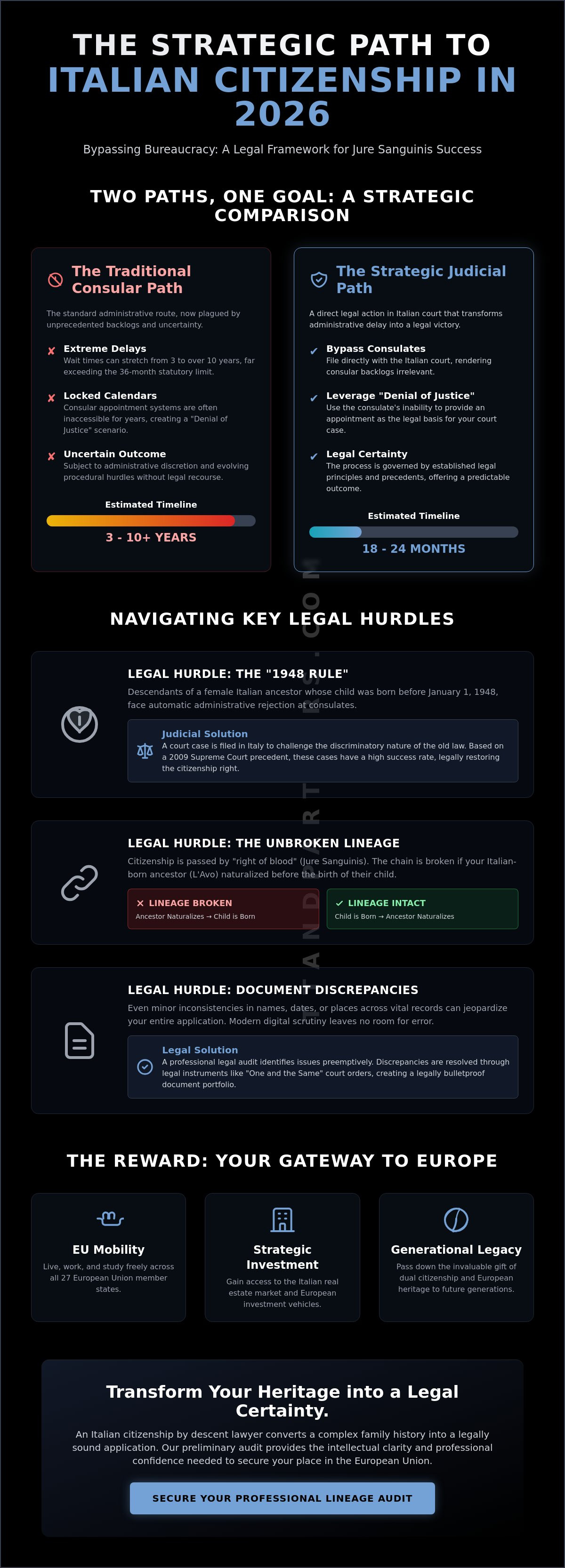
Success begins with identifying your "L’Avo," the Italian ancestor who first emigrated. The most critical factor is the date of their naturalization in the United States. If they became a US citizen before the birth of their child, the chain of citizenship was severed. Conversely, if they naturalized after the birth, the right of blood remained intact. We often see complexities regarding "minor cases," where an ancestor naturalized while their child was still a minor. These scenarios require a sophisticated legal eye to reconcile conflicting interpretations of the 1912 Italian citizenship laws, ensuring your lineage meets the strict standards upheld by the Italian courts in 2026.
The Role of Legal Counsel in Preliminary Audits
A professional legal audit is the first step toward a successful claim. It prevents years of wasted administrative effort by identifying "breaks" in the chain before you commit significant resources. During this phase, we evaluate the strength of your "paper trail," looking for name discrepancies or missing vital records that could lead to a rejection. This high-level review ensures that every birth, marriage, and death certificate is precisely aligned with Italian requirements. If you're ready to evaluate your family's eligibility with professional precision, you can contact us for a detailed analysis of your lineage. An Italian citizenship by descent lawyer transforms a collection of family stories into a legally bulletproof portfolio, providing the intellectual clarity needed to move forward with confidence.
The 1948 Rule and Judicial Paths to Citizenship
The 1948 Rule is a remnant of an era where gender inequality was codified within the legal system. Before the Italian Constitution took effect on January 1, 1948, women didn't have the legal capacity to transmit citizenship to their children. If your lineage involves a female ancestor whose child was born before this date, you'll find that the official requirements for citizenship by descent at most consulates will lead to an administrative rejection. This historical exclusion created a significant gap for thousands of descendants, yet it doesn't represent the end of the road for your application.
In 2009, the Supreme Court of Cassation delivered a landmark ruling that fundamentally altered this landscape. The court established that the 1948 Rule was unconstitutional and discriminatory, violating the principle of equality between men and women. Since consulates are administrative bodies, they lack the power to ignore existing statutes, even those deemed discriminatory by higher courts. This is why an Italian citizenship by descent lawyer is indispensable for these cases. These claims require a formal petition filed within the Italian judicial system to override the outdated law. In the current legal climate of 2026, these challenges enjoy a remarkably high success rate because the constitutional precedent is firmly established.
Litigating Gender Equality in Italian Nationality Law
Filing a petition against the Italian Ministry of Interior is a sophisticated act of constitutional litigation. Since the 2022 reform, which remains the standard in 2026, these cases are heard in the regional courts corresponding to your ancestor’s municipality of birth. This decentralization has shifted the workload away from Rome, though it requires a lawyer who understands the specific nuances of regional judicial panels. If you're unsure if your case falls under this category, you can reach out for a preliminary assessment of your lineage.
What to Expect During a Judicial Citizenship Proceeding
The judicial path is often more predictable than the consular one. Your Italian citizenship by descent lawyer manages the entire process as your legal representative; you don't need to travel to Italy or appear in court. Once the judge issues the "judgment of recognition," and the statutory period for the Ministry to appeal passes, the ruling becomes final. The process concludes with the transcription of your vital records in your ancestor's home town, officially granting you the same rights as any other Italian citizen. This path remains the most effective way to secure your heritage when administrative rules present an impassable barrier.
Strategic Legal Solutions for Consular Delays and Backlogs
The administrative reality of 2026 presents a stark contrast to the historical ease of reclaiming heritage. Major consular hubs, particularly those in New York, Los Angeles, and Miami, face unprecedented backlogs where appointment wait times frequently exceed eight years. This systemic stagnation has transformed the application process into a test of endurance rather than a simple verification of rights. When the administrative path fails, the legal theory of "Inadempimento," or the Denial of Justice, provides a sophisticated alternative. This principle asserts that when the Italian state fails to process a citizenship claim within the legally mandated 730 day window, the applicant's rights have been violated, granting them the standing to move their case into the judicial system.
Engaging an Italian citizenship by descent lawyer allows you to bypass the consular queue entirely. By filing a lawsuit in the regional court of your ancestor's origin, you shift the jurisdiction from a backlogged consulate to a judge. This transition offers a significant strategic advantage. While a consular clerk may operate with broad administrative discretion, a judge is bound by strict legal precedents and statutory timelines. In many cases, judicial recognition is achieved in 12 to 24 months, a fraction of the time required for a standard consulate appointment. This path doesn't just save time; it provides the structural certainty that the administrative system currently lacks.
Bypassing the Consulate via the Italian Court System
To succeed in a Denial of Justice suit, you must provide empirical evidence of "lack of access." This typically involves documenting repeated attempts to secure an appointment through the Prenot@mi portal and demonstrating that no slots are available within a reasonable timeframe. A judge evaluates these facts with intellectual objectivity, focusing on the law rather than administrative quotas. This strategic shift ensures your application is treated as a legal right to be upheld, rather than a file in an endless queue. It's a proactive approach for those who view citizenship as a time-sensitive asset.
The "Against the Clock" Filing Strategy
Precision is vital when coordinating the judicial path, as many US vital records and background checks have specific validity windows. Our approach involves a meticulous synchronization of document procurement with court filing dates to prevent expiration. Successfully managing these cross-border procedural hurdles often requires specialized international litigation expertise to ensure every apostille and translation meets the exacting standards of the Italian judiciary. An Italian citizenship by descent lawyer ensures that your portfolio remains valid throughout the litigation period, protecting your investment from bureaucratic delays. If you're facing a multi-year wait, you can contact us to discuss how a judicial appeal can accelerate your timeline.
The Document Portfolio: Precision Legal Procurement and Certification
The successful acquisition of dual nationality rests on the "Golden Rule" of Italian citizenship. Every significant life event, including births, marriages, and deaths, must be documented in a continuous line from your original Italian ancestor to yourself. This isn't merely a clerical collection of papers; it's the construction of a legal chain of custody that must withstand the scrutiny of either a consular official or a regional judge. In the 2026 legal environment, naturalization records remain the most critical documents in this portfolio. They serve as the definitive proof that your ancestor didn't renounce their Italian status before passing the right of blood to the next generation. If these records are missing or contradictory, the entire claim can collapse without the intervention of an Italian citizenship by descent lawyer who understands how to authenticate secondary evidence.
Precision in procurement is what separates a successful application from a rejected one. While some services treat document gathering as a simple administrative task, we view it as a rigorous legal verification process. Each document must be legalized with an Apostille and accompanied by a certified Italian translation that captures the legal nuance of the original text. Discrepancy in names, dates, or locations aren't just minor errors; they're legal obstacles that require formal resolution to ensure your portfolio meets the high aesthetic and professional standards of the Italian authorities.
Procuring Records Across Two Continents
Retrieving historic birth acts from Italian Comuni often requires a deep understanding of local municipal archives and historical record-keeping. Simultaneously, you must interface with US federal and state agencies to secure "Letters of No Record" if naturalization never occurred. A lawyer's role is to verify the legal integrity of these documents as they're gathered. This ensures that the paper trail is unbroken and authentic before it ever reaches a court or consulate, saving you from the frustration of mid-process rejections.
Correcting Discrepancies and Legal Amendments
Name discrepancies, such as a shift from "Giuseppe" to "Joseph" or a misspelled surname on a death certificate, frequently trigger rejections. Resolving these issues often necessitates "One and the Same" (OATS) court orders or judicial amendments to US vital records. An attorney manages these complex filings to align your American documents with your Italian heritage, ensuring the portfolio meets the exacting standards of the Italian judiciary. If you're ready to build a legally sound portfolio, you can schedule a document audit with our team today. An Italian citizenship by descent lawyer ensures that every typo is corrected and every record is certified, providing you with a seamless path to your EU passport.
Why a Strategic Law Firm is Essential for Cross-Border Success
Securing an Italian passport isn't merely the conclusion of a genealogical search; it's the beginning of a sophisticated cross-border lifestyle. In 2026, dual nationality acts as a gateway to broader intellectual and financial opportunities, ranging from streamlined real estate acquisitions in Tuscany to complex tax planning within the Eurozone. While many view the process as an isolated bureaucratic event, a strategic approach treats it as a foundational element of your global architecture. An Italian citizenship by descent lawyer provides the necessary bridge between these two worlds, ensuring that your new status is fully integrated into your professional and personal goals.
A firm with a physical and legal footprint in both the United States and Italy offers a distinct advantage. This dual presence allows for a seamless transition from the litigation phase in regional Italian courts to the administrative nuances of AIRE registration once recognition is achieved. It also enables us to coordinate your Italian status with other immigration objectives. We frequently integrate citizenship recognition with E-2 Visa or Green Card strategies for family members who may not share the same lineage, creating a comprehensive residency and investment plan for the entire household.
The Integrated Legal Approach to US-Italy Immigration
Dual status simplifies international business operations significantly. It removes the barriers to LLC incorporation and cross-border investment, allowing you to operate with the same legal ease on both continents. Beyond business, we focus on future-proofing your heritage. By ensuring your records are correctly transcribed, your children inherit their citizenship automatically, sparing them the legal hurdles you've faced. This holistic vision transforms a legal process into a lasting legacy for the next generation.
Choosing Your Legal Partner
When selecting a partner, look for a firm that offers more than just document collection. Professional liability, ethical oversight, and direct attorney access are non-negotiable standards for a premium experience. You deserve a transparent fee structure and a team that understands the nuances of both US and Italian jurisdictions. This ensures your application isn't just a file, but a carefully managed legal asset. Ready to secure your heritage? Contact Tosolini, Toniutti & Partners for a consultation and let an Italian citizenship by descent lawyer guide you through this transformative journey with precision and care.
Securing Your Italian Legacy in a Globalized Future
The path to dual nationality in 2026 demands a shift from passive waiting to proactive legal strategy. By moving your application from the administrative backlogs of a consulate to the precision of the Italian court system, you regain control over your timeline and your heritage. We've examined how addressing historical gender discrimination and ensuring a meticulous document chain can transform a complex genealogical search into a definitive legal recognition. An Italian citizenship by descent lawyer serves as the architect of this transition, aligning your ancestral rights with your future global ambitions.
Our firm brings decades of experience in US-Italy cross-border law to every case, offering specialized expertise in complex 1948 judicial appeals and integrated support for your corporate or real estate interests. We don't just process papers; we build the legal framework for your international lifestyle. Schedule a Strategic Consultation with Our US-Italy Legal Experts to begin your journey. Your Italian heritage is a powerful asset, and with the right counsel, the recognition you deserve is within reach.
Frequently Asked Questions
How long does the Italian citizenship by descent process take with a lawyer in 2026?
The processing time for adult applications is now dictated by Law No. 11 of January 19, 2026, which sets a statutory maximum of 36 months. While consular paths often stretch to this limit, judicial cases typically reach a conclusion within 12 to 24 months. These timelines vary based on the specific regional court's docket and the complexity of the ancestral documentation you provide during the filing phase.
Can I apply for Italian citizenship if my ancestor was a woman?
You can apply, but the legal route depends on the birth date of her child. If the child was born on or after January 1, 1948, the process is administrative. If the child was born before that date, you must pursue a 1948 Rule case through the Italian courts. These cases have a high success rate because they're based on established constitutional precedents regarding gender equality and the right to transmit nationality.
Do I need to speak Italian to qualify for citizenship by descent?
There's no Italian language requirement for Jure Sanguinis applicants. Unlike citizenship by marriage, which requires a certified B1 level of proficiency, citizenship by descent is recognized as an inherent birthright. Your eligibility is determined solely by proving your unbroken bloodline through vital records. You won't be required to sit for an interview or pass any linguistic examinations to secure your recognition.
What is the difference between a citizenship service and an Italian citizenship lawyer?
A citizenship service generally provides administrative help with document procurement and translation. In contrast, an Italian citizenship by descent lawyer provides formal legal representation and can litigate on your behalf within the Italian judiciary. Only a licensed attorney can manage 1948 Rule cases or file suits to bypass consular backlogs, making them essential for applicants who face legal hurdles or systemic delays.
Is it possible to bypass the Italian consulate appointment wait times?
It's possible to bypass these delays by filing a "Denial of Justice" lawsuit in Italy. If you can prove that your local consulate cannot provide an appointment within a reasonable timeframe, an Italian citizenship by descent lawyer allows you to challenge this delay in court. This strategy is increasingly common in 2026 as wait times in major US hubs like San Francisco or Philadelphia continue to exceed several years.
What happens if my Italian ancestor became a US citizen before my parent was born?
This usually severs the chain of citizenship because the ancestor renounced their Italian status before passing it to the next generation. However, it's vital to check if the ancestor was still a minor when their parent naturalized, as this can sometimes preserve the line. A legal audit of the exact naturalization dates is the only way to confirm if a "break" in the chain actually occurred or if an exception applies.
How much does an Italian citizenship lawyer typically cost for a 1948 case?
Attorney fees for 1948 Rule judicial cases in 2026 generally range from $3,000 to $10,000 depending on the number of family members joining the petition. These costs cover legal drafting and representation in regional courts. You must also factor in the €600 consular fee for adult applicants, though the €250 fee for minor children was eliminated as of January 1, 2026, to ease the financial burden on families.
Can my spouse and children get Italian citizenship through my application?
Minor children become citizens automatically once your recognition is finalized and your records are transcribed in Italy. For those who were minors on May 24, 2025, the deadline for certain declarations has been extended to May 31, 2029. Your spouse can apply for citizenship by marriage after three years of marriage, or 1.5 years if you have children together, provided they meet the B1 language proficiency requirement.


Comments