

Italian Citizenship by Descent Lawyer: Strategic US-Italy Counsel for 2026
- Gianni Mendes Toniutti, Esq.

- Jul 31
- 12 min read
What if the legal bridge to your Italian heritage is narrower than it was just a year ago? Many families assume their right to Jure Sanguinis is a permanent fixture of their identity, yet the 2025 legislative reforms have introduced rigorous new limitations on ancestral claims. It's a complex reality where yesterday's documentation strategies no longer meet tomorrow's judicial standards. Engaging an Italian citizenship by descent lawyer professionals rely on is no longer just about genealogy; it's about a calculated integration of heritage and international law.
This guide offers a comprehensive strategy for reclaiming your Italian passport while simultaneously shielding your global assets and corporate interests. You'll learn how to master the current US-Italy cross-border complexities, from document procurement to the strategic optimization of your business structure under the latest tax treaties. We believe that true global mobility requires more than a second passport. It demands a visionary approach that harmonizes your family's past with a secure, tax-efficient future in a rapidly evolving legal environment.
Table of Contents
The Strategic Landscape of US-Italy Cross-Border Law in 2026
Italian Citizenship by Descent (Jure Sanguinis): Navigating the 2025 Reform
Investor and Professional Visas: Strategic Entry to the United States
Beyond the Visa: Corporate Architecture and Real Estate Integration
Choosing a Strategic Partner for Your US-Italy Legal Journey
The Strategic Landscape of US-Italy Cross-Border Law in 2026
The global mobility environment in 2026 requires a shift from reactive document gathering to proactive portfolio management. High-net-worth individuals can't afford to view their Italian heritage claims in isolation from their US corporate interests. Securing a strategic Italian citizenship by descent lawyer Miami provides the necessary foresight to navigate the 2025 reforms while protecting global wealth. The legal framework governing these two nations is a delicate architecture of treaties and municipal regulations that demands constant synchronization. Without a dual-jurisdiction strategy, families risk falling into the gaps of double taxation or administrative delays that can span years.
The US-Italy Legal Bridge
This bridge isn't merely a metaphor. It's a functional legal structure built on decades of bilateral agreements. Central to this is the Italian nationality law, which provides the foundational right of Jure Sanguinis while establishing the strict boundaries of eligibility. In 2026, navigating this requires more than just knowing the rules; it requires an active coordination between USCIS and Italian municipal authorities. A specialized approach ensures that your legal standing is consistent across both borders.
Coordination ensures that corporate filings in Delaware don't conflict with residency declarations in Tuscany.
Counsel manages the flow of documents across two continents to meet the 2026 regulatory standards.
Compliance risks are mitigated by aligning your US asset protection with the US-Italy Tax Treaty.
Identifying Strategic Immigration Goals
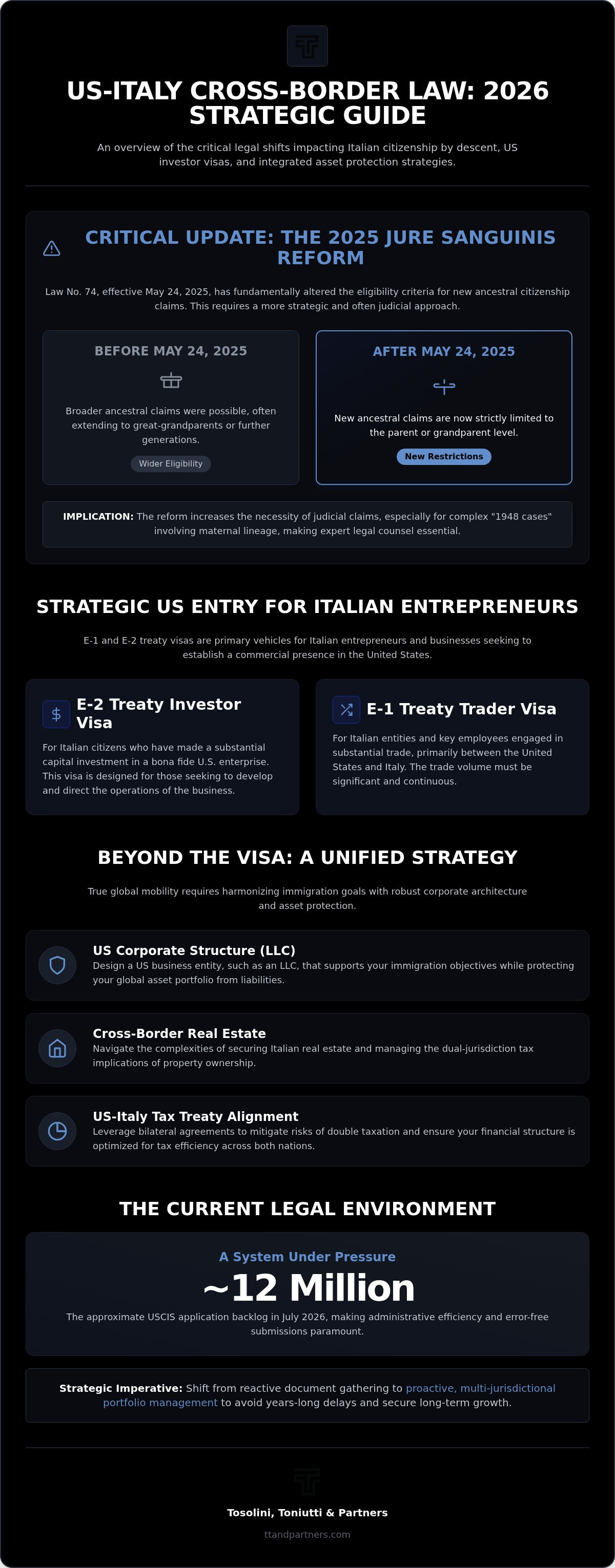
Successful relocation or status acquisition begins with a clear vision of the final outcome. Whether you're pursuing a Green Card or reclaiming citizenship, you need a multi-generational roadmap. Many clients find that an Italian citizenship by descent lawyer Miami expert is essential for balancing personal heritage with corporate expansion. With the USCIS backlog reaching nearly 12 million applications in July 2026, efficiency is paramount. You don't have time for administrative errors that restart the clock.
Protecting your global assets during this transition is not optional. The US-Italy Tax Treaty offers significant protections, but only if your corporate architecture is designed to leverage them. If you're ready to align your heritage with your business future, you can contact us to discuss a tailored strategy. We don't just process papers; we build the infrastructure for your international life. This holistic approach transforms a legal requirement into a tool for long-term growth and security.
Italian Citizenship by Descent (Jure Sanguinis): Navigating the 2025 Reform
The recognition of Italian citizenship through Jure Sanguinis, or the right of blood, is a profound legal mechanism for reclaiming one's heritage. In 2026, this process is defined by the significant legislative changes introduced by Law No. 74, which went into effect on May 24, 2025. This reform fundamentally altered the eligibility criteria for new applicants, narrowing the scope of descent to the parent or grandparent level. For many in the United States, this shift necessitates a more rigorous and strategically sound approach to documentation. An Italian citizenship by descent lawyer Miami specialist can help determine if your lineage remains viable under these restrictive new standards or if you fall under the safeguard clause for applications initiated before March 27, 2025.
Securing an Italian passport provides more than just a symbolic connection to the past. It's a powerful tool for global mobility, granting full rights to live, work, and study anywhere within the European Union. Beyond mobility, it offers sophisticated avenues for estate planning and the protection of family legacies across generations. As the Italian government increases scrutiny on historical records, the precision of your application becomes the deciding factor in your success.
The Jure Sanguinis Application Framework
Reclaiming citizenship is a meticulous exercise in historical reconstruction. It requires procurement of vital records across two continents, often involving the resolution of discrepancies in names or dates that occurred during the immigration waves of the early 20th century. Proving "non-renunciation" of citizenship by the ancestor is the cornerstone of a successful claim. While consular applications remain the standard path, many find the administrative wait times prohibitive. If you're navigating these hurdles, you can reach out for a strategic evaluation of your document portfolio to ensure every record meets 2026 judicial standards.
Judicial Citizenship and the "1948 Case"
The judicial pathway offers a strategic alternative to the often-congested consular system. This is particularly relevant for "1948 cases," which involve descendants of Italian women who gave birth before January 1, 1948. Because the law at that time did not allow women to pass citizenship to their children, these claims must be adjudicated in Italian courts to correct this historical discrimination. In 2026, the judicial route is frequently preferred because it bypasses the years-long appointment backlogs at consulates. This path requires a sophisticated understanding of the Italian court system and a high level of bilingual legal expertise to manage the litigation effectively.
Bypassing Consular Backlogs: Judicial filings can often reach a resolution faster than waiting for a consular appointment in the US.
Correcting Discrimination: The judicial route is the only way to resolve lineage claims involving female ancestors before the 1948 constitutional change.
Comprehensive Representation: Success in the Italian courts requires counsel capable of managing dual-jurisdiction legal complexities.
Investor and Professional Visas: Strategic Entry to the United States
For many Italian nationals, the path to the United States isn't always through a birth certificate. While an Italian citizenship by descent lawyer Miami expert often starts with Jure Sanguinis, the immediate needs of a business or career frequently require a more direct entry point. Treaty-based visas offer a sophisticated solution for those who possess the capital or the talent to contribute to the American economy. These aren't just administrative permits. They're strategic instruments that allow for an immediate presence while heritage claims are adjudicated in the background. This dual-track approach ensures that your professional momentum isn't stalled by the administrative timelines of citizenship recognition.
The E-2 Visa for Italian Citizens
Italian entrepreneurs have a distinct advantage through the E-2 Treaty Investor Visa. In 2026, a "substantial investment" is generally viewed as $100,000 or more, though the law doesn't set a hard minimum. The capital must be "at risk" and committed to a real, operating business. All E-2 applications for Italian citizens are processed through the U.S. Embassy in Rome, requiring a narrative that demonstrates the venture's non-marginal nature. It's about proving that the business will do more than just support your family; it must create jobs and impact the local economy. For a deeper analysis of the requirements, consult our E-2 Visa Guide 2026.
O-1 Visas for Extraordinary Ability
For the visionary, the O-1 visa remains the gold standard for those with extraordinary ability in science, arts, or business. With approval rates holding between 91% and 94% through 2025, it's a highly viable path for Italian innovators. You must provide evidence of high remuneration, prestigious awards, or significant press coverage. The strategic counsel of an Italian citizenship by descent lawyer Miami can be invaluable even here. They ensure your extraordinary ability claims don't conflict with any concurrent heritage applications. Our O-1 Visa for Entrepreneurs guide details the evidentiary threshold needed for 2026.
E-1 Treaty Trader Visas: These facilitate substantial trade between the US and Italy, focusing on the volume of transactions rather than capital investment.
Green Card Transition: Moving from non-immigrant status to permanent residency requires a long-term vision. It's about designing a path that protects your status today while building the foundation for tomorrow.
Source of Funds: Proving the legitimate origin of your capital is a critical compliance step that requires meticulous documentation.
Success in these categories depends on the quality of the narrative you present to the authorities. It's not enough to meet the technical criteria. You must demonstrate how your presence serves a larger strategic purpose. This holistic approach transforms a legal requirement into a tool for long-term growth and security.
Beyond the Visa: Corporate Architecture and Real Estate Integration
Establishing residency or citizenship is only the first layer of a successful cross-border strategy. For the sophisticated investor, the legal architecture must extend into corporate holdings and physical assets. This is where the guidance of an Italian citizenship by descent lawyer Miami professional becomes indispensable. They bridge the gap between your personal status and your commercial interests. Without this integration, you risk administrative friction that can jeopardize both your immigration standing and your global wealth. True security comes from a holistic view where your passport and your portfolio exist in a single, harmonized framework.
Strategic LLC Incorporation
Designing a US business presence requires a nuanced understanding of jurisdictional advantages. Whether you choose the corporate flexibility of Delaware, the commercial prestige of New York, or the growth-oriented environment of Florida, your choice must align with your long-term visa goals. In 2026, foreign-owned US entities face specific reporting requirements that demand precision. An Italian citizen can own 100% of a US LLC without a Green Card, but operating that business from within the US requires a specific visa strategy. For a detailed roadmap on structuring your venture, explore our LLC Incorporation Guide.
Cross-Border Real Estate Transactions
Securing property in a foreign jurisdiction involves complex due diligence that goes beyond simple title searches. If you're a US citizen looking toward Italy, the principle of reciprocity generally allows for seamless ownership. However, the administrative reality of Italian real estate closings involves specific notary requirements and tax obligations that differ significantly from US practices. In 2026, the registration tax for a second home in Italy stands at 9%, making careful planning essential for your ROI.
Conversely, Italian investors in the US must navigate the Foreign Investment in Real Property Tax Act (FIRPTA). This regulation requires careful management of withholding taxes upon the sale of US property to avoid liquidity issues. Protecting your global portfolio requires a visionary approach to the US-Italy Tax Treaty. It's about ensuring that your residential investments and commercial holdings work in harmony across both borders.
FIRPTA Compliance: Italian investors must prepare for a 15% withholding tax on the disposition of US real property interests.
Italian VAT Standards: Understanding the 10-22% VAT on second-home purchases is critical for accurate budgeting.
Escrow and Title: Managing these elements in a cross-border deal requires counsel capable of dual-jurisdiction litigation if disputes arise.
If you're ready to secure your cross-border assets and ensure your corporate structure supports your heritage claims, you can contact our team for a consultation on integrated legal strategy. We don't just close deals; we build the infrastructure for your international life.
Choosing a Strategic Partner for Your US-Italy Legal Journey
Selecting the right counsel is the most critical decision in your international transition. It isn't just about filing forms. It's about finding a visionary partner who can navigate the nuances of both Italian and American law with equal precision. An Italian citizenship by descent lawyer Miami professional serves as your strategic anchor. They ensure that your actions in one country don't create unintended liabilities in the other. This dual-jurisdiction perspective is vital for maintaining the integrity of your global portfolio. In 2026, the complexity of international compliance means you need a partner who is both bilingual and bicultural, capable of translating not just words, but legal cultures.
International Litigation and Dispute Resolution
A firm's capacity for international litigation is often the silent safeguard of a successful relocation. Disputes involving cross-border contracts, inheritance, or real estate require a sophisticated understanding of how to enforce foreign judgments between Italy and the United States. Whether you're defending a corporate structure or resolving an estate matter, your counsel must be prepared for the complexities of two distinct court systems. Our International Litigation 2026 guide provides a deeper look into how we manage these high-stakes legal challenges. We don't just plan for success; we build the defenses necessary to protect it.
Dual-Jurisdiction Coordination: We synchronize legal efforts between US and Italian authorities to prevent administrative delays.
Status Maintenance: Long-term support for status renewals and citizenship maintenance ensures your global mobility remains uninterrupted.
Asset Protection: We apply the US-Italy Tax Treaty to shield your wealth from double taxation and compliance risks.
Next Steps: Consultation and Strategy
Your journey begins with a clear, multi-year roadmap. Preparing for your initial consultation involves more than just gathering birth certificates. It requires a candid discussion about your family's heritage, your business's expansion goals, and your long-term vision for global mobility. We focus on developing a strategy that harmonizes these elements into a single, cohesive path. This approach transforms a complex legal process into a structured, manageable transition.
The 2025 reforms have made the window for certain heritage claims narrower. Timing and precision are now your most valuable assets. If you're ready to align your past with your future, you can schedule a strategic consultation with our team. We'll evaluate your documentation, assess your corporate needs, and design the framework for your new life across borders. This isn't just about a visa or a passport. It's about the enduring legacy of your family and your business in a connected world.
Securing Your Dual-Jurisdiction Legacy in 2026
Reclaiming your Italian heritage in 2026 is an exercise in both legal precision and visionary planning. The 2025 reforms have fundamentally narrowed the eligibility window. This makes the timing of your application a critical factor for success. You've seen how a dual-track strategy, aligning Jure Sanguinis claims with US corporate architecture, protects your global interests. Partnering with an Italian citizenship by descent lawyer Miami expert provides the boutique expertise in US-Italy treaty law required to bridge these two worlds seamlessly. We offer comprehensive support for your corporate, real estate, and immigration needs with a proven track record in complex international litigation.
It's time to transform your ancestral rights into a functional tool for global mobility and business expansion. We're ready to help you navigate these complexities with professional confidence and aesthetic care. Schedule a strategic consultation with our US-Italy legal experts to begin your journey. Your heritage isn't just a part of your past; it's the foundation of your international future.
Frequently Asked Questions
What are the primary requirements for an Italian citizen to obtain an E-2 visa in 2026?
Italian citizens must make a substantial investment in a real, operating US business to qualify for the E-2 Treaty Investor visa. While there's no statutory minimum, successful applications in 2026 typically feature investments of $100,000 or more. The capital must be "at risk" and committed to the venture. All E-2 visa applications for Italian nationals are processed exclusively through the U.S. Embassy in Rome, requiring proof that the business is non-marginal and will create a significant economic impact.
How did the Law No. 74 of 2025 change the Italian citizenship by descent process?
Law No. 74 fundamentally restricted Jure Sanguinis claims by limiting recognition to applicants with an Italian citizen parent or grandparent. This reform, effective May 24, 2025, ended the previous system that allowed citizenship to be traced through great-grandparents or earlier ancestors. A safeguard clause protects those who submitted their applications or confirmed consular appointments by March 27, 2025. These restrictive new standards make professional document verification more critical than ever for new claimants.
Can I apply for a US Green Card while holding an E-2 treaty investor visa?
Yes, it's possible to pursue a Green Card while holding an E-2 visa, though the process requires careful strategic timing. Since the E-2 is a non-immigrant visa, you must manage the transition through an immigrant petition, such as an EB-2 or EB-3, without violating your current status. Consulting an Italian citizenship by descent lawyer Miami professional ensures that your long-term residency goals don't conflict with your treaty investor renewals or heritage claims during the multi-year transition period.
What is the "1948 Case" and how does it affect my Italian citizenship claim?
A "1948 Case" refers to a citizenship claim involving an Italian female ancestor who gave birth before January 1, 1948. Prior to this date, Italian law did not allow women to pass citizenship to their children, a rule later deemed discriminatory. These cases cannot be processed through a consulate and require a judicial proceeding in the Italian court system. In 2026, the judicial route remains the only way to secure recognition for these specific maternal lineages.
Do I need to maintain residency in Italy to keep my Italian citizenship?
No, you aren't required to maintain physical residency in Italy to keep your citizenship once it's recognized. You can live anywhere in the world and retain your Italian passport indefinitely. However, you're legally obligated to register with the Registry of Italians Residing Abroad (AIRE). This registration ensures you can access consular services, vote in national elections, and renew your documents while living in the United States or elsewhere.
What are the tax implications of owning real estate in both the US and Italy?
Owning property in both jurisdictions triggers complex obligations that are managed under the US-Italy Tax Treaty to prevent double taxation. In Italy, you'll face registration taxes of 2% for a primary residence or 9% for a second home. In the US, Italian investors must navigate FIRPTA regulations, which involve a 15% withholding tax upon the sale of real property. Specialized counsel is necessary to harmonize these obligations and protect your global asset portfolio.
How long does the Jure Sanguinis process typically take in 2026?
Consular processing typically takes 18 to 24 months after the initial appointment is completed. However, wait times for an appointment at an Italian consulate in the US can span several years. Because of these delays, many applicants in 2026 choose the judicial route through Italian courts. While court timelines vary by region, this path often bypasses the consular backlog entirely, providing a more predictable roadmap for families seeking an Italian citizenship by descent lawyer Miami specialist's help.
Can an Italian company sponsor an O-1 visa for a high-level executive?
An Italian company can sponsor an O-1 visa if it has a qualifying relationship with a US-based entity, such as a branch or subsidiary. The O-1 visa is reserved for individuals with extraordinary ability in business, science, or the arts. The sponsoring US employer or agent must file a petition demonstrating the executive's high remuneration, prestigious awards, or significant industry impact. With approval rates exceeding 90% through 2025, it's an excellent vehicle for Italian corporate leaders.


Comments